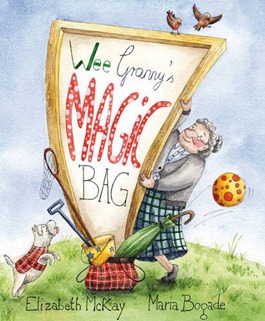
Review: Wee Granny’s Magic Bag by Elizabeth McKay

wee grannys magic bag

Wee Granny’s Magic Bag by Elizabeth McKay, illustrated by Maria Bogade

Emily and Harry are looking forward to heading out to the park with Wee Granny, but most of all they hoped that she would bring along her amazing tartan bag.  They had seen magical things come out of that bag!  Last Christmas, she had pulled out a lamp-post (fully lit) to help Harry see his carols.  Then in the summer, she pulled out chairs for them to sit on the beach.  Emily and Harry tried to see inside Wee Granny’s bag, but she closed it too quickly.  Then they tried asking her what she had in there, but she only said she had brought her phone.  When her phone rang, the children were amazed to see her pull an entire phone booth out of the bag and answer it!  It was their mother calling, asking them to make more cupcakes for the fair.  And that is when Wee Granny really pulled amazing things out of her bag!

Originally from Scotland, this book celebrates grannies, tartan and magic.  McKay writes with a cheerful tone and the entire book awaits the magic that everyone knows is coming!  The pacing is nicely done, dancing along happily.  The story has a gentleness to it as well that is warm and friendly.

Bogade’s illustrations are done in ink and watercolor.  They have a merriness to them as well, filled with bright colors and playing up the effect of pulling huge items from a small bag.  The humor of the entire work is well reflected in the images.

For children too young for Nanny McPhee, this picture book introduces an equally magical Wee Granny who is sure to fill their bedtime dreams with magic.  Appropriate for ages 4-6.

Reviewed from copy received from Floris Books.

Review: No Two Alike by Keith Baker

no two alike

No Two Alike by Keith Baker

Starting with the fact that no two snowflakes are alike, though they almost are, this book merrily explores the snowy woods.   Things are found in pairs, and pointed out to be different from one another.  No two nests are the same, no two tracks in the snow.  Branches and leaves are all different from one another.  Throughout nature it’s the same.  Even the two very similar little red birds who accompany the reader on the trip through the snow are shown in the end to be different from one another, “Almost, almost… but not quite.”

Just right for toddlers, this book looks at things that may seem the same but upon closer inspection are actually different.  Baker’s writing is simple and effortless, gliding through the story with just enough support to carry the book.  The rhythm and structure of the book also help make it a great read aloud.

His illustrations are equally light and cheery.  The two red birds are merry companions for young readers as they explore the snowy woods together.  Readers can stop and take the time to see the differences between things for themselves. 

This book could be used in several ways.  It could be used to explore differences in objects or for walks in nature to explore how each object is different.  It can also be used as a gentle way to enter conversations about how we as people are all different too in many ways. 

This sweet, jolly book makes is worth a warm snuggle on a wintry day and a walk in the winter weather to look up close at nature.    Appropriate for ages 1-3.

Reviewed from library copy.

Review: I See the Sun in Afghanistan by Dedie King

i see the sun

I See the Sun in Afghanistan by Dedie King, illustrated by Judith Inglese

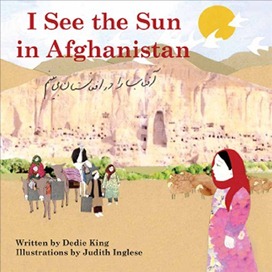
Looking for an ideal book to use with children about Afghanistan?  See Afghanistan and its culture through the eyes of a young girl in this book.  Follow her through one day from waking when it is still dark to fetch water.  Listen to the sounds she hears, see the chores she does, visit her school, and see how her family is impacted by the war and takes in extended family members.  Told in the first person, this book invites readers to see themselves as part of this country with its strong traditions and culture.

Using the device of a first person story told by a child, this book works quite well.  It explains many of the small things about life in Afghanistan, leaving the larger issues in the background.  While war is definitely a part of the story, this book does not take sides or express political opinions.  Rather, this is a book about everyday life and about the impacts of war on one family.  The tone is quiet and evocative, using sensory information to create the setting.

Inglese’s illustrations are a mix of painting and collage.  This works particularly well with the textiles, allowing the fabrics to really splash.  The collages also include occasional photographs which also pop against the browns of the landscape. 

I do have two issues with the book.  One is the whiteness of the skin of the characters, though this seems more of a stylistic choice than a statement of any kind.  It is used in other books in the I See the Sun series.  The other is that religion has been removed from the book, which is an odd choice for a book about a culture.

This look at the culture of modern Afghanistan is in picture book form, but will work best for slightly older children.  With the dearth of books on this subject for young readers, this would make a good addition to any library collection.  Appropriate for ages 6-9.

Reviewed from library copy.

Review: Moving House by Mark Siegel

moving house

Moving House by Mark Siegel

Foggytown had such thick fog that people couldn’t even see where they were walking!  Chloe and Joey wished that they could see the stars from their house, but it was far too foggy for that.  One foggy day when they returned home, their parents announced that they were moving.  As they went to bed, the two children thought about everything they would miss about this house: the warm spot on the kitchen floor, the long hallway to run down, and their secret spot upstairs.  Then suddenly, their room moved and they were wiggled around.  Their house had sprouted arms and legs and was walking down the road!  It took them to a hill above the fog where they could see the stars and look over the world for miles.  After visiting with other buildings, the children got tired and headed back to bed.  What will they see when they wake up in the morning?

This clever take on books about moving adds a large dose of fantasy.  The story stays true to the emotions of moving even though it is fantasy.  The children think about their current home with great affection, worry about where they will live, and soon learn that things can be even better in a new location. 

Siegel injects the entire book with humor.  My favorite part is the series of panels at the beginning of the book with one person after another running into objects in the fog.  The series goes on long enough for it to be a great running gag.  That broad humor slows down as the book moves forward, pacing it much like a bedtime story.

A book about moving to share with children who enjoy a touch of whimsical fantasy, some sweetness, and plenty of humor in their picture books.  Appropriate for ages 4-6.

Reviewed from library copy.

Review: We March by Shane W. Evans

we march

We March by Shane W. Evans

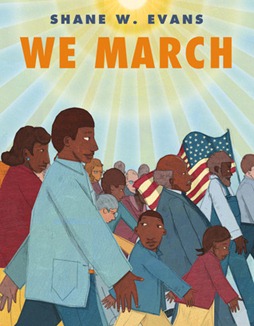
More than a quarter million people marched on Washington on August 28, 1963.  In simple prose and stirring images, Evans tells the story of one child whose family marched that day.  It is a day of working together, faith, and community that culminates with Martin Luther King Jr.’s “I Have a Dream” speech.  This picture book invites even the youngest of children to feel the power of that day, the message of racial harmony, and to understand how much more work there is yet to do.

The prose here is so simple that it just barely tells the story of the march.  With just a handful of words on each double-page spread, the words are very brief.  But the story being told here, is much more than those simple words.  Rather than obscuring the power of that day with too much exposition, this minimalist approach lets the transcendent moment in history shine.  The book does end with a page of information about the march for those looking for further details.

Evans’ illustrations are filled with strength.  He uses simple lines that he combines with a mix of painting and collage to get a layered effect in his art.  The colors are a mix of subtle and strong.  The illustrations focus on a single family that day, but also convey the size of the crowd and the diversity of the people marching.

A powerful, simple look at a historic moment, this book shines with its strong message of unity.  A great pick to share any time of the year, it’s one worth highlighting for February’s Black History Month.  Appropriate for ages 3-6.

Reviewed from copy received from Roaring Brook Press.

Review: A Few Blocks by Cybele Young

few blocks

A Few Blocks by Cybele Young

It was time for school, but Ferdie did not want to go to school.  He wasn’t done playing with his cars, his blocks, or his drawing.  In fact, he was not sure he ever wanted to go to school again.  But Viola held up his coat, called it his cape and invited him to blast off with his rocket-blaster boots.  They fought evil until Ferdie’s boots ran out of fuel.  Ferdie sat down and once again announced that he wasn’t going to school, maybe not ever.  Viola discovered a leaf in the gutter and invited Ferdie to hop on board the ship to find treasure.  Their trip to school continued, moving from one imaginary game to another, until suddenly it was Viola who isn’t sure that she can make it to school.  It was up to Ferdie now to get them that last block to school.

Young’s story is inventive and very readable.  The children going from one game to another is something we see in children’s books.  Viola is a patient leader, guiding Ferdie from one scenario to another despite grumpiness and even tears.  The joy of imagination is clear throughout the book.

The illustrations are exceptional.  They are eye-catching with their fine detail.  Outside of the imaginary worlds, the children and the objects around them are colorless and flat.  When they enter their imaginations, the illustrations are colorful, whimsical, and have dimensions and shadows.  They are sculptural and enticing.

This picture book takes the everyday trip to school and turns it into something extraordinary with its illustrations.  Appropriate for ages 4-6.

Reviewed from library copy.

Also reviewed by:

Review: George Flies South by Simon James

george flies south

George Flies South by Simon James

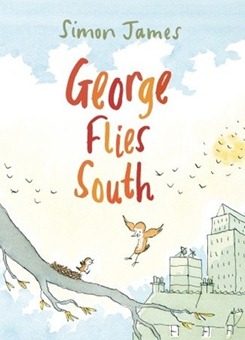
Winter was coming, but George was not quite ready to try to fly yet.  George waited for his mother to return with some worms, when a gust of wind picked up his nest and carried the nest and George into the air!  The nest landed softly on the top of a car, which promptly started driving with George’s mother chasing behind.  The nest flew off the car and then landed on a boat.  From there, George and the nest were lifted high up into a tall building that was being constructed.  George slept safely up in the building until he was awoken by a pouncing cat.  Now George was falling without his nest and without knowing how to fly! 

James has written a story that feels very familiar but has its own personal twists.  The combination of the baby bird and his nest traveling through a city together makes this all the more charming.  Add in the appeal of different kinds of transportation, the thrill of the chase, and the daring high building, and you have a book that will appeal to the wiggliest of preschoolers.  The need to learn a new skill under pressure will also be something that will appeal to this age group.

James’ illustrations are done in ink and watercolor.  They have fine lines, washes of color, and a wonderful feel of motion throughout.  They add much to the cheery story.

A great pick for autumn story times, this book will have children cheering George along and seeing that they too are capable of much more than they may think they are.  Appropriate for ages 3-5.

Reviewed from library copy.

Review: The Princess and the Pig by Jonathan Emmett

princess and the pig

The Princess and the Pig by Jonathan Emmett, illustrated by Poly Bernatene

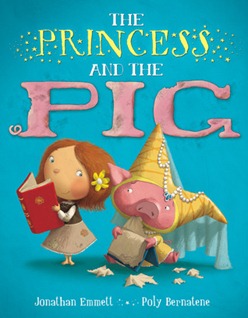
I have to admit, I came to this book with a lot of reservations.  It’s ANOTHER princess book in a time filled with sparkly pink books.  But if you are as sick of the regular princess books as I am, then this is just the book for you!   A farmer had a little pig in the back of his hay cart.  He decided to name it Pigmella.  At the same time, in the tower high above, a queen picked up her baby daughter and decided to name her Priscilla.  But the queen dropped the baby out of the window without noticing and up flew the piglet in her place.  Soon the piglet was being treated as a princess and the princess was happily adopted by the farmer and his wife.  After all, this sort of thing happens all the time in books!  The princess was happy at the farm, growing up and making everyone happy.  Unfortunately, the same thing can’t be seen of the piglet, who grew into a pig, could not learn to read, and refused to wear her finery.  But what is to happen when the mix-up is discovered and the young woman is told she is a princess?

Emmett has inundated his book with references to other fairy tales that the characters in the book use to rationalize what has happened.  They blame things on evil fairies and magic, which is why the mix-up is not discovered for so long.  The writing is merry and filled with humor.

That same humor is carried out to great effect in the illustrations.  They are filled with the funny things that would happen if a pig were a princess, the pomp and ceremony that would still be attempted, and the gentle, loving family of farmers raising a real princess.  The illustrations are done so that the characters pop on a softer background.  The jolly nature of the book is embraced in full here.

Exactly the antidote to children who have read too many princess books, this is a shining example of what a twisted fairy tale book can be.  Great fun and very satisfying.  Appropriate for ages 4-7.

Reviewed from library copy.

Also reviewed by:

Review: Who Has What? by Robie Harris

who has what

Who Has What? All About Girls’ Bodies and Boys’ Bodies by Robie H. Harris, illustrated by Nadine Bernard Westcott

Have a child asking about their body and the ways that boys and girls are different?  Here is a picture book for younger children that answers those questions clearly, simply and with a great matter-of-fact tone.  Told through a family trip to the beach, the book starts with the child characters having questions themselves.  Emphasis is placed on the fact that boys and girls are mostly the same in their bodies.  They both love to play, love to laugh, but they do have some body parts that are different.  Even then, most of their body parts are the same.  As the children move into the changing rooms, the different body parts are shown and defined.  The book covers both the external organs and the internal ones.  As always, Harris presents the information with clarity and makes it easy to understand.

This book is appropriate for preschoolers who are asking questions about their bodies.  The answers here cover the body parts only.  No sexual explanations are given in this book about how babies are made or arrive.  It’s a great early lesson in bodies that speaks to the questions children that age have.

Westcott’s illustrations are charming and factual, nicely combining clear images of the body parts but also having an inviting cartoon feel.  The addition of the dogs in the dressing rooms and when talking about general body parts will also help answer questions that children have about pets.  It’s another way that this book is clearly designed for this specific age group.

Ideal for families looking for clear information to share with their children, this book belongs in every public library.  Appropriate for ages 4-8.

Reviewed from library copy.