Review: Subway Story by Julia Sarcone-Roach

10969431

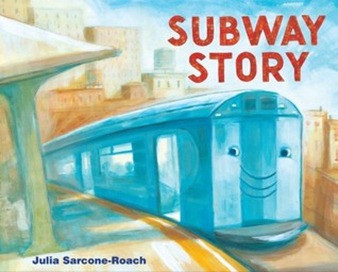
Subway Story by Julia Sarcone-Roach

Based on a true story, this picture book follows Jessie, a subway car, from her “birth” until her unusual ending.  Jessie was a New York City subway car that carried people and things around the city.  At first, she was new and shiny, but eventually she was covered in graffiti and then painted red.  She kept on working, running on tracks around the city.  Then she was used only in the winter because her fans could not keep up with the heat, and finally she wasn’t used any more.  But Jessie’s travels and adventures were far from over!  Whatever will happen to her when she is shipped by barge and taken far from land!

Sarcone-Roach has created a picture book that seems to be quiet and then takes a turn into the unexpected.  She begins with a true story and then personalizes it through the eyes of one specific subway car.  It works really well as a technique to make the subject very child friendly and to invite readers in to experience the story.  The writing is clear and Jessie’s perspective is strong and active. 

Her art is also very successful.  The colors are deep and jewel-like, showing the beauty of the city as well as the subway lines.  She plays with perspective throughout, stacking the subway lines like shelves, showing both the outside and inside of the subway cars, and always showing Jessie with her smiling headlights and chains. 

This is a lovely book that works well on many levels.  Use it for an unexpected take on recycling, add to your transportation stories, or just share it to see the children guessing where Jessie is headed on that barge.  They are sure to be entranced by the answer.  I certainly was!  Appropriate for ages 4-7.

Reviewed from copy received from Alfred A. Knopf.

Also reviewed by:
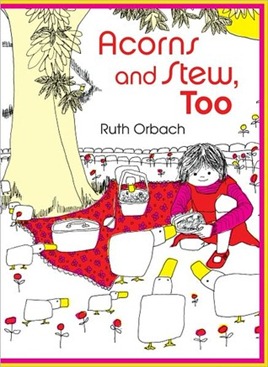
Review: Acorns and Stew, Too by Ruth Orbach

acrorns and stew too

Acorns and Stew, Too by Ruth Orbach

First published 25 years ago, this book has a classic feel combined with a great story.  Lenore loved a lot about her life, but most of all she loved the ducks who lived near the lake.  She visited them every day and fed them bread and other food.  But winter was approaching, so Lenore knew that soon the ducks were going to fly south.  She made them little houses to live in, fed them on stew and acorns, even made winter coats for them.  In the end, the ducks did not fly south.  They stayed with Lenore.

I love the ending of this book, where the ducks stay for the winter.  So often, children in stories are infinitely creative and resourceful, but they don’t create real change.  Here the universe shifted a bit to make room for Lenore and her dreams.  Orbach writes with real joy.  She delights in the small moments of creation that Lenore has, the attachment of the ducks to Lenore is evident too.  She has created a book where emotions are tangible and hard work really makes a difference.

Orbach’s art has a vintage feel.  The illustrations are done in ink on white and then colored with wild bursts of color.  The yellow is warm, the red pops, the pink is beyond bright, and the yellow is neon.  It all makes for an eye-poppingly bright book.  At the same time, the illustrations have a whimsical feel.  The bright colors and the whimsy make for an interesting contrast with one another.

I hadn’t read this years ago, so I’m very happy to find it now.  Here is a sweet, clever and empowering story for children.  Appropriate for ages 3-5.

Reviewed from copy received from Kane Miller.

Review: Waiting for the Biblioburro by Monica Brown

WaitingForTheBiblioBurro

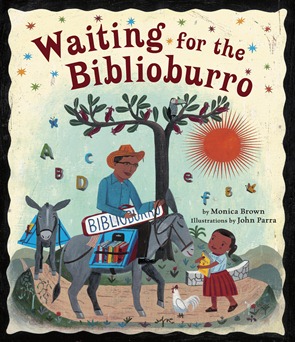
Waiting for the Biblioburro by Monica Brown, illustrated by John Parra

Inspired by a true story, this picture book shows the power of books and reading.  Ana is a small girl who lives in Colombia and adores books.  Her village is very remote though, so there is no library to go to.  Ana has just one book, given to her by her teacher, and she has read it over and over again.  Ana makes up her own stories that she tells her little brother at bedtime.  Then one day a man with two burros comes to their village.  The burros carry a library of books and he invites all of the children to select books to keep until he returns.  As she waits for the librarian to return, Ana creates her own book about him, his burros and his books.

Brown has created a book that is gentle and beautifully written.  Ana’s life is shown as loving and filled with blessings.  It will contrast vividly for American children with their own lifestyle.  Brown also focuses clearly on books and the power of reading and stories.  The story here is told clearly and warmly with sprinklings of Spanish throughout.

Parra’s illustrations have a lovely folk art feel to them.  Done in acrylics on board, they have a texture adds another dimension to the book.  The colors are bright, the storytelling portions filled with wild and amazing creatures, and the entire work makes a complete and unified package.

The entire book sings, revealing a different culture and the power of words (and librarians.)  Appropriate for ages 4-6.

Reviewed from copy received from Tricycle Press.

Also reviewed by:

You can also check out the book trailer:

Review: Born and Bred in the Great Depression by Jonah Winter

born bred great depression

Born and Bred in the Great Depression by Jonah Winter, illustrated by Kimberly Bulcken Root

Winter tells the story of his father’s childhood during the Great Depression in this historical picture book.  Through the life of his father, he shows the poverty of the time.  Grandpa Winter searched for work in the area, often unable to find any, which meant that there was no money to help support the family of 8 children.  When he did find work, it was dirty and back-breaking labor.  This is contrasted with the simple joys of childhood as Winter’s father spent time outside exploring the woods and walking the railroad tracks.  The family grew most of their own food, eating lots of produce from the garden and canning excess to eat during leaner times.  There was little ease in their lives, but what they could find they used.  There was time as a family for music, chess and reading books.  There was time to explore the natural world.  This glimpse of history opens our eyes to the way we live today as well.

Winter’s words are compelling, inviting readers into the world of the Great Depression.  He manages to tell the story of the poverty through a lens that children will be able to relate to.  Focusing on the family life, including many people in each bed, there are definite contrasts with today’s economic problems.  Winter does not romanticize the Great Depression, instead he brings it to life through the history of his own family.  There is a lovely simplicity to the story that makes it all the more readable.

Root’s illustrations are done in pencil, ink and watercolor.  They have a softness to them that evokes the past.  The colors are subdued with the focus on telling the story through the images as well as the words.  Root manages to show the Great Depression through images that are beautiful, quiet and rich.

This historical picture book celebrates strength of family and overcoming hardship.  Appropriate for ages 5-7.

Reviewed from copy received from Schwartz & Wade Books.

Review: Eddie Gets Ready for School by David Milgrim

eddie gets ready

Eddie Gets Ready for School by David Milgrim

Eddie can get ready for school all on his own, but his routine is not what his mother would have done!  That’s for sure!  His healthy breakfast is spilled around so much that it becomes a way to take care of feeding the dog too.  He washes up with a diving mask on.  When he’s gotten dressed he has on a cape, no shirt, and his underwear is on his head.  Then comes watching cartoons and drinking root beer.  That is until his mother shows up!  His routine continues to be uproarious fun and he does make it onto the bus on time, even if he is carrying his clean underwear in his hand!

Milgrim taps into exactly what small children will find funny.  The underwear jokes are bound to get big laughs, but so is the idea that a school snack includes a whole watermelon.  Each page contains something that children would have loved to do themselves, therefore they will love to see what happens when Eddie tries it.  It is a very satisfying premise for a book.

Much of the humor is visual and told in Milgrim’s bright colored illustrations.  The white background on many of the pages make the colors really pop.  There is a feeling of enthusiasm within the illustrations and the story itself. 

Perfect for fans of the No, David! series, this book has the same zany humor and energy.  Appropriate for ages 4-6.

Reviewed from copy received from Scholastic.

Review: What Animals Really Like by Fiona Robinson

what animals really like

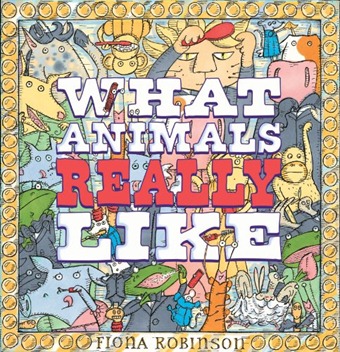
What Animals Really Like by Fiona Robinson

Mr. Herbert Timberteeth is happy to present his new song that he composed, “What Animals Like Most.”  He will also be conducting it, just open the red curtains and… There are groups of animals on stage who flatly deliver, “We are lions, and we like to prowl.  We are wolves, and we like to howl.  We are pigeons, and we like to coo.  We are cows and we like to…”  Turn the page to have the chaos begin as the cows change the obvious rhyme into something else entirely.  Best of all, you can tell from the animals’ faces that they are up to something.  They are the only ones on stage grinning.  The same is true of the next grouping.  Children will get the joke immediately when the first rhyme is missed. Finally, Herbert, now bedraggled, allows them to sing the new and non-rhyming version of the song.  He hates it, but the audience has a very different reaction.

Robinson has tapped into a kind of humor that children enjoy.  The unexpected happening when you think you have the structure pegged.  Children will be relaxed and ready for the rhyme to come next.  In fact, they will probably announce that first rhyme before you get the page turned.  Their reaction will be that much better if they do!  The unexpectedness of this entire book is a great treat.

The illustrations are also fun.  Keep an eye out for all of the small touches.  My favorite is where the show is lit by glowworms, and if you look closely one of them has fallen asleep and is no longer lit.  But there are many to enjoy, making this a book that can be read again and again.

This is a definite read-aloud pick for any preschool story time.  It would make a great final book that is sure to keep wiggly children interested and listening.  Appropriate for ages 3-5.

Reviewed from library copy.

Review: Mouse & Lion by Rand Burkert

mouse and lion

Mouse & Lion by Rand Burkert, illustrated by Nancy Ekholm Burkert

This classic Aesop fable is told with exceptional ease.  The story focuses more on Mouse than other versions, even giving him top billing in the title.  Mouse scampers right over Lion before he even realizes he is not a mountain.  And as the tale goes, Lion grants Mouse a reprieve from being eaten and sends him on his way.  In this story, Lion is captured in a hunter’s net and Mouse gnaws him free.  Set in Africa, this story features a four-striped African grass mouse rather than the expected little brown mouse.  Combined with the baobab trees, it all works to evoke Africa completely. 

Burkert’s text is beautifully done.  At first blush, his writing reads aloud so well that it seems simple.  But instead it is just written by a storyteller, who realizes exactly how words play and how to create a mood.  When Lion has captured Mouse, there is a gorgeous moment when Burkert leaves Mouse literally dangling:

Mouse spun slowly as he dangled.  He dangled as he spun.  He squinted into Lion’s mouth, feeling his warm breath, noting his yellowed teeth.

This is just one of many such times when the writing sings, the moment stretches, and the story is illuminated. 

Add to this skilled writing, the illustrations and you have quite the book.  The illustrations are strong at the same time they are delicate.  Done with fine lines, each hair on the animals is individual.  Mouse’s nose and whiskers seem to twitch.  Lion seems to snore.  There is life here in these illustrations, life that moves and breathes.  The illustrations are captivating.

Who would think that after last year’s Caldecott Award winner, libraries would want another version of Aesop’s fable.  They definitely should get this one with its beautiful combination of writing and illustration.  It too is a winner.  Appropriate for ages 4-6.

Reviewed from copy received from Scholastic.

Also reviewed by Cracking the Cover.

Review: One Love by Cedella Marley

one love

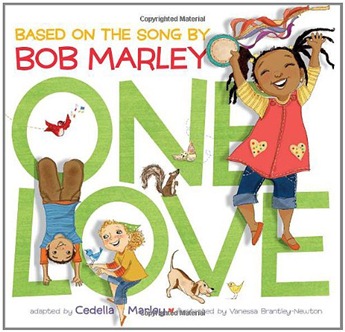
One Love by Cedella Marley, illustrated by Vanessa Brantley-Newton

Marley has adapted her father Bob Marley’s famous song into this picture book.  The book follows the same arc as the song, but is simplified considerably.  Fans of the song will definitely try to sing along with the words since they are so iconic.  Children who don’t know the song will discover a vibrant picture book where the words give the emotion, but the pictures tell the story.  It’s the story of a community coming together to turn a vacant lot into a park, One Love Park.

This simple picture book owes much to the original song.  It’s where the book gets its heart.  The words are pulled directly from the song and in picture book form read aloud well.  Just like the song, the emphasis is on community, love, and creating a new world together.

Brantley-Newton’s illustrations add so much joy to this book.  They are full of color and movement, the multicultural cast of characters are vibrant and glowing.  Readers can also keep an eye out for visual references to Bob Marley.

Simple, lovely and powerful, this book is definitely worth celebrating.  Appropriate for ages 2-4.

Reviewed from copy received from Chronicle Books.

Here’s the book trailer:

Review: What’s New at the Zoo? by Betty Comden

whats new at the zoo

What’s New at the Zoo? by Betty Comden and Adolph Green, illustrated by Travis Foster

This funny book about an overcrowded zoo contains words that are lyrics from the Broadway Show, Do Re Mi.  The zoo is so crowded that the animals are stepping on one another.  The kangaroo’s pouch is stepped on by a bear.  The moose’s snout is stepped on by a goose.  All of the animals demand to be let out of the zoo.  So when the zookeeper arrives at the door, he is stampeded by all of the animals in their rush to escape.  The book combines humor and rhythm into one very appealing read.

Comden and Green had a way with words and rhythm.  I only wish I could have heard the music for the book and kept checking to see if there was a CD that I had missed.  The writing is humorous, offering plenty of laughs for young readers.

Much of the humor is also visual in the illustrations by Foster.  His art adds an appealing cartoonish, slapstick humor to the read.  Children will love the expressions on the faces of the animals as they are trod upon.  There are also several large flaps to lift that add even more fun.

This one is a treat to read aloud, the rhymes and rhythms flow beautifully.  Children will love the animals, the jokes and all of the zany fun.  Appropriate for ages 3-5.

Reviewed from library copy.