Review: Neville by Norton Juster

neville

Neville by Norton Juster, illustrated by G. Brian Karas

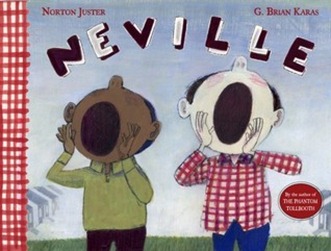
This story about a boy moving to a new place will speak to any child who has had to move.  The boy was never asked by his family if he wanted to move, he just got told that they were.  Now he had to move into a new house and go to a new school, and worst of all, find new friends.  His mother suggested that he go for a walk, so he did, very reluctantly.  After he walked for awhile, he turned around and called out:  “Neville!”  Nothing happened.  He did it again and again.  Then another boy joined him and they shouted together.  More children arrived and they all began calling for Neville.  Even the dogs were howling along.  When they stopped to catch their breath, the children started asking about who Neville was.  The children all decided that they quite liked Neville and the boy too.  Then it was time to head home, and the boy felt much better about moving.  That feeling lasted all the way until bedtime, when his mother wished him, “Good night, Neville, pleasant dreams.”

This clever story is written with a graceful simplicity that reads aloud smoothly and easily.  The story is beautifully crafted, with a a solid feel and a strong story arc.  There is also a wining humor about the entire story, from the children joining in so willingly to the twist at the end.  It all makes for a charming book that begs to be shared with a group of children. 

Karas’ illustrations capture the emotions of the characters clearly and with humor.  He also plays with fonts when the boy is calling for Neville.  The word is art in the air, changing and moving.  What I found most lovely was the change from the initial stark white of the new house and community where even the grass was gray.  When the boy starts meeting children, color enters the picture around him and the community is revealed to be welcoming, colorful and warm.

This outstanding picture book conveys the stress of moving in both textual and visual ways, offering a great twist and a clever resolution.  Appropriate for ages 4-6.

Reviewed from copy received from Schwartz & Wade Books.

Also reviewed by:
Review: The Parrot Tico Tango by Anna Witte

parrot tico tango

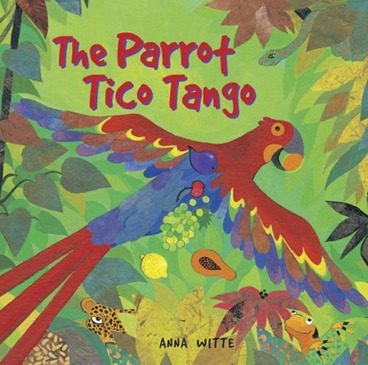
The Parrot Tico Tango by Anna Witte

Parrot Tico Tango is a naughty bird!  He has his own mango, but as he soars through the jungle, he steals fruit from other animals.  There is the sloth’s lemon, the monkey’s fig, the snake’s cherry, the frog’s grapes and more.  Eventually, it gets to be too much to carry and he crashes.  Now Tico Tango is left with nothing, not even his own mango.  But the others offered him a slice of mango in exchange for him dancing the tango.  And dance he did!

This is a colorful book that merrily teaches colors and fruits along the way.  The rhyme is jazzy and great fun to read aloud.  The text is written in a cumulative style, so each new fruit is added to the list that is repeated with each new addition.  This adds a lot of style and emphasizes the greed of Tico Tango.  While the book teaches colors, what it would work best for in a classroom is a discussion of adjectives.  Each new fruit is talked about in detailed adjectives that are used in different sentence structures.  It would make a very approachable and fun lesson.

Witte’s art is bright and bold, a winning combination of collage and paint.  The animals themselves are bright colored, especially Tico Tango who lights up each page in his own rainbow of colors.  The fruit also adds a lot of color and then it all pops against the green of jungle and the varying colors of the sky.

This is a simple book that will be enjoyed by toddlers learning their colors on one level and then by elementary students learning adjectives on another.  Appropriate for ages 2-6.

Reviewed from copy received from Barefoot Books.

Review: Brother Sun, Sister Moon by Katherine Paterson

brother sun sister moon

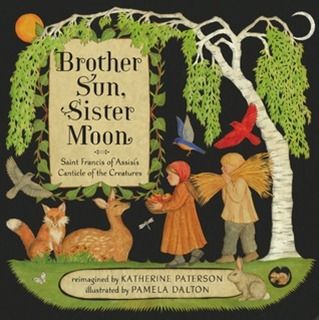
Brother Sun, Sister Moon: Saint Francis of Assisi’s Canticle of the Creatures by Katherine Paterson, illustrated by Pamela Dalton

Acclaimed author, Katherine Paterson has reworked a hymn of praise first said by Saint Francis of Assisi.  It praises God for our Brother Sun, Sister Moon, and Sister Stars.  Brother Wind and Brother Air are praised for being both harsh and mild.  Sister Water is thanked for being life-giving and Brother Fire is thanked for both warmth and playfulness.  The song of praise moves through Death as well, thanking God for the days we are given and the love that we are ushered into at death.  It is a universal prayer made joyous through Paterson’s changes to Saint Francis’ original version, which is included at the end of the book.

The delicacy of Paterson’s writing is not apparent until her words are compared with the original.  She has carefully teased deeper meaning from his words.  At the same times she has made them more appropriate for young readers and listeners.  The hymn of praise sings as she has written it, endowed with a new grace thanks to her skill.

Dalton’s illustrations are simply exquisite.  Using a cut paper technique that involves delicate knife work, watercolor painting, and then a process of being steeped in coffee, the result is luminous yet rustic.  It suits this subject matter perfectly, managing to be beautiful but not too lofty.

This is a magnificent selection for libraries’ religious shelves, one that will speak to people of many faiths and is phenomenally appealing and beautiful.  Appropriate for ages 4-6.

Reviewed from copy received from Chronicle Books.

Also reviewed by:

You can see Dalton create her art in the video below:

Review: The Money We’ll Save by Brock Cole

money well save

The Money We’ll Save by Brock Cole

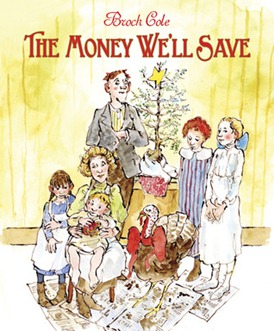
When Ma is forced to send Pa to the store for eggs and flour, she warns him to just buy those two items.  But Pa is talked into purchasing a turkey poult at the market because of the money he’ll save.  They plan on having the turkey for Christmas dinner after feeding it on scraps and letting it live in a box by the stove.  But their nineteenth century apartment was definitely not designed to raise poultry.  Alfred, the turkey, grew and grew and soon started to eat much more than table scraps.  The family started to get creative with where they could house Alfred but there wasn’t much they could do with the limited space.  As Christmas neared, the mess and stink of a turkey was getting to be too much.  Though he may be messy, the children started to love Alfred.  What happened when Alfred became more of a pet than a meal?

The setting here is brilliantly done.  The depiction of the tenement building, the attitudes of the hard-working family, and the frugality of their family life all are vividly depicted.  The 19th century time period works well for a Christmas story, one that focuses more on family than on expense and presents.  This is an old-fashioned Christmas tale with lots of heart and character.

Cole’s art also captures the day-to-day life of this family.  The clothes and home immediately let readers know that they are not reading about today.  The illustrations are a jumble of family life, turkey mess, and a small space packed with furniture.  The illustrations have a real heart to them, filled with familial love and busyness.

Highly recommended, this book is a great one to add to Christmas traditions.  It is sure to have smiles beaming from all ages and will inspire the sharing of your family’s holiday memories.  Add this one to Christmas story times too as a break from Santa Claus and presents.  Appropriate for ages 4-6.

Reviewed from library copy.

Review: The Orphan by Anthony L. Manna

orphan

The Orphan: A Cinderella Story from Greece by Anthony L. Manna & Soula Mitakidou, illustrated by Giselle Porter

This story of Cinderella has a distinct Greek twist to it.  In the author note at the beginning of the book, they state that the tale is drawn from two Greek versions of Cinderella.  One change that was made from the traditional stories is that Cinderella takes a more modern and active stance than she had in previous versions.  It is the story of a girl who loses her devoted mother and then has a stepmother and two stepsisters who take her father’s attention, love and money.  She weeps at her mother’s grave and is encouraged by her mother’s spirit to have hope and wait for blessings to appear.  They arrive in the form of Mother Nature and her children, who give Cinderella the Evening Star as a headpiece, dresses, and shoes.  Instead of a ball, this Cinderella meets her prince in church and in disguise, riding there on a white mare made of clouds.  She loses her shoe when leaving the church after the prince tries to capture her by making the threshold sticky.  All is revealed when the shoe fits.

This is a very satisfying version of the story with a spiritual tone that is not in the more familiar version.  Cinderella’s connection with her dead mother is much stronger here as well, having her turn to that guidance rather than a fairy godmother deepens the story considerably.  Also connecting her dresses, shoes and crown to nature is an adroit move. 

Porter’s illustrations have a folktale feel to them with a traditional grounding in the style.  At the same time, they have a rather ethereal quality as well, a lightness and wonder that infuses them.  It is a pleasing combination.

While we don’t really need more versions of the Cinderella tale, this one has a unique appeal and a very different feel.  Appropriate for ages 5-7.

Reviewed from copy received from Schwartz & Wade Books.

Review: The Three Little Aliens and the Big Bad Robot

three little aliens

The Three Little Aliens and the Big Bad Robot by Margaret McNamara and Mark Fearing

The story of the Three Little Pigs heads to outer space in this fractured fairy tale.  Here there are three little aliens, who must find a new planet to live on.  Their mother advises them to stick together, but two of the little aliens don’t listen.  When Bork sees the space rover on the red planet, she just can’t resist living there.  Gork is drawn in by the satellite circling around a planet surrounded by rings.  Nklxwcyz went deep into space until he found a planet that he thought was perfect.  It was blue with nice breezes.  When the Big Bad Robot arrived in the galaxy, there is no where for Bork and Gork to hide, because they had been too busy playing with their new toys to build homes.  So both of them fled to Nlkxwcyz’s house deep in space.  And you will just have to read the book to see how the Big Bad Robot is defeated.

While this is a light-hearted fiction book, it is also one that has some science mixed in.  The planets that the three aliens travel to are the planets in our galaxy.  They start out at home at Mercury.  Bork settles on Mars, Gork on Saturn and Nlkxwcyz on Neptune. This adds a nice dimension to the book. 

McNamara’s prose is a pleasure to read aloud.  The noises of the Big Bad Robot add much to the book’s fun and build the tension up.  The illustrations by Fearing are quirky and fun.  The backdrop of stars and the familiar planets make for a winning setting for the pictures. 

A fun, fractured fairy tale, this book will be popular with children who enjoy space and robots.  Appropriate for ages 4-6.

Reviewed from copy received from Schwartz & Wade Books.

Also reviewed by:
Review: Chocolate Me! by Taye Diggs

chocolate me

Chocolate Me! by Taye Diggs, illustrated by Shane W. Evans

The main character of the book, who goes unnamed, is teased because he is different than the other boys in the neighborhood.  Compared to the white kids, his skin is darker, his hair more poofy, his nose is wider, and his teeth shine brighter.  He returns home in tears, because he wants to fit in.  His mother talks to him, telling him how special he is and how perfect he is.  She tells him that his skin is like “velvet fudge frosting mixed in a bowl.”  She gives him a t-shirt that says “Chocolate me!” and he starts to rethink things as do the other kids.

The focus of this book is self-acceptance and self-love.  The universal theme of trying to fit in and feeling different than others will speak to all children.  Diggs writes with a smoothness and natural rhythm.  The book reads as confident poetry, though it does not rhyme.  Evans’ illustrations have a great organic feel as well.  They are bright colored, rough lined, and filled with motion. 

Share this with a group of children discussing self-esteem or diversity.  It will also be one of those books that children pick off the shelves thanks to the sunshine bright cover.  Appropriate for ages 3-5.

Reviewed from copy received from Feiwel and Friends.

Review: If You Lived Here by Giles Laroche

if you lived here

If You Lived Here: Houses of the World by Giles Laroche

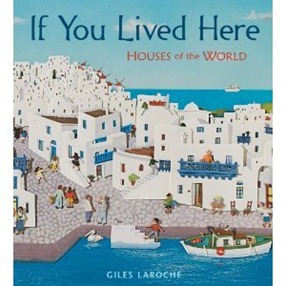
This book invites readers to explore the different types of houses that are lived in throughout the world.  Beginning with the phrase, “If you lived here…” the book then describes some unique features of that particular type of home.  There are homes that you would have to go outside to get to the kitchen, others where you would not have to go out to even get to the barn, others are built around caves, still others are close to water or surrounded by it.  The book then defines the type of house, what materials it is made from, where this type of house is found, the date that this house first appeared, and a fact about them.  The tone is kept light and interesting, which will invite young readers to explore this subject in depth.

Laroche’s writing is welcoming and light.  He finds the most unique features of a home and describes them in simple and inviting ways.  Even the information on the materials and location are kept short and contain only the most interesting details. 

The illustrations, done in paper, have a three dimensional effect.  The homes are done in exacting detail that includes individual shingles, decorative features, and even the ability to peer closely and see into the windows to the rooms beyond.  There is a physical quality to this, creating almost a model effect where you lean in closer to see even more.  The illustrations are a delight and truly bring the structures to life.

When I first started reading this book, I wondered who would be the audience for it.  The entire book is so appealing that it will have no trouble being enjoyed by young readers interested in architecture, history, or travel.  Appropriate for ages 8-10.

Reviewed from library copy.

Review: The Ice Bear by Jackie Morris

ice-bear

The Ice Bear by Jackie Morris

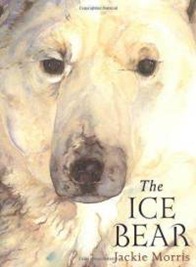
Poetic and mystical, this picture book is a rich read.  In the beginning of time, people and animals were as one.  Two tiny polar bear cubs were born into the world and cared for by their mother bear in an ice cave.  But the mother was tricked, and Raven was able to steal one of the cubs away.  A hunter found Raven with a bundle of white fur.  Raven flew off, and the hunter picked up the bundle of fur and headed back home on his sled.  When he brought the furs into his home, he and his wife discovered a baby inside.  The two had wished for a child and here was one.  They raised him as their own.  When the child was seven years old, Raven returned and drew him out onto the ice and away from home.  There he almost froze to death, until the bears found him and took him away with them.  He is a boy of two families, two worlds, who must make a choice.

Morris proves here that she is just as radiant a writer as an illustrator.  Her story is told in words that make you slow down, savor them.  If you read them aloud, it reads as verse, a poem in paragraph form.  The world she creates is one of wonder and timelessness.  It is a world at birth, a world that mirrors our own, but is also filled with magic and connections.  She has created a picture book that is an invitation to dream.

Her illustrations have a lot to do with this too.  They capture the Arctic landscape in all of its blues, whites, and purples.  Then they also show the human family filled with the warmth of fire, furs and the snugness of their home.  But most powerful of all is the bear home, where it is still cold, but the heat and warmth comes from the animals themselves, shown powerful in creams and yellows and equally loving.

A gorgeous story that is both beautifully written and illustrated, this book is radiant.  Appropriate for ages 5-8.

Reviewed from library copy.

Also reviewed by:

Check out the video of the author reading the book: