Review: Cows to the Rescue by John Himmelman

cows to the rescue

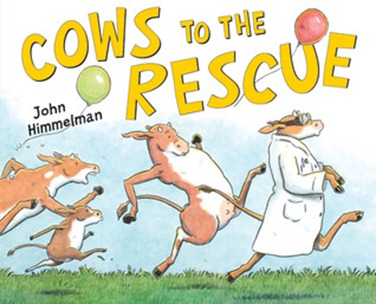
Cows to the Rescue by John Himmelman

This third book in a hilarious series follows Chickens to the Rescue and Pigs to the Rescue.  It’s time for the county fair where there will be plenty of opportunities for the cows to save the day.  They help when the truck won’t start by carrying the family, the pigs and the duck to the fair.  They fill in during the three-legged race so that Jeffrey would have someone to race with.  They help the duck win the Handsomest Duck contest by getting him cleaned up.  They filled in for family pictures at the fair.  In the end, they have done so much that they can’t make it home.  So it’s up to the duck to try to get everyone back to the farm.  Look out for the next book, which just might be Duck to the Rescue.

Himmelman has a great touch for humor, painting it in broad strokes without holding back.  His words may be simple, but they have a jolliness that make it a pleasure to read.  His use of page turns to delay the cow’s solutions also adds great timing into the book. 

His illustrations have a pleasant cartoon quality to them, which definitely adds to the humor of the title.  From the duck that gets caught up in the action to the tiny pig who has a great personality of his own, this book has so much to look at and enjoy.

If you enjoyed the first two books, make sure to check this one out.  And if you haven’t read the first two, you can start at any point.  Appropriate for ages 4-6.

Reviewed from copy received from Henry Holt & Company.
Review: The Bear Who Shared by Catherine Rayner

bear who shared

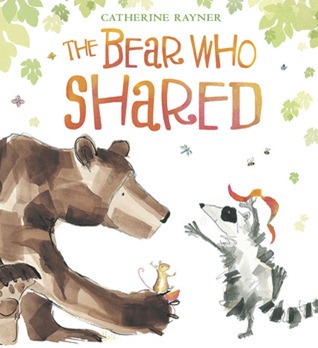
The Bear Who Shared by Catherine Rayner

Norris, the bear, knew that the plorringes were the best fruits.  So he waited under the plorringe tree because he knew something special was going to happen.  Tulip and Violet, a mouse and a raccoon, knew that plorringes were the best too.  They were able to climb up in the tree to get closer to the single hanging plorringe.  They could see how delicious it looked and smell its delicious scent.  They listened to it and hugged it too.  They were just about to lick it when it fell off of the tree and down right onto Norris’ head.  Now Norris was closest to the plorringe and had it all to himself.  But just as Norris was patient, he was also a very nice bear.  The type of bear who would not only share but would make some new friends doing it.

The story here is one that has been shared in many picture books.  Rayner’s writing has a gentle repetition that is almost not noticeable.  She has a playfulness and a warmth to her writing that makes it a pleasure to read aloud.

It is the illustrations that make this book something extraordinary.  There is the brawny brown of the bear done in overlapping paint that show his girth and weight, but also his sturdiness and steadiness.   Then the raccoon is a mash of black and grays, blending and merrily mixing, capturing the dynamic movements.  The mouse is all delicate line and a whisper of pink expression for the tail.  The plorringe is yellows, reds and pinks, a mix of mango, plum, and guava.

A book about sharing and friendship that will be loved due to the illustrations.  Appropriate for ages 3-5.

Reviewed from copy received from Dial Books for Young Readers.

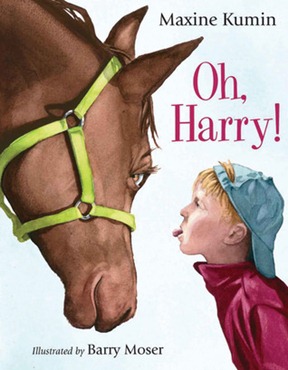
Review: Oh, Harry! by Maxine Kumin

oh harry

Oh, Harry! by Maxine Kumin, illustrated by Barry Moser

Harry the horse did not have the lean lines of the other horses at the Adams & Son farm.  He wasn’t jittery or temperamental like the others either.  Instead, he was gentle, kind and calm.  When any other horse got out of line, Harry was brought in to calm the situation down.  He didn’t have a stall like the others either, instead he was allowed to move from spot to spot in the barn as he liked.  But then Algernon Adams, aged 6, arrived at the farm.  He ran around, yelled and scared the horses.  Until one evening, when he got shut in the grain bin.  All the people had left, only the horses were in the barn, including Harry.  And now Harry had a decision to make about the naughty young Algernon.

Kumin’s verse is playful and jaunty.  This is not poetry of a serious sort, but rather the type that skips along telling a story.  The rhymes read aloud well, moving the entire story along at a brisk pace.

Moser’s art offers a lot of range here.  His paintings show quiet moments of beautiful horses together.  They also show silly moments with Harry and Algernon.  They have deep colors placed again white space that really make the images pop.

A winning combination of engaging verse and art, this picture book will be appreciated by horse lovers of any age.  Appropriate for ages 4-7.

Reviewed from library copy.

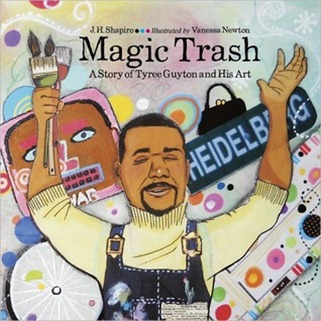
Review: Magic Trash by Jane Shapiro

magic trash

Magic Trash: A Story of Tyree Guyton and His Art by J. H. Shapiro, illustrated by Vanessa Brantley-Newton

This is the life story of Tyree Guyton.  Tyree grew up in Detroit in a large family.  He was always picking up stray objects and creating things with them.  At age nine, Tyree decided he wanted to be an artist.  But as the years passed, he worked many jobs, none of them artistic.  When he returned back home, his street has changed from a bustling neighborhood into a stretch of dilapidated  houses.  So Tyree went to work, painting everything he could find.  Houses got polka dots, bright colors were everywhere, found objects were incorporated.  But not everyone loved Tyree’s work, they considered it garbage.  Houses were knocked down by the city, until finally after years, Tyree’s art was safe.  This year marks the 25th anniversary of the Heidelberg Project, certainly something to celebrate!

Shapiro has written this book with a sparkle and jazz that suits the subject.  Her storytelling is impressive as she creates moods that change from one page to the next as the story progresses.  She weaves in rhyming lines at times, adding to the distinctive feel of her words.

Brantley-Newton’s art is done in mixed media, incorporating found objects, torn pages filled with words, painting, pattern and texture.  Her art is bright, beautiful and vibrant.  Against the distinctive backgrounds, her characters stand out with great charm.

A look at street art that is part of the street, this book will be enjoyed by art teachers and budding young artists alike.  Appropriate for ages 6-9.

Reviewed from copy received from Charlesbridge.

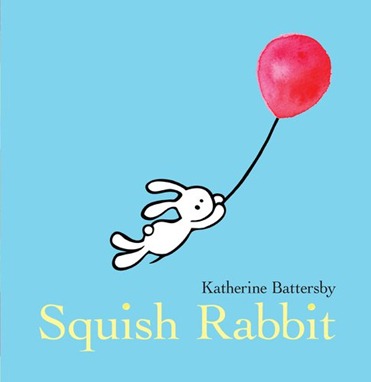
Review: Squish Rabbit by Katherine Battersby

squish rabbit

Squish Rabbit by Katherine Battersby

Squish is such a little rabbit that no one seems to see him or hear him.  So he made himself a stuffed rabbit friend.  But that only helped his loneliness for a little bit.  He tried playing with the trees, but they didn’t play fair.  Finally, Squish lost his temper and threw a tantrum.  He kicked an apple high into the air, and someone saw and thought it was a game.  Squish saw that the squirrel was heading for a cliff chasing the apple and finally found his voice.  And a new friend.

Battersby has created a picture book with an exceptional amount of appeal.  Her text is simple and understated, allowing the pictures to tell the rest of the story at times.  And what pictures they are!  Done in mixed media collage, the illustrations are winningly simple.  They have a charming ease to them, especially the depiction of Squish, done in white with free black lines.  The mixed media comes in with cut paper, fabrics, and watercolors that give great texture and color.

Highly recommended, this is a superb picture book that small children will relate to and that is also beautiful and stylish.  Appropriate for ages 3-5.

Reviewed from copy received from Viking.

Review: Zombie in Love by Kelly DiPucchio

zombie in love

Zombie in Love by Kelly DiPucchio, illustrated by Scott Campbell

Mortimer the zombie is lonely.  Cupid’s Ball is approaching and he has no one to take.  He does try hard, giving girls candy, hearts, and even diamonds.  But something about him seems to turn them off.  He tries reading advice books, working out, and dance lessons, but nothing worked.  Finally, he takes out an ad in the paper (which Jimmy Buffet fans will be able to hum along to) that invites that special someone to meet him at Cupid’s Ball.  He dresses up and sits by the punch bowl.  But no one takes any notice of him.  Finally, he decides to leave, until he hears a crash behind him, just in time.

DiPucchio fills this book with plenty of zombie puns.  Just the personals ad alone offers plenty of laughs.  She has created a book that works on many levels.  Children will enjoy the simple storyline while tweens and teens will get the puns and antics. 

A lot of the humor is visual in this book.  Campbell’s illustrations have a great wild and zany quality to them that suits the story.  From the dangling eyeball of Mortimer’s skeleton dog to the worms that appear throughout the book, there is plenty to love here.

A wonderful pick for either Halloween or Valentine’s Day or any day in between, this book is a funny look at love, zombie style.  Appropriate for ages 6-12.

Reviewed from copy received from Atheneum Books for Young Readers.

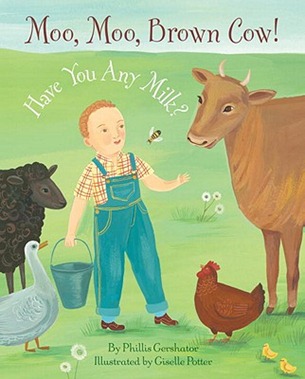
Review: Moo, Moo, Brown Cow, Have You Any Milk? by Phillis Gershator

moo moo brown cow

Moo, Moo, Brown Cow! Have You Any Milk? by Phillis Gershator, illustrated by Giselle Potter

An extended version of Baa, Baa, Black Sheep, this book adds new verses with additional animals.  It begins with the traditional rhyme which then changes a little with the wool becoming a blanket for the little boy’s bed.  The goose provides down for a pillow.  The hen has eggs, the bee honey, and the cow milk, which all make a perfect bedtime snack.  The animals then all head to bed too, and readers are left with the boy fast asleep in his bed with his stuffed animals tucked in close with him: a sheep, goose, hen, and cow.

Gershator has used the same rhythm as the original and it all fits nicely into the song pattern as well, so this book can be sung too.  With each new animal, she gently offers up the noise the animal makes, what that animal provides, and then a use for that product.  It’s a pleasant look at animals, farming and the connection between farm and end product. 

Potter’s illustrations have a wonderful folkart aspect to them that adds a timelessness to the entire book.  For a new version of a beloved nursery rhyme, this is just the right art to set the tone. 

This book is a solid addition to nursery rhyme collections.  Appropriate for ages 2-4.

Reviewed from library copy.

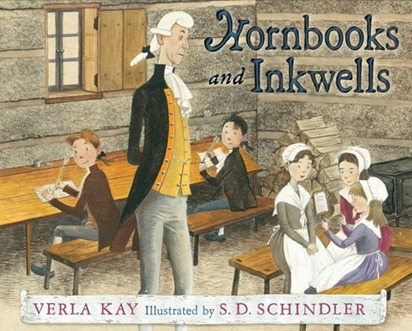
Review: Hornbooks and Inkwells by Verla Kay

hornbooks and inkwells

Hornbooks and Inkwells by Verla Kay, illustrated by S. D. Schindler

Head to school with brothers Peter and John Paul in this picture book that shows school days in the 18th century.  The one-room school has hard benches where the children learn math, history and their alphabet.  Punishments for misbehaving are being struck with the rod or wearing neck yokes, as both Peter and John Paul find out.  As winter comes, there is skating on the pond and hauling wood for the schoolroom fire.  With spring, the children are learning more and more, but leave school with the same bursts of energy they started with.

According to the Author’s Note, this book is based on Christopher Docks’ mid-1700s school.  He not only taught the normal courses, but included morals, safety, health, courtesy and social attitudes. The book is written in rhyming verse that reads easily.  The verse captures the activities of the days at school.

Schindler’s illustrations are detailed and really point out the differences between schools today and in the 18th century.   The illustrations have natural colors that offer a feel of life in the past.

A wonderful marriage of picture book and historical content, this book will be appreciated by children studying history as well as the history of studying.  Children returning to school this fall will also appreciate that they go to modern schools.  Appropriate for ages 6-9.

Reviewed from copy received from G. P. Putnam’s Sons.

Also reviewed by The Places You Will Go.

Review: Who’s There? by Carole Schaefer

whos there

Who’s There? by Carole Lexa Schaefer, illustrated by Pierr Morgan

A very active bunny bounces into bed when the moon comes up.  But just as he is curled up and ready to sleep, he hears a strange noise!  What could be making the creak, creak, CRINCH?  When he sits up and listens, nothing is there and everything is quiet.  But then it comes from even closer.  Perhaps it’s a Crusty Dumply Ogre?!  The noise comes closer still.  Maybe it’s a Grimy Gooey Ghoulie!  The noise is even closer.  And now the door is starting to open!  The little bunny gets his flashlight out and shines it at the door.  And what does he see?  You’re just going to have to read the book to find out.

This book reminds me so much of Ruth Brown’s A Dark, Dark Tale which is one of my favorite autumn reads for kids.  This one reads aloud delightfully well too and gives the reader so much to work with from the dramatic pauses to the alarming noises.  The drama is well crafted, so the story builds up and up, each noise and reaction becoming more and more intense. 

Morgan’s illustrations are dark and dramatic, with only the bed and the door in stark colorful contrast to the darkness.  The descriptions and depictions of the imagined monsters adds to the fun, because they are so silly that children will feel a bit of relief from the drama.

Just the right amount of drama and tension for young listeners, this is a tale that will delight.  Appropriate for ages 4-6.

Reviewed from copy received from Viking.