Review: Dot by Patricia Intriago

dot

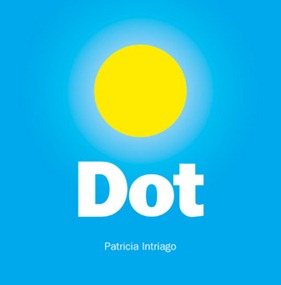
Dot by Patricia Intriago

This concept book uses dots to demonstrate opposites and follows the course of a day into night.  It opens with a big yellow dot that is very sun-like.  Then the simple but very strong graphic design creates a zippy, fun feel as the opposites are demonstrated.  Lines are added to show motion and direction.  Then chunks are taken out to show additional opposite pairs.  The simplicity lends the entire book a vibrancy and sense of humor.  Most of the book is done using black and white.  When color is used it is done specifically to show a concept, like red for stop and green for go. 

The text is just as simple as the illustrations, offering the concepts being shown.  It also has a nice rhythm that moves the book forward easily. 

Ideal for toddlers and for teaching opposites, this book is simply perfection.  Appropriate for ages 1-3.  Pair this with Lots of Dots by Craig Frazier for a story time filled with great illustrations and plenty of dotty fun.

Reviewed from copy received from Farrar, Straus and Giroux.

Also reviewed by:
Review: The Quite Contrary Man by Patricia Rusch Hyatt

quite contrary man

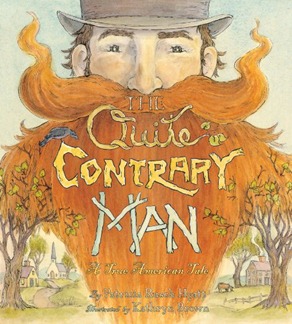
The Quite Contrary Man: A True American Tale by Patricia Rusch Hyatt, illustrated by Kathryn Brown

In 19th-century New England when people lived and dressed plainly, Joseph Palmer most certainly did not.  It was his beard that made him different, since all the other men were clean shaven.  But Joseph did not just have a normal beard, his was huge, long and wide.  His neighbors were scandalized and tried to shame him into shaving, eventually trying to shave him by force.  His attackers headed to court before Joseph could get there and claimed that he had attacked them.  The judge fined him $10, but Joseph refused to pay it.  So he was jailed for a full year.  The rule in the jail was that prisoners had to be clean shaven, and you can guess how that went with Joseph.  As the tale twists and turns, readers will be in turns inspired by Joseph Palmer’s strength of conviction and appalled by the system that persecuted him.

Hyatt has found a true story that really speaks to what being an American means, down to the most basic rights of deciding how you appear.  While modern children may be shocked by the fact that beards were scandalous, this is a great book to start discussions about what sorts of things are taboo today that may also not make any sense.  Hyatt’s writing is engaging and rollicking.  The spirit of the book matches Palmer’s own strength and humor.

Brown’s illustrations are done in fine lines and soft colors.  They depict the glory of Palmer’s beard with enthusiasm.  On alternate pages, she creates a rustic frame from illustrations of branches tied together with vines, which adds to the feeling of the book being set in an earlier time.

An American hero, Joseph Palmer’s is an inspiring story of a regular man who stood up for his rights.  He would also make an intriguing hero to discuss in units.  Appropriate for ages 6-8.

Reviewed from library copy.

Also reviewed by

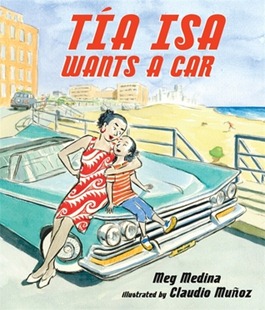
Review: Tia Isa Wants a Car by Meg Medina

tia isa wants a car

Tia Isa Wants a Car by Meg Medina, illustrated by Claudio Munoz

A little girl’s Tia Isa wants to get a car in order to take the family to the beach.  She wants one that is the color of the ocean with pointy wings at the back.  But Tio Andres laughs at the idea, calling it “ridiculous.”  They don’t have much money, but head to a car dealer where they find out they need to save more.  So the little girl sets out to help.  She stacks fruit at the store, feeds people’s pets, and teaches Spanish.  She waits until her money sock is bulging full and then surprises her Tia Isa.  Immediately, they run to the car dealer where they find just the right car way in back near the fence. 

A story of family and the importance of saving money for your dreams, this book will resonate with children who are saving their money for a large purchase as well as children from families where saving money is difficult but vital.  Medina writes with lovely imagery that creates a very vivid reading experience.  Readers discover that Tia Isa smells of lemon pies from the bakery where she works, that the car dealer smells of tar, and that work boots resemble ogre shoes. 

Munoz’s illustrations depict an urban neighborhood of apartments where neighbors help one another.  There is a feeling of safety in the illustrations, offering that rare glimpse in picture books of urban life without urban decay.  The illustrations of the family have that same feeling of warmth and belonging.

Dreams, savings, waiting and helping: this book speaks to all of those and ends with a refreshing ocean breeze.  Appropriate for ages 4-6.

Reviewed from library copy.

Also reviewed by There’s a Book.

Review: King Jack and the Dragon by Peter Bently

king jack and the dragon

King Jack and the Dragon by Peter Bently, illustrated by Helen Oxenbury

Open this book and you are immersed in a wonderful world of make-believe that you will not want to leave.  There is a timelessness to not only the story here, but the way it is told. 

Jack, Zack and Caspar were making a fort for King Jack out of a large box, a sheet, a blanket, some sticks, broken bricks, some trash bags, and other odds and ends.  Then they spent the entire day fighting dragons and beasts until they returned back to their fort for a celebratory feast.  Unfortunately, after that a giant came and took Sir Zack home.  Then another giant came and took Caspar off to bed.  That left King Jack alone on his throne in his fort.  As darkness fell, he tried to not feel frightened of the noises of wind and the scurrying of animals.  He wasn’t really truly scared until he heard the four footed beast approaching in the dark. 

Beautifully told by Bently, this book reads aloud with zest and style.  The story moves from the building of the fort to the playing of pretend through to the end of the day when reality comes calling for each of the children.  It is a story that speaks to the power of imagination, the ability of children to create worlds that they fall into, and the love of play.  The entire text captures that sense of play, merrily creating tension towards the end of the book without any real fear.

Oxenbury’s illustrations help to strengthen the timelessness of the story.  The sweetness of her illustrations is tempered by the ferocity of the dragons and beasts she depicts.  Yet there is no real danger here, and her illustrations help underline that to the youngest of readers.

Have large boxes and plenty of “swords” ready after you share this book.  It is sure to create some new knights out of any children who listen to it.  Appropriate for ages 3-5.

Reviewed from library copy.

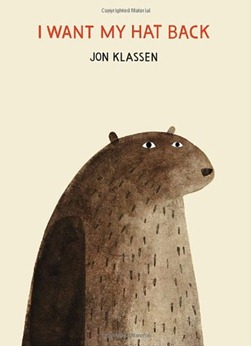
Review: I Want My Hat Back by Jon Klassen

i want my hat back

I Want My Hat Back by Jon Klassen

Published September 27, 2011.

I don’t think I can express how much I love this picture book.  It happily breaks all picture book rules by using a very muted palette with punches of color, not having much action at all, and ending with a dark twist.

The bear, who narrates the book in first person, is searching for his hat.  He asks one animal after the next about his hat and no one has seen it.  The only exception is the rabbit who is wearing a distinctive bright red pointy hat and seems to be protesting too much.  The bear continues past him though and on to several more animals until suddenly he realizes that he HAS seen his hat!  He rushes back past all of the animals until he reaches the rabbit.  And to find out what happens next, you will just have to read this humdinger of a picture book.

The illustrations are subtle, clever and in their understated way, hilarious.  The deadpan of the animals, the grasses and rocks near each of them on a tan page, all add up to the perfect background for this surprising story.

Klassen’s wording is perfection.  Each animal has a straight-forward response except the rabbit, so readers will be sure to notice the frenzied excuses being made.  He also incorporates plenty of repetition into the book which makes it flow like a book for preschoolers, but the humor will be enjoyed by older readers most of all.

Get your hands on this one, it is a clever, funny read with a dark twist.  What more could you ask for?  Appropriate for children ages 4-6, but most appreciated by children 7-12.

Reviewed from ARC received from Candlewick Press.

Also reviewed by:

You can also watch the book trailer:

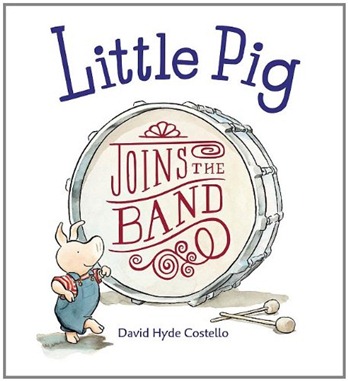
Review: Little Pig Joins the Band by David Hyde Costello

little pig joins the band

Little Pig Joins the Band by David Hyde Costello

His family all call Jacob, Little Pig, and he is the smallest in his family.  So when his siblings get out his Grandpa’s old marching-band instruments, Little Pig has trouble finding one that fits him.  He’s far too small for the drums, too little for the trumpet and trombone, and don’t even ask about the tuba!  All he can do is watch as his older brothers and sisters march around the room.  But when they come to a crashing stop, Little Pig knows just how he can join the band after all.

This simple story speaks to everyone finding their own niche and value in a family.  Here, Little Pig finds the special place for himself rather than the older children or adults helping him.  It makes for a very powerful message for young children, that not only do they have value but they can discover it on their own. 

Costello writes with simplicity and a solid feel.  His story has small, clever asides that are filled with puns as well.  His art is friendly and cheerful.  Little Pig has an oversized snout, small eyes and expressive ears.  Even the older children are treated as individuals in the art, with one decked out in hat and a boa.  I can see more stories about the children in this family.

A strong story about finding your place and becoming a leader, this book has a cheery feel that is very appealing.  Appropriate for ages 3-5.

Reviewed from copy received from Charlesbridge.

Also reviewed by

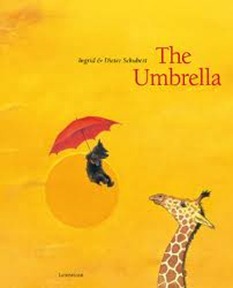
Review: The Umbrella by Ingrid & Dieter Schubert

umbrella

The Umbrella by Ingrid & Dieter Schubert

A wordless story told in vivid images, this book will whirl readers into an adventure.  A small dog finds a red umbrella and sails up in the autumn breeze into the air.  He walks on the clouds, visits Africa with its elephants and alligators, yikes!  Off he heads into the air again, carried this time to the expanse of the ocean where his umbrella serves as a boat.  Until that is, he sinks down below the surface only to be blown high from a whale’s spout.  He is carried into the jungle in a strong breeze and then caught by a pelican and lifted higher.  Then down onto the snowy peak to be met with the applause of seals.  His umbrella becomes a sled, sweeping past polar bears and then up into the air again.  Bats join him in flight until down below amid the autumn leaves, his house appears.  He puts the umbrella back where he found it and where a cat who has watched him come and go just might have an adventure too.

There is a wildness to this book that is as refreshing as a strong autumnal wind.  It comes from the wandering of the breezes and the wildlife that the little dog experiences.  The book captures his emotions with great skill from the delight of sledding down snowy hills to the utter exhaustion at the end of his travels. 

This is a book that does not need words.  The images capture the story fully, allowing readers to create their own story from the expanse of world that they get to see.  Children will revel in walking on top of clouds, of meeting elephants, of escaping arrows, and of finding the way back home. 

A perfect read for fall that will inspire imagination, this book opens and closes with gusts of wind and swirls of autumn leaves.  Appropriate for ages 3-5.

Reviewed from copy received from Lemniscaat.

Review: My Name Is Elizabeth! by Annika Dunklee

my name is elizabeth

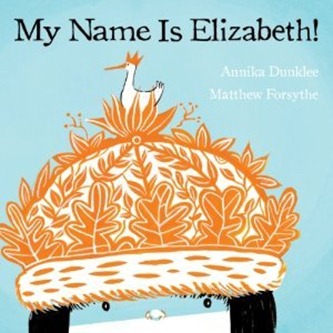
My Name Is Elizabeth by Annika Dunklee, illustrated by Matthew Forsythe

Elizabeth really likes her name, her full name.  She likes its length, the way it feels when she says it, and also that there is a queen named after her!  But she doesn’t like it when people shorten it to things like Liz, Lizzy, or Beth.  So she announces that her name is ELIZABETH Alfreda Roxanne Carmelita Bluebell Jones.  But you can just call her Elizabeth.  Now everyone has it right, except for one little person, her younger brother.  It’s close enough when he calls her “Wizabef.”

Dunklee captures the joys and pains of having a name that can be shortened in this book.  Children with a variety of names will understand the conflict of having a name they love but that others feel free to change.  My own name, Tasha, is already a shortened version of my full name, so I choose to go by a nickname.  Only the DMV calls me by my full name.  😉

Forsythe’s illustrations give this book a distinctive feel.  He uses a limited palette of blue, orange and black.  Throughout the book, Elizabeth is accompanied by a friendly duck.  The duck is never mentioned in the text, but offers a unique vibe to the book and to the central character.  The illustrations have a vintage feel thanks to the palette, yet the colors are modern and so is the art itself. 

Highly recommended, this book will speak to boys and girls with names that they feel strongly about.  Appropriate for ages 4-6.

Reviewed from copy received from Kids Can Press.

Also reviewed by

Review: The Crossing by Donna Jo Napoli

crossing

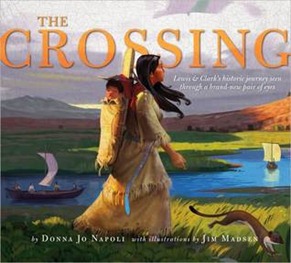
The Crossing by Donna Jo Napoli, illustrated by Jim Madsen

A gorgeous retelling of the Lewis and Clark story, told through the eyes of Jean Baptiste Charbonneau, the infant that Sacagawea carried on her back during their explorations.  Readers will see mountains, rivers and forests.  They will also meet bear, elk, cougars and more.  Napoli’s poem captures the rhythm of the journey, the stroke of the oars, the moments of quiet.  It is an immersive book where readers get to see the glory of the land that makes up our country, unspoiled by man-made structures.

Napoli’s verse incorporates many senses.  There are the sounds of the animals and humans that work to bring the entire setting to life.  There are the views that the baby sees, a wildness that is a large part of the story, a sense of expanse and freedom.   The author’s note adds much to the book, including the duration and length of the journey.

Madsen’s illustrations have a depth to them that adds much to this title.  He uses deep colors and uses the beauty of the land as the perfect inspiration for his work.  There are small moments of a child growing from infant to toddler, but also moments where the world is spread before them and reveled in. 

A beautiful and creative look at Sacagawea’s journey with Lewis and Clark, this book is a luminous look at the origins of our country.  Appropriate for ages 5-7.

Reviewed from copy received from Atheneum Books for Young Readers.

Also reviewed by The Fourth Musketeer and Kiss the Book.