Not Little by Maya Myers

Cover image for Not Little.

Not Little by Maya Myers, illustrated by Hyewon Yum (9780823446193)

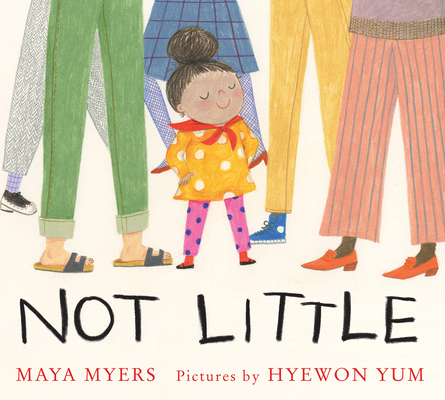
Dot is the smallest person in her family. Everybody thinks that she’s too little to do things, but they are all wrong. She can do all sorts of things. She’s also the smallest person in her class. People even ask if she is in preschool. That’s when she proves them wrong by talking about all the things that she knows. When a new student joins her class, Sam is even smaller than Dot is. He is quiet and seems to be afraid of Dot. At recess, she sees that the mean boy is talking to Sam, and it’s clear he isn’t being nice. Dot decides to sit with Sam at lunch, both to talk to him about the bully but also to measure and make sure she is taller. Before she can reach the table though, the mean boy is there again and he is saying that Sam is a baby! Sam slumps lower and lower, while Dot gets angrier and angrier. The bully then makes the mistake of calling Dot little. But Dot has found her voice and knows she needs to stand up as tall and brave as she can.

Myers captures the indignities of being small for your age with Dot. Beautifully, Dot uses her words to fight back at the stereotypes, both by demonstrating what she knows out loud and also in the end by standing up to a bully. Dot’s push back at being called “little” is cleverly handled, as is her desire to not be the smallest when Sam arrives. It’s all lovely and richly human.

Yum’s illustrations show a protagonist from a multiracial blended family. Dot dresses in polka dots with bright colors that draw the eye directly to her on the page. Even if she is sometimes the smallest thing on the page, she is the focal point.

A big hearted book for tall and small alike. Appropriate for ages 3-5.

Reviewed from copy provided by Neal Porter Books.

On the Trapline by David A. Robertson

Cover image for On the Trapline.

On the Trapline by David A. Robertson, illustrated by Julie Flett (9780735266681)

A boy travels with his grandpa, Moshom, to his trapline up north. Moshom hasn’t returned to the trapline since he was a boy himself. The trapline is where people hunted animals and lived off the land, Moshom explains to his grandson. Once the small plane lands, the two meet one of Moshom’s old friends. They pull up to a small house near a big lake, but that is not the trapline. It’s where Moshom lived after they left the trapline. In the winter, everyone slept together in the room with the wood stove to keep warm. Moshom shows his grandson the ruins of the school he went to, where he was required to speak in English and not Cree. They head out on the water in a slow boat, until they finally reach the trapline. Moshom shows him where they trapped muskrats, where their tent was, and how they lived on the trapline. As they leave, the two of them can continue to envision the trapline as it is now and as it once was.

The Governor General Award winning team returns with a book about connection to the land, deep memories, family ties and generations sharing stories. The warm relationship between Moshom and his grandson, who narrates the book, is clear and central to the book. The grandson regularly asks whether this place is the trapline, until they reach the real trapline and it is clear. The book examines memories, both dark and happy, alongside physical discovery of the places. It’s a powerful look at experiences and connection.

As always, Flett’s illustrations are exceptional. Done in pastel and then manipulated digitally, they have a muted natural palette that works for both memories and current times. The greens are deep and rich, the blues offer clear skies and rich water.

A look at grandfathers, memories and the importance of place. Appropriate for ages 4-6.

Reviewed from library copy.

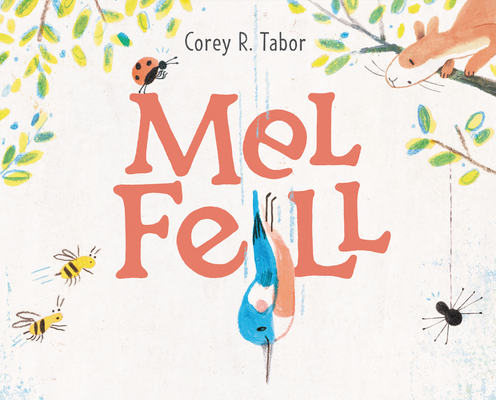
Mel Fell by Corey R. Tabor

Mel Fell by Corey R. Tabor (9780062878014)

One day, Mel decided that it was going to be the day that she learned to fly. Mama was away and her siblings were doubtful, but Mel didn’t let that stop her. So she stepped to the end of the branch, flipped and fell, down and down. The squirrels further down the trunk tried to catch her but they missed. The bees reached her, but barely slowed her down. The spider used all eight of her hands, but Mel still fell. Until she dove into the water. There she caught a fish and flipped, heading back up again. She flew up and up, back past the spider, the bees, the squirrels and many others who had worried for her fall. She flew!

Tabor has created a picture book full of drama that centers on a little bird who has a lot of self-confidence. Even as she terrifies everyone by falling down so far, she keeps a smile on her beak, blissfully falling with her eyes closed until just before she hits the water. That sudden drop into water creates almost a splash of water in the face of the reader, since it’s so surprising. The triumphant return to her family high above is joyful and celebrated by all those around her.

The art is marvelously simple, the trunk of the tree staying steady as Mel falls past. The various creatures who either try to help or watch in shock create lots of humor along the way. I particularly enjoyed the very slow snail offering to help but far too slowly. The shift to having the fish Mel caught falling down after she is back home adds to the giggles.

A joyous and triumphant look at trying something for the first time. Appropriate for ages 3-6.

Reviewed from e-galley provided by HarperCollins.

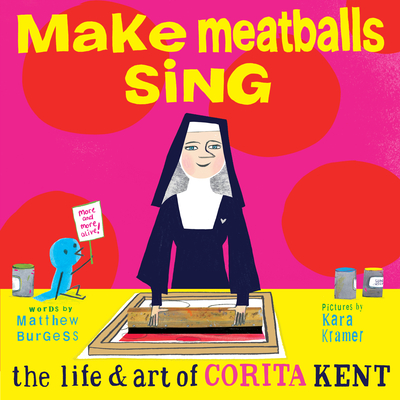
Make Meatballs Sing: The Life and Art of Sister Corita Kent by Matthew Burgess

Cover image for Make Meatballs Sing.

Make Meatballs Sing: The Life and Art of Sister Corita Kent by Matthew Burgess, illustrated by Kara Kramer (9781592703166)

Corita Kent was a remarkable pop-artist who was also a nun, a teacher and an activist. From a small child, Corita showed kindness and empathy for others and also a love of art and creativity. Her father wanted her to do something original, and Corita certainly did. She surprised her family by becoming a nun, discovering a love of teaching and training new teachers. She joined the art faculty at Immaculate Heart College, where she discovered a love of silkscreen printing. Soon her art was winning competitions. Corita continued to teach classes and make her own art, which spoke to social justice and against poverty and war. She transformed a rather formal celebration into one of bright colors and activity. Not everyone approved of what Corita was doing, and she surprised the people around her once again, asking to be released from her religious vows. She found places for her largest work, painted on a gigantic tank, and her smallest, a rainbow postage stamp.

While Kent may not be a household name, many of us have seen her work on the iconic postage stamp. This picture book embraces her unusual life, celebrating the decisions she made, the art she created and her voice for social change. The book cleverly pulls out elements of how Kent taught and created her art, offering unique perspectives gained by seeing the world in a fresh way. The writing here is engaging and offers a tone of delight as Kent continues to surprise and amaze.

The bright and vibrant art in the book shares elements of Kent’s own work. Her play with lettering and words appear throughout the illustrations of the book, filling tree trunks, coloring margins, and as posters on the walls. The entire book is a delight of collage, typography and riotous color.

A positive and affirming look at an artist who should be better known. Appropriate for ages 6-9.

Reviewed from copy provided by Enchanted Lion.

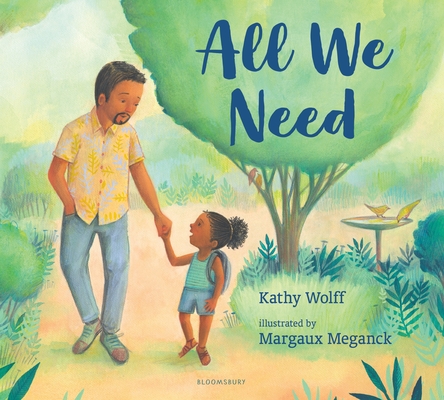
All We Need by Kathy Wolff

Cover image for All We Need.

All We Need by Kathy Wolff, illustrated by Margaux Meganck (9781619638747)

This picture book explores what we need to live. That includes essentials like air, food and water, then the book also explores the importance of learning opportunities, having a home, and the joy of family and friends. Told in poetic text, the book explores the necessities in ways that show how they bring special moments to our lives. For example, air is explained first as stillness and deep breaths. Food is explored both for filling bellies but also through the illustrations as cultural connection. This picture book takes simple essentials and shows the way they allow us to form community and inclusion.

Wolff’s poetic writing establishes those connections clearly, exploring the deep connection we have to air, water, food and one another. The book ends by establishing what we should do when we have enough or more than we need. Sharing becomes just as essential as the other elements here, connecting to new people and a larger community through generosity and giving.

Meganck’s illustrations are bright and colorful with a diverse cast of characters, including diverse races, religions and LGBT representation. The illustrations tell a lot of the story, showing playful elements of air and water. The images are given several full-page wordless spreads that reveal new ways to connect and form community with one another.

A look at sharing, connection and being human. Appropriate for ages 2-4.

Reviewed from e-galley provided by Bloomsbury Children’s Books.

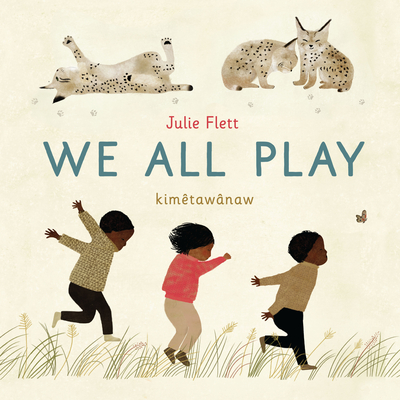
We All Play by Julie Flett

We All Play by Julie Flett (9781771646079)

Children and animals both love to play. This picture book incorporates Cree words into the narrative. Animals play in the grass, hopping, sniffing, sneaking. They peek and peep. Children play too, leaping through the grass or laying down in it. Animals swim and so do children. Animals slide and rumble and wiggle, just like children sledding in the snow. Animals settle down, roosting and yawning, finally falling asleep. Children do too.

Told in very simple language, woven with Cree words, this picture book shows the connection the natural world and its value to children in particular. The Cree words repeat with the children themselves saying them, something that would be great to do in a story time when this book is shared. The illustrations show a diverse group of children playing outside, acting just like the animals. A glossary of Cree words is offered at the end of the book along with a list of the animals who appear on the pages.

A frolic of a picture book that speaks to the importance of outdoor play. Appropriate for ages 2-4.

Reviewed from e-galley provided by Greystone Kids.

Paletero Man by Lucky Diaz

Cover image for Paletero Man.

Paletero Man by Lucky Diaz, illustrated by Micah Player (9780063014442)

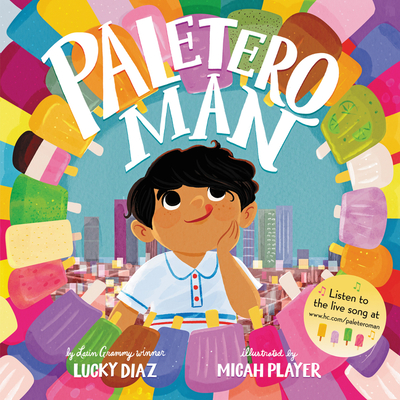
It’s the hottest day in the hottest month in Los Angeles, so a boy heads out with his money to find the paletero cart, hoping that his favorite flavor is still available. The first cart that he finds is the tamale cart, but that’s not what he wants today. Ms. Lee has Korean BBQ for sale, but he won’t even stop for a sample. He runs past the bike shop too, not stopping to visit. Finally, he finds Paletero Joe in the park and there is still some pineapple flavor left. But when he reaches into his pocket, all of his money is gone. Luckily, all of the business owners he ran past noticed him dropping his money and are all there at the park to return it to him.

A story of delicious food set against the urban LA cityscape, this picture book shows a strong, connected and diverse community. The various foods from different cultures are all celebrated as the narrator dashes past them looking for his desired cool treat. Diaz manages to write a rhyming picture book that is merry and bright, never becoming sing-songy but instead incorporating Spanish to create many of the rhymes.

The illustrations cleverly show the money dropping out the boy’s pockets though readers may miss it the first time they read the book. The illustrations are bold and bright, reflecting the colors of the paletero and showing the diverse people in a bright and friendly urban neighborhood.

A great read-aloud just right if you have popsicles to share. Appropriate for ages 2-4.

Reviewed from e-galley provided by HarperCollins.

Fred Gets Dressed by Peter Brown

Cover image for Fred Gets Dressed.

Fred Gets Dressed by Peter Brown (9780316200646)

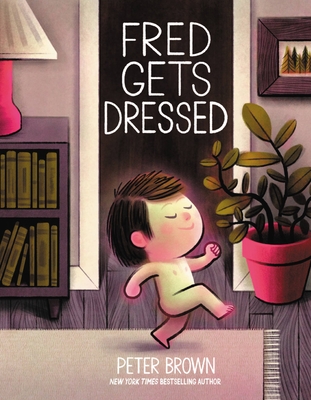
Fred loves to be naked. He runs through the house wild and free. He thinks he may never get dressed, but then discovers the closet in his parents’ bedroom. First, he tries on his Dad’s clothes, including a shirt, tie and pair of shoes. But he has trouble putting them on and they don’t fit right. He looks at his mother’s side of the closet. He picks out a blouse, scarf and some shoes. He doesn’t have any trouble putting them on in an outfit. Now he needs some additional touches, like some jewelry and maybe some makeup. That’s when his parents come in the room. His mother shows him how to put the makeup on and how to do hair. Soon all of the family, even the dog, are all dressed up together in a marvelous mix of outfits.

Brown uses simple wording to show a young boy exploring with nakedness and then playing dress up. The parents he shows are clearly unconcerned with the naked child running all around the house. His merriment is wonderful to see as is their casual response. As Fred tries on his mother’s clothes and then gets “caught” the reaction of the parents is perfection as they join in the fun but also show Fred some new skills along the way.

Brown’s art is always marvelous. Here his palette is an unusual mix of greens, vivid pink and browns. The result is a modern yet classic feel.

A charmer of a picture book that celebrates freedom from gender norms. Appropriate for ages 3-5.

Reviewed from e-galley provided by Little, Brown and Company.

The Rescuer of Tiny Creatures by Curtis Manley

Cover image of The Rescuer of Tiny Creatures.

The Rescuer of Tiny Creatures by Curtis Manley, illustrated by Lucy Ruth Cummins (9781250246714)

Roberta spends her time rescuing tiny creatures. She flips over pillbugs and moves worms from sidewalks. But everyone around her doesn’t understand. Her classmates make fun of her and her teacher insists that she wash her hands. At home, her cat helps out and so does her little brother, watching as she takes the ladybug outside safely. Some of the creatures, Roberta gets to know better before she has to release them. Others are only welcome in certain places and still others bite. If Roberta finds a dead creature, she collects them to look at how beautiful they are. When spiders emerge at school, Roberta is able to figure out a solution that has everyone helping out and gets the spiders safely outside. After the spider excitement, Maria approaches Roberta at recess and the two dream of all of the larger animals they can rescue together, maybe with a bit more help.

Manley takes the ickiness of bugs and worms away and instead celebrates them as creatures worthy of saving. Roberta is a wonderful example of what paying attention to small things can become, showing a deep kindness towards all lifeforms and the brain of a scientist as she gathers more information. With the spider incident at school, Roberta fully comes into her own as she takes her knowledge and turns it into shared action. It’s a brilliant and affirming moment that becomes a way to connect with others with similar interests.

Cummins uses her signature simple illustrations to great effect here. Their whimsical nature adds to the special appeal of insects and bugs and show how Roberta feels connected to them.

A buggy book of daily heroism. Appropriate for ages 3-5.

Reviewed from e-galley provided by Roaring Brook Press.