A Place for Frogs


A Place for Frogs by Melissa Stewart, illustrated by Higgins Bond

This book is filled with fascinating information and facts about frogs.  It is less about the transformation from egg to tadpole to frog and more about individual species, specific habitats, and what we can do to help save frogs.  The book can be read two ways.  One way is less wordy and offers a chance to share the book with younger children.  The other way, incorporates the detailed information on frog species, which tells the story of how they live and what they need to survive.  Readers will be astonished to discover the different habitats that frogs live in and the wide variety of species. 

Stewart has a gift for offering scientific information in an inviting way for children.  She never talks down to them, but keeps the facts interesting and brief.  The focus on the environment makes this book a good one for green units or programs.  The information offered gives children a way to make a difference for these fascinating creatures.

Bond’s illustrations are almost photographic in detail, but better.  She is able to offer perspectives that would have been impossible to photograph.  Her use of long views of habitat combined with close-ups of animals makes the theme of the book even clearer.  These animals cannot survive without this place. 

Highly recommended, this book belongs in every public library.  Children will pick it up for love of the animal and in the process learn about their own impact on frogs.  Appropriate for ages 5-8.

Reviewed from copy received from Peachtree Publishers.

Mathilda and the Orange Balloon

Mathilda and the Orange Balloon by Randall de Seve, illustrated by Jen Corace.

Mathilda’s world is small, only a few things in it: gray skies, green grass, green barn, gray stones, and gray sheep.  It was all ok, until she saw the bright orange balloon float past.  Then all she wanted to be was an orange balloon herself.  First, she made herself as round as the balloon.  The hardest part is turning herself orange.  The other sheep offer up ideas of things that are orange: fierce tigers, the sun, autumn leaves.  Mathilda imagined herself orange and round as hard as she could and suddenly, there she was, a Mathilda-shaped orange balloon.  That was when the lives of all of the sheep changed.

A wonderful book about the power of dreams and imagination, this book is simple and delightful.  De Seve’s writing is straight-forward and plain, offering a wonderful contrast between it and the subject matter.  Corace’s illustrations use white space to great advantage, emphasizing the simplicity of Mathilda’s world until imagination enters it.  Her sheep have great personality, with winning facial expressions.

Bravo for such a creative little book that takes imagination into reality with no hesitation.  This will make any sheep story time less gray and more colorful!  Appropriate for ages 3-5.

Reviewed from copy received from Harper Collins.

Also reviewed by Creative Literacy.

Sit-In

Sit-In: How Four Friends Stood Up by Sitting Down by Andrea Davis Pinkney, illlustrated by Brian Pinkney

Inspired by the words of Dr. Martin Luther King, Jr. four young men sat at the Woolworth’s lunch counter in Greensboro, North Carolina on February 1, 1960.  They placed their simple order of a doughnut and coffee, with cream on the side, and sat quietly, refusing to comply with the Whites Only rule.  The next day, more people joined them, sitting still for what was right.  The sit-ins got bigger and moved beyond lunch counters to buses, parks and libraries.  The students were jailed for loafing, but they didn’t resist.  All of these brave actions led to the Civil Rights Act of 1964.

Pinkney has written this book with such verve and style that it reads like a King speech.  Throughout, she has woven the threads of the lunch counter, coffee and recipes, reminding readers again and again where it all started.  Her use of repetition and poetic style really make the book sing.  Brian Pinkney’s illustrations are done in watercolor and India ink.  They capture the time with an exuberant style that is filled with colors and the swirls of motion.  Though the people sit still, the illustrations are in motion, moving to the future with them.

Highly recommended, this book truly captures the wonder of this time, the courage it took to sit still, and the progress that was made.  This husband and wife team have created a powerful book about a vital time in our history.  Appropriate for ages 7-10.

Reviewed from copy received from Little Brown and Company.

Also reviewed by Muddy Puddle Musings and Wild Geese Guides.

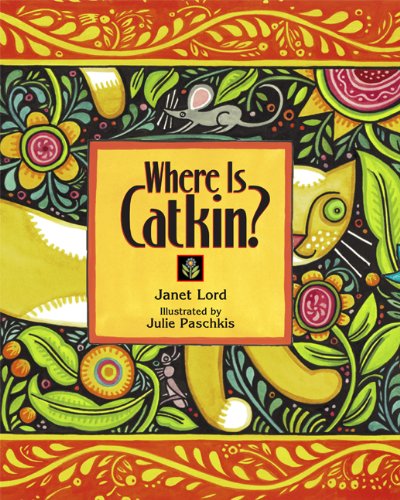
Where Is Catkin?

Where Is Catkin? by Janet Lord, illustrated by Julie Paschkis

Catkin heads out to hunt in the garden.  He sees and hears different animals in the garden but he can’t catch them.  There is a cricket, a frog, a mouse, a snake, and a bird.  After Catkin pounces them they disappear from view.  But sharp-eyed readers will be able to spy them hiding.  Finally, Catkin climbs a tree to catch a bird, but goes too high.  Now it is Amy’s job to find Catkin in the garden and rescue him!

The first thing you will notice about this book is its amazing illustrations.  Done in an almost Slavic motif, they are rich, deep colored and stylized.  As Catkin pounces an animal it appears in the yellow and red border, adding another layer to this book.  Lord’s text is brief and invites young readers to participate in the seeking and finding of the animals.  Readers will enjoy spotting not only the animals in the text, but also insects and other animals. 

A richly illustrated seek-and-find book that is perfect for the youngest listeners.  I would suggest using this with only a very small group, because the pleasure of the book is to look closely at the illustrations and talk about them. Appropriate for ages 2-4.

Reviewed from copy received from Peachtree Publishers.

Also reviewed by Beth Fish Reads, 7 Imp, and We Love Children’s Books.

Boom Boom Go Away!

Boom Boom Go Away! by Laura Geringer, illustrated by Bagram Ibatoulline

Vintage toys combine with noise and mayhem to create a fabulous bedtime read!

When a small boy is asked to go to bed, he responds by starting up his toys one by one in response.  The little gnome is at the heart of it all as he bangs the drum with a “Go away, boom boom.  Go away!”  An elf dings on a gong, a prince screeches on his bassoon, a knight plays his bells, more and more toys join in, creating a great rhythm and song as they do.  But in the end, the noise is not enough to keep the little boy awake and they all wind down with a “Go away! Hush, hush… boom boom. Go away.”

Reading this book is great fun.  Geringer has created just the right mix of noises and sounds to make reading this book aloud a treat.  The rhythm makes it easier, the sounds are different enough to be interesting, and her framing of the story is done with a gentle touch.  Ibatoulline’s illustrations are beautifully done in a soft yet bright palette that really reinforces the vintage feel of the toys.  The writing, the fonts and the illustrations all work together to create a charmer of a book.

Highly recommended for pajama story times or a bedtime read, this book may become one of those books that is asked for again and again.  If you are going to use this with a group, consider handing out instruments or assigning noises to kids.  They are sure to love adding to the rhythm.  Appropriate for ages 2-4.

Reviewed from book received from Atheneum Publishers (Simon & Schuster)

Also reviewed by The Excelsior File and Young Books.

Arbor Day Square

Arbor Day Square by Kathryn O. Galbraith, illustrated by Cyd Moore

Everything in the prairie town is brand new because the town itself has just been built by settlers.  There is a church, stores, and a school, but what is missing is trees!  Everyone donates coins to send east for trees to plant.  When they arrive, Katie is alarmed at how small the trees are, but her father reassures her that they will live and grow.  Katie helps her father plant the trees, even a special dogwood in memory of her mother.  Year after year, the town gathered on Arbor Day to plant more and more trees.  Katie now came with her own daughter to celebrate the day and linger under her mother’s tree. 

This picture book is based on the creation of Arbor Day in the new state of Nebraska in 1872.  Ideal for release in April, this book is a glimpse into the history of Arbor Day and the importance of planting trees.  Galbraith’s text is simple and at times poetic.  She uses repeating phrases and rhythm subtly and effectively.  Particularly effective is having Katie as the protagonist of the story and the lens through which readers view the history and the planting.  Moore’s illustrations are soft with a lovely vintage tone to them that suits the subject.  The transformation from dusty prairie to a lush green  filled with trees is reflected in the illustrations with a nice gradual palette change.

Pick this one up for Arbor Day!  Appropriate for ages 4-7.

Reviewed from copy received from Peachtree Publishers.
The Quiet Book

The Quiet Book by Deborah Underwood, illustrated by Renata Liwska

There are many kind of quiet.  Quiet can cozy.  Quiet can be tense.  Quiet can be worth savoring.  Quiet can be gone in a flash.  This book celebrates the many kinds of quiet, offering examples of the many moments of quiet in a day.  Starting with the quiet of being the first one awake, the book ends with the quiet of being sound asleep.  In between, readers will find examples of quiet that are funny, surprising and poignant.  This is a simple premise executed with great finesse.

Underwood’s one-per-page examples of quiet each end with the word “quiet.”  As you read through the book aloud, you will discover which of the examples make you hush your words even more and which examples are exuberant despite the silence.  Deftly done, the examples are varied and interesting.  Liwska’s illustrations add to the gentle humor, offering visual examples of quiet.  Her pencil and digital images are soft and witty at the same time.

Recommended for bedtime reading, this book is perfect for snuggling under the covers and reading to a little one.  Happy cuddles!  Appropriate for ages 2-4.

Reviewed from library copy.

Check out the websites of Deborah Underwood and Renata Liwska

Miss Brooks Loves Books! (and I Don’t)

Miss Brooks Loves Books (And I Don’t) by Barbara Bottner, illustrated by Michael Emberley

Miss Brooks is a librarian who loves books.  She tries to share her enthusiasm for books with the children, but Missy is having none of it.  Then comes Book Week!  And Missy is asked to wear a costume and tell the class why she loves her favorite book.  Missy is certain that she will never fall in love with a book, but Miss Brooks remains sure that she will.  Book Week arrives and Missy has yet to find a book she likes.  They are either too flowery, too yippity, or too furry.  Miss Brooks sends more and more books home with her but she complains about them all.  Her mother tells her she is as stubborn as a wart.  Wart?  And Missy is off to find a book about warts where she finds and falls for Shrek!

Yes, this book does my librarian heart good, but it is also told with a great sense of humor.  Missy while dismissive and grumpy is also written with just the right tone.  Readers will wonder if there really is a book for this kid!  The book reads aloud well, and I can see librarians using it and then asking for a chance to find each kid the right book for them.  What a great way to sell our services!

Emberley’s art is a hoot.  I adored all of the costumes of Miss Brooks as she tries to get kids excited about books.  I particularly love the way that Missy is depicted with her overalls, woolly hat and glasses.  She is purely an individual and it shows. 

Recommended for any librarian to read and glow about, this book is also just right for kids who don’t think books are cool.  They just might love this one!  Appropriate for ages 4-7.

Reviewed from library copy.

My Brother Charlie


My Brother Charlie by Holly Robinson Peete and Ryan Elizabeth Peete, illustrated by Shane W. Evans

Callie and Charlie have always been together because they are twins.  They have a lot in common: music, football, loving their dog, and their curly hair.  But they are also very different.  Charlie often seemed distant and never returned affection.  Mommy was worried and took Charlie to a doctor who diagnosed him with autism.  Callie wished that she could join Charlie in his mental world, that he would play more with her.  Sometimes he is right there with her and enjoying it, but often he isn’t.  Callie began to understand that her brother sees things differently.  He may find it hard to tell you how he feels, but when it matters most he does find the words.  And best of all, Charlie loves you for who you are inside.

This very personal book reflects the lives of the mother and daughter authors who are both activists and educators about autism.  The book is far from being another of those celebrity books that misses the mark.  Instead this book really educates children about autism and about differences.  It explains autism simply and frankly but with great love and understanding as well.

Evans’ illustrations add a warmth and appeal to the book with their mixed media.  The thick brush strokes and fine lines are visually appealing as are the deep colors.  The art adds to the appeal of the title.

Highly recommended for library collections, this book will offer information and hope for families dealing with autism.  Appropriate for ages 4-7.

Reviewed from copy received from Scholastic.

Reblog this post [with Zemanta]