The Easter Egg

The Easter Egg by Jan Brett

Jan Brett turns her prodigious talents to an Easter story!

Hoppi the rabbit is now old enough to participate in the egg decorating competition.  Each year the rabbits decorate Easter eggs and the winning bunny got to help the Easter Rabbit hide the eggs.  But Hoppi needs a great idea for his egg, so he hops around to visit the other rabbits.  Each bunny is doing something unique and interesting and inspires Hoppi to try their technique.  As he visits, each rabbit offers him a scrap of material or a tool as well as ideas.  Hoppi tries to come up with the perfect idea, but is distracted by the distressed calls of some robins.  One of Mother Robin’s eggs fell out of the nest on onto the forest floor.  Hoppi knew just what he had to do and sat gently down on the egg with his warm fur.  Hoppi sat and sat and sat on the egg, unable to create an egg of his own for the Easter Rabbit.  But the Easter Rabbit knows just what makes the perfect egg for Easter!

Done in her signature style with one main image on a two-page spread and two smaller images on each side, this book celebrates Easter, spring, art and creativity.  It is also about self-sacrifice and giving to the community.  Brett has created a book that never becomes overly sweet.  A large part of this is her attention to minute details that make the rabbits realistic, the forest come alive, and the individual eggs masterpieces.  I also appreciate her use of wild plants and flowers as the framing for the illustrations.  Brett’s use of repetition as Hoppi travels the village of rabbits allows for a real surprise when Hoppi discovers Mother Robin and the egg. 

This book will work well with a group, though the tiny details are worth lingering over and discussing within a family or very small group of children.  Appropriate for ages 3-7.

Reviewed from copy received from Penguin.

I Love Bugs!

I Love Bugs by Emma Dodd

This brightly colored book is a cheerful exploration of the world of insects that is less about scientific accuracy and more about an adoration of our six-legged friends.  The book moves quickly from bug to bug, from “jumpy leapy bugs” to “slimy crawly creepy bugs.”  All are appreciated for their differences until the end when a spider appears!  It is a great twist that children are sure to enjoy.

Dodd’s art is what really takes this book beyond a run-of-the-mill insect book.  Filled with bright colors, an eager child to guide us, and plenty of bug-eyed insects, young readers will feel right at home.  Her illustrations are thick lined and beautifully patterned, bringing the essence of grass, dirt and bugs directly to the reader.

Dodd’s language here is bouncy and pure fun.  She offers rhymes that have a real spring about them.  Since she doesn’t name the insects, children will be eager to name them themselves from caterpillars to ladybugs to grasshoppers.

Add this to a toddler story time and then set out on a bug hunt together.  It could just be cut outs around the children’s room.   This would pair wonderfully with nonfiction picture books about specific insects that will offer enticing details.  Appropriate for ages 1-4.

Reviewed from library copy.

Windows with Birds

Windows with Birds by Karen Ritz

The cat loved his home.  It had windows filled with birds to watch, hiding places, stairs, and a mouse in the basement.  It also had the boy who filled the water dish and scratched just right.  The cat would wait for him to return from school.  But one day, the boy took the cat to a new home in an apartment building.  The cat was not happy.  He hid, meowed aloud, and avoided the boy but the boy did not take him back home.  The cat was very upset until the morning when he discovered that these windows had birds too! 

This is a book that explores the emotional effects of moving from the point of view of a family pet.  Children will see their own emotions reflected there in a tangible and relatable way.  The illustrations are realistic and filled with loving detail.  Sharp-eyed readers will spot a moving box and the moving van before the move comes.  Ritz has captured the movements and position of the cat perfectly both in action and repose. 

A lovely addition to moving books, this should find its way onto most library shelves.  Appropriate for ages 4-7.

Reviewed from library copy.

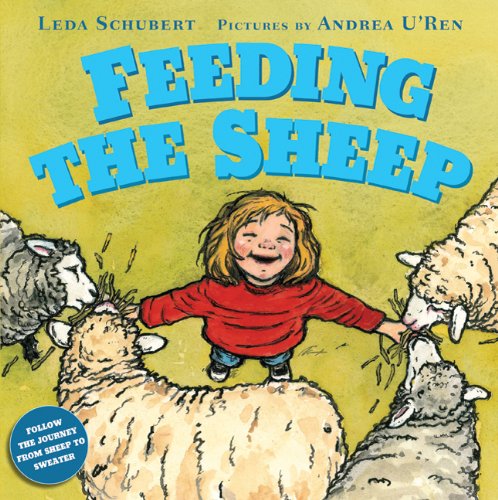
Feeding the Sheep

Feeding the Sheep by Leda Schubert, illustrated by Andrea U’Ren

Follow the process from sheep to sweater through the eyes of a young girl.  The book starts with feeding the sheep corn and hay on a wintry day.  Then it moves on to shearing, washing the wool, drying the wool, carding it, spinning the yarn, dyeing the yarn, and then knitting it.  Each step is done by the little girl’s mother to the refrain of “What are you doing?” The book uses gentle rhymes and repetition to show the steps as well as detailed illustrations where the young girl gets involved too.

This book is ideal for toddlers and preschoolers who will enjoy realizing where their sweaters come from.  The style of writing is approachable and gentle.  Nicely the book comes full circle back to the feeding of sheep, making the point that the cycle of sheep to sweater continues.  U’Ren’s illustrations are filled with homey touches and small details, yet they will work well with a group.  A wonderful touch is the changing of the seasons throughout the book, often glimpsed only out of the window.  This again underlines the cyclical nature of farming.

Short sentences with plenty of rhythm and repetition, make this a friendly choice.  It is also a joy to read aloud.  Appropriate for ages 2-4.

Reviewed from library copy.

Roly Poly Pangolin

Roly Poly Pangolin by Anna Dewdney

This new book by Dewdney has the same cadence as her Llama Llama books.  Roly Poly is a very small, young pangolin who doesn’t like new things.  Even friendly faces scare him and have him running away.  When he hears frightening noises, he runs, falls and then rolls tightly into a ball.  It takes a lot of courage for him to eventually uncurl and see exactly what frightened him so badly.  But when he does, he finds that it just might be easier to make friends than keep on fleeing in fear.

This is a simple book perfect for a toddler audience.  Dewdney uses rhyme and rhythm as well as repeated phrases throughout the book.  Filled with just enough action and strange noises, this book will appeal to children who may be fearful of new things themselves.  Dewdney’s illustrations are equally welcoming.  There is plenty of humor here in both the text and the illustrations too.  The book ends with a paragraph of information on the pangolin.

Get this into the hands of Llama Llama fans and also to those children who enjoy new, strange animals.  Appropriate for ages 2-4.

Reviewed from copy received from Penguin.

Big Red Lollipop

Big Red Lollipop by Rukhsana Khan, illustrated by Sophie Blackall

Rubina has been invited to her very first birthday party and is elated.  Until she tells her mother about it and her mother insists that she takes her little sister, Sana, or else she can’t go.  Rubina tries to explain that here the kids don’t bring their little siblings to a birthday party, but her mother won’t budge.  Sana is the only little sister at the party, but it isn’t so bad.  Each girl gets a bag of party favors to take home and there is a big red lollipop for each of them.  Sana eats hers right away, and Rubina saves hers in the refrigerator until the next morning.  But when she wakes up eager for a taste, she discovers that Sana has helped herself to it!

A story based on Khan’s own childhood, this book perfectly captures the differences between families of various cultures and backgrounds.  Rubina is simply expected to take her younger sister with her.  And then she is expected to forgive her sister and share her lollipop.  The wonderful piece of the book is when Rubina stands up for her younger sister at the end and helps convince her mother that Sana doesn’t have to bring their even younger sister to her first birthday party.

Illustrated with great style, the Arab-American culture is depicted here with real warmth.  The illustrations have a creamy background color against which the characters and their expressive faces really pop.  The relationships between the characters are strong and interesting.  The final result of Rubina’s kindness rings true and is very satisfying.

This is a beauty of a book with multicultural elements and a strong story and style.  Appropriate for ages 5-7.

Reviewed from copy received from Viking.

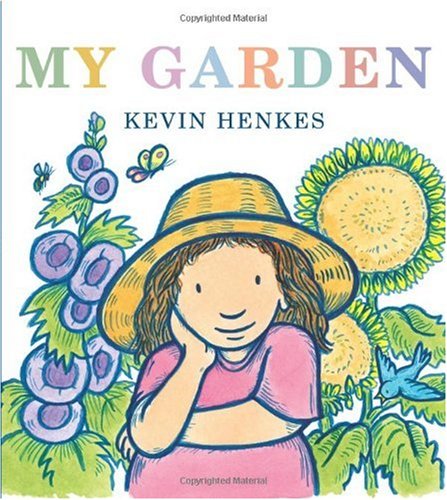
My Garden

My Garden by Kevin Henkes

A little girl helps her mother in her garden.  It is a nice garden, but if the little girl could create her own garden, it would be very different!  There would be no weeds.  No plants would die.  If you imagined the flowers different colors and patterns, they would change.  Rabbits would not eat lettuce, instead they would be chocolate rabbits meant to be eaten.  There would be lots of birds and butterflies, and unique things would suddenly grow.  This beauty of a book will inspire children to dream their own gardens and perhaps plant a seashell to see what will happen.

With his gentle feel, Henkes has created a creative look at gardening that will have a permanent spot in everyone’s spring story pile.  His art is done in ink and watercolors, offering a soft palette perfect for the story.  The flights of fancy in the book are whimsical and wonderful, capturing a welcoming friendly invitation to explore a garden of dreams.

I can see this leading to a craft where children design their own imaginary gardens or write a story about what should be in their gardens.  It is such a springboard for dreams and imagination!  Appropriate for ages 2-5.

Reviewed from library copy.

Also reviewed by Brimful Curiosities.

Reblog this post [with Zemanta]

Shapes That Roll

Shapes That Roll by Karen Nagel, illustrations by Steve Wilson

Follow brightly-colored Triangle, Circle and Square as they take you on a tour through the world of shapes.  Some shapes roll, some don’t.  Some stacks, some don’t.  Some open and close, some are in pieces, and other are heavy.  This book doesn’t tell readers the names of the shapes until the very end, allowing the text of the book to be more playful.  It also is built for conversation about the shapes readers are seeing, from basic shapes to cubes and spheres too.  This silly, colorful book about shapes is playful fun for young children.

Nagel’s rhymes are simple and are more about moving the reader through the world of shapes than naming the shapes themselves.  The first and last pages are filled with information while the bulk of the book is lighter fare.  Wilson’s illustrations really bring the book to life with bright colors, plenty of action, and lots of shapes to discuss and name.  I actually like the format of not naming shape after shape in the text of the book, allowing for a more interactive read with children.

A lap book rather than a group read, the friendly shapes that host this book will take readers on a shape adventure.  Appropriate for ages 2-4.

Reviewed from library copy.

I Can Help

I Can Help by David Hyde Costello

Little Duck is lost in the tall grass and is helped by Monkey.  This starts a chain of helpful actions where one animal helps the next.  Monkey is caught by a giraffe when he falls from a tree, Giraffe is helped when Gorilla bends a branch low enough, Gorilla’s splinter is pulled out by a bird.  And it continues, one after the other until the chain loops back when Little Duck helps Elephant find a cool pool of water.  Unfortunately, moments later Little Duck is once again lost in the grass, but now there are lots of animals willing to help!

Very simply written in short sentences, this book clearly demonstrates how one good deed gets repaid again and again.  Costello’s art is as clear and simple as his text with illustrations filled with deep colors that are very inviting.  As the chain continues, each animal is united with a parent after they are helped.  This small touch adds to the warmth of the book.  It is also pleasant to see that each animal gives thanks for the help they receive. 

Perfection for toddler or even baby storytimes, this book exudes a bright friendliness that all children will find inviting.  Appropriate for ages 1-4.

Reviewed from library copy.