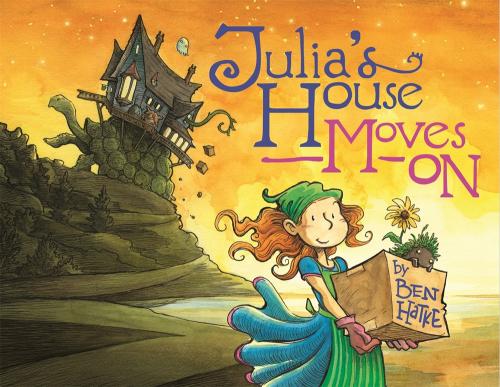
Julia’s House Moves On by Ben Hatke

Cover image for Julia’s House Moves On

Julia’s House Moves On by Ben Hatke (9781250191373)

This sequel to Julia’s House for Lost Creatures carries readers back to the marvels of the Julia’s unusual house and the creatures she shares it with. Julia’s house was getting restless and all of the different creatures who lived there could feel it and started to act out too. Luckily, Julia had a plan for moving them, she even knew just the spot in the mountains for them. But then, the turtle whose back carried the house decided to move right then, down into the ocean. Now the house was tattered and barely afloat. Julia though had a plan filled with paddling and pushing but the house sunk faster and sharks were circling. She went to her other plan, and blew on Triton’s Horn but that didn’t work out either. With her house sinking, the creatures floated off away from Julia. All was lost. Or perhaps they had their own plan!

Written just for compulsive planners like myself, this picture book is funny and full of dynamic moments. Hatke, the creator of graphic novels like Zita the Spacegirl, is just as at home in the picture book format. His pacing is brisk, never letting poor Julia linger for long in her new spot of trouble. Julia’s plans are feats in themselves, constantly figuring out what to do, and show real resilience in dire situations.

As with all of Hatke’s art, he creates characters who are fascinating, friendly and full of life. Here he gets to delve into all sorts of strange creatures too who liven up the story. His illustrations are worth lingering over, with small touches that make Julia’s house come alive (literally).

Perhaps the perfect COVID fantasy read that shows how communities can work to save one another. Appropriate for ages 4-6.

Reviewed from e-galley provided by First Second.

The Boy and the Gorilla by Jackie Azúa Kramer

Cover image for The Boy and the Gorilla

The Boy and the Gorilla by Jackie Azúa Kramer, illustrated by Cindy Derby (9780763698324)

In a sad, gray world, a huge gorilla appears. He joins a boy out in his mother’s garden. The two talk about the death of his mother, about how you know when someone is dead. The two spend time together, coloring, flying kites on the beach. The beach was one of his mother’s favorite places. The boy misses his mother’s pancakes and her reading books at bedtime. Sometimes he just wants to be alone. Other times, he wants to climb high into trees to see if he can reach his mother. The gorilla stays at his side throughout, while baking Mom’s special cookies, picking daisies in her garden and playing baseball. Eventually, the boy reached out to his father about how much he misses his mother. After holding father and son close, the gorilla moved off, heading elsewhere.

Kramer tells a gentle and sorrowful story here, where sadness and loss is embodied in a huge, purple and black gorilla. That gorilla shows such tenderness and such attention to the boy, keeping silent when needed, dashing up trees together, sitting and lingering with one another. The gorilla becomes more than loss, he becomes care and healing without pressure or timetable. The book reads in a series of linked scenes, the process not linear but complex with motion forward and back. It is not until the boy connects more with his father that progress is made, a new team formed.

The art by Derby is instrumental here. Her huge and furry gorilla appears out of the gray, his black and purple dark against the fog of loss. Color tones are used very effectively through her watercolors in the book, moving from the initial grays to more blues, eventually having touches of red and yellow, sunshine nearby. Towards the end of the book, the pages are aglow with light and hope.

A lovely and touching look at loss. Appropriate for ages 4-6.

Reviewed from e-galley provided by Candlewick.

Butterflies Belong Here by Deborah Hopkinson

Butterflies Belong Here by Deborah Hopkinson

Butterflies Belong Here by Deborah Hopkinson, illustrated by Meilo So (9781452176802)

A Latina little girl has moved to the United States, discovering that she acts like a caterpillar and hides in the back of the class since she can’t speak English. In the summer, she looks for monarch butterflies, but can’t find any even in the community garden. In fall, she finishes her book about monarch butterflies. Able to read better now, she learns that the monarchs need milkweed to survive. Encouraged by her school librarian and inspired by the monarch’s migration, she forms a plan that she presents to her class. It’s hard to stand in front of the class and speak in English, but she really wants to plant a migration station for the monarch butterflies. Soon they are all working together, led by her, to create the station. She feels herself evolving now, into a citizen activist who stands at the front of the crowd.

The parallels between the narrator’s experience and that of the monarch butterfly offers a great framework for this picture book. Those connections are not overplayed, rather they form the reason that this little girl finds solace in studying butterflies. Interspersed throughout the book are excerpts from the nonfiction book on butterflies that she is reading. It’s a clever way to offer information in a separate and clear way.

The illustrations show a girl finding her way in a new country and a new city. The transformation in her body language as she becomes more confident and finds her voice is profound in the illustrations. By the end, she glows on the page alongside her garden.

An inspiring look at how to help butterflies but also how to find your voice. Appropriate for ages 5-7.

Reviewed from copy provided by Chronicle Books.

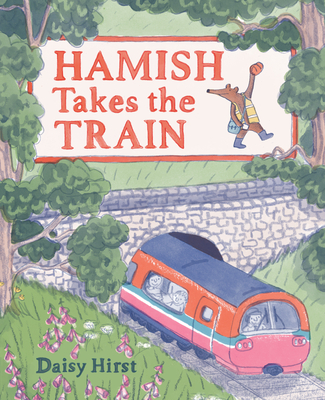
Hamish Takes the Train by Daisy Hirst

Hamish Takes the Train by Daisy Hirst (9781536216592)

Hamish the bear and Noreen the goose love to watch trains together. Hamish longs to take a train to the city, but Noreen isn’t interested. So Hamish set off, following the train tracks on foot. When he got to the station though, he found he needed a ticket, so he just kept on walking. As night fell, he came to a railroad yard and discovered a caboose all lit up inside. There he found Christov who was sick with the flu and too ill to go to work in the morning and run a big crane. So Hamish offered to help. He borrowed Christov’s hat and jacket and headed into the city on the train. When he got to the building site though, he didn’t have any boots, luckily he was able to find some nearby. Then it was time to run the huge crane. Hamish worked hard, running the crane from the cozy cabin. He did it for the five days that Christov was sick and was offered a job himself by the end. But Hamish was missing Noreen and took a train home, to share his adventures with her, and maybe have some new ones together.

Hirst tells a charming tale of Hamish, a bear with a taste for adventure and trying new things. He is also a very helpful and thoughtful character, helping out where he can and finding unique solutions to problems he encounters along the way. I was most impressed that Hamish was a success as he tried to help. It became a celebration of trying new things, learning and succeeding rather than what is often seen in children’s books like Curious George where helping becomes failing in a funny way.

The art is simple and friendly, capturing both the expanse of the countryside and the bustle of the city streets. Some of the pages are fully colored while others use white space and smaller images that move the story ahead. Throughout there is a sense of happy positivity.

A glorious adventure full of trains and cranes. Appropriate for ages 2-4.

Reviewed from e-galley provided by Candlewick Press.

11 New Picture Books Arriving in November

Here are some great new picture book coming out in November to add to your TBR pile!

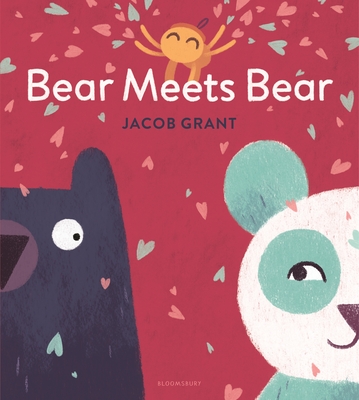
Bear Meets Bear by Jacob Grant

The Couch Potato by Jory John, illustrated by Pete Oswald

Find Fergus by Mike Boldt

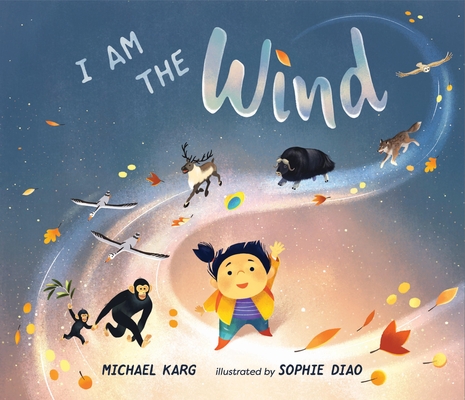
I Am the Wind by Michael Karg, illustrated by Sophie Diao

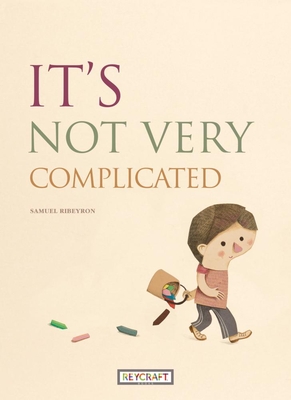
It’s Not Very Complicated by Samuel Ribeyron

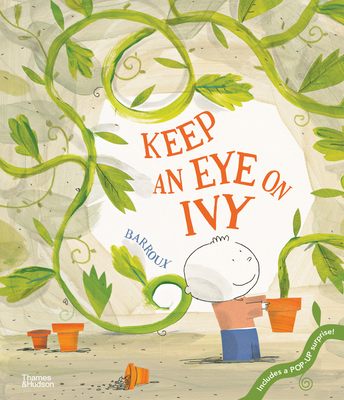
Keep an Eye on Ivy by Barroux

The Little Mermaid by Jerry Pinkney

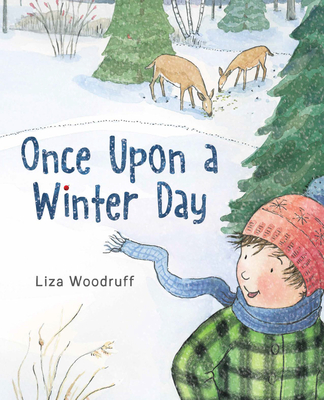
Once Upon a Winter Day by Liza Woodruff

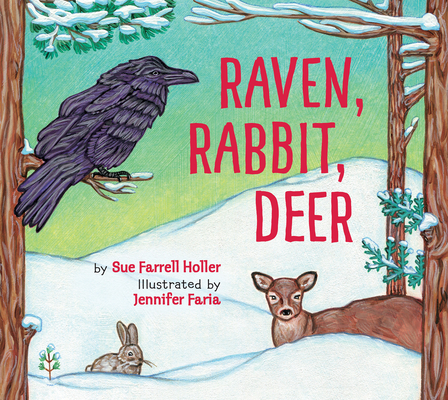
Raven, Rabbit, Deer by Sue Farrell Holler, illustrated by Jennifer Faria

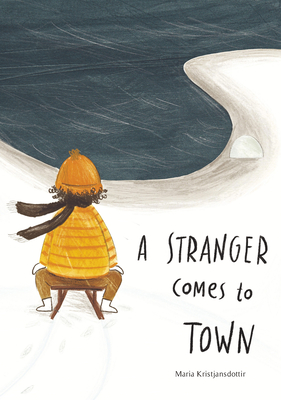
A Stranger Comes to Town by Maria Kristjansdottir

William Still and His Freedom Stories: The Father of the Underground Railroad by Don Tate

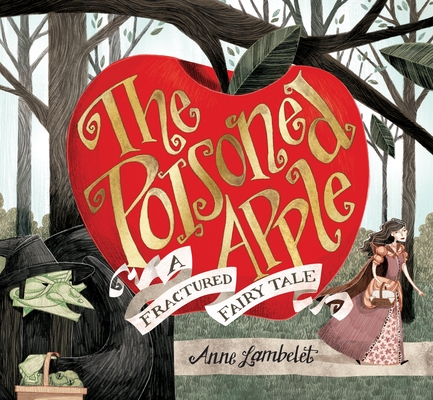
The Poisoned Apple by Anne Lambelet

Cover image for The Poisoned Apple

The Poisoned Apple by Anne Lambelet (9781645670605)

This picture book retells the story of Snow White and the poisoned apple. This version focuses very cleverly on the witch herself. It tells of the hard work she put into creating just one poisoned apple and no more. The witch gets the apple directly into Snow White’s basket, but then her plans go awry as the apple is passed to the dwarves as part of their lunch. Luckily, none of them take a bite, instead sharing the apple with some hungry forest animals, who in turn share it with a squirrel looking for food for her babies. As the squirrel climbs high into the tree, the witch follows, desperate to get the apple back and give it to Snow White. But her plans continue to fail her as the branch snaps from beneath her weight.

Lambelet has very nicely twisted and fractured this retelling of the classic Snow White story. The book will work best for children who know the classic version, as this one quickly moves away from that tale and into a riff of its own. Snow White and the dwarves make appearances, but are not the main focus of the story. The witch herself stays at the center, conniving and evil, making this just right for a witchy Halloween read.

The art is marvelous, full of fine lined details that come together to form dramatic moments that fill the page. From the creation of the poisoned apple itself to the witch’s fall from the tree, these moments are elongated by the art and the format to great effect.

This witch-focused retelling of Snow White is creepy, dark and satisfying. Appropriate for ages 5-7.

Reviewed from copy provided by Page Street Kids.

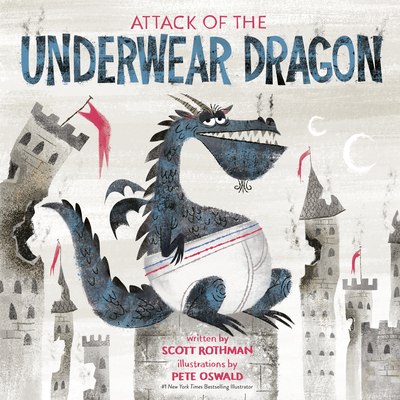
Attack of the Underwear Dragon by Scott Rothman

Cover image for Attack of the Underwear Dragon

Attack of the Underwear Dragon by Scott Rothman, illustrated by Pete Oswald (9780593119891)

Cole has a favorite knight of King Arthur’s Round Table. So he writes Sir Percival a letter asking to be his assistant knight. Sir Percival received the letter and cried, because knights do cry and he too as a boy asked to be an apprentice. Cole had a lot to learn in his new position. There were many things to do and figure out how to help Sir Percival be a great knight: lugging stuff, getting knocked down, and cheering him along. Sir Percival was also terrified of the Underwear Dragon, unfortunately that dragon arrived and destroyed the kingdom. All of the knights lost! So Cole wrote another letter, this time to the Underwear Dragon. But dragons can’t read, so the dragon ate the letter and just kept on destroying things. The Underwear Dragon finally faced off against Cole. Cole was scared, but had also learned a lot of skills. He used them all until finally the underwear flew off, and the dragon left. Cole became a member of the Round Table, but needed a nap before he could choose his own assistant knight.

Rothman has created a very funny picture book that plays against knight stereotypes, making them marvelously open about their feelings. He has a great sense of comedic timing where the impact is increased by page turns. The book has several montage scenes of things like “why knights cry” and “what Cole needed to learn” that are funny and boisterous. The Underwear Dragon himself gets his own montage of things that he cannot read, which makes for great comedy as well.

The illustrations are just right for reading aloud, whether to a group or individuals. There are many sight gags, offering just the right amount of silliness to an already funny book.

Funny, silly and full of knights and dragons. Appropriate for ages 4-6.

Reviewed from e-galley provided by Random House Books for Young Readers.

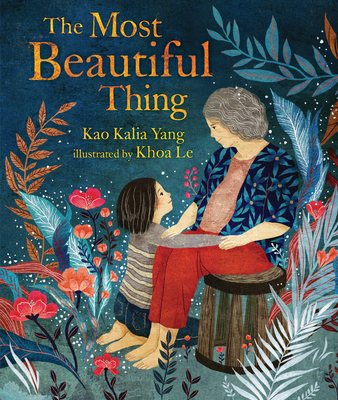
The Most Beautiful Thing by Kao Kalia Yang

Cover image of The Most Beautiful Thing

The Most Beautiful Thing by Kao Kalia Yang, illustrated by Khoa Le (9781541561915)

Based on the author’s childhood growing up in a Hmong refugee family, this picture book looks at the impact of poverty on childhood and the incredible importance of a loving family. Kalia grew up with her grandmother who had been born across the ocean and once threatened by a tiger there. Now her grandmother is old with only a single tooth left. The luckiest of the grandchildren got to help take care of her. It was Kalia’s job to trim her fingernails and toenails. Her grandmother’s feet were rough and her toenails thick. They were cracked with dirt in the cracks from long ago. The family didn’t have a lot of money so regular ice had to stand in for ice cream, peppermint candies shared together took the place of a new dress. Kalia grew tired of not having enough money for treats, eventually asking for braces to fix her crooked teeth. But the family could not afford them. Her grandmother pointed out her own single tooth, and suddenly Kalia realized what beauty is, and it was not perfection.

Yang vividly tells the story of her childhood, inviting readers into her childhood home to see the care and love there. The dedication goes both ways, with her grandmother offering wisdom and love and the grandchildren sharing in taking care of her needs too. The book steadily builds to the take away, a moment that reminds me of the Russian folktale about the little girl describing her mother as the most beautiful person in the world when by societal standards she was clearly not. Throughout the book, poverty is handled in a matter-of-fact way with love as the healing force.

Le’s illustrations depict a household full of children, plants and toys. The wobbly family table and brightly covered couch add to the feel of a family in need but making do together. The Hmong tales told by the grandmother are lush and bright, carrying readers into a mystical world of jungles and creatures.

A thoughtful and rich picture book featuring a Hmong-American family. Appropriate for ages 3-5.

Reviewed from e-galley provided by Carolrhoda Books.

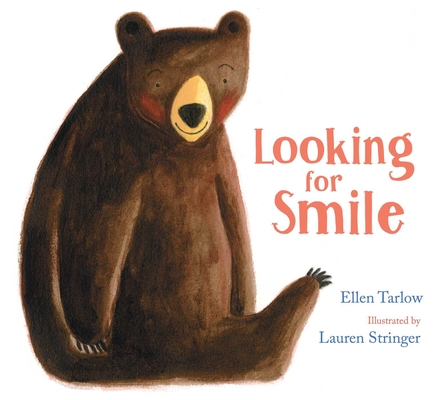
Looking for Smile by Ellen Tarlow

Cover image of Looking for Smile

Looking for Smile by Ellen Tarlow, illustrated by Lauren Stringer (9781534466197)

Bear and Smile spent all their time together doing all sorts of things. Smile was always there when Bear woke up in the morning. They both liked the same breakfast and to explore the forest together. They also both would do anything for some honey. But then one morning, Bear woke up and Smile wasn’t there. Bear called for Smile but they never came. Breakfast didn’t taste the same. Rabbit suggests that Bear look for Smile in their favorite places. But even eating honey doesn’t bring Smile back. Bird comes and sits close to Bear not saying a word. Then Bird started to sing and Bear hummed along. Soon Bear started to feel something deep inside. There was Smile!

Tarlow explores emotions in this picture book, allowing all emotional states to be treated with compassion and empathy. Bear is usually very happy but some days can be blue ones, where it’s impossible to smile. Treating Smile as its own character makes the book really work well. Readers will understand immediately and enjoy seeing what will bring Smile back. They will likely expect the honey to work, and when it doesn’t that’s a great moment where only quiet empathy will work to find Smile again.

The illustrations are done in watercolor, gouache and acrylics. They create an entire world for Bear and Smile to explore and live in together. From Bear’s cozy home to the waterfalls and forests of their habitat. The landscapes are filled with bright colors of water, flowers and leaves. When Bear gets sad though, he changes from his deep warm brown to a cool blue and stays that way until Smile returns.

An empathetic look at emotions and sadness. Appropriate for ages 3-5.

Reviewed from e-galley provided by Beach Lane Books.