A New Green Day by Antoinette Portis

A New Green Day by Antoinette Portis

A New Green Day by Antoinette Portis (9780823444885)

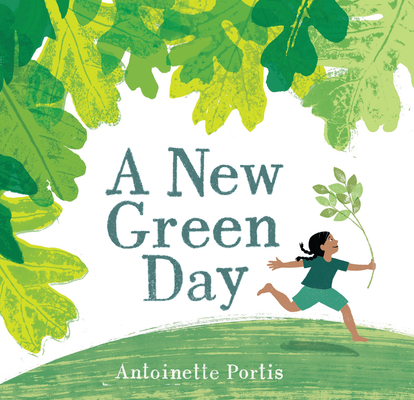
Welcome to your new day. The sun invites you to play when you wake up, creating a square on your pillow. Creatures are up and moving, snails scribbling across the sidewalk, inchworms measuring out their paths, and tadpoles punctuating the streams. There are things to find: leaves with paths imprinted on them, pebbles smoothed by the water. Then a storm arrives with lightning and thunder, rain pounding down. Mud is created to wriggle your toes in. Long shadows capture the approaching evening until night falls with a sky of stars and the voice of a cricket thrumming you to sleep.

Portis creates quite an invitation to head outside and experience nature with all of your senses from touching stones and leaves to feeling the rain to hearing the thunder and seeing the stars. It is all an immersive experience for the reader. Portis’ text is deceptively short and simple. Yet within each four-line verse she creates almost haiku moments of discovery.

The art was done in brush and sumi ink, leaf prints, and vine charcoal with the lettering done by hand. The illustrations are large and bold, offering a book that will work well shared with a group. They have a wonderful natural feel to them, tactile and warm.

Ideal for a summer day. Appropriate for ages 2-4.

Reviewed from e-galley provided by Neal Porter Books.
The Word for Friend by Aidan Cassie

The Word for Friend by Aidan Cassie

The Word for Friend by Aidan Cassie (9780374310462)

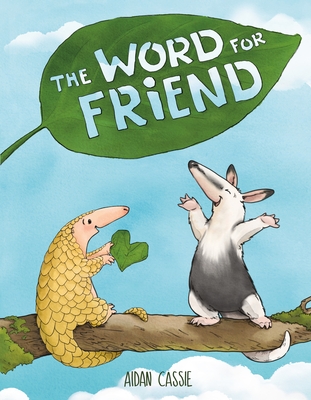
Kemala, the pangolin, loved everything that was new and different when they moved. There were new foods, new smells, new clothing to admire. But there was also a new language to learn. When Kemala headed to school, she realized that no one could understand her. So she curled into a ball in dismay. She stayed that way until recess, when she climbed high in a tree to get away from everyone. She sat on a branch cutting animals out of leaves, until Ana found her there. Kemala showed Ana how to cut leaves too, and Ana loved it even though she made a big mess. While Kemala didn’t want to go back to school at all, she steadily found herself learning a new language with Ana’s help, particularly through animals they cut out. Until finally, Kemala is brave enough to try talking to the entire class.

Cassie has written a universal book about friendship, belonging and learning a new language. She wisely chose Esperanto as Kemala’s new language in the book. Esperanto is not associated with a specific country, so Kemala could be moving anywhere in the world. Cassie gives the entire story room to breathe a bit, offering time for Kemala to relax and start to learn in a very believable way. The connection with one specific kind friend is also great to see, as well as a tactile way for them to connect with one another without speaking at first.

The art is welcoming and friendly with all sorts of unusual animals in the class that Kemala joins. The choice of pangolin as a main character works particularly well, both her connection with her mother but also when she gets overwhelmed, the ability to just curl up protectively.

A great book to talk about language learners and welcoming new students to school. Appropriate for ages 4-6.

Reviewed from e-galley provided by Macmillan Children’s Publishing Group.

What Could That Be? by Reza Dalvand

What Could That Be by Reza Dalvand

What Could That Be? by Reza Dalvand (9781338530193)

On a beautiful day, something small lay in the middle of a clearing in the forest. The thing glittered red and green. The leopard believes it is one of her spots that has fallen off and runs off to warn the others. The crow thinks it is part of a star and that the entire sky may be collapsing. The fox and bear thought it might be something that would bring humans into the forest. The owl was certain it was a dragon’s egg. The cat thought it might be poop and covered it up. Throughout the forest confusion rang out, but that was a long time ago. The thing is still there. What could it be?

This picture book is a delightful mix of Chicken Little fears and an unsolvable mystery for the reader. The book is filled with the theories from different creatures in the woods, almost all of them leading to a sense of panic, even though they really don’t know what the object is. Readers will expect to have the question solved by the end of the story, but this Swiss import has a more European twist. It leaves the question still open, ready for readers to fill in the blank.

The illustrations are done in oil and crayons. They depict a rainbow-colored forest filled with animals of many colors, some of them just as bright and varied as the trees themselves. The bright colors add to the imaginative feel of the tale, tying it nicely to folklore.

One enigma offers plenty of solutions, do you have one? Appropriate for ages 3-5.

Reviewed from e-galley provided by Scholastic.

13 Stories about Harris by Amy Schwartz

13 Stories about Harris by Amy Schwartz

13 Stories about Harris by Amy Schwartz (9780823442492)

Harris is a little boy who lives with his parents in his urban neighborhood. In the thirteen (quite short) stories in this book, he is very busy. He draws a huge dragon on the sidewalk, helps in the kitchen, goes on a windy walk, attends his first birthday party, and heads to preschool for the first time. On Thanksgiving, Harris was a truck all day. On other days, he goes to the beach or takes care of a friend’s hamster. There is a lot to do!

Schwartz once again captures the activities and essence of being a preschooler. Harris is wonderfully open to all of his small adventures, experiencing a lot of them for the first time. The book exudes warmth and a family that allows their small child the space to explore and make mistakes but are also always attentive and around to help. The charm of these thirteen stories is remarkable, showing children that they are right where they need to be and that many of these experiences are universal to all small children.

The illustrations show a dynamic and diverse urban neighborhood where Harris is living. The illustrations have plenty of white space, the city streets sometimes taking over with their brick buildings and sidewalks.

Gorgeous preschool vignettes that show the delights of this age. Appropriate for ages 3-5.

Reviewed from e-galley provided by Holiday House.

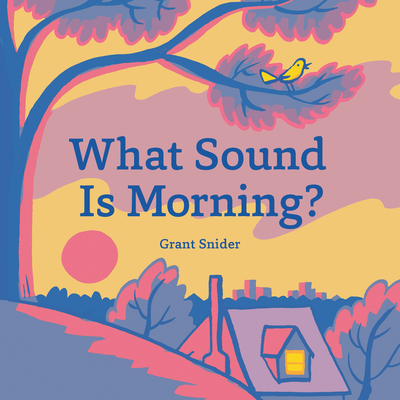
What Sound Is Morning? by Grant Snider

What Sound Is Morning by Grant Snider

What Sound Is Morning? by Grant Snider (9781452179933)

Morning can seem very quiet at first, but if you listen you can clearly hear morning sounds. As light spreads across the sky, cats creep quietly, babies wake and babble, wind whispers. Roosters crow and sprinklers hiss. Traffic begins to rumble, buses run. Bakeries open, frogs croak. Garbage trucks bustle, breakfast sizzles. Hot air balloon rise. It’s time for you to get up and greet the day yourself, filling it with your own sounds.

This simple picture book invites readers to explore what happens in the early hours of the morning before they get up. When it is still dark and there is just a touch of color in the sky, the noises are almost silent. Then as the town awakens, the noises grow, but still there is room for the small noises of morning that create our own experiences. Written with a lovely slow pace and a delight in the small things, this picture book also has a strong cadence that makes it a good read aloud.

The art glows with color and light, the yellows, reds, oranges and purples of the sky fill the pages and light the quiet awakening world beneath them. The tropical colors spill across the page, bringing morning light into dark rooms and filling the sky with joy.

A quiet yet noisy picture book just right for waking up. Appropriate for ages 2-4.

Reviewed from e-galley provided by Chronicle Books.

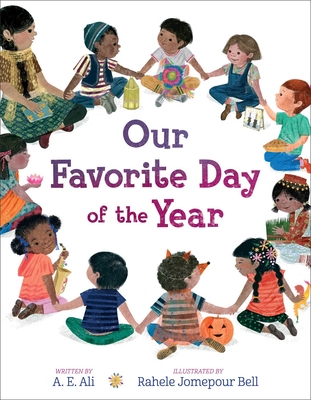
Our Favorite Day of the Year by A. E. Ali

Our Favorite Day of the Year by A. E. Ali

Our Favorite Day of the Year by A. E. Ali, illustrated by Rahele Jomepour Bell (9781481485630)

When Musa started kindergarten, his teacher explained that the other children around him would become his new friends. Musa wasn’t sure about that, they were strangers! His teacher also said that her favorite day of the year was the first day of school and that show-and-tell that year would center around each child’s favorite day of the year. Musa was thrilled, he knew that everyone would pick Eid along with him! Musa soon found out that the other children celebrated different holidays. A few weeks later, Musa and his mother brought in food and told the class about Eid. On Mo’s turn, he talked about celebrating Rosh Hashanah. Moises explained that his family celebrated Los Posadas on Christmas. Kevin’s family of scientists enjoyed celebrating Pi Day with plenty of pie. Each child had their own celebrations and all the children got to learn about one another’s cultures in a very celebratory way.

Ali’s story is focused on inclusion and demonstrates how that can look in a classroom filled with children from various cultures, countries and faiths. The story is straight forward and powerful, clearly showing that not all children celebrate Christmas and even when they do, it may not look the same. Readers will enjoy seeing not only the celebrations shared in the story, but others shown on the class calendar.

Bell’s illustrations are done digitally but also incorporate handmade textures, giving them a marvelous organic quality that warms them. The children and families here are diverse with multiracial families, grandparents raising children, and gay parents represented in the story.

A beautiful look at diversity and inclusion through family celebrations and holidays. Appropriate for ages 3-5.

Reviewed from e-galley provided by Salaam Reads.


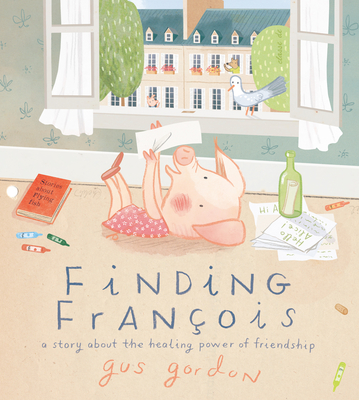
Finding Francois by Gus Gordon

Finding Francois by Gus Gordon

Finding Francois by Gus Gordon (9780525554004)

Alice Bonnet loved living with her grandmother in their French town. She loved baking together and also loved making lists on her own. But sometimes Alice was lonely, like when she felt small or didn’t feel brave or when her grandmother was napping. So one morning, she decided to try to find a friend. So she wrote a letter, put it in a bottle and threw it from the bridge. The bottle floated into the ocean, was handled by several different creatures, and eventually found its way to an island where Francois the dog lived with his father. Soon the two were writing back and forth, sending the bottle across the ocean again and again. But when Alice suffered a loss, it was hard for her to write letters or make lists or plan any more. So she stopped writing to Francois for some time. Eventually though, Alice began to plan again, make lists and write letters. And soon a big plan came together!

There is such magic about sending messages in bottles and what an idea that you could throw a message into the water and it would go and back and forth forming a true friendship. That underlying magic is a huge part of the charm of this book, though the characters and the French setting have their own magic about them as well. Alice’s optimism and creativity shine in the story, offering hope even when she is terribly sad.

The art in the book is done in watercolor and pencil. It also incorporates clippings from old paper that fill the pages with old-fashioned objects. Some of the illustrations also appear to be done on postcards, which matches the mailing of messages in the story.

Warm and endearing, this picture book looks at new friendships across wide distances. Appropriate for ages 4-6.

Reviewed from e-galley provided by Dial Books for Young Readers.

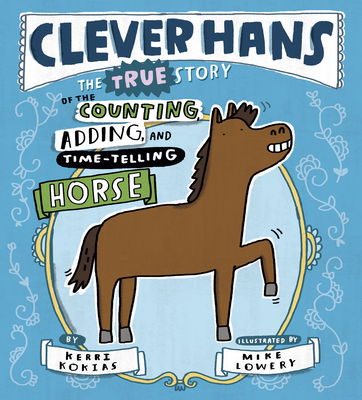
Clever Hans by Kerri Kokias

Clever Hans by Kerri Kokias

Clever Hans: The True Story of the Counting, Adding, and Time-Telling Horse by Kerri Kokias, illustrated by Mike Lowery (9780525514985)

In 1904 in Berlin, Germany, Wilhelm von Osten had an extraordinary horse named Clever Hans. Hans could count and tell time. He could identify colors and the value of coins. He could do math, read words, and knew music as well. Many people didn’t believe that Hans could really do these things and assumed it was nothing but a trick. Wilhelm von Osten truly believed in his horse though, having spent four years teaching him using treats to keep him focused. Scientists came to test Clever Hans and watch for secret signals from van Osten or others in the audience. Soon the tests started to figure out how Clever Hans was doing such amazing things! It wasn’t a trick, but instead showed exactly how smart he actually was.

Kokias invites readers deep into the mystery and wonder of Clever Hans. She sets up her book so that readers are presented with the amazing things that the horse can do and then bring them along on the journey of exploring what was actually happening. The book is gripping and fascinating as readers steadily see their own theories dismissed by the experts and the final reveal of the truth is satisfying and fascinating. The art by Lowery has a great playfulness to it that adds to the delight of the book.

A book of scientific discovery that readers must finish to discover how Clever Hans does it. Appropriate for ages 6-9.

Reviewed from e-galley provided by G. P. Putnam’s Sons.

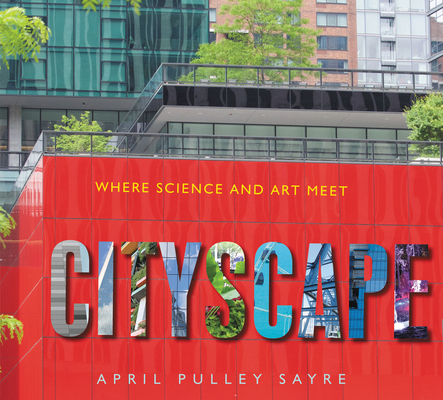
Cityscape: Where Science and Art Meet by April Pulley Sayre

Cityscape Where Science and Art Meet by April Pulley Sayre

Cityscape: Where Science and Art Meet by April Pulley Sayre  (9780062893314)

Explore the angles, lines and structures of the buildings and spaces that make up the city. Through vibrant photographs, this poetic informational picture book takes readers on a journey through cities and their spectacular architectural features. The author focuses on more than soaring skyscrapers, also showing readers mosaic floor tiles, dramatic doorways, ancient cities, and the plants that live in urban environs. Fountains, bridges, trusses and more also fill the pages with fascinating gears and incredible structures.

Sayre has once again created an informational picture book that really shines. Here she turns her lens to urban environments, showing readers various elements that they may overlook on their own journeys. She includes information on how to explore a city and offers questions for readers to ask themselves as they wander. The questions are architectural, asking readers to look closely and then wonder a bit.

As always, Sayre’s photographs are impressive. Here she beautifully plays with angles and arches, points and columns, windows and water. The book feels like a walk through a city, each page turn like rounding a new corner.

A joyful look at our cities and the beauty to discover there. Appropriate for ages 4-6.

Reviewed from e-galley provided by Greenwillow Books.