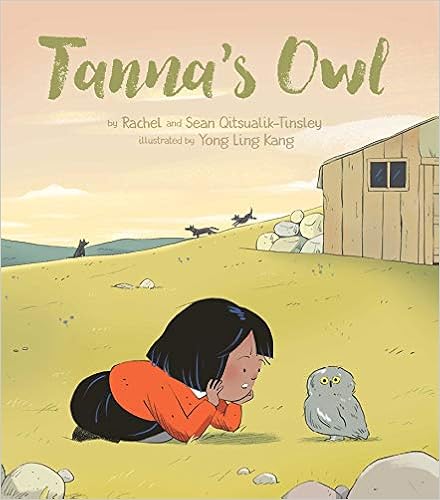
Review: Tanna’s Owl by Rachel and Sean Qitsualik-Tinsley

Tanna’s Owl by Rachel and Sean Qitsualik-Tinsley, illustrated by Yong Ling Kang (9781772272505)

Based on the story of the owl one of the author’s cared for as a child, this picture book offers a glimpse of life in the Arctic as an Inuit family. Tanna’s father came back from hunting with a baby owl. It was so ugly, it was somehow also cute. The owl had to be fed two or three times a day, so Tanna and her siblings caught lemmings to feed it. The owl, named Ukpik (or owl in Inuktut), lived in her father’s workshop. When the owl was hungry she would stomp her feet, sway back and forth, and chomp her beak. Soon Ukpik wanted even more to eat and everyone was tired of catching lemmings, so they started to feed her other types of meat, including caribou and fish. Her beak was very sharp, so now she had to be fed with gloves on. When summer ended, Tanna had to return to school in another community. She didn’t return home until the next summer. That’s when she found out that Ukpik had been set free. But maybe the large white owl that she saw around their home was Ukpik coming back to visit.

The authors clearly share both sides of caring for a wild animal. There is the initial joy of learning about the animal and starting to be able to understand their needs and ways of communication. Then there is the drudgery of the ongoing care. At the same time, there is a delight in being that close to a wild creature, of knowing it needs to learn to fly away someday, and knowing you are helping in some way. The book also shows modern Inuit life complete with an unusual way of attending school. 

The art is large and bold with the images fully filling both of the pages. Readers will get to see the transformation of the owl from small and gray to a graceful white bird. They will also get glimpses of the Inuit home and the wide-open setting of the Arctic.

An inspiring picture book for kids who dream of caring for wild animals themselves. Appropriate for ages 4-6.

Reviewed from e-galley provided by Inhabit Media.

Review: A Ride to Remember by Sharon Langley

A Ride to Remember by Sharon Langley

A Ride to Remember by Sharon Langley and Amy Nathan, illustrated by Floyd Cooper (9781419736858)

Back in the 1960’s, African-Americans were not allowed to enter the Gwynn Oak Amusement Park in Baltimore. They were not allowed to sit on the grass, share treats or ride on the carousel. As the world around them began to change and become less segregated, Gwynn Oak continued its policies. They became the center of protests where hundreds were arrested. A mother and child who were African American and light skinned covertly entered the park and were allowed to enjoy themselves for hours. They shared their story with the press. As the pressure built, the park’s owners agreed to allow everyone into the park and to drop any charges from the protests. The first day the park was open was August 28, 1963. That day, a little girl named Sharon Langley, was the first African-American to ride the carousel with her father holding onto her. A photo of the ride made the papers as did the other major news story of the day, when Martin Luther King, Jr. made his iconic “I Have a Dream” speech. The carousel was moved to Washington, D. C. where Sharon took a ride on the fiftieth anniversary of her first ride in Baltimore.

The authors make a point of framing the tumultuous 1960’s for young readers. They have a child ask questions about why African-Americans were not allowed to enter the park. This is such an important moment in the book, giving modern children a lens into the inherent societal racism of the time, racism that is not erased in our modern society either, of course. They then turn to the protests about the park, showing the bravery of the people who protested, who went to jail, and who insisted on staying overnight to make a point. The body of the book does a great job offering historical perspective as well as details about the protests and efforts to desegregate the park. More information is also shared in the final pages, including more details of the events in the book, a bibliography and a timeline.

Cooper’s art is done with a lush softness to the lines. He used oil erasure on illustration board to capture an almost sepia-toned historical feel. The faces he shows of the people involved are tremendously moving, showing that this was about people insisting on change.

In a single story, children will deeply understand what the civil rights struggle was about. Appropriate for ages 5-9.

Reviewed from copy provided by Abrams.

Review: Lilah Tov Good Night by Ben Gundersheimer

Lilah Tov Good Night by Ben Gundersheimer

Lilah Tov Good Night by Ben Gundersheimer, illustrated by Noar Lee Naggan (9781524740665)

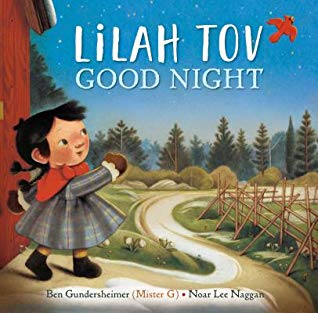
After a long day on their farm, the small family eats dinner together and then pack their belongings. The moon rises as they say goodbye to the hens and chicks they are leaving behind. The family stops to take shelter in a cave on their journey, wishing the bats that fly around them lilah tov, good night. They say good night to the beach as they climb aboard a small boat. Lilah Tov to the stars and the clouds. Good night to the mountains they walk into and to all the animals along the way, until they arrive at their new home. 

Gundersheimer based this picture book on a Hebrew lullaby and weaves in a story of a refugee family leaving their home and heading to a new one. The book is quiet and full of grace, just right for a bedtime story. It weaves together saying goodnight all along the way, embracing the silence of the night. 

Naggan’s illustrations are filled with hope. The little girl experiences the entire journey as one of wonder and excitement. The worry on the adult faces though creates somber moments throughout. The illustrations capture that this is a Jewish family as they carry their menorah with them. The pages are illuminated by the light of the moon and the stars.

A graceful and powerful lullaby entwined with the story of a refugee family. Appropriate for ages 2-4.

Reviewed from e-galley provided by Nancy Paulsen Books.

Review: Cezanne’s Parrot by Amy Guglielmo

Cezanne’s Parrot by Amy Guglielmo

Cezanne’s Parrot by Amy Guglielmo, illustrated by Brett Helquist (9780525515081)

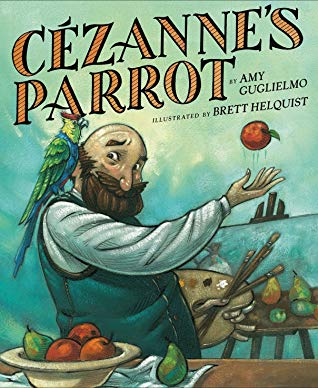
Cezanne was a French painter who longed to be told that he’s a great artist, so he tried to train his parrot to say that to him. Cezanne’s focus on ordinary events and people as well as his unique style of thick paint and heavy lines did not speak to the professors at the famous Academie des Beaux-Arts where he longed to study. Monet advised Cezanne to head into the French countryside for inspiration. But Monet painted quickly and Cezanne painted very slowly, sometimes taking over 100 visits to a site before his painting was complete. He continued to submit his art for consideration by the Academie, but continued to be rebuffed. The Impressionists emerged as a group that broke the rules of art, but Cezanne didn’t fit in, even with them. He continued to paint the way that only he could, eventually becoming a huge success. 

Cezanne’s continued disappointments in gaining attention for his art flavor this picture book biography with rejection and sorrow. They also give readers a chance to see someone who never gave up even as people mocked him. This incredible resilience is also captured in the humor of teaching his parrot to compliment him, something that finally happens in the picture book towards the end. 

Helquist’s illustrations are saturated with color, rich and vibrant. He reproduces several of Cezanne’s masterpieces on the page while the majority of the illustrations are filled with images of Cezanne’s hard work, using speech bubbles and humor when appropriate.

A look at one of the greatest painters of all time and what it took to be a success. Appropriate for ages 6-9.

Reviewed from e-galley provided by G. P. Putnam’s Sons.

Review: The Bug Girl by Sophia Spencer

The Bug Girl by Sophia Spencer

The Bug Girl by Sophia Spencer with Margaret McNamara, illustrated by Kerascoet (9780525645931)

This is the true story of a little girl who loves bugs, written by her. She first fell for bugs at two-and-a-half years old when she visited a butterfly conservatory with her mother. She loved books about insects and noticed them everywhere she went. In kindergarten, everyone thought that bugs were cool too. Sophia started a bug hunter club at school and had her own collection of live insects on the porch at home. But in first grade, bugs weren’t cool anymore and the other kids started to call Sophia weird for liking them so much. Sophia was dejected and tried to stop liking bugs, but that didn’t work. So her mother went online and reached out to scientists about their own love of bugs. Stories poured in, supporting Sophia and her passion for insects. Sophia was now making news herself and also got her name on a scientific article, all because of being the bug girl.

Written in Sophia’s own voice, this picture book is entirely engaging. It demonstrates how finding one’s passion in life is a powerful thing, but that the world can also be less than encouraging if you are a girl exploring science and creepy crawlies like insects. The change from kindergarten to first grade is dramatic and impactful, even resulting in one dead bug, killed right in front of Sophia. The end of the book offers an example of the sort of bug book that Sophia would love to write, filled with information on a variety of insects. 

The art is bright and fresh, done in watercolors on white pages. They move from full-page illustrations to smaller ones that capture events in a brisk and friendly way. 

A book about following your bliss, particularly if it’s a trail of ants. Appropriate for ages 4-6.

Reviewed from e-galley provided by Schwartz & Wade.

Review: Fix That Clock by Kurt Cyrus

Fix That Clock by Kurt Cyrus

Fix That Clock by Kurt Cyrus (9781328904089)

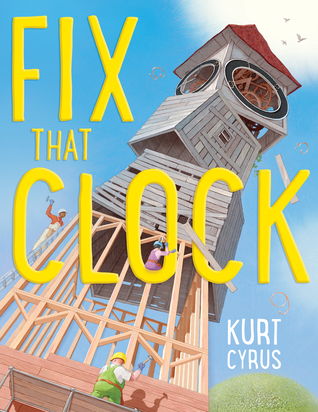
Full of rhythm and rhyme, this picture book takes a broken down clock and rebuilds it. The clock is teetering and old, with the structure and the clock no longer functional. The only things that live in it are the wild animals who have moved in. So three builders arrive to change all of that. Floor-by-floor, they transform the zigzag of crooked walls into straight new boards and squares. The clock too gets reworked and soon the tower is straight and working once again. But what will happen to the little creatures who lived there? 

This book was made to share aloud. It has such a jolly rhythm to it, with hammers banging, boots tramping, and the clock bonging. Still, Cyrus takes the time to tell a full story here, giving quieter moments where the reader gets to more fully understand the structure itself and the creatures who live there. It’s that contrast that really makes the book work as a read aloud, giving it a heart beyond the rhythm and rhyme. 

Cyrus’ art is great, the old wood grayed and weathered by time contrasts with the fresh gold of the new wood. One can almost smell the sawdust as you turn the pages. The three builders are diverse as far as race and gender, which is very welcome to see. The use of interesting perspectives adds to the appeal visually.

A great choice for reading aloud for any units on construction or clocks. Appropriate for ages 2-4.

Reviewed from library copy.

Review: Old Rock (Is Not Boring) by Deb Pilutti 

Old Rock (Is Not Boring) by Deb Pilutti 

Old Rock (Is Not Boring) by Deb Pilutti (9780525518181)

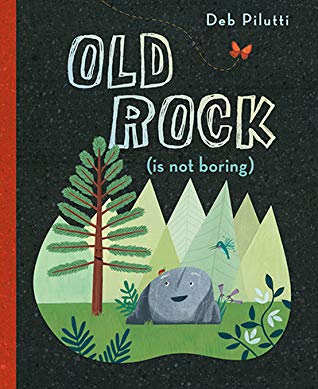
Old Rock has sat in the same spot on the edge of a clearing in a pine forest for a very long time. Tall Pine, who stands next to Old Rock, thinks that being a rock must be very boring. Spotted Beetle and Hummingbird agree. Hummingbird talks about flying to different parts of the world. Old Rock then mentions that he flew once when he was erupted from a volcano. Spotted Beetle talks about what he can see from different vantage points. Old Rock then tells about watching dinosaurs walk past and riding a glacier. He even had a vantage point when the glacier left him high on the top of a ridge. Old Rock may never have danced, but he talks about somersaulting down from the ridge and meeting mastodons. And that’s when a very small pine tree started to grow next to him, and he met a beetle and a hummingbird too.

Pilutti pushes back against assumptions that could be made about rocks or others that are content right where they are. As the tree, bird and beetle brag about their own experiences, Old Rock can match them and share his own tales that are far more interesting. Old Rock’s clear contentment and stillness add a wonderful grounding to the book, even as he sometimes teeters on a ridge.

The illustrations are marvelous, filled with the emotions that go across the face of Old Rock. They contrast modern day with the past nicely using different color palettes for different times. Old Rock though stays solid and gray throughout.

A clever book that includes evolution, dinosaurs and a little rock and roll. Appropriate for ages 3-5.

Reviewed from e-galley provided by G. P. Putnam’s Sons.

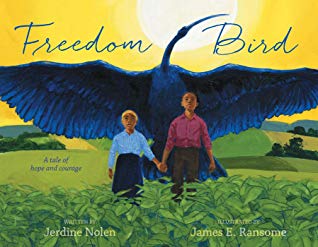
Review: Freedom Bird by Jerdine Nolen

Freedom Bird by Jerdine Nolen

Freedom Bird by Jerdine Nolen, illustrated by James H. Ransome (9780689871672)

John and Millicent were slaves on a plantation in the south. The siblings’ parents were sold away from them, never to be seen again. But before they left, they made sure that their children knew about freedom, hoping that it would come in time for them. The two worked hard labor on the plantation from dawn to night. One day, a great black bird flew over the field only to be shot down and left for dead. The two children head out after dark to see if the bird survived and rescue it. But the next morning, John is hired away to another farm, likely to be gone for many months. Millicent continued to care for the bird, keeping it alive and quiet until John returned. Reunited, the two hear of plans to sell John away and decide to act and choose freedom.

The cruelties and horrors of slavery are front and center in this picture book. The dismantling and breaking of families, the threats and violence, the backbreaking work day after day. The addition of the bird adds a symbol of hope to the book, clearly offering it as a representation of freedom that must be looked after and tended. The text is dense for a picture book, but important as it explains slavery, freedom and the importance of seeing a better future.

Ransome’s illustrations are paintings that play with perspective, looking at the world from the bird’s perspective, seeing its shadow long before it appears, and glimpsing the two children entering the dark field to rescue the bird. One illustration in particular is powerful and dramatic with Meredith and the bird stretching arms and wings together.

A folktale look at freedom and the evils of slavery. Appropriate for ages 6-9.

Reviewed from copy provided by Simon & Schuster.

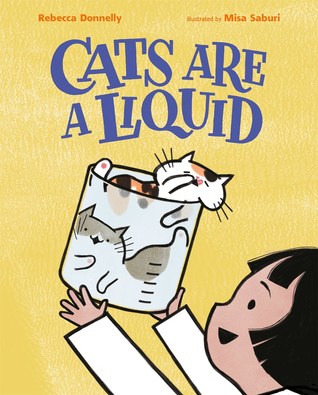
Review: Cats Are a Liquid by Rebecca Donnelly

Cats Are a Liquid by Rebecca Donnelly.jpg

Cats Are a Liquid by Rebecca Donnelly, illustrated by Misa Saburi (9781250206596)

Based on a scientific paper, this picture book shows the various ways that cats act like both liquids and solids throughout their day. They go limp and drip when picked up. They flow downhill. They fill any container they are placed in, whether boxes or beakers. They flop and drop to the floor. But they also can shred and tear at times, and go stiff when they see a tempting feather float by. Told in simple language that gets readers seeing cats as watery creatures, this picture book celebrates everything feline. 

The lines of text in this book are short with lots of rhyming that avoids becoming sing-songy by playing with internal rhymes too. There is a wonderful jauntiness to the tone of the book, wondering aloud at what cats truly are and how different they are from other forms of matter. I firmly believe that cats are fluids, but non-newtonian ones. The book ends with information on forms of matter as well as a recipe for oobleck. 

The art here is simple and accessible, almost in the style of popular cat collection apps for cell phones. The cats are varied and marvelous in their liquid and solid states, whether mesmerized by snowfall or avoiding a bath. 

A clever scientific look at the splendor of cats. Appropriate for ages 4-6.

Reviewed from library copy.