Review: Bear Out There by Jacob Grant

Bear Out There by Jacob Grant

Bear Out There by Jacob Grant (9781681197456)

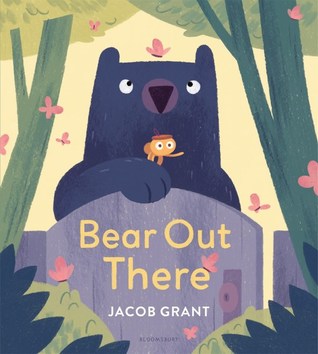
This second book about Bear and his friend Spider follows Bear’s Scare. Bear is happy staying at home all day, being cozy and warm. Spider though has a kite that he wants to fly, and he loves to be outdoors. When Spider’s kite gets away from him, Spider asks Bear for help finding it. So Bear heads out into the itchy, bug-filled, dirty woods along with his friend. The two search for a long time, Bear completely missing the charm of the woods. When it starts to rain though, the entire adventure gets bleak and disheartening. The two friends though, never quit. They eventually find the kite tangled in the trees. Now can they find a way of compromising and finding some indoor/outdoor fun together?

Grant writes with a great wry sense of humor that really allows Bear to be just as grumpy as he likes without the book ever becoming too filled with complaints. Spider helps in that way too, without saying a word, keeping spirits high and trying to show Bear how lovely the outdoors actually are. The text is simple and the pace is just right for a walk in the woods.

As with the first book, Grant’s art is perfect for sharing with a group. He fills the pages with color and large shapes. Even small Spider can be easily viewed by children seated on the floor. The art is welcoming and simple.

A look at the wonders of nature through the lens of a friendship. Appropriate for ages 2-4.

Reviewed from ARC provided by Bloomsbury Children’s Books.

Review: Moth: An Evolution Story by Isabel Thomas

Moth An Evolution Story by Isabel Thomas

Moth: An Evolution Story by Isabel Thomas, illustrated by Daniel Egneus (9781547600205)

This nonfiction picture book explains a specific process of evolution by following the story of the Peppered Moth. The moths emerge from their cocoons after the long winter, quickly seeking shelter from predators. At first, most of the moths had speckled black and white wings. It allowed them to better hide in the bark of the woods. The ones that happened to be born with dark wings got eaten by predators. So the speckled moths were able to survive to lay their eggs. But then the world around them changed with more soot and pollution covering the bark of the trees and other objects. Now it was the dark moths that survived best and could lay their eggs. Steadily, the moths started to become darker and less speckled. Now though, pollution is lessening and there is no longer as much soot. So the speckled moths are returning alongside the dark moths.

The tale of the Peppered Moth shows many elements of evolutionary process, including natural selection and adaptation. Both of those concepts are more fully described in the final pages of the book but are fully realized in the main part of the book as well. Thomas does a lovely job with the prose, giving the reader just enough information to allow the story to unfold before them. She limits the amount of words on the page, making this accessible for quite young children.

The illustrations are marvelous, inviting readers into the darkness of a moonlit woods as the moths emerge from their cocoons. The pages fill with moths of different mixtures of black and white. When day comes, more predators enter the pages. As the pollution enters, the world becomes dark and filled with dots and specks of dirty soot. The moths glow against the new darkness, or hide well, depending on their color. It’s a stirring and rich look at evolution happening right before your eyes.

Beautifully written and illustrated, this is a very special nonfiction picture book. Appropriate for ages 5-8.

Reviewed from copy provided by Bloomsbury Children’s Books.
Review: Leila in Saffron by Rukhsanna Guidroz

Leila in Saffron by Rukhsanna Guidroz

Leila in Saffron by Rukhsanna Guidroz, illustrated by Dinara Mirtalipova (9781534425644)

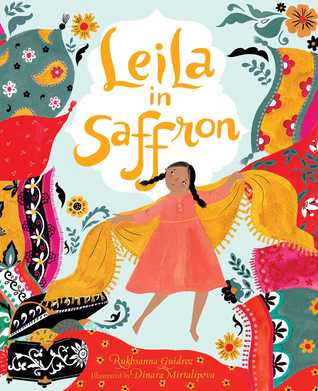
Leila isn’t sure she likes what she sees when she looks in the mirror, but her grandmother tells her how lovely the color saffron looks with her dark eyes. It makes Leila feel better, but she still sees her skinny arms and knobby knees in the mirror. As she joins her extended family for dinner, she realizes that she smiles the same as her aunt. Leila helps her grandmother make the curry. She heads out to the neighbor’s garden to ask for some cilantro. Everyone congratulates Leila on a wonderful dinner. Before Leila leaves that evening, her grandmother shows her a trunk of silk scarves. They are all the colors of the foods they just worked with, and Leila discovers a saffron one that makes her see herself clearly in the mirror.

Guidroz has created a book centered on a warm and loving Pakistani family. Leila’s concerns with her appearance are addressed by the family in a more holistic way, talking about beauty but also focusing on her skills and her talents. They never make her feel less for having concerns, instead surrounding her with options and choices to really feel more fully herself.

The illustrations are filled with oranges, yellows, reds and deep greens. They also have lots of patterns, filling the page with different textiles. Those colors pop against the simple white backgrounds.

Rich and warm, this book is just like a good curry. Appropriate for ages 3-5.

Reviewed from copy provided by Salaam Reads.

Review: If I Was the Sunshine

If I Was the Sunshine by Julie Fogliano

If I Was the Sunshine by Julie Fogliano, illustrated by Loren Long (9781481472432)

Two master picture book creators collaborate on this lovely book filled with metaphors and using opposites as more than just a concept. On sun-drenched pages, children and animals explore relationships to one another. Using “If I was…” statements, each of the verses delicately explore the inter-connective nature of the world around us. The book moves throughout a day, from morning through to bedtime. It shows various seasons as the book continues too, filling the pages with autumn apples, frozen lakes, and fireflies in the summer.

It is the combination of the art and the words that makes this picture book exceptional. Fogliano’s words are written with such skill. The verses rhyme without any forcing of the meter or the words, made even more difficult by the relationships embedded in each verse. The play of words is so deftly done, each combination is a surprise and a joy as the pages turn.

Long’s paintings are filled with light, whether it is the spark of a firefly or the gold of summer sun. He shows the relationships with various perspectives and cleverly juxtaposes the characters in double-page spreads that one can almost sink into.

A grand picture book that celebrates our world. Appropriate for ages 4-6.

Reviewed from copy provided by Atheneum Books for Young Readers. 

Review: Sparky & Spike by Barbara Lowell

Sparky & Spike by Barbara Lowell

Sparky & Spike: Charles Schulz and the Wildest, Smartest Dog Ever by Barbara Lowell, illustrated by Dan Andreasen (9781944903589)

Sparky has a dog that is black and white. His dog knows fifty words, loves to each strange things, and only drinks from the bathroom faucet. Sparky and his father always head to the drugstore every Saturday night to pick up the Sunday comics. Sparky loves comics and also loves to draw himself. His teacher says that he may be an artist one day, but Sparky definitely wants to be a cartoonist. But drawing is hard, especially getting characters right in multiple panels. The kids at school love Sparky’s drawings, but ignore him otherwise. When Sparky realizes that his dog could make the comic for Ripley’s Believe It or Not, he sends it in along with his drawing of Spike. Eventually, his drawing and caption are published! It’s just the start for the kid whose real name is Charles Schulz.

Lowell deftly depicts the growth of a young artist as he develops his own dream, his own art and a path forward. It is a pleasure to see a young Charles Schulz and his connection to the dog who will inspire Snoopy. His connection to comics from a young age is also fascinating to see as well as his struggles with friendship. The art by Andreasen is cleverly done with a realistic touch that both pays homage to the work of Schulz but also stands on its own stylistically.

An inspiring look at the creator of Peanuts. Appropriate for ages 6-9.

Reviewed from copy provided by Cameron Kids.

Review: Grandpa Cacao by Elizabeth Zunon

Grandpa Cacao by Elizabeth Zunon

Grandpa Cacao by Elizabeth Zunon (9781681196404)

A little girl and her Daddy are making her birthday cake, a chocolate one. As they bake the cake, her father tells her about Grandpa Cacao who lives in the Ivory Coast and has a cacao farm. The book looks at the importance of the right soil and weather to grow cacao as well as the skill to know when precisely to harvest the crop. The process of harvest and then scooping out the white beans, curing them in the ground, and then drying them is shown in detail. All the while, the girl and her father are baking together, the smell and taste of the chocolate bridging the two story lines. In the end, as the cake is finished, the little girl gets a special birthday treat.

Zunon’s picture book tells the important tale of where chocolate comes from and the fascinating process of going from farm to product that is not at all what one might expect. The framing of the chocolate farming process by a girl about to celebrate her birthday with a chocolate cake is lovely. It is strengthened even more by her family connection to the Ivory Coast and her grandfather’s farm. The treat at the end makes that even more firmly and tangible for readers.

The illustrations by the author are cleverly done. The little girl’s world is done in full color collages filled with rich touches of patterns and textures. The African farm is done in a more flat format with the people simply white outlines against the landscape. When the two worlds come together, they both become full color and lush.

Everyone loves chocolate and this book explains how it comes to our tables. Appropriate for ages 5-7.

Reviewed from copy provided by Bloomsbury Children’s Books.


Review: Waiting for Chicken Smith by David Mackintosh

Waiting for Chicken Smith by David Mackintosh

Waiting for Chicken Smith by David Mackintosh (9781536207712)

A little boy waits for his friend, Chicken Smith, who usually stays at the same beach for the same week in the summer. The boy comes to beach every year and knows it very well, just like Chicken Smith does. Chicken can do all sort of things like ride his rusty bike without any brakes, just using his foot to slow down. As the boy thinks about Chicken Smith and anticipates his arrival, his sister starts to call him, but he is too busy waiting for Chicken to come. He looks forward to spotting whales together like they did last year. But his sister is still calling, so he heads up to the lighthouse to see what she wants. Out in the ocean, they can see a whale together. Maybe Chicken Smith won’t be coming this summer after all. But hanging out with his sister may not be so bad anyway.

This picture book is about a summer friendship and by exploring their connection with one another, the book also shares iconic summer moments at the beach. Finding a buoy, seeing a flying fish, swimming all day. Mackintosh has fully developed the voice of the little boy, who tells the story from his personal perspective. It is his voice that makes the book come alive and that tells of the ache of not knowing when or if a friend will arrive and what that might do to an entire summer vacation.

The illustrations are modern and move from white sand with a clearly hot sun to images of whales swimming in the sea. Macintosh plays with color, using reds, blues and greens to fill some pages while leaving others bleached out.

Ideal summer reading that mixes sunshine fun with summer friendships. Appropriate for ages 4-6.

Reviewed from copy provided by Candlewick Press.


Review: Nobody Hugs a Cactus by Carter Goodrich

Nobody Hugs a Cactus by Carter Goodrich

Nobody Hugs a Cactus by Carter Goodrich (9781534400900)

Hank is a very prickly cactus sitting in a window and overlooking the emptiness of the desert. Occasionally others intrude on his blissful quiet, and he doesn’t respond in a very friendly way. When Rosie the tumbleweed rolls past, Hank ignores her entirely. Hank yells at a tortoise so loudly that the tortoise hides in his shell. Other animals and people pass too, each greeted rudely by Hank. Someone suggests that he needs a hug, but no one wants to hug a prickly cactus. The next morning though, Hank is less angry and more lonely. But what is a grumpy cactus to do? Hank may have a new and friendly idea.

Goodrich has created quite the character in Hank. Hank moves beyond just being rather ferocious and cranky into something more closely approaching sadness and isolation. That shift is the key to this book, one that allows readers to truly start to feel for Hank and his predicament. The use of being “prickly” meaning both personality and having sharp needles is clever handled and not overplayed in the text. The book is engaging and funny with a brisk pace despite being centered on a plant.

The art is done in a desert color palette with sand, rich blue skies at night, and changing clouds and weather. Hank himself is full of personality, grumpy as can be at times while being rather morose at others. Goodrich uses plenty of humor in the illustrations too, particularly with Hank himself.

A great pick for grumpy days when you might be feeling a bit prickly yourself. Appropriate for ages 3-5.

Reviewed from copy provided by Simon & Schuster Books for Young Readers.


Review: Hair Love by Matthew A. Cherry

Hair Love by Matthew A. Cherry

Hair Love by Matthew A. Cherry, illustrated by Vashti Harrison (9780525553366)

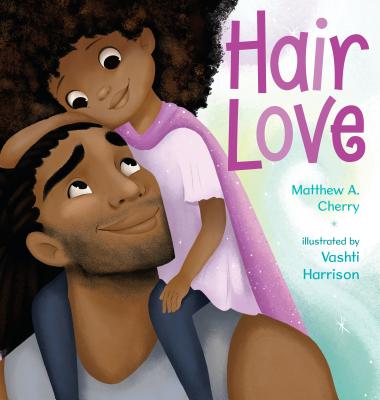
Zuri has hair that can do almost anything. It curls all over when she gets up in the morning. She wears it in all different styles. In braids and beads, she is a princess. With two puffs, she is a superhero. Then one day she wakes up and it’s a very special day. Her father is still asleep, so she decides to try to do perfect hair herself. After a little accident in the bathroom, her father joins her. Together they figure out how to get her hair just right, but not without a few mishaps along the way. All in time for her mother to return home!

This picture book celebrates African-American hair. Offering all sorts of styles, the book exudes warmth and self-esteem. Creating an opportunity for a father to try to do hair, makes this book all the more lovely, also adding just the right dash of humor too. The use of modern technology to help is also something you don’t see a lot in picture books. The digital art is full of bright colors, humor and light.

Fall in love with this family and their hair. Appropriate for ages 2-4.

Reviewed from ARC provided by Kokila.