Gender Bias in Children’s Books

I don’t think that any children’s librarian is going to be surprised by the findings of a recent study of children’s books.  The most comprehensive study of 20th century children’s literature ever done, it revealed a bias towards books that feature boys and men.  Intriguingly, the bias was also present when the characters are animals.

Now, if you has asked me if more books featured boys or girls, I would have automatically answered boys.  I am surprised by the extent of the bias as well as the fact that it had not gotten any better towards the end of the 20th century.  In other words, we aren’t making much progress with gender in children’s books!

Science Daily has some bulleted points in their article about the study that I find particularly interesting:

  • Males are central characters in 57 percent of children’s books published per year, while only 31 percent have female central characters.
  • On average, 36.5 percent of books in each year studied include a male in the title, compared to 17.5 percent that include a female.

While I find the information interesting and important, even more important to me is what we do about it.  It seems to me that it is the same issue we have with all sorts of diversity in children’s books:  races, colors, sexual orientation.  So the question is universal about featuring children and adults in children’s books that speak to all levels of diversity.

What do we do as librarians who are cultivating collections for children? What do we do as book creators to get more girls and even women into our books?  How do we all take responsibility for what children in our world are reading and therefore learning about how society works?

Big thanks to Hedgehog Librarian for the link.

2010 America’s Most Challenged Books

ALA has announced the most challenged books of last year.  Interestingly, the ones I have read are favorites of mine.  I’m considering using the list as a recommended book list for my future reading.  Here are the books:

1. And Tango Makes Three by Peter Parnell and Justin Richardson

  • Reasons: Homosexuality, Religious Viewpoint, Unsuited to Age Group

2. The Absolutely True Diary of a Part-Time Indian by Sherman Alexie

  • Reasons: Offensive language, Racism, Sex Education, Sexually Explicit, Unsuited to Age Group, Violence

3. Brave New World by Aldous Huxley

  • Reasons: Insensitivity, Offensive Language, Racism, Sexually Explicit

4. Crank by Ellen Hopkins

  • Reasons: Drugs, Offensive Language, Sexually Explicit

5. The Hunger Games by Suzanne Collins

  • Reasons: Sexually Explicit, Unsuited to Age Group, Violence

6. Lush by Natasha Friend

  • Reasons: Drugs, Offensive Language, Sexually Explicit, Unsuited to Age Group

7. What My Mother Doesn’t Know by Sonya Sones

  • Reasons: Sexism, Sexually Explicit, Unsuited to Age Group

8. Nickel and Dimed: On (Not) Getting By in America by Barbara Ehrenreich

  • Reasons: Drugs, Inaccurate, Offensive Language, Political Viewpoint, Religious Viewpoint

9. Revolutionary Voices edited by Amy Sonnie

  • Reasons: Homosexuality, Sexually Explicit

10. Twilight by Stephanie Meyer

  • Reasons: Religious Viewpoint, Violence

Glorious Golden Book Gown

Designer Ryan Novelline has created a spectacular gown out of Golden Books.  You can visit the website for more photos of the gown as well as a look at the process that made it possible.

Via The Centered Librarian

Literacyhead Features Leo Lionni

Literacyhead, a biweekly online magazine, has just published an issue that is an author study of Leo Lionni.  They received permission to use over 60 of Lionni’s images on their site, making it a feast of Lionni goodness.  Each issue of their magazine offers a writing lesson and a read-aloud lesson that incorporate the visual arts.

The Leo Lionni issue will be available for free until October 5th.  Every current issue is available for free.  If you are interested in accessing back issues, you will need a membership.

The magazine is put together very nicely with a friendly interface, plenty of great graphics, and a real ease of use. 

Make sure you take a look at the Coaching Matters section where I hope you will be as delighted as I was to get a glimpse of Lionni’s baskets of mouse parts. 

How I Made It to Eighteen

How I Made It to Eighteen: a mostly true story by Tracy White

Based on the author’s experiences, this book takes a straight-on look at depression and self-destruction.  Seventeen-year-old Stacy Black checked herself into a mental hospital to help deal with her anger and depression.  She had just put her fist through a glass window.  Stacy hated the hospital but knew that she had to be there to survive, so she stayed.  As she spent time there, she developed new friends who helped her in her recovery and in being honest with herself.  Told in graphic novel format that is more like a journal than manga, this book is honest, blunt and intelligent.  Teen readers will easily see themselves in Stacy whether they are struggling with similar issues or not.

This book appears to be a regular novel until you open it and see all of the illustrations.  Done in line drawings, the illustrations are quirky and have the unedited feel of a real journal.  Readers get to know Stacy as well as her friends both in the hospital and from outside.  This perspective shift, done at the end of each chapter is a welcome view of how outsiders view a teen who enters a hospital.  While they express confusion and concern, all of them realize that it was a necessary step.  It is a brilliant and subtle way to tell teens that they will not be vilified if they get the help they need.

Though heavily illustrated, White’s writing is also a large part of the story.  Stacy is a sarcastic and caustic character.  Readers will realize immediately that she is putting on a front, but it takes time for readers and Stacy to acknowledge what exactly has brought her to the hospital and to this place in her life.  The slow unveiling of the basis of her problems mirrors the steps in her counseling.  This makes the entire book feel organic and honest.

A book that teens will enjoy and relate to, this graphic novel will appeal to a much broader audience than graphic novel readers.  Appropriate for ages 14-17.

Reviewed from copy received from Roaring Brook Press.

Also reviewed by:

Thunder Rolling and Rainbows Shining

There are times that the entire universe seems to be thrumming with the same woes, the same prejudice, and the same amazing people standing up to it all.

Liz B tells us about book banning in the Burlington County Public Library of Revolutionary Voices, a GLBT title.  The banning was done quietly, on the sly.  In other words, it was done spinelessly as a way of avoiding confrontation.  Frankly, I think this is the most prevalent type of book banning happening in libraries today.  Someone makes complaining noises about a book and it conveniently disappears so there is no reason for complaint.

Let’s ignore the fact that libraries have request for reconsideration forms for just such a situation.  It is sooo much easier if the forms are not even used and the library can just “fix” the problem quietly.

Also today, I had the pleasure of reading a great piece on Pinched Nerves by Brent, a gay teen book blogger who fought for the right to read books about kids like him at his school and his public library.  He’s my hero!

I have other heroes, who make me proud to be a librarian:

The West Bend Public Library here in Wisconsin who went through a horrible time with someone who wanted to ban around 80 books from the library.  They followed their policies to the letter, which allowed them to retain all of the titles in their collection.  The battle was fought very publicly and strengthened libraries around the state in our resolve to stand up for books.

Currently, the Fond du Lac School District also here in Wisconsin, is working their way through a list of books being questioned in their school libraries.  So far all of the books have been retained without changes.  Unfortunately, the same can’t be said for the neighboring community of North Fond du Lac where a sticker was added to a book deemed appropriate for high school students.  Man, what a slippery slope that is!  And what a sad decision to make.

Let’s remember in the midst of all of this, we can all find the heroes to give us courage to stand up, insist on the freedom to read, and not bow to pressure to make our libraries something they are not.

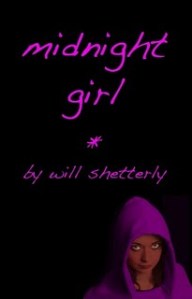
Midnight Girl – FREE

Award-winning science fiction author, Will Shetterly has released his new YA novel via Lulu.  This means it is FREE.  Just head to Scribd and you can start reading immediately.

You can also read Shetterly’s blog to hear about why he did not go with a publishing house

Thanks to Boing Boing.

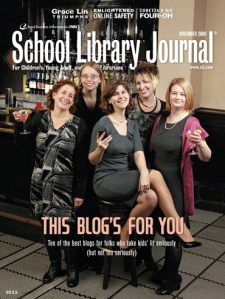
Betsy's SLJ Article

covergirls

Gorgeous bloggers grace the November 2009 cover of School Library Journal!

Betsy took on the challenge of creating a list of ten of the top children’s lit blogs and did a grand job.  I am thrilled to be one of the bloggers quoted in the body of the article which does a nice job of showing how children’s lit blogging has grown and evolved in the last few years while emphasizing that blogs and review journals remain completely different beasts.

Welcome any new readers who journeyed from that article!  Good to have you hear.  Feel free to put your feet up, hog the comfy chair, and read.

Book Bloggers Under Scrutiny

The book blogging world is abuzz with the news of the FTC’s new Guides Concerning the Use of Endorsements and Testimonials which will be revised to address bloggers.

In a fascinating, but confusing, article, Edward Champion interviews Richard Cleland of the FTC about the changes. 

Bloggers, including myself, have a lot of concerns about these changes.  First, the fact that the rules for bloggers are going to be more stringent than those for review journals in print is very troubling.  I don’t mind disclosing the book I receive from publishers, but it seems to me that Cleland wants disclosure plus return of the books. 

There is no way that I would have enough funds to return the books I receive from publishers.  That said, I don’t keep the books I receive from publishers.  The books that I receive go to my library’s collection unless they are ARCs.  ARCs are shared with colleagues, given away as book program prizes, or put into the library book sale.

For me as a library blogger, it gets even more confusing.  Cleland says that if bloggers are being paid to blog then there is no need for concern.  I blog on library time and for the library’s website.   Does that clear me of concern?  I don’t think so. 

I am entirely confused, a bit concerned, and hoping for more clarifications to come.  How about you?  I’m happy if anyone can shed more light on this for me!