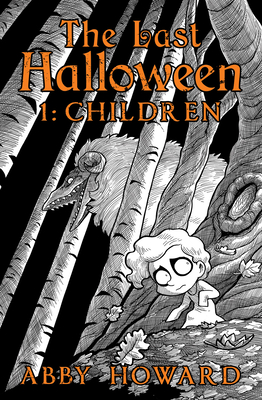
This marvelously creepy horror graphic novel starts with a man’s death by fire where a strange dog-like demon stays to witness and then reports back to a woman. That same woman has a teenager in the back of her car, hooded and kidnapped. Later at the hospital, it is clear that the man survived after all, but is terribly burned. The doctor helping him is surprised by a strange figure with two heads and a body sewn together who demands her help. With such strange things afoot, the story moves to Mona, a 10-year-old girl who gets caught up as the world turns to chaos around her. After being left home alone on Halloween, Mona discovers a huge horned creature on her couch. Running away, she tries to reach the police station and takes a short cut through the cemetery. It is there that she meets the others who will join her in her Halloween quest: a vampire, a ghoul, and a living doll. Halloween is just getting started!
A warning first of all, this is not a graphic novel for 10-year-olds, even though the protagonist is that young. Save this one for teenagers who will revel in its grotesque creatures and gore. The panels include maiming, death and dismemberment vividly shown, and often done with a sly sense of humor. This book offers a demon horde determined to take over the world with only a handful of teens and children to try to stop them and one rather inept mummy. The plot offers a satisfying adventure and hero’s journey through a landscape of horrors with pacing that adds to the humor as well as the fright.
Drawn in black and white, the illustrations are captivatingly macabre. Even the human characters like Mona have over-large heads, tiny bodies and eyes that look right at readers. Howard leans into the gross factor, creating gore in black ink that you swear is actually blood red. With a diverse cast of characters, including Mona’s parent who uses the pronouns they/them.
Perfect for teens who enjoy blood, gore and demons mixed with lots of humor. Appropriate for ages 13-17.
Reviewed from e-galley provided by Iron Circus Comics.
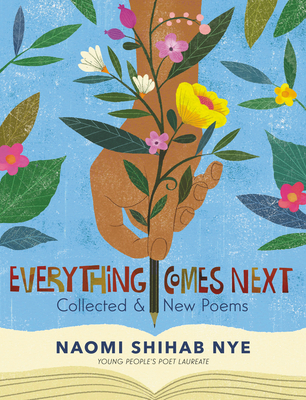
The current Young People’s Poet Laureate has compiled a collection of over 100 of her poems. It is a mixture of both previous published poems and new ones that have not been published before. Though some date back to the beginning of her stellar career and others are newer, there is a strong consistency across the collection with their eye towards hope combined with a strong sense of truth and honesty. Nye also has a way of focusing on the small and mundane in our lives and bringing out the wonder, including flour sifters, toddler comments, and cat food.
I bookmarked far too many of the poems, looking forward to returning to them again. While I had my distinct favorites (and lots of them) there were no poems in this collection that disappointed. The entire collection work both as a whole and as its separate parts. It provides a great introduction to Nye’s poetry.
Perhaps Nye’s greatest quality is her refusal to speak down to children or to simplify her poetry for them. She asks them to stretch to understand them, but not in confusing ways or using esoteric language. The concepts are fascinating, the poems leading the reader but not in a straight line, her poems more of a journey.
A gorgeous collection of poetry from one of the best. Appropriate for ages 12-15.
Reviewed from e-galley provided by Greenwillow Books.
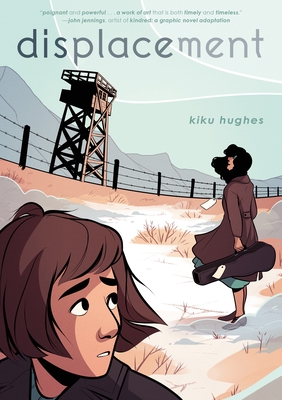
This historical graphic novel takes a modern-day teen and puts her back in time. Kiku is vacationing with her mother in San Francisco, when she first travels through time back to World War II. As the mists form around her, she finds herself watching her grandmother play her violin as a teen. It happens again the next morning, when Kiku finds herself joining the line of Japanese-American people heading for the internment camps. Those experiences were shorter. But then Kiku finds herself back in time for a longer period as she experiences the internment camps herself. She lives near her grandmother, but can’t bring herself to actually meet her face to face. As Kiku witnesses and actually lives the experiences of Japanese-Americans in the internment camps, seeing how they suffered, the restrictions, the injustice but also the communities that were formed in the camps.
Hughes uses a dynamic mix of modern and historical in this graphic novel. She takes the sensibilities of a modern teen and allows readers to see the world through Kiku’s eyes. When Kiku is stuck in time, readers get to experience the full horror of the internment camps and what our country did to Japanese-Americans. Hughes ties our current political world directly to that of the camps, showing how racist policies make “solutions” like internment camps more likely to happen. She also keep hope alive as well, showing Kiku making friends and also developing a romantic relationship with a girl she meets.
The art is done in full color throughout. The color palette does change between modern day and the internment camps, moving from brighter colors to more grim browns, grays and tans. Hughes uses speech bubbles as well as narrative spaces that let Kiku share her thoughts. There are no firm frames here, letting colors dictate the edges of the panels.
Timely and important, this is a look at what we can learn from history and stop from happening now. Appropriate for ages 12-15.
The finalists for the National Book Award have been announced. The awards go to the best of the year’s adult fiction, adult nonfiction, poetry, translated literature and young people’s literature. The winners in each category will be announced on November 18th. Here are the finalists for the Young People’s Literature category:
This gripping novel for teens takes readers into a world of high-rolling musicians and the abuse and exploitation of Black girls. Enchanted, age 17, is in high school, on the swim team and dreaming of making it big in the music industry. When she lies to her mother to get her to take her into the city for an audition, Enchanted doesn’t get the spot but does catch the attention of legendary R&B singer Korey Fields. As Korey begins to shower Enchanted with attention, her parents agree to let Enchanted leave high school and tour with Korey. What starts as a rocket to her singing career, quickly turns to a relationship with Korey. As Korey becomes more and more controlling, Enchanted finds herself unable to contact anyone for help, held against her will, and manipulated into staying. When Enchanted wakes up to find blood all around her and Korey’s body nearby, she needs to figure out what happened that night and what she did.
Jackson writes with such raw power here. She harnesses growing tensions, fear for Enchanted’s life, and reader’s horror at the situation that Enchanted finds herself in. Jackson shows how even a close and caring family can be conned into allowing their daughter to travel with an adult man and be taken advantage of. She shows how the families too are manipulated, beaten down and forced to be separated from the children they love. Readers will recognize many of the details in the book in the recent exposures of R. Kelly’s abuse of young Black girls.
Enchanted is a marvelous depiction of a seventeen year old. She is a mix of child and adult, yearning to be even more adult, to launch her life and be seen. But she is certainly still young, naive and innocent as Korey manipulates her, drawing her deeper and deeper into the world he has crafted to control her. The book is almost suffocating as their interactions become more and more abusive, leaving readers looking for a way out alongside Enchanted.
Powerful truth about Black girls and their place in the #MeToo movement. Appropriate for ages 15-18.
Reviewed from e-galley provided by Katherine Tegen Books.
Amal is an artist and a poet. He’s also a Black teen. So when he’s in the wrong place at the wrong time and makes a poor decision, his life is turned upside down. With a white boy left in a coma from the fight, Amal is wrongly incarcerated, accused of beating the other teen almost to death. Sent to prison, Amal must figure out how to survive incarceration without his anger at his situation changing him and his future forever. Amal must find a way to stay in touch with his inner artist, to write the words that come to him, to insist upon being seen as more than a convict. He must face the racism of the system, of his community, and of the people around him in prison. It’s a system set against him and it takes real courage and humanity to stay alive and whole as it grinds you down.
Told in verse, this is a powerful book that insists that readers see how the system actually works, its inherent racism, and the way that Black youths, particularly boys, are seen by white communities and white teachers. It is unflinching in showing the grueling nature of prison, the way that teens are treated in detention, the beatings and the inevitable protection in finding a group to belong to. Yet through it all there is hope, solely because of who Amal is and the fact that he is innocent but needs help proving it.
The book reads with such honesty about what life is like for an innocent person incarcerated that it is clear that Salaam offered so much of his own experience to this verse novel. As one of the Exonerated Five, he lived through what Amal does in the story, what so many Black men and boys in our communities do.
This powerful verse novel demands that we see the reality of what we are doing to generations of Black men and boys. Appropriate for ages 14-18.