The Finalists for the 2021 National Book Award in Young People’s Literature have been announced by the National Book Foundation. The five finalists are mostly first-time nominees with the exception of Kekla Magoon who has received her second nomination. Here are the finalists:
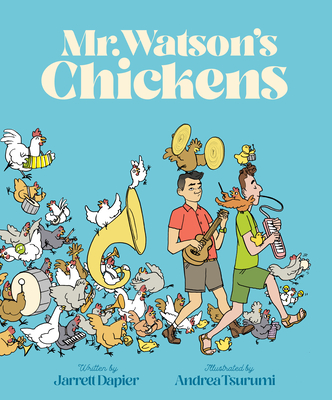
Mr. Watson’s Chickens by Jarrett Dapier, illustrated by Andrea Tsurumi (9781452177144)
Mr. Watson lives with Mr. Nelson in a big house in an even bigger city. In their little yard, they kept dogs, cats and three chickens. They started with a sensible number of chickens, but Mr. Watson’s collection quickly grew until they had 456 chickens! Their big house had chickens in every room. One of the chickens, Aunt Agnes, even wrote a song that added to the chaos and noise. She sang it all the time. Finally, Mr. Nelson had had enough and threatened to move out to the chicken coop in the yard if nothing was done. The two of them took the chickens to the county fair to get rid of them. But after an accident sets all of the chickens free, they are forced to gather them all up again. Luckily, their accident proves to be exactly the solution to the chickens.
This picture book shares rollicking rhythms and repetition along with a skillfully told story. Dapier leans into the full chaos of so many chickens. It’s the song that Aunt Agnes writes that really proves to be too much, though young listeners will love it. There is a merriness to the entire book, where the chickens steal the story away from the gay couple who are struggling to adapt and figure out how to take control back from their feathered friends. The human couple caught in the frenzy are a wonderful example of how being gay can be an integral part of a story but not seen as an issue.
Tsurumi’s illustrations have a touch of vintage cartoons mixed with modern elements. She shows the wild world of the chickens with details that are great fun to look at. There is even one double-page spread of the county fair where readers can search for the last chicken. She layers additional visual jokes and humor onto a story that is already great fun.
A funny feathery frantic tale of pets that get out of control. Appropriate for ages 3-5.
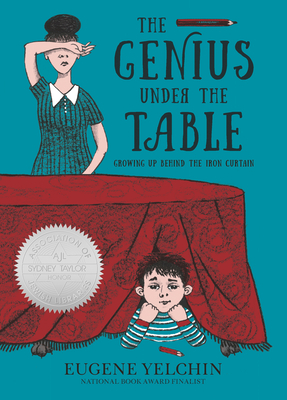
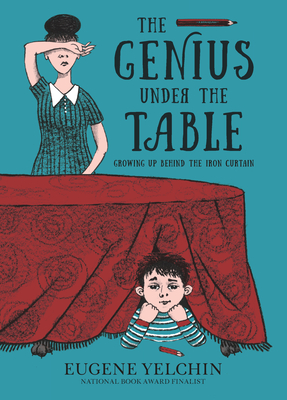
Yevgeny only seems to disappoint his parents who are rather desperate for him to find a natural gift that will let him escape Soviet Russia. They already know he’s not much of an athlete, unlike his older brother who is going to be a famous ice skater. When his mother takes him to see Mikhail Baryshnikov dance, Yevgeny tries to become a ballet dancer, practicing the movements in their tiny shared apartment. But what he truly loves to do is draw. Since he sleeps under the huge table, he steals his father’s pencil and draws on the bottom of the table where no one can see. Could those small doodles be the talent that his family has been waiting for? And what about the KGB agent who lives down the hall? And what happened to the grandfather whose pictures have been removed from the family album and no one speaks about? There are so many questions to be answered, but Yevgeny must be willing to start insisting on answers.
In this hilarious and touching book for middle grade readers, Yelchin shares a memoir of his own childhood in Russia during the Cold War. Yevgeny is a wonderful naïve protagonist, who doesn’t understand the immense political and social pressures hovering over his family and the entire Russian people. His misunderstandings of this and his growing desire for answers add tension to the story as readers will understand far more than he does.
As Yevgeny covers the bottom of the table with drawings, readers are shown Yelchin’s illustrations of his family and others in his life. They are humorous and filled with a wry charm that shows Yevgeny’s point of view.
Filled with an honesty about life in Cold War Russia, family expectations, and one gifted child. Appropriate for ages 9-12.
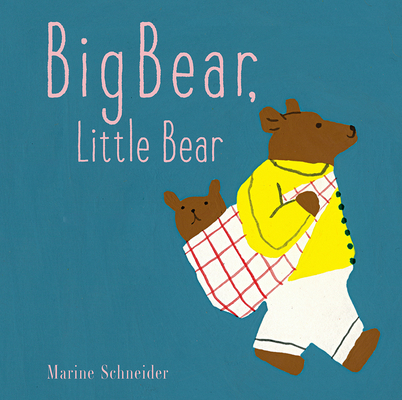
Big Bear and Little Bear do a lot of things together. Sometimes they do the same thing, like wearing boots, living in the same house, and sharing the same bed at night. Other things are different. Big Bear has a car, while Big Bear is Little Bear’s car. Big Bear drinks coffee, while Little Bear’s looks more like milk. Big Bear has his own chair, and Little Bear sits on his lap. This board book is a sweet look at a parent and child and their relationship shown through objects that they use. The simplest of text allows the illustrations to tell the story more fully.
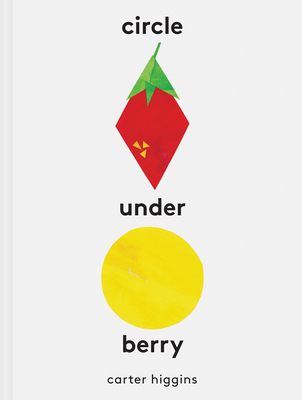
Compare the spatial relationships of different objects in this rhyming picture book with thick pages for little hands. The illustrations are bold and inviting, a combination of shapes and also objects like frogs, grasshoppers and an octopus who becomes upside down. There are colors to explore, shapes to find, and plenty to discover in this simple book that asks readers to participate. The text is perfect to share aloud with a small or large group who are sure to want to join in.
Reviewed from copy provided by Chronicle Books.
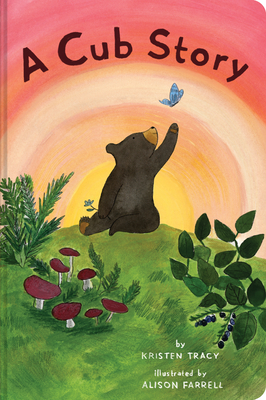
A Cub Story by Kristen Tracy, illustrated by Alison Farrell (9781452174587)
A bear cub explores his woodland home, comparing himself to the other animals. He eats a lot compared to a hedgehog and compared to a moose, he eats a little. Readers get to visit his favorite spots in the forest, watching the hawks soar, smelling the woods. The cub is slower than the elk but faster than the snails near the pond. He spends his summer eating berries, playing games with friends, climbing trees, and digging for insects. In the fall, he goes fishing. In the winter, he heads to his den with his family and feeling like he is just the right size. With a lot more story than most board books, this book also has rich and warm illustrations that invite readers into the cub’s world.
Reviewed from e-galley provided by Chronicle Books.
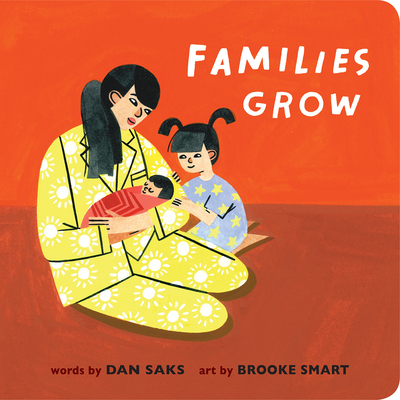
Families Grow by Dan Saks, illustrated by Brooke Smart (9780593223673)
This board book embraces the many ways that families grow and add a new member. The baby begins with a wish and becomes a growing belly. That person may be Mom, or it may not. Babies are brought home and loved, some right away and others take longer. The book gently looks at surrogacy and adoption in a way that normalizes every way that a family might grow. This gentle and quiet book celebrates all sorts of families and floods the pages with love. The bright colors are warm and celebratory as each baby finds their home in a family.
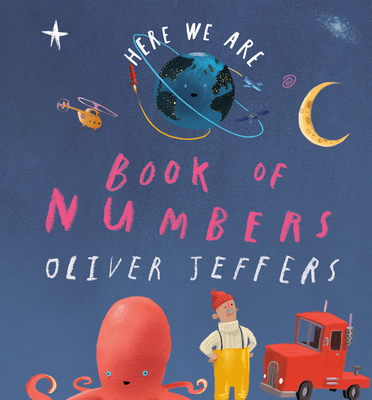
Two new board books are companions to Jeffers’ earlier Here We Are book. In my favorite of the two, little ones get to visit our planet and count things along the way. Jeffers doesn’t keep it overly simple as we count three kinds of land, five things to think about, eight body parts, and ten ways to travel. The book ends with a lot of stars and finally with infinity (how much I love you.) This counting book offers amazement at our world, moments of quiet contemplation, and Jeffers’ playfulness throughout.
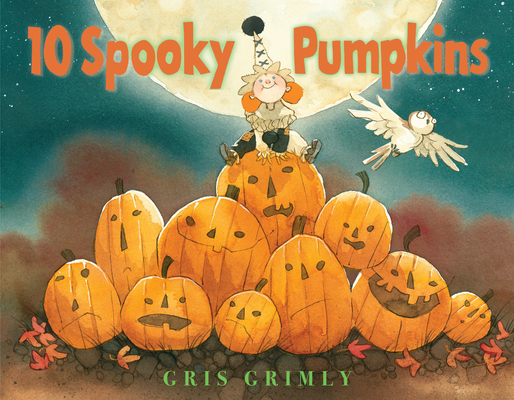
Count backwards with plenty of Halloween creatures in this jaunty picture book full of autumn shadows. The ten pumpkins start us out by looking for a cat and finding 9. The black cats creep along the gate, finding eight bats. They discover seven goblins, then six ghosts, five wolves, and onward until we end up with everyone having a grand Halloween bash together. But the book isn’t done yet, as one round full moon rises in the sky, sending everyone running in fright. The little girl ends up fast asleep in bed, her Halloween candy nearby.
The text here is marvelously simple and has a merry rhythm and rhyme that bounces along nicely. That is combined with illustrations that are full of Halloween sights. All of the creatures are perfectly strange with snaggle toothed wolves, slinky black cats, flapping eerie bats, and whispy yet round ghosts. The creatures add to the strangeness of the book, bringing it fully into the Halloween spirit. With dark blacks, bright oranges and the light of the moon, the illustrations are full of seasonal colors.
A counting book sure to bring a Happy Halloween! Appropriate for ages 2-5.
A little plant sprouted on one beautiful morning. The little plant was hungry! The sun couldn’t satisfy how hungry it was, because it was a carnivorous plant. It ate a caterpillar passing by. It ate a butterfly. The plant got bigger and hungrier. It ate a spider, a gecko, and a rabbit. It grew bigger and hungrier with each one. Then it ate a gymnast, an acrobat bear, and a parachuting cow. It even ate an entire airplane of parachuting cows. But it only got hungrier as it grew. It ate a flying mammoth, a bunch of witches, a UFO and a dragon. Finally, it ate an angel choir. Now it was finally satisfied, and stopped to rest. But the story doesn’t quite end there!
With a repeating structure and ever-increasing surreal silliness, this picture book is great fun. Readers will notice the nod to Eric Carle and his Very Hungry Caterpillar in the first part of the book, something that is marvelous to see incorporated so nicely. The carnivorous and voracious plant eats so many marvelous things, small and then so huge! The absurdity of it all is delightful as is the simplicity of the story and the twist at the end.
The illustrations are very simple as well, accompanied by hand-painted text that adds to the zany nature of the book. The plant stays an open, yawning mouth of green with red teeth-like cilia until it is finally satiated towards the end of the book. When it closes, the maw of hunger becomes almost docile, just in time for the ending.
Funny and immensely satisfying. Appropriate for ages 2-4.
Reviewed from copy provided by Eerdmans Books for Young Readers.

 Waking Brain Cells