Guess Who, Haiku by Deanna Caswell

Guess Who Haiku by Deanna Caswell

Guess Who, Haiku by Deanna Caswell, illustrated by Bob Shea (InfoSoup)

Haiku poetry is turned into a guessing game in this delightful picture book. One animal after another is described in haiku format and then the reader is asked to guess what animal it is. The answer is revealed with a turn of the page. This simple idea is engaging for youngsters learning about poetry and also works as a more basic picture book for younger listeners. It is that ease of use that makes this book so engaging for various age levels.

Caswell’s haiku are exceptional in the way they offer clues that children can understand and yet conform to the strict haiku format rules. They also read as haiku and real poems, each one working as a stand-alone haiku as well as a clue in the game of the book. This takes real skill, particularly since it looks so very effortless on the page.

Shea’s illustrations are loud, dynamic and funny. From the almost round bumblebee and the grinning flower to the googly-eyed frog , they are simple and also capture the essence of the animal they are depicting. They are filled with energy and life, making the book all the more fun.

This is the ideal book to introduce children to haiku since it makes the experience completely engaging and game-like. Appropriate for ages 3-7.

Reviewed from copy received from Abrams.


A Hungry Lion by Lucy Ruth Cummins

A Hungry Lion by Lucy Ruth Cummins

A Hungry Lion, or A Dwindling Assortment of Animals by Lucy Ruth Cummins (InfoSoup)

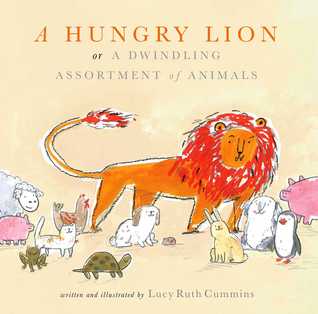
There was once a hungry lion in a room in a large number of small animals like a penguin, a pig, a could of bunnies, a mouse, a frog, a bat and many more, including a turtle. But as you turn the pages, more and more animals no longer appear on the page. Soon there is only the pig, a bunny and the turtle. Then only the turtle. Then just the lion and then after looking right at the reader, the lion leaves too and everything goes dark. What do you think happens next?!

Reminiscent of Jon Klassen’s classic I Want My Hat Back, this picture book has a delightful darkness about it. Even better, it toys with that darkness, allowing readers to think all is well right before plunging them right back into it again. It’s rather like a picture book roller coaster ride that will have readers demanding to ride again immediately. Cummins paces the book cleverly, filling it with a sense of impending doom.

The art adds to the emotional twists and turns. Readers can watch the lion’s face for clues, since at times he is far too innocent to actually not have done something wrong. Other times, he appears completely villainous with arched brows and big teeth. Yet all along, things may not be as they seem adding to the delicious tickles of dread.

Dark and delightful, this picture book is one wild ride worth sharing. Appropriate for ages 4-6.

Reviewed from copy received from Atheneum Books for Young Readers.


Daniel Finds a Poem by Micha Archer

Daniel Finds a Poem by Micha Archer

Daniel Finds a Poem by Micha Archer (InfoSoup)

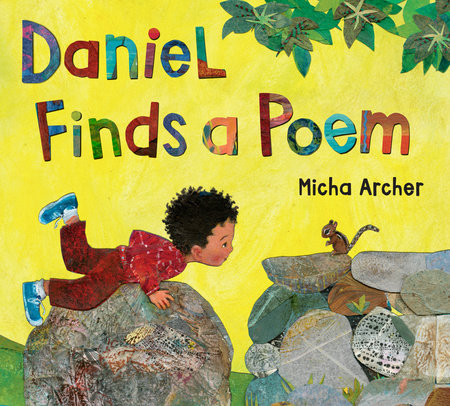
When Daniel discovers that there will be Poetry in the Park on Sunday, he begins to wonder what poetry is. The friends he has made in nature help him start to understand it. Spider says that poetry is “morning dew when it glistens.” For Squirrel, it is “when crisp leaves crunch.” Frog sees it as “a cool pool to dive into.” Owl has many ideas about stars, moonlight and her own silent wings. As Daniel listens to all of the creatures, he realizes that he has created a poem, one that lets him see poetry everywhere just as they do.

Archer’s look at poetry is delightful. She shows poetry connected to each creature’s life, each animal having its own unique way of viewing the world and then turning it into something poetic and special. Young readers will understand poetry just as Daniel does, piece by piece, symbol by symbol in an organic and natural way. While Daniel’s poetry at the end is lovely, I really enjoyed that the book had one final moment where Daniel finds his own personal piece of poetry.

Archer’s illustrations are exceptional. Using a layered technique that involves paint, hand-made block prints, and collage, the illustrations are rich and detailed. They have deep colors that sing on the page and a complexity in texture that is particularly pleasing.

A lush and striking book about poetry and its power in everyone’s life. Appropriate for ages 3-5.

Reviewed from ARC received from Nancy Paulsen Books.

Glow by W.H. Beck

Glow by WH Beck

Glow: Animals with Their Own Night-Lights by W. H. Beck (InfoSoup)

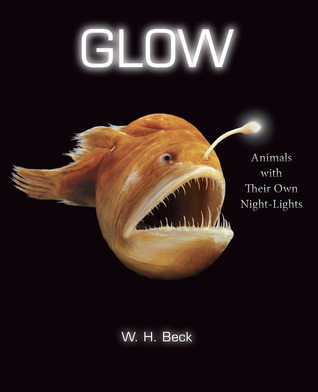
This nonfiction picture book invites young readers to explore the world of bioluminescence. Set against black backgrounds these glowing creatures pop on the page. The book not only shows different organisms that glow, but also explains why they glow too. Children will learn the terms for the chemicals that allow the light to be created and also see that there are some creatures who glow but no one knows quite why. Filled with dazzling photographs, this is a book that will fly off the shelves of public libraries as kids are hooked by the fish on the cover.

Beck has the book written at two levels. The larger font offers a less specific look at the organisms themselves and therefore a simpler experience. The smaller font allows readers to learn more about each creature. More information on each is also found at the end of the book where size, Latin name, and the depth they live at is given for each. This is a book that is engaging and fascinating. The text is restrained and focused, offering enough information to appeal but never standing in the way of the dazzling creatures themselves.

The photographs in the book are exceptional. Each shows the light of the creature against a black background, allowing that creature attention by the reader. The photos were taken by several different photographers, yet they make for a cohesive book thanks to their similar nature and the beauty they depict. I particularly enjoyed the firefly photo and the glowing shoreline.

An awesome book that is sure to appeal to children who enjoy nature and bizarre creatures, this is a winning science book for public libraries. Appropriate for ages 4-7.

Reviewed from copy received from HMH Books for Young Readers.

Counting Lions by Katie Cotton

Counting Lions by Katie Cotton

Counting Lions by Katie Cotton, illustrated by Stephen Walton (InfoSoup)

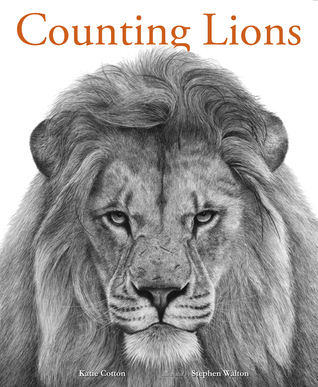
Counting one by one, this book tells the story of ten endangered and threatened animals. It begins with the lion on the cover, solitary and watching the savanna. Two gorillas are next, a mother and child, breathing the same breath together. The book moves on, each creature captured in captivating and brief verse that speaks to their way of life and the behaviors they exhibit. Each one is accompanied by a photo-realistic charcoal drawing that is haunting and incredibly detailed.

Cotton’s verse is profoundly lovely, managing to show each creature as an individual and give voice to their relevance and stature. The tigress and her cubs is a “warrior of the forest” while the macaws are “a colorful, fluttering explosion” and the giraffes are “peaceful patterned giants.” Each short verse will have readers seeing these animals in a new way, entranced by their beauty.

The illustrations are simply phenomenal. They are charcoal but with such detail that you can see the individual hairs in the lion’s mane, the each feather on the penguins, and every wrinkle of the elephants’ skin. Beautiful and powerful, these illustrations are a striking way to introduce these creatures.

A stunningly gorgeous book, the verse and illustrations marry to create a story of the threatened creatures of our world. Appropriate for ages 5-7.

Reviewed from library copy.


Review: Tiptoe Tapirs by Hanmin Kim

Tiptoe Tapirs by Hanmin Kim

Tiptoe Tapirs by Hanmin Kim (InfoSoup)

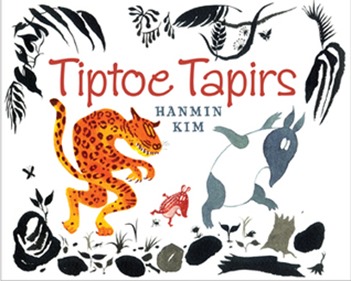
The jungle was a very noisy place with all of the animals making the most noise they can. The elephants went BOOM, the rhinos went BAM-BAM, the hornbill went CAW, and the ape went HOO-HAA-HOO-HAA! But there was one animal that wasn’t noisy at all, Tapir and Little Tapir. They were very quiet, tiptoeing through the jungle silently. When Little Tapir wanted to go to the Great Puddle for her third birthday, the two tapirs moved silently to get there and then enjoyed the lovely mud. Then out of the blue, a leopard attacked the tapirs. The leopard ran after them with loud THUDDING steps while the tapirs ran silently. The tapirs were almost eaten by the leopard when a gun shot rang out. The leopard was terrified, but the kind tapirs had a solution to save them all.

Kim has woven a fable-like story around his love for tapirs. The book is a delight to read aloud from the loud noises of the other animals to the hush-hush of the tapirs and their quiet silence. It’s a wonderful contrast that is great fun to act out. Kim uses repetition and solid writing to create a traditional feel in this story. There is also a lot of humor throughout, the noises are wild, the mud cakes are fresh. The focus on kindness as the solution in the end is also a treat of its own.

The art also has a dynamic mix of traditional and modern feel. Done in watercolor, ink and marker, the illustrations are filled with organic shapes of leaves and trees. Colors range from bright washes of watercolor to the darkest black of ink. The shapes of the animals themselves are delicately done, particularly the tapirs who both hide in the jungle settings and dance on the page.

Whether you are sharing this with a loud or quiet little animal, this book is a great pick to share aloud. Appropriate for ages 2-4.

Reviewed from ARC received from Holiday House.

Review: Flutter & Hum by Julie Paschkis

Flutter and Hum by Julie Paschkis

Flutter & Hum: Animal Poems by Julie Paschkis (InfoSoup)

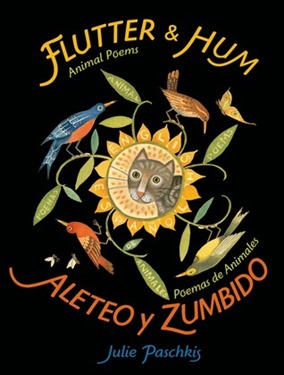
In short poems in both Spanish and English, animals are explored in the way that they move and live in their habitats. The book begins with a slithering snake poem that hisses on the page. Other poems include black crows hopping and cawing, the slow movement of a black cow in a golden field, fleeting glimpses of a deer, and the shine of an owl at night. Still other poems focus on domestic pets like dogs and cats who fill the page with their personalities captured in verse on the page.

I was surprised to read in the Author’s Note at the end of the book that Paschkis is not a native Spanish speaker nor a poet. It was Spanish that allowed her to find her poetic voice, which is just as special as her art. She effectively uses her verse in both languages to convey the essence of the animal, celebrating what makes them unique. The poems are stand alone and strong, easily adapted to the classroom for specific units and subjects.

As always, Paschkis’ illustrations are gorgeous. They have a folkart flair about them and have words in both Spanish and English woven into them that let the words become part of the art in a very concrete way. It also gives these bilingual poems a new way to convey the dance of the two languages next to one another.

A dazzling collection of poems, it is welcome both for its bilingual elements and the alluring combination of words and art. Appropriate for ages 6-9.

Reviewed from copy received from Henry Holt and Co.

Review: In, Over and On the Farm by Ethan Long

In Over and On the Farm by Ethan Long

In, Over and On the Farm by Ethan Long

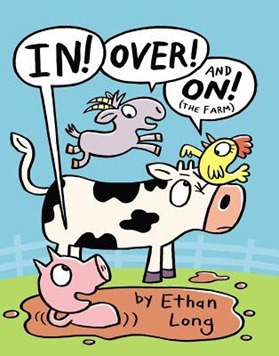
Following his Geisel Award-winning Up, Tall and High, Long returns to prepositions. Four animals friends have adventures on the farm in this easy reader. Broken into three short stories, each story focuses on one pair of prepositions. Chicken can’t get in the coop, so she is left out in the rain, until she realizes that everyone else is warm and dry in there, so she orders them to get out. In the next story, Chicken can’t get over the fence or go under it either. Luckily Cow has another solution for her, go around! In the last story, Pig is on the tractor and Cow and Goat join him there. When they are all on the tractor though, it starts to roll away and soon they are all thrown off. But they want to go on it again.

Long is a very prolific author and excels at creating books for beginning readers which are a winning mix of humor and simplicity. It also helps that he is a natural storyteller and so his short stories in the book have the feel of being complete tales despite their brevity. His characters are also universal, in their group and individual dynamics. The book is entirely relatable by children and will be enjoyed in classrooms looking at prepositions as well as by individual readers.

Long’s illustrations are funny and filled with a cartoon appeal. The colors are candy-bright and even gray rainy days are tinged in lavender. The incorporation of a few flaps to lift is also very appealing for young readers who will enjoy that the twist for each story is revealed in a physical way.

Silly and very easy to read, these stories have massive appeal. Appropriate for ages 3-5.

Reviewed from copy received from G. P. Putnam’s Sons.

Review: Night Animals by Gianna Marino

Night Animals by Gianna Marino

Night Animals by Gianna Marino (InfoSoup)

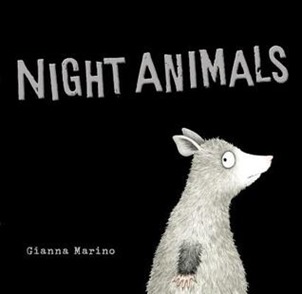
When Skunk walks by, he notices that Possum is hiding and asks why. She’s hiding from “the night animals” and hushes Skunk. The two hide together in a hollow tree until Skunk hears Wolf coming. Wolf shouts for help and says that something big is chasing him. Meanwhile Skunk has gotten alarmed and released his scent which has Possum fainting. Bear arrives in a panic saying that something HUGE is following him! It must be a night animal. Logic is restored by a little bat who informs all of the animals that THEY are the night animals. So what could they be afraid of? You will see!

Marino captures the hectic pace of panic neatly in this picture book. It builds from one animal to the next until it reads at almost breakneck speed as the animals grow in both size and number. The text is very simple and lends itself to lots of voices and humor when read aloud. Children may realize that all of these are nocturnal animals right away, but the final twist of the book will have even those clued into the lack of reason for any panic laughing.

The illustrations add so much to this book. With backgrounds of the darkest black, the animals pop on the page with their light coloring. Speaking in speech bubbles, they are funny and frightened. The addition of Skunk’s overuse of his scent makes for an even funnier read, particularly with it being Possum who is always hit with it.

Funny and a delight to read aloud, this picture book is ideal for sleepovers and bedtime reading, particularly if done by flashlight. Appropriate for ages 3-5.

Reviewed from copy received from Viking Books for Young Readers.