Hector and Hummingbird by Nicholas John Frith

Hector and Hummingbird by Nicholas John Frith

Hector and Hummingbird by Nicholas John Frith (InfoSoup)

A bear named Hector was best friends with Hummingbird. But sometimes Hector wanted to just eat a snack in peace and Hummingbird would not stop talking. He wanted to scratch his back on a tree, but Hummingbird kept chatting. He wanted a nap and Hummingbird wanted to tell a story. One day Hector had had enough and stormed away from Hummingbird and into the jungle. Hummingbird let him go, kind of. But having complete quiet was not what Hector expected and soon he was missing Hummingbird. Luckily, Hummingbird was right there when Hector needed him.

Frith captures the dynamics of friendship in a very clear and clever way in this picture book. You have a rather quiet bear and a very talkative bird and the two of them may be best friends but sometimes it’s too much. Seeing an existing and strong friendship run into problems is a good set up for a picture book where often you are seeing new, budding friendships instead. The choice of animal for each of the characters makes the book a joy to share aloud, from the fast high Hummingbird to the slower and grumpier Hector.

The art in this picture book shines. Filled with lovely tropical colors of bright pinks, greens and teal blues, the illustrations have a vintage feel but a modern zing and energy. The color palette changes when the friends are reunited, becoming even more pink and filled with the energy of their friendship. It’s a clever transition that shows visually what is happening emotionally.

A great pick for friendship story times, this book is a winner as a read aloud. Appropriate for ages 4-6.

Reviewed from copy received from Arthur A. Levine Books.


Apples and Robins by Lucie Felix

Apples and Robins by Lucie Felix

Apples and Robins by Lucie Felix (InfoSoup)

Released March 8, 2016.

So simple and so clever, this picture book takes the wonder of shapes and page turns to a new height. Apples are made of circles and red, turn the page and the white circles on a red background transform into red apples and green leaves. A ladder appears from a stack of six rectangles and one long one. A robin flies onto the page as ovals and triangles are framed by a circle cut out. The book comes together as a birdhouse is built in the apple tree and soon robins and apples are thrown into disarray as the page turns reveal a big storm. The simple elements though return and things are set to rights once more.

There are a lot of books with cut outs on the market. Few though have this book’s flair with surprises and a sense that with each page turn there is a reveal. Even the very simple ladder somehow surprises and delights. The combination of apples and robins may not seem clear at first, but that too is revealed in a playful way as the book comes together into a cohesive whole filled with enough drama to keep those pages turning quickly.

The illustrations are simple and lovely. They use basic shapes in a compelling and creative way. As I mentioned earlier, it is the reveal that works so well here with each page turn having a sense of magic about it.

Smart and lovely, this is a brilliantly designed book. Appropriate for ages 2-4.

Reviewed from copy received from Chronicle Books.


Review: I Am Henry Finch by Alexis Deacon

I Am Henry Finch by Alexis Deacon

I Am Henry Finch by Alexis Deacon, illustrated by Viviane Schwarz (InfoSoup)

The finches live all together in a flock making a huge racket and not thinking at all. They all say good morning, good afternoon, good evening and good night each day, starting over again each day. The only thing that changed their routine was when the Beast came and ate one or more of them. After that, the flock would shout about the Beast and fly higher in the tree. But then something different happened. Henry woke up and heard a thought in his head. He thought and thought, and realized that someone had to stop the Beast and that he could be a hero! But when he tried to best the Beast, it did not go as planned. Can thinking some more save Henry?

I am a fan of strange picture books and this is certainly one of them. It has a philosophical feel to it, changing from what is at first a look at the cacophony of the modern world and the lack of thinking happening in mobs to then the power of thought, the importance of ideas, and the way that thinking alone can change the world. This is a book that is not pat. It will instead inspire discussion. If you are looking for a picture book to inspire a metaphysical discussion with children, this is it. Clever and smart, it allows children themselves to start to think too.

Using thumbprints as the finches is a fascinating choice. Fingerprints are unique but these birds are anything but. The book then moves to darkness where Henry is inside the Beast. The pages black with white lines, all deep and dark and filled solely with silence and thought. It’s a powerful visual transition.

Not for everyone, this picture book will delight some and confuse others. I hope it delights you like it did me! Appropriate for ages 5-8.

Reviewed from library copy.

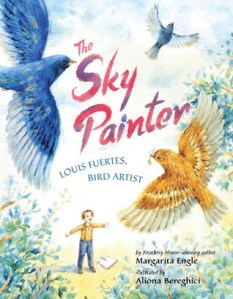
Review: The Sky Painter by Margarita Engle

Sky Painter by Margarita Engle

The Sky Painter: Louis Fuertes, Bird Artist by Margarita Engle, illustrated by Aliona Bereghici (InfoSoup)

Told in verse, this nonfiction picture book celebrates the life and work of Louis Fuertes. As a child, Louis loved watching birds and caring for them if they were injured. Even in his youth he started drawing and painting birds, despite the fact that his father wanted him to be an engineer. He kept drawing and painting in college, and learned to paint quickly and capture birds in action. At the time, the practice was to hunt the birds and then paint the dead bodies posed. Fuertes instead watched birds in life and painted them. Soon he was traveling the world to see different birds and paint them for museums, books and scientific record. Fuertes painted murals at the Natural History Museum and had a series of collectible cards with his paintings of birds on them. He helped make bird watching one of the most popular sports in the world by reinventing the way artists approached painting wildlife.

Engle speaks as Fuertes in her poems, giving him a voice to describe his own life and his own art. The book swirls like birds wings, moving from one colorful part of the world to another, delighting in the diversity of bird life everywhere. The format is rather like Fuertes’ work itself. She captures Fuertes in his real life, speaking as himself, traveling around the world, and then settling down to be the Bird Man in his old age. He is in his natural habitat throughout. Engle also captures the power of art and the importance of following the natural gifts you have.

The illustrations by Bereghici are bright with color and filled with birds. She labels each one, so that readers can learn about the different types of birds along the way. The book is filled with different habitats, even showing Fuertes underwater attempting to learn more about ducks so that he doesn’t have to shoot them. The illustrations of the birds are serious and detailed while there is often a playfulness to Fuertes’ image on the page.

A beautiful celebration of an artist who forever changed the way that birds and wildlife are painted. Appropriate for ages 7-9.

Reviewed from library copy.

Review: Woodpecker Wham! by April Pulley Sayre

Woodpecker Wham by April Pulley Sayre

Woodpecker Wham! by April Pulley Sayre, illustrated by Steve Jenkins

In brief stanzas of rhyme, this nonfiction picture book looks at the habitats and lives of a variety of different species of woodpecker. Starting with finding food, the book explores woodpeckers eating insects and sap. Then woodpeckers bathe and preen. They create homes by digging holes in the bark of trees. They hide from hawks. They lay eggs and the chicks hatch, forcing the adult birds to scrounge for food for them. The fledglings start trying to fly and then fall comes and once again woodpeckers are searching for food and shelter to get them through the winter.

Sayre and Jenkins continue their partnership that started with Eat Like a Bear in this new book. Sayre writes with a light hand, creating a sense of exploration and wonder around these backyard birds. Children will learn some things from the brief poetic text and there is a lot more information to be found on the back pages where individual species are identified and all of the subjects are expanded upon.

Jenkins continues to create illustrations that amaze. With his cut paper collages, the illustrations pop on the page as the birds fly, hide, peck, eat and reproduce. I love that the color of the sky changes from one page to the next, creating moments in time rather than one continuous time period. The result are illustrations that stand on their own in terms of beauty and the incredible detail that they offer readers.

Beautiful and informative, this nonfiction picture book will have children gazing out of their windows to try to see the birds in their neighborhood. Appropriate for ages 4-7.

Reviewed from copy received from Henry Holt and Co.

Review: Spots in a Box by Helen Ward

Spots in a Box by Helen Ward

Spots in a Box by Helen Ward

A guinea fowl is worried about his lack of plumage design, so he sends off for spots in the mail. They come wrapped in brown paper and string, something that always makes a package more intriguing. But inside, they are not the spots he expected. They are too big for his taste. Luckily though, more spots arrive. Some are too small, others too sparkly. Still others glow in the dark! But eventually after looking at lots of different options, our protagonist picks out some spots that are just perfect and they may not be what you may have expected. Yet they are just right for him.

Ward has written a winning book. Written in rhyme that is never forced but feel very natural, this book is a pleasure to share aloud. The real focus here are the illustrations and those are what make the book so interesting. A large part of the joy here is the silliness of a bird shopping for spots. That is made all the more fascinating because our guinea fowl hero is drawn very lifelike and reacts like a bird would. It is a delightful mix of reality and the rather farcical humor of shopping for dots and spots.

This book is about design and personal style without it being about pink things and tulle. So it’s a very refreshing addition to book shelves where children who have different tastes will find themselves imagining what spots would suit them in life. The design of the book itself is lovely with nods to leopard print and playful die cut pieces at times.

Very young readers will find lots to love here with pages that sparkly and some that have raised spots. It’s also a great book to inspire drawing or discussions of style. Appropriate for ages 3-5.

Reviewed from library copy.

Review: Sweep Up the Sun by Helen Frost

sweep up the sun

Sweep Up the Sun by Helen Frost and Rick Lieder (InfoSoup)

The pair who created Step Gently Out return with another gorgeous book connecting young readers to nature. This picture book focuses on birds and flight, using the metaphor to encourage young people to “fly” themselves and spread their own wings in life. The poem at the heart of the book is simple and lovely, creating a sense of wonder and opportunity. The photographs dynamically capture eleven species of birds in flight and in their natural habitats. There are wide-mouthed babies in the nest and incredible pictures of birds in full flight, like the one on the cover. This is a book that inspires both in words and images.

Frost is a gifted poet who has written novels in verse for older readers as well as picture books for younger readers. Her words here create a positive feeling of strength for the reader, showing them what is possible. At the same time, her poem is also beautifully written, creating imagery that is tangible and that will make sense for children. One of my favorites is that wings are “stitching earth to sky with invisible thread.”

Lieder’s photographs are simply stunning. He has captured birds in poses that are dramatic and amazing, leaving plenty of dappled light and green on the page for the poetry to shine next to his images. I found myself leaning into the book to look even more closely at the structure of wing and feather on the page.

I hope there will be more collaboration between these two since their first two books are so noteworthy. This vibrant picture book will be at home equally in units on birds and poetry. Appropriate for ages 5-8.

Reviewed from library copy.

Review: You Can Do It, Bert! by Ole Konnecke

you can do it bert

You Can Do It, Bert! by Ole Konnecke (InfoSoup)

Bert is ready, he knows just what to do.  He approaches the end of the branch, and… decides he needs a running start. Here he comes! Wait, he’s got a banana for a snack. He looks over the edge again and after a little yelling from the narrator in encouragement, he dashes right off the end of the branch! He’s worried on the way down, down, down until he hits the water. The other birds are right there saying they always knew he could do it and together they head up to jump off again.

This wonderful twist on a first flight book will take children by surprise. The book captures the dread and then the wonder of taking a plunge in life, literally. Children who are trying new things will find encouragement in this little orange bird who has enough personality for multiple books. Throughout the text is spare and told in the voice of an observing narrator, who uses all sorts of tones to encourage the little bird on his way. This makes for a great read aloud.

The art too is simple and bright. Most of it is Bert alone on the one branch, with plenty of white space around him. Readers will envision right from the beginning Bert launching into that blankness and flying off. It is the space around the illustrations that help with the subtle deception and assumptions. It’s cleverly designed and will work well with groups of children thanks to its large format and clarity.

Great read aloud and a great addition to story times and units on taking risks. It will also make a great one to mix into books on flying! Appropriate for ages 3-5.

Reviewed from library copy.

Review: Counting Crows by Kathi Appelt

counting crows

Counting Crows by Kathi Appelt, illustrated by Rob Dunlavey (InfoSoup)

This playful picture book comes from the author of The Underneath and other novels for older children. This counting book does not move from one to twelve, but instead starts at three and allows a merry amount of counting along the way. Throughout the action is led by the crows who climb around on trees, sit on lines and find all sorts of treats to eat, including spicy ants. The story moves forward with counting until there are twelve crows who then discover one cat!

Appelt proves that she can be a very successful writer for any age of child with her first picture book. Her rhyme reads aloud so well that it’s impossible to read it silently to yourself. It has a great rhythm and buoyancy to it, giving the book a really dynamic energy and feel. I also enjoy a book that has counting in it, but isn’t solely a counting book. This one tells a full story in a cheery way and allows you to share it either as a story book or a concept book.

The illustrations truly make the book unique. Using light drawings with touches of red, the book pops. Readers may notice the one scarf-wearing crow who appears in each scene and then they can see what happens to the scarf after the cat appears. It’s a nice touch that may have some readers turning back to trace the scarf from the beginning of the book.

Bouncy, rhyming, fun and jaunty, this picture book has its own unique tone and feel that readers will appreciate. Appropriate for ages 2-4.

Reviewed from copy received from Atheneum Books for Young Readers.