3 Picture Books to Make Your Heart Soar

Papilio by Ben Clanton, Corey R. Tabor and Andy Chou Musser (9780593693254)

Three well-known children’s book creators have come together to each tell part of the story of the caterpillar, chrysalis and butterfly life stages. Papilio starts life bursting out of her egg. She eats leaves but then falls to the ground. She can’t reach the enticing strawberry above her without some help from a friendly mouse. In her chrysalis, she is safe and sound or so she thinks. A robin gets a bit too interested in her and it’s that same friendly mouse who rescues her. Finally, as a butterfly she finds getting to the flower a little more challenging than she thought. Luckily, the mouse is there again to lend a paw. Seeing the stages done in different but supportive art styles is a real pleasure.

Young readers will enjoy the energy and action in each stage. Appropriate for ages 3-5.

Reviewed from library copy.
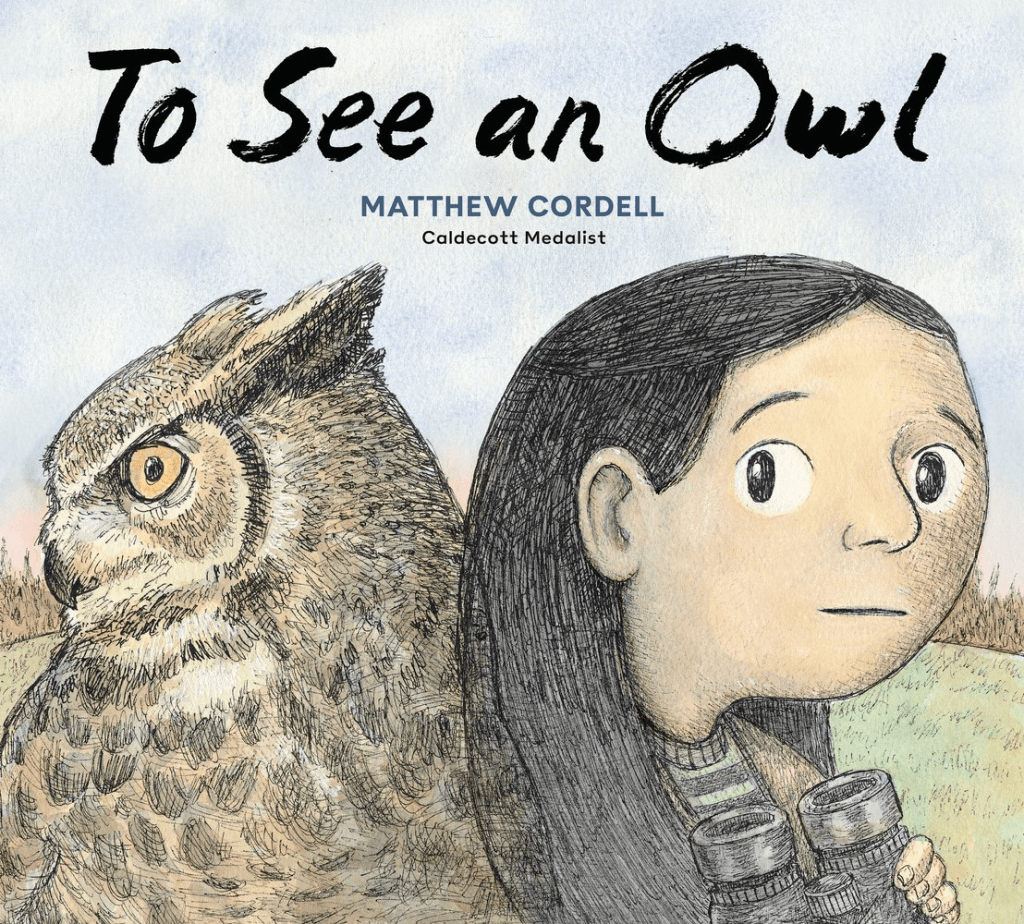
To See an Owl by Mathew Cordell (9780593649893)

Janie loves owls and dreams of being able to see one in the wild. Her teacher this year is a birder and his favorite birds are owls too. She tries to find an owl, learning about whitewash and pellets, listening hard and keeping an eye out. She even heads into the woods at night with her mother, but no owl is found. Months go by and Janie brings in her collection of owl information and shares it with her class. Her teacher is amazed and shows her on a map where he saw a pair of great horned owls. Could this be the clue that Janie needs?

This quiet picture book speaks to the importance of persistence and patience when entering nature. Watching Janie’s knowledge grow organically throughout the book is a treat. Cordell’s signature fine-lined drawings offer a glimpse of nature, Janie’s family and her search for the elusive owl. 

Appropriate for ages 4-7.  Reviewed from library copy.
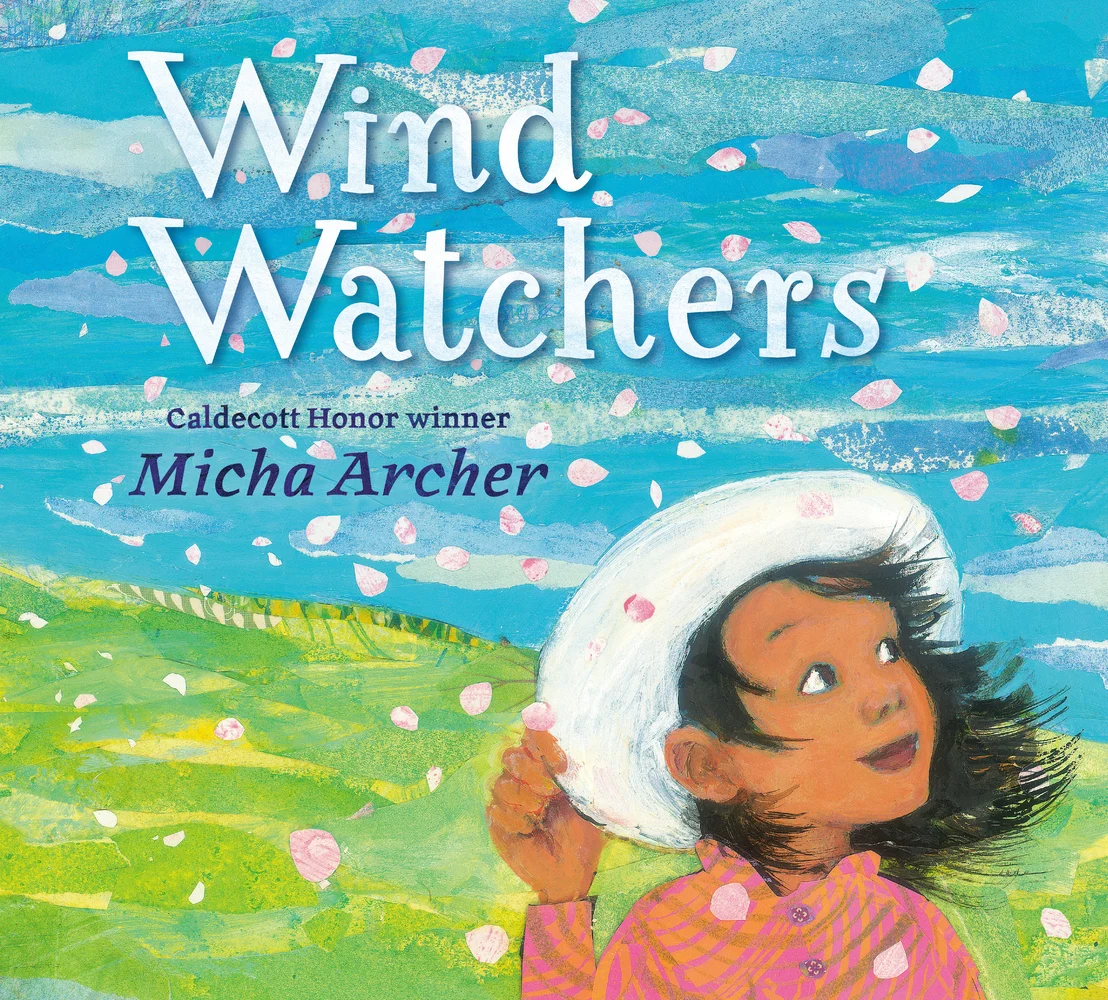
Wind Watchers by Micha Archer (9780593616550)

Wind blows in a variety of ways. Fluttering spring blossoms, bringing spring showers. It helps fly kites and ripples the pond on hot days. Sometimes Wind brings a surprise thunderstorm. In fall, Wind scatters seeds and blows leaves off trees. Winter wind brings icy cold and blizzards. Celebrate the seasons with this joyful interaction between children and the wind. Written and illustrated by Archer, a Caldecott Honor winner, the illustrations are done in inks and collage. The nature scenes and the rain fall are particularly striking and will draw young readers in. 

Appropriate for ages 3-5. Reviewed from library copy.

Butterflies Belong Here by Deborah Hopkinson

Butterflies Belong Here by Deborah Hopkinson

Butterflies Belong Here by Deborah Hopkinson, illustrated by Meilo So (9781452176802)

A Latina little girl has moved to the United States, discovering that she acts like a caterpillar and hides in the back of the class since she can’t speak English. In the summer, she looks for monarch butterflies, but can’t find any even in the community garden. In fall, she finishes her book about monarch butterflies. Able to read better now, she learns that the monarchs need milkweed to survive. Encouraged by her school librarian and inspired by the monarch’s migration, she forms a plan that she presents to her class. It’s hard to stand in front of the class and speak in English, but she really wants to plant a migration station for the monarch butterflies. Soon they are all working together, led by her, to create the station. She feels herself evolving now, into a citizen activist who stands at the front of the crowd.

The parallels between the narrator’s experience and that of the monarch butterfly offers a great framework for this picture book. Those connections are not overplayed, rather they form the reason that this little girl finds solace in studying butterflies. Interspersed throughout the book are excerpts from the nonfiction book on butterflies that she is reading. It’s a clever way to offer information in a separate and clear way.

The illustrations show a girl finding her way in a new country and a new city. The transformation in her body language as she becomes more confident and finds her voice is profound in the illustrations. By the end, she glows on the page alongside her garden.

An inspiring look at how to help butterflies but also how to find your voice. Appropriate for ages 5-7.

Reviewed from copy provided by Chronicle Books.

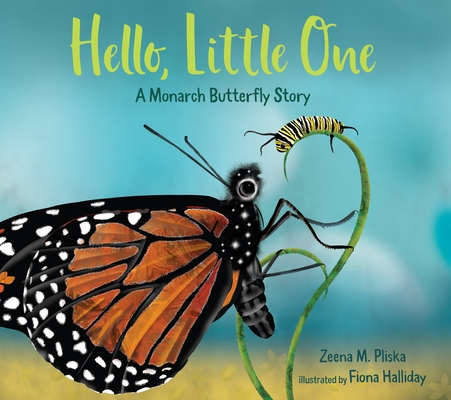
Hello, Little One: A Monarch Butterfly Story by Zeena M. Pliska

Hello, Little One A Monarch Butterfly Story by Zeena M. Pliska

Hello, Little One: A Monarch Butterfly Story by Zeena M. Pliska, illustrated by Fiona Halliday (9781624149313)

Caterpillar’s entire world is filled with green after he leaves his egg. Then something orange arrives, soaring high above. Caterpillar calls out to the flying orange thing, but it doesn’t stop. Later, Orange lands nearby to sip nectar from a flower. Caterpillar is eating a leaf nearby. The two spend time together, Orange talking about how they used to feel as a caterpillar and Caterpillar longing to be more like Orange someday. Orange tells all sorts of stories of the things they have seen as they fly. Soon it is time for Caterpillar to form their chrysalis. Orange explains that they won’t be here when Caterpillar emerges. Once caterpillar emerges, they too are a monarch butterfly and are ready to inspire another tiny caterpillar on their journey.

Pliska writes with a tenderness in this picture book. Her words look at the wonder of a new world filled with green leaves and the promise of eventual flight. She creates a natural connection between the two characters who clearly enjoy their shared company. The beauty of the change from caterpillar to butterfly plays out against the sadness of Orange  not being there. These quiet and aching moments create quite a special book.

The illustrations in this book are done in traditional and digital mixed media. The colors are so vivid and deep. They are large enough to work well with a group, focusing on the bright colors of the caterpillar and butterfly and also the greens and blues of their surroundings.

A marvelous book about butterflies, their life cycle and the circle of life. Appropriate for ages 4-6.

Reviewed from copy provided by Page Street Kids.


Review: The Very Impatient Caterpillar by Ross Burach

The Very Impatient Caterpillar by Ross Burach

The Very Impatient Caterpillar by Ross Burach (9781338289411)

When it’s time for the caterpillars to make their cocoons and metamorphosize, one caterpillar isn’t clear what is actually going on. To make matters worse, he’s also quite impatient about the entire process. Once he starts his metamorphosis, he just can’t wait the entire time and pops out before he has changed at all. He rebuilds his cocoon, but continues to complain the entire time and ask whether it’s time to emerge yet. Happily, the second time, he does become a butterfly but his impatience isn’t cured quite yet.

Burach writes this picture book entirely in dialogue, showing both the impatience of the main character and the exasperation of those around him. Thanks to a high level of humor in the book, the main character is more funny than troublesome. Children will see their own impatience in him. I also deeply appreciated that he didn’t change at all by the end of the book, even after changing into a butterfly. The art is big and bold, filled with bright colors and lots of energy. It is ideal to share with a group.

A great mix of humor and STEM. Appropriate for ages 2-4.

Reviewed from library copy.

The Island at the End of Everything by Kiran Millwood Hargrave

The Island at the End of Everything by Kiran Millwood Hargrave

The Island at the End of Everything by Kiran Millwood Hargrave (9780553535327)

Ami has grown up on Culion, an island in the Philippines filled with people who have leprosy, like Ami’s mother. Ami loves her home, the others who live there with her, the kind nun who helps everyone out. But then things change and new government rules are implemented. Ami and her mother must be tested to see if Ami is also “Touched” with the infection. When Ami is declared to be free of leprosy, she is taken with the other children to a neighboring island and placed in an orphanage. Watched over by a cruel man who is terrified of disease and by extension hates the children from Culion, Ami slowly makes new friends, longing for news from home. After finding a letter withheld from her, Ami makes a desperate journey to see her mother once more.

Using butterflies as a beautiful metaphor throughout the book, one of strength and fragility, Hargrave has crafted a book that looks past the surface level of leprosy and deeply at the people who suffer from the infection and those who love them. Throughout the book, butterflies emerge from cocoons, appear suddenly and inspire those who see them, die at the hands of a collector, and eventually form a way of life. There is a resilience throughout this novel, a tale of overcoming not leprosy but expectations and limitations of all sorts.

The setting of Culion and the Philippines is brought lushly to life on the pages. From journeys through the jungle with its fruits, fish and streams to the coral reefs that tear at boats to the colony itself, each place is drawn with care. The setting is evoked through sounds, scents and sight.

A complex book that takes a deep look at grief, loss, courage and family. Appropriate for ages 9-12. (Reviewed from e-galley provided by Edelweiss and Alfred A. Knopf.)

Review: Handle with Care by Loree Griffin Burns

handle with care

Handle with Care: An Unusual Butterfly Journey by Loree Griffin Burns, illustrated by Ellen Harasimowicz

When I started this book, I expected a beautiful book about the life cycle of butterflies, but then discovered this was so much more!  In Costa Rica there is a farm that raises butterflies.  The book begins by showing what a container received in the mail that is full of butterfly pupae looks like.  The life cycle of butterflies is explained as is the pupa stage in particular.  Then we head to Costa Rica and the farm itself and here is where the book turns into an amazing tour of sustainable butterfly farming.  Readers get to see inside the greenhouses where the butterflies live and lay their eggs.  The roles of the farmers are shown in detail as is the beauty of the natural world around the farm.  Food for the butterflies, their transformation from egg to caterpillar to pupa, and the harvesting process are all detailed out for the reader.  This book takes a familiar yet captivating transformation and turns it into a trip to Costa Rica and back again.

Burns text is very engaging.  She describes the processes in detail but also throws in words that show how she too is excited by what is happening.  Cabinets are described as “crawling with caterpillars” and the pupae are “sturdy and tightly sealed…ingenious packages ready to travel.”  Her own delight at what is being described is evident and makes for very pleasurable reading.

The photography by Harasimowicz is simply beautiful.  All of her work is not only clear and crisp but also demonstrates the various steps in the process.  She uses different perspectives and different levels of distance to create a dynamic feel throughout the book. 

A wonderful and lovely surprise of a butterfly nonfiction book, this one is a superb pick for butterfly fans and library collections.  Appropriate for ages 7-10.

Reviewed from digital galley received from Netgalley and Millbrook Press.

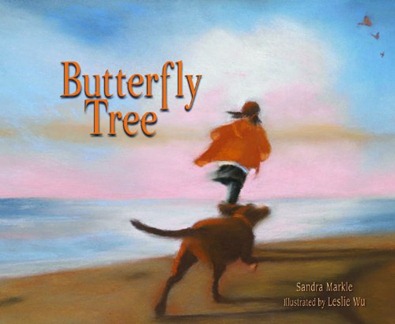
Review: Butterfly Tree by Sandra Markle

butterfly tree

Butterfly Tree by Sandra Markle, illustrated by Leslie Wu

A girl is playing at the beach in early September when she sees something odd in the air.  At first it looks like black pepper raining down, then it turns into a shimmering orange cloud.  Jilly runs to get her mother because she is scared of what it might be.  Her mother heads toward the beach and then to the neighboring woods.  As they walk, Jilly tries to figure out what the cloud might be.  As they enter the dim, cool woods she tries to spot orange things.  She sees an oriole and a kite, and then a tree that is completely orange.  It’s not until her dog rushes at the tree chasing a squirrel and the monarchs fly into the air that she realizes that the orange are monarch butterflies on their migration.

Markle has written this book in very evocative language, describing what Jilly is seeing with details.  The book is in verse, so the language is just right, creating a sense of mystery and wonder that readers are sure to feel clearly as they read.  The imagery here is clear and well drawn, comparing the butterflies to clouds and jewels.  Markle also draws the setting very clearly, showing the touch of sand on feet, the chill of the woods after the beach, and the play of light and dark in the woods.

Wu’s illustrations add to the beauty here.  Her pictures range from hazy, long-distance looks at the shore to the soft close-ups of the girl and her mother.  Everything is soft and filled with rich colors of fall.  The author’s note at the end of the book has information on Markle’s own experience with migrating monarchs as well as other resources for more information.

This is a perfect book to share in the autumn, but children will enjoy it year round.  The stellar writing and rich illustrations create a book that is impressive and enjoyable. Appropriate for ages 4-6.

Reviewed from copy received from Peachtree Publishers.

Review: A Butterfly Is Patient by Dianna Hutts Aston

butterfly is patient

A Butterfly Is Patient by Dianna Hutts Aston and Sylvia Long

This third book in their series together continues the beautiful detail and natural information of A Seed Is Sleepy and An Egg Is Quiet.  Here the subject is butterflies and the book begins with the egg and caterpillars, moving quickly into metamorphosis with the clear knowledge of where exactly children will be intrigued.  The book speaks to butterflies’ roles in pollination as well as their camouflage, drinking, and poisonous capabilities.  Readers will be intrigued with the scaly close-up of a butterfly wing and with the long-travels of the migrating monarch.  This book is full of great details that will have everyone understanding that butterflies are many things as well as lovely to look at.

Aston and Long create books that have readers lingering.  When I share them with my son, we take our time on the pages, talking about our favorite names of the butterflies, our favorite caterpillars, the most lovely butterflies.  He has used the fact about butterfly scales on their wings at least twice in conversations I have overheard since we read this.  When we found a dead monarch in our driveway, he was elated to be able to touch the wing and talked about how it felt “as soft as air” for a long time afterwards.

These are gateway to science books, offering just the right tone and perfectly selected facts.  Add the illustrations that are large, interesting and filled with details.  You now have the ideal package to get children interested in the nature right in their own backyards.

If you haven’t read any of these books, run to your library and get them!  This is one gorgeous and inviting look at butterflies.  Appropriate for ages 6-8.

Reviewed from library copy.

Also reviewed by:

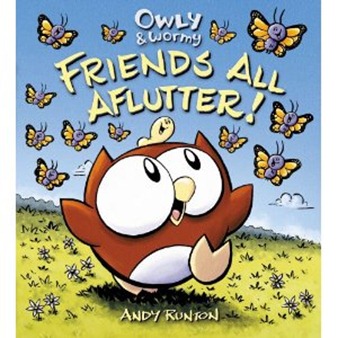
Owly & Wormy: Friends All Aflutter

owlyandwormy

Owly & Wormy: Friends All Aflutter by Andy Runton

The popular Owly graphic novels make their picture book debut with this colorful new story.  Owly and his best friend Wormy want to make friends with some butterflies.  So they plant a milkweed plant, hoping to attract some.  All they manage to attract are some bugs that are definitely not butterflies and that are munching on the milkweed leaves.  Owly and Wormy make friends with the bugs instead until one day the bugs have to leave.  Now Owly and Wormy are left alone.  They wait and wait for their friends to return.  When they eventually do come back though, Owly and Wormy don’t recognize them!

Runton’s friendly and funny Owly graphic novels are some of my go-to graphic novels for younger children.  This new book makes the Owly stories available to even younger readers.  With the wordless format, this is a book that will appeal to children just about to become readers themselves. 

Add the bright colors to the illustrations and you have a very appealing book that is about friendship and metamorphosis.  The cartoon-like illustrations filled with smiling faces large and small are very friendly themselves.  The illustrations run from two-page spreads to smaller more graphic-novel-like images that read as panels.

This book takes graphic novels to the youngest readers and introduces them to a friend that they can share adventures with for years to come.  Appropriate for ages 4-6.

Reviewed from copy received from Simon & Schuster.