Review: Here I Am by Patti Kim

here i am

Here I Am by Patti Kim

This wordless picture book is the story of a boy and his family coming to an American city.  The signs don’t make any sense, the crowds are huge.  It’s noisy and big and confusing.  In the boy’s pocket is a red object from home.  It reminds him of what he left behind whenever he holds it in his hand.  He spends a lot of time at home, not interacting with anyone until one day, he drops his keepsake out of the window where a girl picks it up.  The girl heads off and the boy follows her and along the way discovers the greener parts of the city, food he recognizes, and people who are friendly.  In the end, he’s planted himself firmly into this new place.

Told entirely in pictures, this wordless book is written by a person who lived through this experience when they came to America from Korea forty years ago.  The book has an honesty that runs through it and nicely shows the time that it takes for someone to even see the positive in a new place.  It addresses the overwhelming feeling of homesickness and the jarring loss of language that isolates.  Beautifully illustrated, this book is one that has intricate images that come together to form a cohesive and powerful whole.

A remarkable capturing of the immigrant story, this book will speak to those who are immigrants and will also help others understand what children from other countries are going through.  The choice to make it wordless makes it all the more useful with immigrant populations in our communities.  Appropriate for ages 4-7.

Reviewed from digital galley received from NetGalley and Capstone Young Readers.

Review: The Other Side of Town by Jon Agee

other side of town

The Other Side of Town by Jon Agee

A New York taxi driver picks up a rather odd passenger who asks to be taken to Schmeeker Street on the other side of town.  They reach a dead end, but that is not the other side of town yet.  The man pulls out a remote control and the dead end opens into a tunnel, the Finkon Tunnel.  The tunnel leads to a maze of ramps that twist and turn, ending in spotholes.  The driver tries to avoid them, but accidentally drives into one of the large black holes from which they are dumped onto Schmeeker Street.  Suddenly everything is pink and green, just like the man.  Finally, they reach his destination but the cabbie is caught on the other side of town until he notices the remote control left in the back seat.  But yet another surprise is waiting for him when he gets home!

Agee plays with our expectations with a great sense of fun in this book.  Renaming landmarks into something very similar but yet strange and different was a great choice.  The tone is entirely one of silliness and laughter with just enough being different and zany to make it clear that the other side of town is unlike anywhere readers have ever been.  It is through this that Agee subtly demonstrates that there are paths to cultural acceptance for those who are different from us.

The color palette of the other side of town also plays a large role in the story.  Immediately readers will see the little man as unusual thanks to his pink plume and green bodysuit.  When the story moves to the other side of town, the cabbie suddenly pops in his pale blue against all of the pink and green.

Funny, silly and a treat, take a visit to the other side of the town!  Appropriate for ages 4-6.

Reviewed from copy received from Scholastic.

Review: Machines Go to Work in the City by William Low

machines go to work in the city

Machines Go to Work in the City by William Low

This is an inventive look at machines, combining it with large flaps to open and questions to engage.  Low looks at one machine after another that works in the city and then asks a question about it.  The questions are not simple either, this is not a book that talks down to its young audience.  Instead you have to think a bit.  Do the garbage men go home after picking up the garbage?  Can the crane operator still work when the building grows taller than the crane?  Is the airplane ready to leave when the passengers are on board and the baggage is loaded?  Little listeners get to turn the flap to learn the answer and the reason. The answer is given with a quick explanation and then the book moves on to the next machine. It’s just enough information for a preschooler to really enjoy.

Low has created a brisk pace here, never lingering too long and offering exactly the right amount of information.  This makes the book very readable, something that can be happily shared at bedtime unlike a lot of nonfiction vehicle books.  More information on each machine is offered at the end of the book, complete with labeled parts.  Those are pages that young truck fans will linger on.

Low’s illustrations are richly colored.  The painted textures add to them with some pages having individual bricks done solely in texture alone.  At other times, the sleek metal stands out. 

A great pick for your own little machine fan or for public library shelves.  Don’t let the flaps scare you off, they are large and just as durable as a regular page.  Appropriate for ages 3-5.

Reviewed from library copy.

The Honeybee Man: The Beauty of Bees

honeybeeman

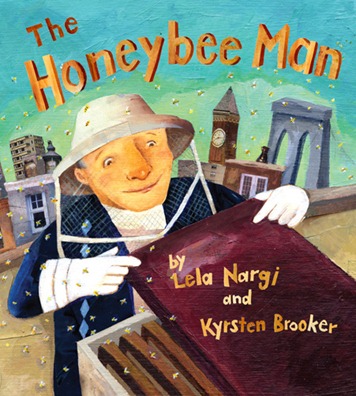
The Honeybee Man by Lela Nargi and Krysten Brooker

On a quiet summer morning, Fred heads to the roof of his home in Brooklyn where his bee hives are.  With his cup of tea, he spends time with the bees, thinking about the honey they will make for him.  He imagines flying like a bee and looking for nectar.  He encourages the young bees to have courage on their first flights.  He celebrates the older bees as they throw themselves into the air, some stopping to land on his sleeves first to greet him.  He knows they will return full of nectar that then will be made into honey by others in the hive.  At the end of August, Fred harvests the honey from the hives, resulting in golden jars of sweetness that he shares with his neighbors.  This is a book about communities large and small, interwoven together.

The language in this book is lovely and evocative.  It is a book that creates small moments of celebrations.  Here is a passage of Fred’s morning in July greeting the bees:

Fred inhales the smells of a summer city morning: maple leaves and gasoline and the river and dust.  He turns to the tiny city and inhales its smaller, sweeter smell – a little like caramel, a little like ripe peaches.

All of the senses are filled with the experience of urban bee keeping in this book.  It is packed with these sensory moments.  The language is poetic and beautifully detailed.

The mixed-media illustrations have a whimsical feel to them.  Just as the book itself does, they celebrate Brooklyn, urban life, and the bees.  There is a homey, warm feel that is often lacking in books about cities that is a pleasure to see.

Celebrate bee keeping, city life, and community with this book.  Appropriate for ages 4-7.

Reviewed from copy received from Random House.

Welcome to My Neighborhood! A Barrio ABC

173

Welcome to My Neighborhood! A Barrio ABC by Quiara Alegria Hudes, illustrated by Shino Arihara

This alphabet book, from the author of the musical In the Heights, takes a gritty and realistic look at urban life that will be familiar to many children while exposing other children to a new setting.  Ava takes her friend on a tour of her neighborhood and many words in Spanish.  She starts with a hug for her abuela and passes through G for graffiti, M for los muralistas painting murals on the walls, V for vegetables in what used to be a vacant lot, and ends at Z Street where the cars zoom past.  Ava adds lots of small details to her alphabet tour that really show her enthusiasm for her neighborhood as well as giving the reader more details about her home.  This is a tour worth taking!

This book does not sugarcoat what you will see in an urban neighborhood with abandoned cars, graffiti, and a burned building.  But for children who see these things in their own neighborhoods, they will find a picture book that depicts their own world, something invaluable for a child.  The Spanish words add a great rhythm to the book and another layer of information.  Airhara’s illustrations use a lot of open space, emphasizing the stretches of blocks, the expanse of the city.  They are simple and have a pleasant mix of bright color and earth tones. 

A book that fills a need in children’s alphabet books for books set in urban locations, this will be welcomed on library shelves.  Appropriate for ages 3-5.

Reviewed from copy received from Arthur A. Levine Books.

Related articles

Enhanced by Zemanta

When You Meet a Bear on Broadway

When You Meet a Bear on Broadway by Amy Hest, illustrated by Elivia Savadier

When you meet a bear on Broadway, you stick out your hand and ask them to stop.  Then you politely ask what his business is there.  He bursts into tears saying that he has lost his mother.  The two of you think of how to find her together.  Then you look uptown.  And downtown.  Along the river.  Until you find a forest where the bear climbs a tall tree and shouts for his mother.  But will a mama bear be able to hear him in the middle of a bustling city?

Though the styles are very different, this has the feel of Laura Numeroff’s If You Give a Mouse a Cookie feel.  It is the short lines and the repeating phrase of “When you meet a bear on Broadway.”  Hest takes this form and creates a book about being lost, being helped, and being found.  There is never any sense of panic about the child helping the bear.  It is far more of a problem solving book about what to do when you find a bear on a city street. 

The book has a nice bit of old-fashioned whimsy about it though the setting is modern.  Savadier’s illustrations contribute to this with their gentle lines and watercolor washes.  The little girl and the bear are often the only bright color on the page, magnifying their relationship rather than the largeness of the city itself.

Funny, quiet and very satisfying, this book would be nice paired with any of Numeroff’s If You titles.  It also offers a nice change of pace for any bear-themed stories.  Appropriate for ages 3-6.

Reviewed from library copy.

Also reviewed by A Patchwork of Books.