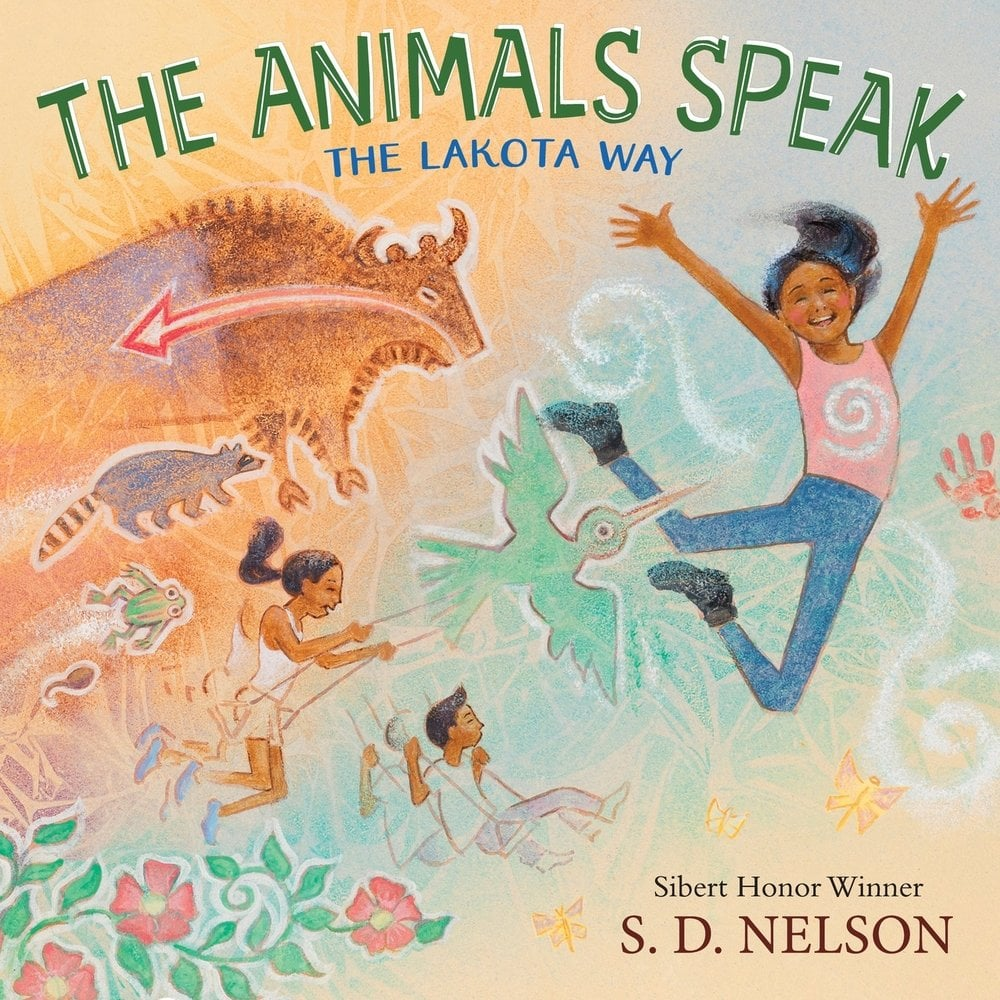
Lakota author and illustrator, Nelson offers a look for children at the Lakota way and beliefs around animals. For those who pay attention, animals offer wisdom and a connected spirit line. The buffalo teaches sharing and generosity since he gave his life for people to have hides and food. With his transformation from egg to tadpole to frog, Frog shows you that you can expect changes in your life too. Bear teaches that you should protect those who are smaller than you, while Coyote enjoys playing tricks and teaches you not to just follow along. After many animals, the book ends with two-leggeds and that we are all related animals and people.
With translations to Lakota that share the names of each of the animals as well as pronunciation guides, this book celebrates Lakota traditions and beliefs. The number of animals and what they teach us is impressive, each accompanied by glowing illustrations inspired by traditional Lakota pictographs and ledger-book drawings. They are done in striking colors with layered elements that add depth and texture.
A celebratory look at Lakota culture that all children can learn from. Appropriate for ages 3-6.
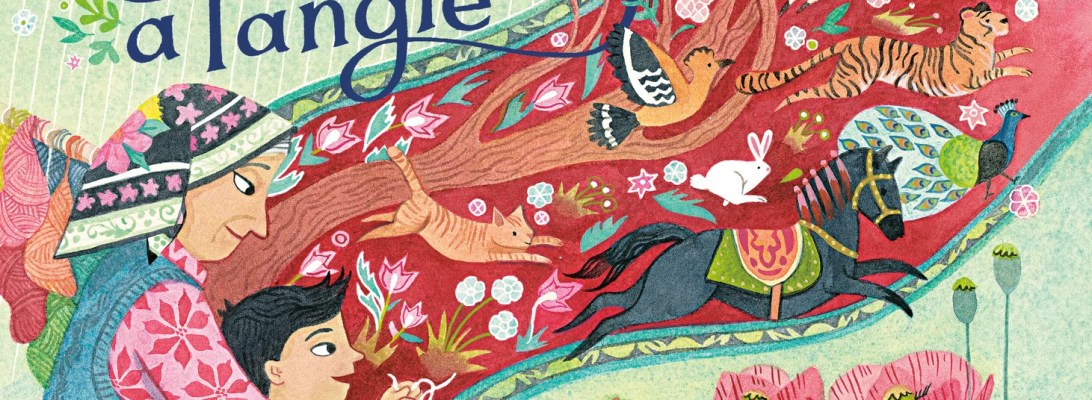
An Iranian boy is woken up by his grandmother. They have breakfast together on the old frayed rug before taking a meal out to Grandpa in the field where he is herding sheep. The three start planning to make a new rug. They wash the wool and card out the tangles. They spin it into wool that is dyed with local flowers. Then the design is plotted out on graph paper. Next they start weaving on the loom, creating Persian knots to hold tight. The boy learns to create knots and not tangles, until midway his grandmother adds the Persian flaw to keep it from being perfect. The new rug is finished and ready for new memories to be made.
Nayeri shows the art of Persian rug making through the eyes of a child, making not only the art itself accessible but also showing the love of grandparents along the way. The boy learns the craft and also the heart of making rugs, with specific emphasis on the Persian flaw and the lack of perfectionism. The art in the book captures the colors of the wool, the beauty of the flowers, and the lovely designs of both rugs that the family uses.
Family, warmth and art combine in a winning title. Appropriate for ages 3-5.
Jack lived with his grandfather in a house filled with music. There was music on the record player plus his grandfather played several instruments, including the guitar. Jack particularly loved it when his grandfather played the guitar, especially the song about the blackbird. Jack asked his grandfather to show him how to play the blackbird song, but first it took a lot of help and practice to even play a single chord. With encouragement from his grandfather, Jack kept at it and learned to play the guitar. As Jack got bigger and the guitar got smaller, he left home and played music all over the world. When he returned, his grandfather was different and this time it was Jack who showed him how to play.
Throughout this book, I could hear the song about the blackbird in my head, haunting and lovely. Children will want to hear that song after reading this book. The touching relationship between the two characters comes full circle by the end of the story as the grandfather grapples with dementia. The power and connectivity of music is on full display throughout the tale. James’ art is deeply organic yet accessible, showing the two characters as their relationship evolves and changes in the small blue house.
Sure to strike the right chord. Appropriate for ages 5-7.
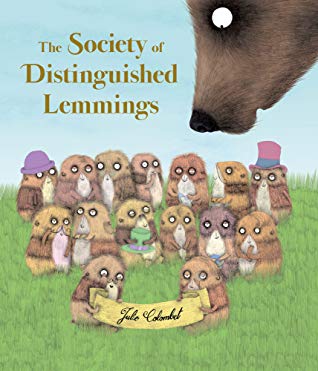
The lemming society had a lot of rules to follow in order to belong. In their warren of tunnels, there was no wild behavior, no growling, no rolling and no mud. Lemmings also had to walk on their hind legs and use utensils to eat. But Bertie got tired of all of the rules, the fine dining, the musical performances and the noise, so he headed up to the surface. When he got outside, he met a bear! After trying to get the bear to act like a lemming, Bertie tried the things the bear wanted to do. With the bear’s help, Bertie started to realize that he actually enjoyed things like rolling in the flowers, climbing trees and jumping in puddles. When Bertie is gone too long, all of the other lemmings come outside too. They try to change the bear and make him eligible to join the lemming society, but he doesn’t conform well to their rules. Eventually, they dismiss him to make their new plans and are off on a vacation as a group. When they are gone, Bertie realizes that they are headed for their doom! Perhaps a big bear could save them all?
The fussy and particular Society of Distinguished Lemmings is depicted here with plenty of peculiarities, a list of their rules, and other odd things that they insist upon. The fussiness and high expectations add up to a very stifling but also funny lemming existence. The introduction of Bertie and his quest for a new friend and a new way of life is refreshing. A bear is just the right creature to be a little bit dirty and very active. The contrast between lemmings and the bear could not be clearer or done with more merriment.
The illustrations are cleverly done with plenty of details about the lemming society revealed through the images themselves. There are lots of little asides in the illustrations through speech bubbles that add to the whimsical nature of the rule-following lemmings.
A funny look at breaking the rules, making new friends and finding oneself. Appropriate for ages 3-5.
Reviewed from ARC provided by Peachtree Publishing.
This wonderful collection of poems and illustrations speak directly to the poets’ cultural heritage. Each poem looks deeply at family and identity, whether it is being asked where you come from or meeting a family member for the first time. Some of the poems show the fear of being African-American in America, the oversimplification of race when filling out forms, the way food can bring people together, and the joy of summer nights. The illustrations paired with each of the poems highlight the wide variety of cultures and heritages in the texts. The result is a rainbow of skin tones and colors, weaving together to create a book that reflects the vastness of our country.
The poems and illustrations in this book are very impressive. As they play through the authors’ memories of their childhoods and the variety of emotions those memories evoke, the reader gets the pleasure of visiting each author’s experience. Poetry always gives a more concentrated look, a deep feel for the author, and that is certainly the case here. The illustrations are wonderful, each self-contained and presented almost as a treasure to discover along this journey.
A great compilation of art and poetry that celebrates diversity and inclusion. Appropriate for ages 7-10.
Reviewed from e-galley provided by Lee & Low Books.
Priya lives with her family in the United States. Her’s is the only house in her neighborhood where an Indian family lives. Priya loves to help her grandmother make rotli for dinner when she gets home. As they make the flatbread, her Babi Ba tells her about India’s spice markets, the architecture, the noises of the traffic, and the monsoon rains. Their house has marigolds strung over the door just like those in India. Priya longs to see India for herself. When winter comes, Babi Ba doesn’t hang marigolds outside any more. Priya has an idea and soon her entire class is helping her make paper marigolds as she tells them about India.
Patel, who is Indian-American, tells a story that focuses on a family’s continued connection to their heritage while living in the United States. Priya is proud of her Indian heritage, loving to hear stories about India and its sounds and sights. Still, there is a sense of distance between her own heritage and the society around her, one that can be bridged by sharing stories. The art in the book is rich will the colors of spices. Deep greens and warm pinks add to the color palette too.
A celebration of Indian heritage and the strength of family. Appropriate for ages 4-6.
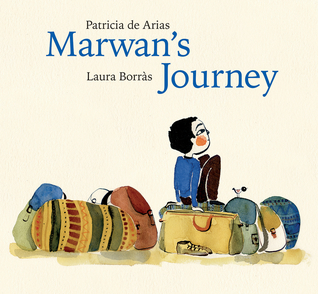
Marwan’s Journey by Patricia de Arias, illustrated by Laura Borras (9789888341559)
Marwan is a little boy on a long journey filled with walking and heading to a place he’s never been. When his home was attacked by soldiers in tanks in the middle of the night, Marwan had to start walking. He thinks often of his mother and father, their little house where they lived happily together filled with sunlight. Now he must walk through the desert to a new homeland carrying a pack of hope on his back.
This picture book is imported from Spain and has the feel of a European children’s book. The language used is poetic and beautiful, showing the emotions rather than telling about them. Here is one example from early in the book: “I walk, and my footsteps leave a trace of ancient stories, the songs of my homeland, and the smell of tea and bread, jasmine and earth.” You can feel it right in your bones. The illustrations have a gorgeous depth to them, filled with deep blacks and rounded out by earthen colors. Throughout the book there is a sense of peace and a hope of a better place at the end of the long walk.
An important book that beautifully captures the dangers and loss of a refugee child. Appropriate for ages 4-7. (Reviewed from copy provided by Edelweiss and Minedition.)
The illustrator of the incredibly popular Go the F*ck to Sleep has created a picture book that truly shows his skill. Told from the point of view of a shark, this picture book tells the unbelievable story of things in the air, above the sea, who are not birds. They are creatures with beards, with two ears, with hair. Creatures who hook sharks, take them out of the ocean and into the air, poke and prod them. Just to return them back to the sea, where no other creatures believe their tale of being taken.
In rhyming lines that have a humor and rhythm, the shark tells his story. The tale is accompanied with luminous paintings that show the beauty of the ocean, the many creatures who live there, and the drama of being taken out by researchers. Gorgeous illustrations accompany this shark’s tale and make for one dynamic picture book. Appropriate for ages 3-5. (Reviewed from e-galley provided by Edelweiss and Black Sheep.)
This book offers examples of untranslatable words from around the world. These are words that some cultures can use just one word to capture but in other languages it takes entire sentences to explain them. The words come from all over the globe, and while some may be familiar others are entirely surprising and fascinating. Perhaps the most interesting part is how these unique words offer a glimpse into the culture they come from. The illustrations of the book are show places and people around the world acting out each word. They are bright and friendly. The text offers the word, a definition and then additional information on where it comes from. Enjoy exploring words like nakama, tartle and gluggavedur! Appropriate for ages 8-11. (Reviewed from copy provided by Kane Miller.)
The lives of seven children from around the world are documented in this engaging nonfiction picture book. A child each from Italy, Japan, Iran, India, Peru, Russia and Uganda share their daily lives. They talk about what they eat, where they live, their schools, how they play and where they sleep. This is an intimate look at these children and their lifestyles that offers a way to look at how cultures are different but also how certain things are universal as well.
Lamothe worked with seven real families to create the book, showing photographs of them at the end of the book. The focus on concrete things that make up our lives offers a tangible way for children to see cultures and explore differences and similarities. It’s a clever way to invite children to explore and learn.
The illustrations are phenomenal and with their fine details offer the same sort of window as photographs. While it is great to see the photographs at the end, they offer a sort of confirmation that the illustrations truly have captured the lives of these children. These are illustrations to pore over and enjoy, allowing them to transport you around the globe.
Wonderful for classrooms and libraries, this nonfiction picture book is exceptional. Appropriate for ages 5-9.
This bright, colorful picture book shows cultural apparel from around the world. The book revels in the unique colors, structure, beading and design. Filled with images of children with smiling faces wearing their unique clothing, the book does contain some simple information on the clothes. They are grouped in categories like dance and play, school clothing, and celebrating who we are. The simple structure and basic information makes the book more appropriate for preschoolers than elementary students.
Because of the simplicity of the text, this book’s quality rests solely with the clarity of its images and the way they are presented. Happily, the book has photographs of children of a variety of races, dressed in gorgeous colors and clothing. They are shown on pages of equally bright colors that really add spice to the design.
A very friendly look at costumes throughout the world, this book is a solid addition to preschool nonfiction collections. It reminded me of looking through my mother’s Unicef calendars as a child. Appropriate for ages 3-5.
Reviewed from copy received from Charlesbridge Publishing.
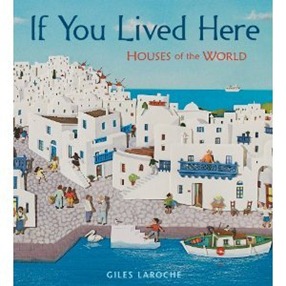
This book invites readers to explore the different types of houses that are lived in throughout the world. Beginning with the phrase, “If you lived here…” the book then describes some unique features of that particular type of home. There are homes that you would have to go outside to get to the kitchen, others where you would not have to go out to even get to the barn, others are built around caves, still others are close to water or surrounded by it. The book then defines the type of house, what materials it is made from, where this type of house is found, the date that this house first appeared, and a fact about them. The tone is kept light and interesting, which will invite young readers to explore this subject in depth.
Laroche’s writing is welcoming and light. He finds the most unique features of a home and describes them in simple and inviting ways. Even the information on the materials and location are kept short and contain only the most interesting details.
The illustrations, done in paper, have a three dimensional effect. The homes are done in exacting detail that includes individual shingles, decorative features, and even the ability to peer closely and see into the windows to the rooms beyond. There is a physical quality to this, creating almost a model effect where you lean in closer to see even more. The illustrations are a delight and truly bring the structures to life.
When I first started reading this book, I wondered who would be the audience for it. The entire book is so appealing that it will have no trouble being enjoyed by young readers interested in architecture, history, or travel. Appropriate for ages 8-10.