Review: Dog in Charge by K. L. Going

dog in charge

Dog in Charge by K. L. Going, illustrated by Dan Santat

Dog had been busy all day.  He had sat, stayed and even danced dressed in a pink ribbon and tutu.  But his entire day changed when he was left in charge of the cats when the humans left.  Dog knew just what to do.  He would have the cats sit and stay.  But before he could order the cats around, all five of them had completely disappeared.  One-by-one dog found the cats.  They were lapping milk on the kitchen counter, hiding in the fireplace, in the clothes hamper, in bed, and putting on makeup.  Dog had to think of something quick!  Then he had a great idea: cat treats!  Unfortunately, they smelled so delicious that he couldn’t help himself and ate the entire bag.  Then, exhausted and full, he fell asleep.  When the cats found him, you will never guess what they did next!

Going has a wonderful tone and patter for slapstick comedy.  Her timing is right on and makes the book a delight to read aloud.  She also puts on an unexpected ending that will warm the heart and makes the book all the more wonderful to share. 

Santat’s illustrations are done in a mixture of different types of frames that add a dynamic touch to the book.  At the same time, they bring to mind vintage cartoon characters and have all of their charm and wit. 

This jolly picture book would make a great addition to storytimes about either cats or dogs.  It’s one of those that you can hold until the end to make the little bodies stay still.  Appropriate for ages 4-6.

Reviewed from copy received from Dial Books for Young Readers.

Review: Kate & Pippin by Martin Springett

kate and pippin

Kate & Pippin: An Unlikely Love Story by Martin Springett, illustrated by Isobel Springett

When Pippin, a fawn, is abandoned by her mother, photographer Isobel Springett found her crying for help.  She took Pippin home and placed her by Kate their old Great Dane.  The two immediately bonded:  Pippin thought she had found a new mother and Kate started to mother her even though she had never raised any puppies of her own.  Pippin learned to drink from a bottle and when she got bigger started to adventure outside.  One evening, Pippin disappeared into the forest and didn’t return for bedtime.  Kate was very concerned, but the next morning Pippin came back just in time for breakfast.  Pippin returned to the woods every night after that, returning to the farm almost every morning to eat and play.  As she grew into an adult deer, she still continued to return to visit Kate and play.  She even still comes into the house once in awhile for a visit. 

This is one of the most lovely picture books about a relationship with a wild animal that I have seen.  I especially appreciate that Pippin was allowed to continue to be a wild deer, returning to the forest and being allowed to create a relationship on her own terms.  It’s definitely refreshing to see.  Here the human and dog were able to rescue, aid but also step back and not absorb this little creature.  The relationship that emerges is breathtakingly touching, seeped in fragility yet incredibly strong.

A large part of the success here are the photographs of this tiny deer bonding with the enormous dog.  By the end of the book, the animals are the same size.  It is clear that both of them adore one another on a deep level, and one that is delightfully separate from the humans. 

This nonfiction picture book reads like fiction, making it a great pick for a touch of nonfiction in a story time.  It’s a story that children will relate to easily and naturally.  Appropriate for ages 4-7.

Reviewed from copy received from Henry Holt and Company.

Review: Emily and Carlo by Marty Rhodes Figley

emily and carlo

Emily and Carlo by Marty Rhodes Figley, illustrated by Catherine Stock

When Emily Dickinson was 19 years old, she was lonely in the big home in New England since her siblings were off at school.  So her father bought her a puppy that she named Carlo.  The quiet and reclusive poet was an odd match with her bounding, huge Newfoundland.  Carlo gave Emily more courage to be out and about, visiting others.  He was with her always, a large drooling dog.  They explored Amherst together with its woods, meadows and ponds.  Their time together inspired her poetry, as shown in this book through stanzas that she wrote.  This friendship with a dog makes this literary figure much more human and approachable for children.  It’s a very special way to see an author.

Figley truly found the key to Emily Dickinson’s personality for children.  All it took was a large messy dog to break through into Dickinson’s quiet, contemplative world.  Interspersing the verse with the story also makes this a friendly window into Dickinson’s work.  The book maintains a fresh, light tone throughout, showing the two friends aging together.

Stock’s art is a radiant mix of playfulness and contemplation, matching the subject matter beautifully.  It shows the deep connection of woman and dog, the natural world they explored, and pays homage to the verse that is embedded in the book. 

A simply lovely look at Emily Dickinson through her love of a pet, this book should be used with anyone working with Dickinson’s poetry and children as a lens through which to view the person and her writing.  Appropriate for ages 6-8.

Reviewed from copy received from Charlesbridge.

Review: Little Dog Lost by Monica Carnesi

little dog lost

Little Dog Lost: The True Story of a Brave Dog Named Baltic by Monica Carnesi

Children along the banks of the Vistula River were the first to spot the little dog floating on the ice floes.  Firemen tried to help rescue the dog, but were unable to reach him before the river carried him away.  The river carried the dog into the Baltic sea where a ship arrived.  The crew members tried to rescue the dog, but it proved difficult.  At one point, the dog even slipped into the water but managed to pull itself back up onto the ice.  Finally, the crew managed to get a boat into the water and move close enough to the ice the dog was on and rescue him.  After warming up and getting dry, the dog was adopted by the crew and named “Baltic.”

This true story of a dog on the ice inspired the author to create a picture book demonstrating the heroism of both man and dog.  Unlike many nonfiction books, this is one that can be used with preschoolers and even toddlers.  The story is kept very simple, with only a few sentences on each page, making it move ahead quickly.  Add to that the drama of the floating dog and the fear that he will not survive and you have a picture book that is a real treat to read.

Carnesi’s artwork echoes that same child-friendly simplicity with its fuzzy dog.  The round-faced people are equally charming and inviting to young readers.  My favorite part was turning to the final page that tells more details about the rescue and recognizing the man holding Baltic from his depiction in the book. 

This entire work is charming, great fun to read, and also an inspiring story.  Appropriate for ages 3-5.

Reviewed from copy received from Nancy Paulsen Books.

Review: A Ball for Daisy by Chris Raschka

ball for daisy

A Ball for Daisy by Chris Raschka

Daisy, the dog, adores her red ball.  She plays with it and even sleeps next to it on the couch.  When her owner takes her for a walk, Daisy brings along her ball.  At the park, she plays and chases after it.  When it gets stuck behind a fence, Daisy frets until it has been retrieved by her owner.  But when another dog tries to play with Daisy’s ball… it pops!  Daisy is broken-hearted, carrying the tattered remains of her ball.  And there is nothing that will make her feel any better.  Or is there?

This wordless book works because of the gorgeous illustrations.  Daisy is a black-and-white dog and her world is colorful and bright.  From the bright red of her ball to the striped couch in green, the book embraces color.  Raschka also uses color to convey emotion, which is particularly effective when the air itself is colored with purples and blues after Daisy’s ball is popped.  Before that, the background was done in pale blues and yellows, light and airy, even playful. 

The storyline is clear with the illustrations filling double page spreads or broken into panels.  Children will immediately relate to Daisy’s loss of a favorite toy and to her emotions throughout.  It is a book that naturally leads to discussion of when the child lost something, or something was broken, and the way that they felt about it.

A winning wordless read, this book is a joy to share with children or perhaps with your favorite furry friend.  Appropriate for ages 2-4.

Reviewed from library copy.

Also reviewed by:

Review: Mr. Putter and Tabby Ring the Bell by Cynthia Rylant

ring the bell

Mr. Putter and Tabby Ring the Bell by Cynthia Rylant, illustrated by Arthur Howard

When autumn arrives with apples, falling leaves and cool wind, Mr. Putter finds that he is missing school.  He wishes that he could return if only for one day.  Then he comes up with a solution:  visit a classroom along with Mrs. Teaberry and have Tabby and Zeke do tricks!  The only problem is that Tabby and Zeke really don’t do tricks.  But Mr. Putter is sure that they can be taught in time.  Unfortunately, it doesn’t all work out as Mr. Putter thinks it will.  It’s a complete disaster: but also completely funny. 

I have been a fan of Mr. Putter and Tabby for years.  They are at that reading level that is so hard, where the children are reaching towards chapter books but not quite there yet.  Rylant has taken a very unlikely character in Mr. Putter and turned him into a man that children will happily relate to.  Tabby on the other hand is easily beloved by young readers.

Howard’s illustrations are equally appealing, filled with plenty of color, lots of action, and more than a touch of silliness.  Readers from a broad range of ages will enjoy this new edition to the popular series. 

A great pick for when children are back at school, this book reads aloud well but works best when young readers tackle it themselves.  Look for the whole series and enjoy them all!  Appropriate for ages 4-6.

Reviewed from library copy.

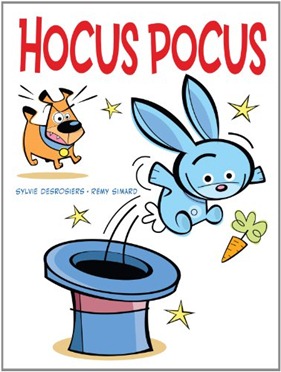
Review: Hocus Pocus by Sylvie Desrosiers

hocus pocus

Hocus Pocus by Sylvie Desrosiers and Remy Simard

This wordless picture book has the feel of a graphic novel, but one designed for very small children.  It tells the story of Mister Magic who heads home with his pet dog, feeds the dog, and then settles in listening to music with his headset.  Once he has fallen asleep, the rabbit jumps out of his hat.  On the counter is a grocery bag and he spots some carrots up there.  But he has to sneak past the sleeping dog to get there.  He has the great idea of wearing slippers to be quieter, but then he crunches on a peanut.  The dog wakes up and discovers the rabbit’s activity, but the rabbit is able to soothe him back to sleep with some violin music.  But that is only the first round, as the dog and rabbit try to outwit each other.

This is a very funny picture book that emerging readers will enjoy.  It’s not a wordless book for toddlers who would miss the humor of the story, but rather one for slightly older children who will read this book like watching a silent cartoon.  The humor is pure slapstick fun, channeling the Daffy Duck and Bugs Bunny feel with plenty of physical gags. 

The art here is crisp and clean with a modern vibe.  The colors are vibrant, bright and very appealing.  Children who pay close attention to the illustrations will see some of the jokes coming, making it all the more fun to read.

A modern picture book that is full of classic humor, this book has great appeal.  Appropriate for ages 4-6.

Reviewed from copy received from Kids Can Press.

Also reviewed by 100 Scope Notes and Sal’s Fiction Addiction.

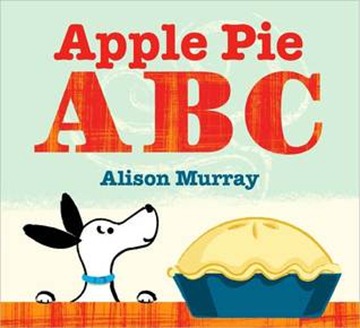
Review: Apple Pie ABC by Alison Murray

apple pie abc

Apple Pie ABC by Alison Murray

A small black-and-white dog desperately wants a piece of apple pie in this alphabetical story.  It all starts with a girl making A for apple pie and a happily sleeping dog.  But as soon as the pie is in the oven with B for bake it, the dog is very interested in the pie.  Then the pie must C for cool it and D for dish it out.  Though the girl gets to eat some pie, the dog must make due with just a crumb.  But after that one delicious crumb, he just can’t stop thinking about eating pie!   This cheery picture book mixes the alphabet with an alphabetical storyline more robust than in other books that try this technique.  Readers will love the many ways the dog tries to get pie and then the very satisfying and delicious conclusion.

Murray has created a book that really works the alphabet into the story.  Even without the alphabet as part of the book, this story and the writing would stand on its own.  That’s something that can rarely be said about an alphabet picture book.  The writing is kept very simple and solid.

Murray’s illustrations are a treat in this book.  They have a natural, old-fashioned quality to them that makes the book warm and inviting.  Add the apple pie element, and you have a book that feels like a classic picture book yet still has a modern perspective too.

A delight of a picture book that will satisfy yet leave young readers eager for seconds.  Appropriate for ages 2-4.

Reviewed from library copy.

Also reviewed by

Book Review: Bone Dog by Eric Rohmann

bone dog

Bone Dog by Eric Rohmann

Right before his dog Ella died, she promised Gus that she would always be with him.  After she died, Gus didn’t feel like doing anything, not even leaving the house, but he did.  He didn’t feel like trick-or-treating, but he put on his skeleton costume and headed out anyway.  But when Gus started to head back home after his bag was full, he passed through a graveyard where it got dark and windy and creepy.  In moments, Gus was surrounded by skeletons, real ones.  At first the skeletons thought he was a real skeleton too, but when they found out that he was a boy, they threatened to steal his guts.  Just before anything happened, Ella showed up as a skeleton dog.  But what in the world can a small boy and a small skeleton dog do to stop a crowd of skeletons? 

If that paragraph above read like a rather strange storyline, then I wrote it correctly.  This is not a “normal” picture book.  It has a wonderfully shivery, scary part to it combined with the loss of a beloved pet, and then a great funny twist at the end.  It is not a disjointed book at all, but rather one that is unexpected which makes for a fun read. 

Rohmann’s art is done in his signature style.  The thick black lines mix successfully with the deep and subtle colors.  What grabs the eye is Rohmann’s layout of the pages, where whitespace is used as more than space for the words to appear.  The style stays consistent throughout the book, but the perspective is intriguing and adds much to the book.

A strange and superb choice for Halloween reading, this book should be shared throughout the year too as a celebration of intriguing, unique picture books.  Appropriate for ages 4-7.

Reviewed from copy received from Roaring Brook Press.