Dara Palmer’s Major Drama by Emma Shevah

Dara Palmers Major Drama by Emma Shevah

Dara Palmer’s Major Drama by Emma Shevah (InfoSoup)

Dara knows that she is a star. She can make all of the facial expressions in her favorite teen movies, has huge posters of her two favorite actors on her bedroom walls, and has lots of imaginary conversations with them as she dreams of her future in Hollywood. Her first step to stardom is landing the lead in the school production of The Sound of Music, and she just knows that her name is going to be called. But then it isn’t. Dara starts to wonder if it’s about the color of her skin, since she knows she’s an amazing actress. Dara was adopted from Cambodia. Then she notices that others with different skin colors are in the cast. The teacher offers her the role of stage manager, but Dara won’t agree to that. The teacher also invites her to join her acting classes, but Dara knows she doesn’t need them. As Dara slowly realizes that she may have a lot to learn after all, readers become convinced that Dara may just be the star she always thought she was.

Shevah has created in Dara a character who is both repulsive and compelling. Dara is unthinking, rather vain and unable to listen at the beginning of the book. Wisely, Shevah frames the book as looking into the past and Dara knowing that she wasn’t a very nice person back then. This gives readers permission to dislike Dara and yet also enjoy her humor, drive and sparkle. It also makes Dara’s deep changes all the more believable. Various characters also help Dara see herself anew, including her siblings, her parents and her best friend. This is done in many different ways from overt to subtle and is a skillful way to create change in a character.

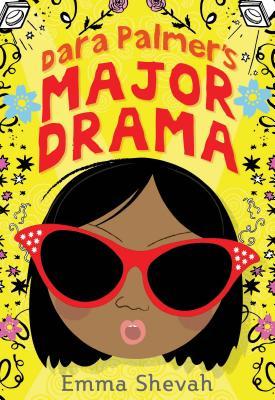
The voice throughout the book is entirely Dara’s. The fonts change with Dara’s emphasis on various words, showing the passion and emotions behind them. The book design is fresh and friendly, having designs around the page edges and illustrations that break up the text a bit.

A strong and funny protagonist becomes much more self-aware in this gorgeous novel. Appropriate for ages 9-12.

Reviewed from library copy.
The Haunting of Falcon House by Eugene Yelchin

The Haunting of Falcon House by Eugene Yelchin

The Haunting of Falcon House by Eugene Yelchin (InfoSoup)

Twelve-year-old Prince Lev Lvov moves in with his aunt at Falcon House. It is a house that he will inherit as he is heir to the Lvov estate. Lev wants to be just like his grandfather, a general in the Russian army, stern and strong. Things are strange though at Falcon House where he finds wonders like an elevator in the home but also rooms that have not been touched in years. As he enters the home, Lev sees another young boy there, playing on the banister. Lev is sent to sleep in his grandfather’s old study where he can’t sleep and finds himself drawing and drawing with much more skill than he ever had before. In fact, he finds it nearly impossible to put the pen down. Slowly Lev starts to learn the secrets of his family and realize that some of the family secrets are more terrifying than ghosts.

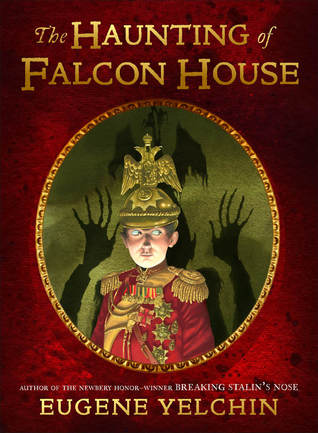
Yelchin won a Newbery Honor for Breaking Stalin’s Nose. Here he very successfully merges historical Russia with a dark ghost story. Based on the premise of having found old notes and drawings from Lvov, the book is immediately mysterious and filled with wonder. There is the amazing setting of the huge mansion, filled with things like death masks and a basement of mothballed clothes. There are the servants who manage to work for his aunt despite her disdain and harshness. There is the ghost, who tells his own story but ever so slowly. They all create a world of darkness and beguilement.

Then the book turns and changes, becoming something deeper and more filled with emotion. It looks beyond the cranky aunt and into why she acts the way she does. It examines the death of a boy and eventually becomes about who is responsible for it and why. It looks at servants and royals, at status and power. It figures out what it takes to become someone willing to wield that power too.

Entirely gorgeous, haunting and deep, this novel is chillingly dark and wonderfully dangerous. Appropriate for ages 9-12.

Reviewed from library copy.


Applesauce Weather by Helen Frost

Applesauce Weather by Helen Frost

Applesauce Weather by Helen Frost, illustrated by Amy June Bates

Faith and Peter know that it is applesauce time when the first apple falls from the tree outside their house. It’s also the time of year when their Uncle Arthur comes to tell his stories about how he lost his finger. But this year is different, since Aunt Lucy died and Uncle Arthur just isn’t as twinkly as he once was. Faith though is sure that her uncle will come and he does, unsure of his welcome without Aunt Lucy. He sits on the bench under the apple tree with the children, warming up to telling his tales. Maybe this year they will finally learn the truth of his missing finger!

There is a beautiful delicacy in this book, spun together by the masterful poetry of Frost. She holds the hearts of her characters with such tenderness, showing the love of the children for their uncle and also the love of Arthur for his beloved Lucy. The stories all twine together, the family sitting under the tree, long-lasting love, Peter discovering his own first love, and then the remarkable stories that Arthur tells. The entire work is dazzling, moments of life held up and made amazing just for taking the time. This is real world writing at its very best and one of the best verse novels of the year so far.

The illustrations by Bates are filled with emotions. There is the hesitation of Arthur as he arrives. The bend of the back of Faith as she waits under the apple tree. The flow of breeze into her hair. They are filled with whimsy, the stoop of an old back, the twinkle of a storyteller starting to tell, the joy of apples in fall.

Beautiful and amazing, this very short verse novel is a celebration of autumn and families. Appropriate for ages 6-9.

Reviewed from ARC received from Candlewick Press.

Piper Green and the Fairy Tree: The Sea Pony by Ellen Potter

Piper Green and the Fairy Tree The Sea Pony by Ellen Potter

Piper Green and the Fairy Tree: The Sea Pony by Ellen Potter, illustrated by Qin Leng

Released August 16, 2016.

Piper sets off on her third adventure living on her small island home. When she visits the Fairy Tree, she discovers a strange whistle inside. Unfortunately though, Piper doesn’t want a whistle. She wants a pony! And the first pony  just arrived on the island that day. Piper was also hoping to spend time with her big brother who is home from school, but he isn’t feeling well so Piper decides to try to make him the treat that her mother makes her when she is sick. They don’t turn out quite the same way. When Piper’s dad needs help on his fishing boat, Piper leaps to help and discovers two things along the way, one that has her dreaming of riding something other than a pony and the other that will help her family even more than her loud whistle does.

Potter has just the right feel in the books in this series. Piper is wonderfully engaging as a protagonist. She is imaginative, funny and entirely herself. Even as Piper is making silly mistakes, the book does not make fun of her, rather it laughs along with her and looks at the errors we all make in our lives. It’s a book of empathy, humor and the importance of family and community.

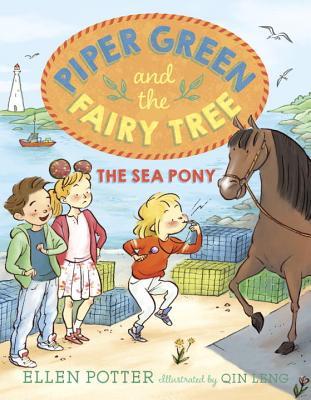
Leng’s illustrations offer young readers a refreshing break from the text, giving them just the right amount of space. They are done in a framed style in either half-page or full-page format. The chapter breaks too are done with style, offering stripes to invite readers to turn more pages and follow the story further.

Another winner in this charmer of a series that is just right for children who enjoy Clementine. Appropriate for ages 6-8.

Reviewed from ARC received from Knopf Books for Young Readers.

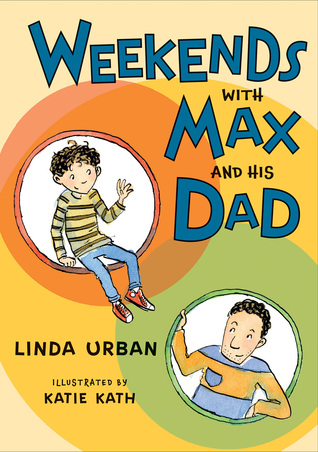
Weekends with Max and His Dad by Linda Urban

Weekends with Max and His Dad by Linda Urban

Weekends with Max and His Dad by Linda Urban, illustrated by Katie Kath (InfoSoup)

Max’s father has an apartment of his own now where Max spends weekends. On his first visit to the apartment, Max is amazed at how white and clean everything is. Everything except his bedroom which is filled with football things, even though Max doesn’t particularly care about football any more. He is much more into being a spy. So Max and his father spend their weekend getting to know his new neighborhood by dressing as spies, taking covert photographs, eating pancakes, and following a mysterious man. Following visits to his father’s apartment involve meeting the neighbors, walking dogs, doing some homework, having a friend over and buying a couch. As Max settles into his new weekend routines with his dad, he learns a lot about what makes a place a home.

Urban writes with a gentleness about this new circumstance in Max’s life. Max is refreshingly unburdened by guilt in his parent’s divorce. The focus instead is on the new place to live, figuring out the different relationship, and realizing that a person can happily have two homes. Throughout the book, real love and devotion is shown by both Max and his father. There is a beautiful flexibility from both of them in each story and also a willingness to listen and learn from one another. Each also takes care of the other emotionally, not wanting to hurt one another. Which is also a very nice change from children lashing out in books about divorce.

The illustrations by Kath make this book very approachable for young readers. They nicely break up the text, plus add to the humor. Readers can see Max’s father in his full spy disguise as well as enjoying the finished school project and the furry fun of two basset hounds. The pictures add to the warmth and love that exude from this book.

A loving book about father and son relationships after a divorce, this novel for young readers demonstrates that life and love continues. Appropriate for ages 7-9.

Reviewed from library copy.


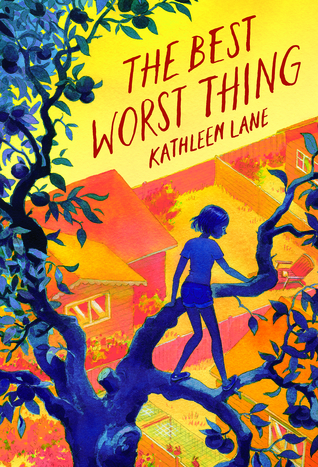
The Best Worst Thing by Kathleen Lane

The Best Worst Thing by Kathleen Lane

The Best Worst Thing by Kathleen Lane (InfoSoup)

Maggie is starting middle school and is getting more and more worried. She has rules to live by that keep the people she loves safe, but there is much more to worry about than that. There is the murderer who was loose in their neighborhood after shooting someone at a local mini mart. There is the boy at school who is going to get a gun for his birthday. There are the rabbits next door owned by a man who doesn’t seem to really love them. Plus there are issues in her own family with a teen sister who is pulling away from Maggie and her little sister and a father growing more and more distant too. Maggie starts to plan new ways to protect her family from danger as her fears mount, but it’s all too much for one person to try to control.

Lane has written an incredible novel for middle grades, particularly as a debut author. She captures the intoxication of danger, the thrill of fear, and then what happens when it becomes more than that, toxic and dark. She shows the problems with fear and worries, the way they mount and the intricate ways that children have of coping in a world where nothing seems firm and solid for them, not even their families. As Maggie copes with OCD tendencies, she is also courageous and caring, striving to control the uncontrollable around her.

Lane captures the real world with honesty here. Rabbits are sold for meat. Children are sometimes not cared for. Marriages have problems. Sisters withdraw. It is all there in this book, but there is more too. There are loving parents, helpful neighbors, friends, apple trees and baby rabbits. So not all is dark and dreary, there is light too and hope here. If only one can see it for the worries.

A bright new voice in children’s literature, this debut novel is delicious and rich. Appropriate for ages 9-12.

Reviewed from library copy.
 

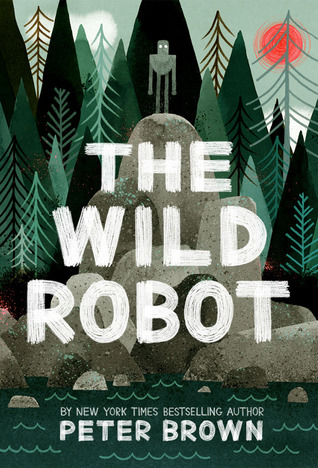
The Wild Robot by Peter Brown

The Wild Robot by Peter Brown

The Wild Robot by Peter Brown (InfoSoup)

A ship carrying crates of robots capsizes in the ocean. Some of the crates float, only to be dashed on the rocks of a small island. One crate though survives and is left safely on the island. Some curious otters explore the crate and accidentally turn on the robot inside. That robot is Roz, designed to ensure her survival and help people. Soon Roz is exploring the island, climbing high on the rocks to see her surroundings. As she explores, the animals of the island declare her a monster and avoid her. Roz begins to acclimate to the island, figuring out how to camouflage herself. It is by sitting still and hidden that she starts to learn the language of the animals around her. As time passes, Roz is no longer gleaming and clean and she can speak with the animals. It isn’t until a deadly accident happens though that Roz shows the island residents who she really is.

This book is entirely magnificent. It is a book about nature, its beauty and grandeur and danger. It is a meditation on the outside, the power of it to change even a robot’s life. It is a look at the importance of listening and learning and finding one’s own way forward in unexpected circumstances. But most of all, it is a book about love and life and the way that finding someone to love transforms each of us.

There is something achingly beautiful about this book. Yes, there is more than enough action and humor to keep the book moving and of interest to children. Yes, the characters are brilliantly created and their relationships are drawn with skill and attention. Yes, its pacing is exceptional. It that ache though, that makes this book exceptional. The way that it is allowed to just be there, loneliness and acceptance, loss and love.

Truly an exceptional read created by a picture book author in his first foray into middle-grade books. Wow. Appropriate for ages 8-12.

Reviewed from library copy.


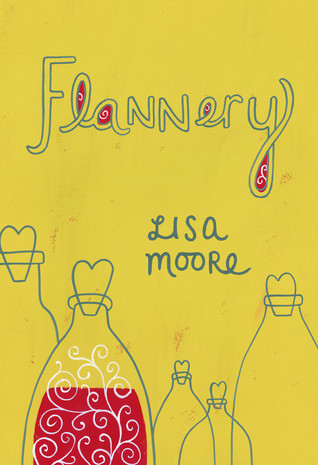
Flannery by Lisa Moore

Flannery by Lisa Moore

Flannery by Lisa Moore (InfoSoup)

At age 16, Flannery is dealing with huge issues. Her mother, an artist, is unable to pay for her biology book or heating bills. Her best friend, Amber, has a new boyfriend that Flannery does not trust because he is over-controlling and their friendship is falling apart. And now Flannery has been put into a Entrepreneurship class project with her long-term crush, a graffiti artist who seems to think he’s too cool for school. So she is left doing all of the work for their project herself. Flannery works to hold it all together, even managing to create a project that sells out: love potions. While Flannery may realize they are entirely pretend, everyone who drinks one seems to be finding love. As things start to shatter around her though, Flannery discovers who is there for her and who is not.

OK, everything I read about this book seems to focus on the love potion aspect. This book does have that, but oh my it is so much more. The writing here is strikingly unique. Moore does away with quotation marks, creating dialogue poetry on the page, the voices running together exquisitely and somehow becoming even more clear without the punctuation. That is great writing. She plays with the mysticism of love, the power of control, and the illusion of it as well.

Beyond the love potions, this is a book about a teenager finding her own strength, her own voice and her own way of living which is not about conforming at all. Flannery knows throughout the book that she is unique and in love and that everything is not what it should be. Still, there are revelations even as she lives her truth, ones that change her point of view and make her grow. That is done so naturally and organically. Beautiful.

A stunning teen read, pick this one up not for the love potions but for the deep story and strong unique heroine that you will want to meet. Appropriate for ages 14-18.

Reviewed from library copy.

The Storm by Akiko Miyakoshi

The Storm by Akiko Miyakoshi

The Storm by Akiko Miyakoshi (InfoSoup)

A little boy heads home after school, excited about a trip to the beach the next day with his family. His teacher did warn that a storm was coming and as the evening goes by, the sky gets darker. His parents prepare for a storm and reassure him that even if they can’t go to the beach the next day, they will go another weekend. Soon rain starts to fall and then the wind picks up and blows hard. When it gets too loud, the boy jumps into his bed and pulls his covers over his head. Soon he is dreaming about being on a ship with big propellers that help to drive the storm away. Finally the storm moves off and his ship can sail higher into the sky. When the boy wakes up the next morning, he discovers a lovely day. Just right for a visit to the beach!

Miyakoshi’s picture book is filled with tension. Not only of the storm itself but of the waiting for the storm to arrive and then the concern about how it will impact their plans for the next day. It is a tension that children will understand, whether about weather and storms or about big plans being disrupted. It is also a picture book that speaks to the power of nature and the way that children can have plans with little control over them.

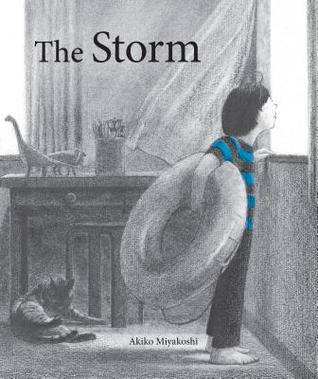
The illustrations in the book are black and white with small touches of color like the blue sky after the storm. The charcoal style has a lovely texture throughout. Light and dark play on the page with one storm page filled with rain showing the falling water as bright zings of light in the darkness. There is both a feeling of drama and also one of safety throughout, particularly during dinner and at bedtime.

This stormy picture book is one that children will relate to on a variety of levels. Appropriate for ages 3-6.

Reviewed from e-galley received from Kids Can Press and Edelweiss.