Review: The Life of Ty: Penguin Problems by Lauren Myracle

life of ty

The Life of Ty: Penguin Problems by Lauren Myracle, illustrated by Jed Henry

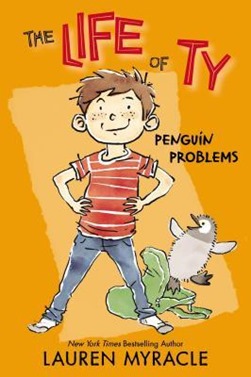
Ty is seven years old and has a pretty complicated life.  He has a new baby sister who is taking all of his mom’s time and attention.  His older sisters won’t walk him into school like his mom used to, insisting that he can do it all on his own.  His best friend is in the hospital battling cancer, and Ty’s other friends can be confusing and even alarming.  Ty keeps getting into trouble at home for things like chasing the cat with a Dustbuster.  Then on the school trip to the aquarium, Ty takes a baby penguin home with him.  This is one wild boy who is also big hearted and caring, just not sure how best to show it. 

Myracle, who writes teen books primarily, has created a truly exceptional book for younger readers.  Ty is a character who is easily relatable, even when he does some extremely unusual things, like stealing a penguin.  His home life will be familiar to many children, who will have older siblings and babies in their families too.  Add to that the universal feelings of being asked to do big-kid things too early and also being treated like a baby, and you get a book that is universally appealing.

Myracle’s writing has an outstanding humor throughout.  In the more dramatic moments, children will understand that things will be alright in the end.  The black and white illustrations by Henry convey that humor and lightness as well. 

Perfect for both reading aloud and for a child reading on their own, this book will be enjoyed by fans of the Stink series as well as those who like Clementine.  This book would pair well with The Year of Billy Miller by Kevin Henkes.  Appropriate for ages 5-7.

Reviewed from copy received from Dutton.

Review: The Year of Billy Miller by Kevin Henkes

year of billy miller

The Year of Billy Miller by Kevin Henkes

After getting a big lump on his head from a fall during their family vacation, Billy is worried that he’s not going to be smart enough for 2nd grade.  And when he starts 2nd grade, he still has a lump on his head!  The year doesn’t start easily with Billy accidentally insulting his new teacher on the very first day.  He has to figure out how to fix the misunderstanding before she gets the wrong idea about him.  Then Billy’s father who is a stay-at-home dad and an artist is trying to find his next breakthrough in his art.  It is Billy who has to learn how to deal with a grumpy father but along the way he also serves as inspiration for his dad.  When his parents go to his father’s gallery show, Billy tries to stay up all night, keeping his little sister up with him for as long as he can.  Finally, he selects his mother as the person he wants to write a poem about.  But it’s not that easy, since he has to make sure he doesn’t insult anyone with his choice and then has to read his poem aloud in front of an audience.  Along the way, Billy learns a lot about how to act in a family, how to support one another but mostly how to love each other.

Henkes has written a book about a boy that will be perfect for fans of Clementine and Ramona.  Happily, he does not resort to grossness, bodily functions, farting or any of the other plot devices so often used in books about boys.  Here instead we have a real boy, one who makes mistakes but also tries to do what is right for his family.  Broken into chapters that are focused on a single relationship: teacher, father, sister, and mother, this book is welcoming to young readers thanks to its logical structure and clear focus.

The black and white art in the book is done by Henkes.  Unfortunately, the digital galley I read did not include much of the art.  What was in the galley adds much to the book, nicely breaking the text into more manageable parts.

A tip top chapter book, this one is destined to be a classic.  I’d think that sharing it would be a great way to start any 2nd grade school year.  Appropriate for ages 5-7.

Reviewed from digital galley received from Edelweiss and Greenwillow Books.

Review: Listening for Lucca by Suzanne LaFleur

listening for lucca

Listening for Lucca by Suzanne LaFleur

Siena and her family move to Maine from Brooklyn to help her little brother Lucca.  He doesn’t speak, using only gestures to communicate with them.  Siena isn’t sad to move, since she didn’t have lots of friends to leave behind.  Maine should be a new start for all of them.  When they arrive at their big old house on the beach, the family gets to work fixing it up.  But both Lucca and Siena believe that the house is haunted by a family that used to live there.  Siena finds a pen on a high shelf in her closet that seems to connect her to a young girl who used to live in the house.  She also dreams about the girl’s brother Joshua as he fights in World War II.  The stories of the two families have striking similarities that give Siena the idea that she may be able to not only fix the present but also the past.

I adored this book.  LaFleur tells a story of mystery and ghosts where the past is just as alive and changeable as the present.  Throughout the book has a sweetness and wistfulness to it that makes it a pleasure to read.  I also appreciated the way that Siena has a tie to the past through her collection of lost items.  LaFleur builds her story carefully, so that each element makes an innate sense as it happens.  Beautifully done.

The characters are strongly written.  Siena is a heroine who can be prickly at times, but has the courage and talents to make a difference.  She is an incredible older sister, loving and attentive, but is much more critical of herself.  Her parents and younger brother are just as fully realized in the story.  The friends that Siena makes in town all also have touches that make them whole as people.

This lovely book transcends genres with its mix of mystery, historical fiction, and fantasy.  It’s a winning combination.  Appropriate for ages 9-12.

Reviewed from digital galley received from Edelweiss and Wendy Lamb Books.

Review: Papa’s Mechanical Fish by Candace Fleming

papas mechanical fish

Papa’s Mechanical Fish by Candace Fleming, illustrations by Boris Kulikov

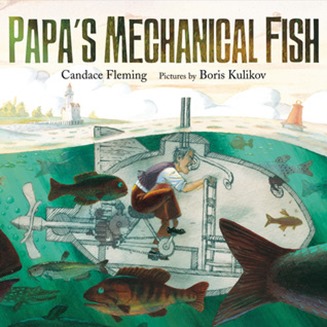
Based on a true story, this picture book reads more like a far-fetched fantasy.  Papa is an inventor but has never made anything that works.  All he needs is one incredible idea, but they don’t come easily.  So the family takes a trip to the lake where one of the children, the narrator of the book, asks what it is like to be a fish.  That gives Papa the incredible idea he was looking for.  The first version of his mechanical fish is so small that Papa himself can barely fit into it.  It almost works.  The second version is bigger and has a fin and a propeller and seats two people.  It almost works.  Whitefish III is even bigger, seats three, and is covered in copper.  It almost works too.  The fourth version is huge, fits the entire family, and…  Well, you just have to read the story to see how it ends.

The whimsy of these inventions is a large part of what makes this book so successful.  From the slow progress of the machines from one version to the next to the joy of seeing them tried out in the story, this is a book where you must find out what happens next.  Fleming has also written a charming story of a family that supports the inventor.  There is a rhythm to the story that makes it a pleasure, each attempt and failure met with similar satisfying responses from his family.  This makes the book work for a larger age range and makes reading it all the more fun.

Kulikov’s illustrations are a mix of realistic illustrations, huge fish that float past as inspiration in the water, and blueprints that let you glimpse the inside of each version of the submarine.  The entire book has a wonderful frantic quality to it, engaging the reader right in the moment of Aha! and then through the different trials. 

A treat of a book, this book will be inspiring to young engineers and inventors.  Appropriate for ages 5-8.

Reviewed from library copy.

Review: The Water Castle by Megan Frazer Blakemore

water castle

The Water Castle by Megan Frazer Blakemore

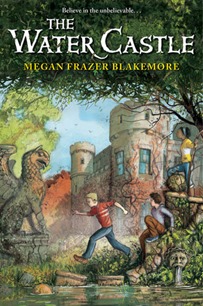
After Ephraim’s father has a stroke, the family moves to the Water Castle, an ancestral home in Crystal Springs, Maine.  Ephraim is convinced that coming from the big city, he will be more popular and seem smarter than he ever had before.  After all, his older brother has always been popular and his little sister is very smart.  But things don’t work out the Ephraim expects.  The house itself is unusual, filled with strange rooms and different levels; it glows blue at night and hums.  Ephraim is definitely not popular, quickly showing how awkward he is and then also demonstrating how little he knows compared to his classmates.  Luckily though, the mystery of the house draws in two other children his age who want to figure out how their own families are tied to the Water Castle and its connection to the Fountain of Youth. 

Blakemore writes with a wonderful mix of science and fantasy here.  The blend is compelling, making the book impossible to put down until the mystery is solved.  Readers will not know if they are reading a fantasy book or one that could have actually happened until the very end.  Told with flashbacks to the past that add to the understanding of the intertwined families as well as the fascination with explorers, this book is complex in the best of ways, keeping readers guessing right up to the end.

Ephraim is a character that has quite a few flaws.  Readers will flinch as he is too brash and too confident for his own good, especially when trying to make friends.  Happily, it is when he calms down and shows his feelings that Ephraim becomes entirely himself, a side that readers see long before the other characters in the book. 

Complex and multilayered, this middle grade book will be embraced by historical fiction, science and fantasy fans.  Appropriate for ages 9-12.

Reviewed from library copy.

Review: The Thing about Luck by Cynthia Kadohata

thing about luck

The Thing about Luck by Cynthia Kadohata

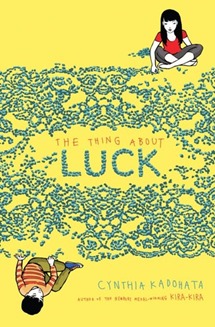
Summer Miyamoto is positive that her family is completely out of luck.  Nothing is going right for them at all.  Her parents had to return to Japan because of a family emergency, leaving her behind with her grandparents and little brother, Jaz.  Now the four of them are heading out to do harvest season for the first time without her parents.  Summer and Jaz have to get all of their homework assignments, so they really don’t have the time off.  Summer is also expected to help her grandmother cook for the others working on the harvest, so she is very busy.  But she isn’t so busy that she doesn’t notice the very cute son of the people they work for or the problems that her brother has making friends.  She is also worried about her grandparents from the pain in her grandmother’s back that incapacitates her at times to the exhaustion that her grandfather seems to be suffering from.  All of this weighs on Summer who just wants the bad luck to end but it may take Summer being something her grandmother would not approve of to save the family in the end. 

Kadohata has created a very compelling story of a family who travels the United States harvesting wheat with giant combines.  She offers just enough details about the machinery and the process for readers to understand it which helps make the work much more understandable.  But this book is far more about this particular family and its dynamics.  The grandparents offer a unique mix of sage advice and confusing world views.  Jaz, the younger brother, is a great example of a very smart child who has almost no social skills.  All of these characters are written as complete people, not ever stereotypical.

Summer herself is equally well drawn.  She is at a confusing time in life in general, being a pre-teen who is starting to notice boys.  That is complicated by her grandmother’s old-fashioned take on boys and girls as well as her own responsibility for her family that puts her in situations that require her to be more adult and less child. 

A beautiful and intense look at a Japanese-American family struggling with an interesting lifestyle and just surviving a year of bad luck.  Appropriate for ages 9-12.

Reviewed from copy received from Atheneum Books for Young Readers.

Review: My Happy Life by Rose Lagercrantz

my happy life

My Happy Life by Rose Lagercrantz, illustrated by Eva Eriksson

Dani has a very happy life, something that she thinks about as she falls asleep every night.  She has a father who loves her very much and is about to start school for the first time.  At first Dani feels like she will never make any friends at school, but then she notices another little girl who is standing alone.  Soon Ella and Dani are best friends, inseparable.  That doesn’t mean that they don’t fight sometimes, but they never fought for long.  But all too soon, Dani discovers that Ella is moving away.  Now Dani has to figure out how to go on without her best friend and it’s not easy.  Dani ends up with a scraped knee and a bandaged head and even hurts a boy in her class by shoving him.  Yet, Dani is a naturally happy person and quickly apologizes for what she did.  It’s not easy, but she learns to move on from missing her friend to being happy once again.

Originally published in Sweden, this book has the feel of a European import.  It has a gentle feel to it but also a deep honesty that is wonderful to see.  Dani has had many challenges in her life, including losing her mother, but she is the epitome of a happy person who embraces joy in every way.  This is an uplifting book where there are challenges, lots of strong negative emotions, but in the end, happiness prevails in a very natural and unforced way.

The illustrations and text work together in harmony here.  I was actually surprised to see that they were done by two people rather than just one since they work so very well together.  The images of the two friends together are buoyant while those of Dani in more dark moods continue to shine with a subtle light even when sad or hurt.

Perfect for families who are trying to be more mindful and happy, this book is a joy to read and to share.  It would also make a great cuddling story for bedtime, leaving everyone smiling together.  Appropriate for ages 5-7.

Reviewed from library copy.

Review: Water in the Park by Emily Jenkins

water in the park

Water in the Park: A Book about Water and the Times of the Day by Emily Jenkins, illustrated by Stephanie Graegin

This picture book opens with the sun rising just before six in the morning on the park.  The turtles warm their shells in the pond and the glow of the sun lights the water.  Dogs and their owners arrive for their morning walks.  When they arrive, the turtles slip back under the water.  By seven, babies have arrived at the park and are getting their drinks from the drinking fountain and setting up for a day of play.  At eight, the sprinkles in the water play area are turned on.  The day progresses with puddles, plants being watered, an ice cream truck, people cooling off in the shade, and lots of splashing.  In the evening, the rain comes and everyone clears out of the park, leaving it again to the turtles and the silence.

Purely satisfying, this book shows the cyclical nature of the day as well as the water cycle too.  All of the many ways that people use water in a park are shown here with a glorious sense of watching people’s lives from a bit away.  We get to know the personalities of children and dogs, the joy of the sprinklers, the heat of the day, and the merriment of a full day spent at the park.  It is also a celebration of the neighborhood park, where people from all over come together in a love of green space and water.

Graegin’s illustrations are filled with small touches that make them a pleasure to explore.  This book is not ideal for sharing with larger groups because so much of its charm is in the details.  It is those details that let us get to know the different people and animals without any explanation.  Small dramas play out in these pictures.

A wonderful book, this story will speak to children from both country and urban settings who know the joys of parks, ponds and community.  Appropriate for ages 4-6.

Reviewed from digital galley received from Edelweiss.

Review: The Lucy Variations by Sara Zarr

lucy variations

The Lucy Variations by Sara Zarr

Lucy Beck-Moreau was considered one of the top concert pianists.  Now at age 16, she has abruptly left the concert circuit and doesn’t play the piano at all.  Instead she is attending school just like any other teenager, doing homework, and listening to her younger brother Gus practice his piano pieces.  When Gus’ aging piano teacher dies, she is replaced by Will, a young teacher who was once himself a child pianist and recommends plenty of time away from the piano for Gus, including once forbidden video games and TV.  As Will balances out Gus’ life, Lucy is drawn to him.  Will is older and sophisticated and interested in Lucy herself as both a pianist and a person.  This is the story of Lucy’s triumph over grief and loss and her struggle to play music on her own terms and for her own reasons.

Zarr has beautifully captured a family of wealth and talent without lingering overlong on those details.  It is Lucy who is the center of the novel, which is told in third person but specifically from Lucy’s view.  This gives the book a necessary distance so that readers can view Lucy from a small space and recognize the mistakes that she is making and repeating.  Lucy is a wonder of a flawed protagonist, filled with talent yet drawn into destructive situations of her own making, one feels an affinity to her and yet pushed away as well.

It is this strength of the central character that lifts this novel above others covering similar subjects.  The writing here is strong and clear, and the story flows with a natural feel that allows Lucy to veer dangerously close to disasters that make the reading that much more exciting.  Along the way, a dysfunctional family is on display, showing readers how Lucy came to be the way that she is, and also showing hope for what is possible.

A true mix of hope, music and tenacity, this book is beautifully composed and harmonious with lingering crescendos.  Appropriate for ages 14-17.

Reviewed from library copy.