Review: My Cold Plum Lemon Pie Bluesy Mood by Tameka Fryer Brown

my cold plum lemon pie bluesy mood

My Cold Plum Lemon Pie Bluesy Mood by Tameka Fryer Brown, illustrated by Shane W. Evans

Moods are matched with colors in this jazzy picture book.  Jamie is having a really great day, feeling purple and just being.  But when his brothers kick him off the couch, his mood turns stormy gray.  As he draws, his mood turns green and easy.  Then his older brothers make fun of his drawing and Jamie’s mood turns black.  Basketball gives him a swishing orange mood and running home almost late has him racing red.  Family dinner is lemon pie yellow and washing up brings on tides of bluesy feelings.  The day ends with that same cold plum purple mood as it began with.  What color is your mood?

Brown’s poetry has a jazz beat and lots of metaphors that make it dance in your mind.  Children will immediately recognize the moods and easily relate the colors to them.  From the teasing of older brothers to the pleasure of making art, Jamie’s moods are universal.  Brown’s writing begs to be read aloud, written so that it tumbles off the tongue.

Evan’s illustrations have a jaunty vibe that matches that of the poem.  The art is digital collage created with oil paints and graphite.  The illustrations have a great depth of color, something that makes this book all the more vibrant.  They also have a wonderful texture from the paint and from swirls in the color. 

This is a positive way to look at complex emotions and would make a great book to start a discussion about feelings and moods.  Appropriate for ages 4-6.

Reviewed from copy received from Viking.

Review: Black Helicopters by Blythe Woolston

black helicopters

Black Helicopters by Blythe Woolston

Valley’s mother was killed by the black helicopters while she was out in the garden when Valley was four years old.  Raised by her father, she has been taught to hide at all times.  There is a den in their house where she and her brother Bo can never be found.  Valley knows above everything else that Those People will kill her without even thinking about it, just like a coyote.  But now Valley is out of the house and on the road with explosives strapped to her and the trigger waiting for her to decide exactly when to use it.  When the first explosive goes off prematurely, Valley is left on her own in a world she has had little contact with.  But Valley knows how to read people and how to manipulate them, right up to the end she is in complete control.  Or is she?

This taut thriller turns the world on its head.  Valley’s story is told in flashbacks so readers know that they are learning the backstory of a domestic terrorist.  And what is amazing about the writing and the storytelling here is that despite that knowledge, readers will begin to understand Valley and the way she was raised and how she came to be the person she is now.  That alone is a tremendous achievement.

Then there is Valley herself.  A girl who is bitter, strong and lonely.  She has lived much of her life in the company of only her father and brother and much of that she spent hiding completely alone.  She is bright and fierce, burning with a hatred for Those People that her father carefully instilled in her.  And she is wrong, oh so very wrong, about the world and about others and about her own family.  She is flawed and ever so human under that bomb.

Well written and carefully paced, this book is tantalizingly taut and thrilling.  In the end though, it is about a girl caught in a web of lies that she cannot see past.  Appropriate for ages 15-18.

Reviewed from library copy.

Review: The Vine Basket by Josanne La Valley

vine basket

The Vine Basket by Josanne La Valley

In East Turkestan, Mehrigul’s beloved brother has left the family and now her father is always angry and her mother has taken to bed.  Mehrigul is forced to leave school and help out on the family farm.  She also works the family market stall which is where her vine basket, created in the form of a cone rather than a more useful shape, is spotted by an American woman who offers to buy it for a very high sum.  But her father just drinks and wagers away the money, leaving the family still on the brink of ruin.  There are political pressures too with the Chinese pushing the Uyghur people to conform.  If Mehrigul does not return to school, she could be sent to work in a Chinese factory.  But there is one ray of hope and that is that the American woman asked for more baskets.  It will take time and determination for Mehrigul to complete the baskets for her, especially once her father forbids her to do it. 

I seriously could not believe this was a debut book.  La Valley writes with such assurance and skill, building a world that makes sense to those unfamiliar with the Uyghur and East Turkestan.  She also neatly explains very complicated politics in a way that children will understand thanks to the perspective of Mehrigul and her family.  La Valley does not shy away from the difficult family situation she has created, clearly creating a world where there are no real villains just adults dealing with impossible situations. 

Yet there are heroes.  They come in the form of more than the American buyer too.  Mehrigul’s grandfather is one of these, as he works impossibly hard and still supports her dreams and skills with baskets.  Mehrigul herself is certainly a heroine as well, creating beauty with an incredible humility, taking on tasks far beyond someone as young as she is, and holding her family together. 

La Valley never forgets to instill beauty into the world she is telling us about.  We learn about the Uyghur rugs, music and art.  We learn about the beauty of the desert, the sting of the sand, the wonder of the sudden rain, and the treasures of true friendship and family.  It is in this mix of destitution and beauty that this book truly shines.  It is a book that enters the very heart of the reader and takes up residence.  Beautiful, haunting, cruel and wondrous, this is one amazing read.  Appropriate for ages 12-15.

Reviewed from digital galley received from NetGalley.

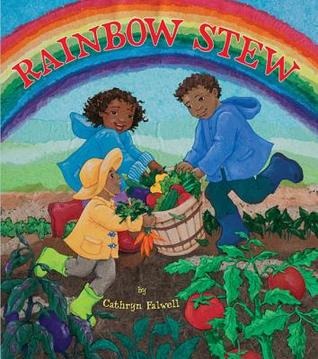
Review: Rainbow Stew by Cathryn Falwell

rainbow stew

Rainbow Stew by Cathryn Falwell

Released on June 15, 2013.

Three children scramble out of bed at their grandpa’s house to a rainy day.  But they don’t want to stay inside, so Grandpa sends them outside to find colors to add to his Rainbow Stew.  They splash their way into the garden and look under the wet green leaves to find what colors are hidden beneath.  They find all sorts of green vegetables like beans, spinach, and cucumbers, some rosy radishes, some purple cabbage, yellow peppers, red tomatoes and brown potatoes.  Soon their basket is full and the three children are muddy and happy.  They all head inside to cook the stew together, each child helping in their own way.  Then there is quiet time inside as the stew cooks, until finally they can all enjoy Rainbow Stew!

Falwell merrily combines a love of gardening and a willingness to get muddy in this book.  She uses quick rhymes that add a bouncy feel to the book, maintaining that sense of joy that is everywhere in this book.  I am particularly pleased to see a book with a grandfather taking expert care of grandchildren in this book. 

The illustrations are filled with falling rain, but also small faces turned up into it and knees plunked down into the mud.  The completely African-American family is also great to see in a picture book that easily integrates into rain or gardening or color units and story times. 

Ripe and ready to be picked, this is a great choice for sharing aloud in spring or fall.  Appropriate for ages 3-5.

Reviewed from digital galley received from Lee & Low Books via NetGalley.

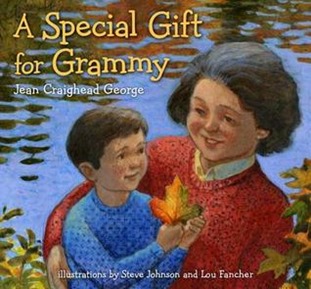
Review: A Special Gift for Grammy by Jean Craighead George

special gift for grammy

A Special Gift for Grammy by Jean Craighead George, illustrated by Steve Johnson and Lou Fancher

Hunter collected a big pile of stones and put them on his grandmother’s porch.  When his father and grandmother ask him what she is meant to do with them, Hunter replied, “What everyone does with a pile of stones.”  Hunter turned out to be right.  Everyone who saw the stack of stones knew just how to use one or more of them.  The postal carrier used one to weigh down the mail on a breezy day.  Workmen used them as hammers or weights.  They are used to stop wheels from rolling and show people what way to turn.  When Hunter returned only six little stones were left.  But this time it’s Grammy who knows just what to do with them.

I have one big issue with this book: the title.  It does very little to convey the charm that is inside this book.  I love the idea of a pile of stones that everyone borrows from and uses.  Then the end of the book is intensely satisfying.  I must admit though that with the uninteresting title, I almost passed on this book, expecting it to be a book about the death of a grandparent or a saccharine poem about familial love.  Instead it is a well-designed look at community, family and connections.  I’d much rather have had the title reference the stone pile or stones or rocks. 

The illustrations are done in collage, acrylic and pencil.  They have gorgeous deep colors, combined with lots of texture from the collage.  The collage is done in such a subtle way that it is almost invisible, just adding a level of texture and pattern to the paintings. 

This book truly is a special gift, but one that could use a new title.  Appropriate for ages 4-6.

Reviewed from copy received from HarperCollins Publishers.

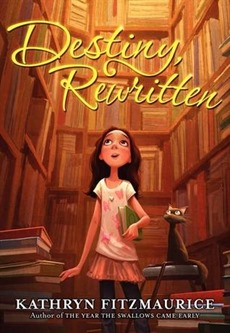
Review: Destiny, Rewritten by Kathryn Fitzmaurice

destiny rewritten

Destiny, Rewritten by Kathryn Fitzmaurice

From even before she was born, it had been decided that Emily’s destiny was to be a poet.  Named after Emily Dickinson when her mother was inspired at a bookstore, Emily’s entire 11-year life has been documented in the margins of a first edition copy of Dickinson’s poems.  When Emily discovers that her mother wrote her father’s name in the margin of one of the poems, she rushes to read the book but a mishap sends it off to be donated to Goodwill.  This begins a search of several used book stores for the book and it quickly becomes apparent that destinies will not be rushed and that there is no way to force them.  But along the way, new friends are made, great books to read are found, and destiny is eventually changed.

Fitzmaurice writes with a wonderful mix of light tone and richness.  She carefully builds her story, creating additional storylines that serve as different strings in the story that are tied together by the end.  Another source of the richness is the way she describes things in the story.  Chapter 4 begins with “So I headed down the hall that Saturday morning with a hopeful feeling that came only on days I was opening a new box of Cheerios…”  This is such a universal image and universal feeling.  The Cheerios play into more of the story along with the prizes in their box.

Emily is an engaging character who struggles with learning patience and the frustration of being so close to the truth and then unable to grasp it.  She comes off as a multidimensional person, again thanks to the richness of the world that Fitzmaurice paints for the reader.  The secondary characters are also well drawn and solidly written.  It is a pleasure to also see poems by Dickinson and her life tied so closely to the lives of modern-day children and families.

Fresh and joyful, this is a novel where storylines click into place like a puzzle.  It will delight children who enjoy reading.  Appropriate for ages 9-12.

Reviewed from copy received from HarperCollins.

Review: The Garden of My Imaan by Farhana Zia

garden of my imaan

The Garden of My Imaan by Farhana Zia

Aliya is different than the other kids in her class because she’s Muslim.  She does all she can to fit in, but that means she doesn’t stand up to the kids who pick on her or even talk to the cute boy she likes.  Then Marwa moves to their town and she is in the same grade as Aliya.  Marwa is also Muslim and wears the hijab or head scarf.  Marwa also does not just put up with the teasing of others and appears to Aliya to be much more confident than Aliya personally feels.  Aliya starts to write letters to Allah which start out as just complaints at first and then lead to something more: action.  As Aliya begins to deal with her own insecurities, she discovers that the world is much more accepting of differences if they are handled with confidence.

Zia has created a universal story with a Muslim heroine.  Children of all faiths will recognize themselves in these pages.  They will have struggled with teasing and bullying, they will have tried too hard to fit in, they will have not liked someone at first and then learned to like them.  Zia incorporates details about Zia’s Indian culture, her faith, and her family traditions with great skill, handily defining things with skill and ease.

It is wonderful to see a young heroine whose life includes cute boys but is not driven by it.  Faith, family and friendship are really at the heart of this novel, but Aliya is definitely a young girl too.  She struggles with issues in a way that shows definite growth in a natural way.  Zia writes with a wonderful lightness that makes this book an effortless read. 

Filled with giggles between girlfriends, this book reveals the warmth of family and faith in a completely approachable and joyful way.  Appropriate for ages 9-12.

Reviewed from copy received from Peachtree Publishers.

Review: Little Cub by Olivier Dunrea

little cub

Little Cub by Olivier Dunrea

The author of the Gossie books returns with this companion book to Old Bear and His Cub that explains the way that Old Bear and Little Cub met.  Little Cub lived all alone near the forest with ono one to take care of him.  He was often hungry and slept alone and cold outside.  Old Bear lived alone too.  He had plenty to eat and a warm place to live, but no one to share it with.  Then one day, Old Bear heard odd noises coming from a pile of rocks.  It was Little Cub, trying to sleep curled into a ball.  It was Old Bear who named him Little Cub and Old Bear who took him home, gave him food, tucked him into a warm bed, and promised to teach him how to fish.  And it was Little Cub who filled up that empty bed so that neither of them had to be alone any more.

This is such a warm story.  Showing the way that Little Cub and Old Bear came together to be a family is honey rich.  Dunrea takes him time showing the parallels between the two bears’ lonely lives.  Though they are different in age, in being able to care for themselves, they are alike at heart and searching for something new. 

Dunrea’s writing is simple but also cheery.  Though it explores a child alone in the cold wilderness, one doesn’t worry because there is a sense of safety throughout.  Children will understand the hunger and chill and also that level of joy that is clear.  A large part of this are the illustrations that show blustery winds but also have the security and solidity of Old Bear right there too.  He is the hope for Little Cub, one that radiates across the pages.

Fans of Dunrea will enjoy this new series and those who read the first in the series will cheer to see Old Bear and Little Cub return.  Appropriate for ages 3-5.

Reviewed from copy received from Philomel.

Review: Betty Bunny Didn’t Do It by Michael B. Kaplan

betty bunny didnt do it

Betty Bunny Didn’t Do It by Michael B. Kaplan, illustrated by Stephane Jorisch

I’m a Betty Bunny fan, since I enjoy protagonists in children’s books who have a feel of being a real kid.  Betty Bunny in this third book in the series breaks a lamp when her siblings refuse to play with her.  When she is asked about it, she blames it on the Tooth Fairy.  Betty Bunny thinks this works so very well that she’s surprised it hadn’t occurred to her to try it before.  But things quickly unravel when her mother asks if she’s telling the truth.  Betty admits to telling an “honest lie” and is sent to her room.  Later, when a vase is broken, everyone in the family automatically blames Betty Bunny, but she really didn’t do it this time! 

Betty Bunny is precocious for a four year old.  I enjoy the way that Kaplan explains what Betty is thinking about her new ideas.  Also, the family dynamics ring very honest with older siblings unwilling to play but all too willing to offer witty advice. 

Jorisch’s illustrations have a great modern vibe to them.  The bunny family is active and they dynamic lives appear clearly on the page.  This has the trademark style of the earlier books with zingy writing and a naughty but quite charming little bunny at the center.

Fans of the earlier books in the series will find more to love here.  This series is not for every reader or family as some will find the naughtiness less funny and more problematic.  Appropriate for ages 4-6.

Reviewed from copy received from Dial Books.