Review: Tracing Stars by Erin E. Moulton

tracing stars

Tracing Stars by Erin E. Moulton

Indie Lee Chickory is heading to her last day of school where she really doesn’t fit in.  Her older sister Bebe fits in perfectly, dresses like the others, and never seems to smell like rotting fish like Indie does.  That’s what she gets for feeding Monty, her golden lobster, before coming to school.  So whenever Indie does something that draws attention to herself, Bebe is embarrassed.  When Indie accidentally carries Monty to school on that last day, she does a lot more than draw attention, she runs away from school to get Monty into the water he needs.  But when they reach the sea, she loses him and he won’t return to her after the sirens from the police car go off.  Now Indie has to figure out not only how to get Monty back but also how to not be so weird and not embarrass Bebe anymore.  Bebe has a part in a summer musical, so she has a lot at stake.  It’s up to Indie to see how normal she can be.

This is a wonderfully deep and thoughtful book for preteens that explores expectations and sisterhood.  While Indie’s own plans may be to not stick out and not be unusual, readers will be delighted to find out that is not the message of the book.  Instead Indie is clearly her own person and unable to fit into any mold, no matter how much she may want to.  Bebe is actually the sister in crisis, the one desperate to be perfect, the one who would do almost anything to belong.  The book allows readers to figure that out on their own as the book progresses. 

While the book is deep, it is also a great read for summer because it has plenty of humor and action to keep things moving.  The setting is clear and used throughout the story almost as its own character.  The dynamics of a small tourist town, the beauty of the natural setting, and the sea herself all play into the action and the story.  The addition of a theater performance and Bebe being an actor and Indie working on set construction gives the book another element that works particularly well, and also gives the book some of its most interesting characters.

This pre-teen novel about a young girl who is unique in many ways but also wants to fit in will resonate with young readers who will be buoyed by the way the story works out.  Appropriate for ages 9-12.

Reviewed from ARC received from Philomel.
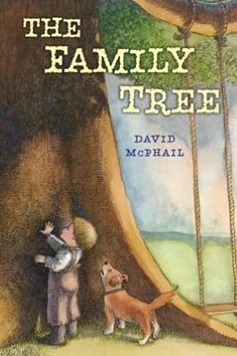
Review: The Family Tree by David McPhail

family tree

The Family Tree by David McPhail

This is the story of a very special tree.  It was left standing when the rest of the space was cleared to build a house many years ago.  This tree would shelter the little house.  It witnessed many changes over the years as horse and wagon changed to cars.  There were births and deaths on the farm, until finally it was the great-great grandson of the original building of the home who lived there.  The tree still stood, strong and straight.  But then it was threatened as a new road was planned that would run right through it.  The grandson refused to let the tree be cut down, and wild animals join him to keep it from happening.  So the road plans must be changed and the tree continues to grow now by the large bend in the road.

There is something to be said about a picture book that decides to tell the story that feels right, the one that resounds in your bones, rather than the one that would happen in real life.  When I saw the bulldozers in the book, I braced myself for heartache, or for the story to turn into that of growing a new tree from an acorn that originated with this tree.  But instead McPhail told a story for tree lovers of all ages, who wish that there were bends in the big highways to keep huge old trees alive. 

McPhail’s writing is simple and straight-forward.  He tells the story with a great matter-of-fact tone that belies the wildlife appearing and the wonder of the tree standing.  His art is signature McPhail with its fine ink lines and watercolor softness.  It has both the clarity of the modern day and the softness of memories.

Get this into the hands of those who hug trees.  They are guaranteed to love it.  Appropriate for ages 3-5.

Reviewed from copy received from Henry Holt and Company.

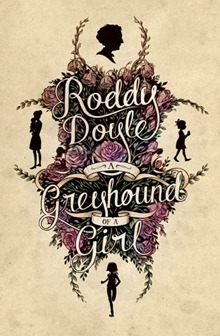
Review: A Greyhound of a Girl by Roddy Doyle

greyhound of a girl

A Greyhound of a Girl by Roddy Doyle

Four generations of a Dublin family come together in this ghost story.  Mary is a modern Dublin pre-teen who finds herself moving away from her childhood rituals but also wanting to cling to them too.  One day on her way home from school, she meets Tansey, a woman who wants her to give a message to her grandmother.  Mary forgets, distracted by visiting her grandmother in the hospital with her mother.  So it isn’t until later that she mentions the woman to her mother, who pales at being told the name, Tansey, because that was her own grandmother’s name.  Soon Mary is having her mother meet Tansey and her relationship is revealed as is her status as a ghost.  The three of them conspire to get Tansey and her daughter together again, even though Tansey can’t survive the harsh lighting of the hospital.  The result is a road trip filled with hellos, memories, family stories, and goodbyes.  Richly layered, this slim volume holds a grand tale.

Doyle plays with the format of a ghost story here, at first starting with a little shiver and danger and then turning the story into that of a family that has dealt with an early death for generations.  It is a story of maternal love and the connections of women in a maternal line.  It is also the story of loss, death and above all, life.  Doyle creates fascinating characters, particularly in the two older women, Tansey and Emer.  Their stories have a pastoral beauty, a vivid warmth, and yet are damaged by death.  It is poignant, lovely and tragic.

The story is character driven and told in a slow, transformational way.  It takes its time, filled with small moments of lives, hands wrapped around tea cups, children on laps, slow steps up stairs for the last time.  Yet it is not a slow story, it is engaging, rich and builds a mood that is inescapable and memorable.

I loved this little book and the world that it created that seemed just for me.  Doyle’s writing is confident and beautiful, meticulously crafted.  This is a ghost story but so much more as well.  Appropriate for ages 11-13.

Reviewed from ARC received from Amulet Books.

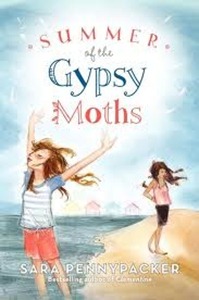
Review: Summer of the Gypsy Moths by Sara Pennypacker

summer of the gypsy moths

Summer of the Gypsy Moths by Sara Pennypacker

Stella lives with her great-aunt Louise on Cape Cod, where the house is always tidy, and even though Louise is not very demonstrative, Stella feels right at home.  Angel, a foster child, lives with them too, but Stella and Angel don’t get along at all.  Then one day, the girls return home to find Louise dead in her chair.  The two girls know that if anyone finds out, they will be put back into the child welfare system.  So they work together to create a plan that will let them stay in the tidy little house near the sea.  It would take a lot of work, because they would have to cover for Louise at her job of caring for four cottages on the property, and they would have to take care of the dead body too!  It’s a challenge for two girls who never got along in the first place and are headed in different directions when the summer is done.  This hope-filled book starts with a death and strangers and ends with hope and family. 

Pennypacker writes the sort of book that Stella would like to read.  It’s filled with all of the between-times, the moments of cleaning up afterwards, the small details, the real parts of life.  And it is through those moments that we get to know both girls, and Louise too.  The two girls are very different, and yet not so different after all, as readers get to know them.  They are both suffering from disappointments and loss, from being left behind, from not having families.  Stella holds onto her Hints from Heloise, determined to have a life of order and neatness that makes sense.  Angel listens to the music her mother played, hiding behind her earbuds and blocking everything out. 

One might think this would be a macabre book, and it does have those moments.  But it is much more a book about people and life, not death.  It is a book that celebrates summer, the days that stretch and lengthen, days shortened by working hard at times.  It is a story about secrets, opening up and revealing things.  It is a story about truth and lies, enemies and friendship.  Throughout the entire book, the story works naturally.  Things happen in their own good time, friendships blossom in a believable way.

This book does have a very neat ending with all of the storylines nicely fitting together.  I can only believe that Stella would approve of that being the way her story ended.  Appropriate for ages 9-12.

Reviewed from library copy.

Review: The Obsidian Blade by Pete Hautman

obsidian blade

The Obsidian Blade by Pete Hautman

This is the dazzling first book in a new trilogy by veteran author, Hautman.  It is the story of Tucker, a teen boy from Hopewell, Minnesota who sees his minister father suddenly disappear into a disk that hangs in mid-air.  His father returns an hour later, changed.   He looks older, his clothes are worn, and his feet are covered in odd blue boots.   But the most significant change is that he no longer believes in God.  After his father returns, Tucker’s mother begins a slow descent into madness.  She stops cooking, stops getting dressed, and her hair turns from red to pure white.  Tucker longs to return to the days when his family was not falling apart, but before he can even begin to hope for that, his father disappears with his mother.  Tucker knows they have both entered the disk again, looking for a cure for her.  This book blends family relationships, technology, time travel and religion into one intoxicating mixture that is impossible to sip slowly.

This book would definitely be categorized as science fiction, but that definition does not fit quite so easily here.  With its detailed look at modern life and families, the audacity with which it explores faith and religion, and the wrenching take on modern technologies, this book is far more than that narrow genre might imply.  Hautman has created a work that transcends simple definition, reaching quickly beyond them. 

Hautman whirls readers through time, creating places that read like Narnia, others that seem more like an Indiana Jones film, and then slows down to take in the crucifixion.   It is a trip through our shared past and future, dancing back and forth across the line until the reader is unsure which is which.  Hautman excels at asking impertinent questions, taking great risks, and exploring the lines that teens themselves like to toy with. 

The book is beautifully written.  The character of Tucker is well done, though others may need time in the upcoming books to come more fully to life.  The book is plotted tightly, picking up pace until by the end, you simply cannot read fast enough to figure things out.  And the final trick is the end of this first book, which is just like stepping through a diskos of your own.  

A triumph of a first book in a series, this reminds me strongly of the wonder of Chaos Walking by Patrick Ness.  I’d suggest getting it into the hands of teens who enjoyed that series which had the same complexity both in terms of storyline and ethics.  Appropriate for ages 14-17.

Reviewed from ARC received from Candlewick Press.

Review: Kate & Pippin by Martin Springett

kate and pippin

Kate & Pippin: An Unlikely Love Story by Martin Springett, illustrated by Isobel Springett

When Pippin, a fawn, is abandoned by her mother, photographer Isobel Springett found her crying for help.  She took Pippin home and placed her by Kate their old Great Dane.  The two immediately bonded:  Pippin thought she had found a new mother and Kate started to mother her even though she had never raised any puppies of her own.  Pippin learned to drink from a bottle and when she got bigger started to adventure outside.  One evening, Pippin disappeared into the forest and didn’t return for bedtime.  Kate was very concerned, but the next morning Pippin came back just in time for breakfast.  Pippin returned to the woods every night after that, returning to the farm almost every morning to eat and play.  As she grew into an adult deer, she still continued to return to visit Kate and play.  She even still comes into the house once in awhile for a visit. 

This is one of the most lovely picture books about a relationship with a wild animal that I have seen.  I especially appreciate that Pippin was allowed to continue to be a wild deer, returning to the forest and being allowed to create a relationship on her own terms.  It’s definitely refreshing to see.  Here the human and dog were able to rescue, aid but also step back and not absorb this little creature.  The relationship that emerges is breathtakingly touching, seeped in fragility yet incredibly strong.

A large part of the success here are the photographs of this tiny deer bonding with the enormous dog.  By the end of the book, the animals are the same size.  It is clear that both of them adore one another on a deep level, and one that is delightfully separate from the humans. 

This nonfiction picture book reads like fiction, making it a great pick for a touch of nonfiction in a story time.  It’s a story that children will relate to easily and naturally.  Appropriate for ages 4-7.

Reviewed from copy received from Henry Holt and Company.

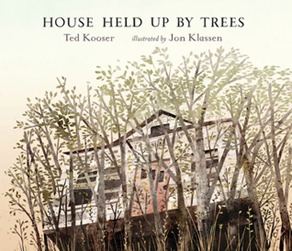
Review: House Held Up by Trees by Ted Kooser

house held up by trees

House Held Up by Trees by Ted Kooser, illustrated by Jon Klassen

This is the story of a family and a house.  When the house was new, it stood upon a newly planted lawn where the trees had been removed.  It was bare, not even a stump left behind.  On either side of the bare lot were trees of all sorts, the kind that spread seeds and scents.  Two children lived in the new house and often played in the trees at the edges, watching their father care for the lawn.  Their father mowed down all of the small tree seedlings before they could get started at all.  But the children grew up, the man moved away to be closer to them, and the house was left alone.  Alone except for the trees, which grew and took over the barren lawn, and eventually lifted the house high on their shoulders.

Kooser writes with amazing depth here, each sentence resonant with meaning and feeling.  While the book can be read more lightly, the joy here is in that dark deep that lies behind the lines.  The story plays with man vs. wilderness, the American obsession with lawns, children being pulled to the edges to find their own wild spaces, and the return to nature in the end.  The writing is beautiful because of that ever-present ache that is there, the tug of the trees, the dance of the seeds.

Klassen has illustrated this book with such delicacy that it shows he feels that same amazing pull.  He lets us peek at the house from the shelter of the woods, our eyes almost aching with the bareness in the sun.  He captures the tree seeds in flight from high above, allowing us to fly with them and plant ourselves too.  He plays with light, shadow and darkness, just as Kooser does. 

This book is poetry, without the stanzas.  It is a picture book that has depth, courage and looks deeply into our relationship with nature and with our families.  Beautiful.  Appropriate for ages 7-10.

Reviewed from library copy.

Review: Remarkable by Lizzie K. Foley

remarkable

Remarkable by Lizzie K. Foley

Jane Doe is a very ordinary person, which wouldn’t be that odd, except she lives in the town of Remarkable, which is filled with the most gifted and talented people anywhere.  Her family is full of gifted people, like her grandmother the mayor, her mother the architect, her brother the painter, her father the best-selling author, and her sister the mathematical genius.  Jane on the other hand is just like her grandfather, easily overlooked and ordinary.  They are so ordinary that they can’t get noticed long enough to get ice cream at the local soda shop.  Jane is the only student left in the regular school, since all of the other children are in the gifted school.  But then things start to change in Remarkable.  A pirate captain comes to town, followed by three of his crew who are searching for him.  Jane gets two classmates who have been kicked out of the gifted school because of their mischief.  In fact, Jane’s life might not be quite as dull and ordinary as she first thought.

Foley takes the idea of a very ordinary character and runs with it.  Jane is completely normal and it is her surroundings that are wild, extraordinary and unusual.  At the same time though, Foley does much to celebrate the ordinary and to point out that the quiet, the plain and the unassuming have gifts too though it may take some time to find them or notice them.

Foley’s writing is great fun in this book that mixes a huge sense of humor with some wild adventures.  The book starts slowly, nicely building towards the incredible ending that is filled with pirates, storms, music, cheap jelly, and even a sea monster.  The story has wonderful little touches, side characters who are nice diversions, and plenty to love. 

This would make a great pick for a class read aloud in elementary school and it would also make a remarkable read this summer.  Appropriate for ages 9-12.

Reviewed from ARC received from Dial Books for Young Readers.

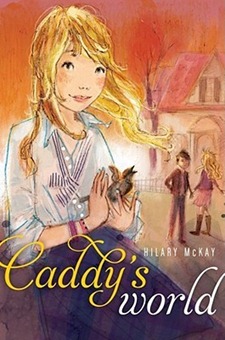
Review: Caddy’s World by Hilary McKay

caddys world

Caddy’s World by Hilary McKay

If you have not yet discovered the artistic, free-spirited, dynamic world of the Casson family, you are in for a treat!  This is the sixth book in the series that started with Saffy’s Angel.  In this book, we return to a time when Caddy, the oldest of the Casson children, was twelve.  She had three best friends and all of them had a role to play in their little group.  But this year, all of them are facing challenges in their lives.  Alison is completely bored with school and longing for something new, so she starts rebelling against school rules.  Ruby has been asked to try for a prestigious scholarship to a private school but she doesn’t want to leave her friends.  Beth is outgrowing her pony and decides to limit her diet. Caddy too has a challenge, a new baby is coming to the family, and her father who usually lives away from the family in London returns to help take charge.  But things are never that easy in the chaos of the Casson family!

McKay has the ability to speak about serious issues like premature babies, growing older, potential bulimia, and chaotic family life without heading into deep drama.  While the subjects are deep and the emotions are real, she keeps a lighter touch on them than most authors.  My favorite example of this is the chaos of this family.  It’s a family filled with love, art projects, failed cooking, and laughter.  But it’s also a family that is often adrift, rudderless, and late for school.  McKay walks the line, demonstrating that there are many sorts of families and that some of them that may look fragmented are actually strong and true.

McKay is also adept at drawing characters.  Here we get to see younger versions of several beloved characters:  Saffy, Indigo and Caddy.  They are all wonderfully true to their older selves, showing interest that later come to full light.  The addition of the three new characters and glimpses of other previous ones make for a book that is fresh but also warmly familiar to fans of the series. 

This sixth book in the series would work as a stand-alone read.  Taking place earlier than the other novels, it will delight fans and should encourage new ones to enter the world of the Cassons.  Appropriate for ages 9-12.

Reviewed from library copy.