Review: Sadie and Ratz by Sonya Hartnett

sadie and ratz

Sadie and Ratz by Sonya Hartnett, illustrated by Ann James

Hannah’s hands are named Sadie and Ratz, and they get into all sorts of trouble.  They like to crunch, squish and squeeze things.  They are especially active when Hannah’s little brother, Baby Boy, does things like going into her room or using all of the markers.  Then Sadie and Ratz try to rub off his ears.  Baby Boy screams for help and Hannah gets into trouble.  But then one day, something strange happens and Sadie and Ratz get accused of drawing on the wall, when they were nowhere near there.  Baby Boy was there, but he tells his parents that Sadie and Ratz were the ones who did it.  Later, Baby Boy blamed Sadie and Ratz for his skinned knee.  He got a cookie and cuddles, while Hannah only got a cookie.  Things were getting out of control, so Hannah sent her hands on vacation so they could no longer be blamed for things they had not done.  After that, she discovered that her pet stick insect, Pin, was missing a leg.  Now that was taking it too far!  Whose busy hands could have done this?

This book is a delight.  It’s going to bother some people that the behavior the children are modeling here is not perfect.  Rather, it is naughty, childlike, and accurate.  This book reflects great parenting on the part of the parents in the book, an openness for creativity, and a welcome zing of real life.  These are children who don’t always tell the truth and have hands that get into mischief. 

The charcoal illustrations by James have a wonderful wild quality as well.  They are rough, often dark, and filled with shadows.  These are not illustrations filled with color, pink and glitter.  All signs point to the fact that this is a different sort of chapter book altogether.  And so it is.

An outstanding addition to beginning readers in libraries, this book will appeal to a certain kind of family and a certain kind of kid.  You know if you are one of those parents and if you are raising on of those kids.  Mine both are.  Appropriate for ages 6-8.

Reviewed from library copy.

Review: My Dad Is Big and Strong, But… by Coralie Saudo

my dad is big and strong but

My Dad Is Big and Strong, But… by Coralie Saudo, illustrated by Kris Di Giacomo

Released May 8, 2012.

Translated from the French, this picture book takes the traditional bedtime story and turns it upside down.  Every night it’s the same thing, Dad does not want to go to bed.  The boy tries to get his father to bed nicely by using logic, but his dad just gets wilder and wilder.  The boy refuses to chase after him, instead offering a quiet story together.  That always works, and the two of them sit together in a chair: the father on the boy’s small lap.  Two stories later, and the boy finally has his father tucked into bed, but the process is not done yet.  The boy can’t head to his own bed yet or his father will ask to sleep with him.  And though his father may be big and strong, he’s also afraid of the dark.

This picture book has a wonderful charm about it that really works.  While there are other books that turn the parent/child relationship around, this one does it with a gentleness and honest joyfulness that is simply lovely.  A large part of this is the tone of the writing.  The sentence structure also works well, showing the skill of the translation.  The book plays with so many of the stereotypes of getting children to sleep that it is a delight to share with children.

Giacomo’s illustrations keep the size of the father and son as different as possible.  As you can see from the cover, the boy is quite small.  It is that size difference that adds so much humor to the illustrations, especially when the father is sitting on the boy’s lap for a story.  Another wonderful whimsical touch is the way the father heads to bed in hat and tie, rather than pajamas. 

Doing a pajama or bedtime story time?  This book would work very well there.  It is also a great pick for bedtime snuggles, though you might find yourself on your child’s lap just to try it out.  Appropriate for ages 3-5.

Reviewed from copy received from Enchanted Lion Books.

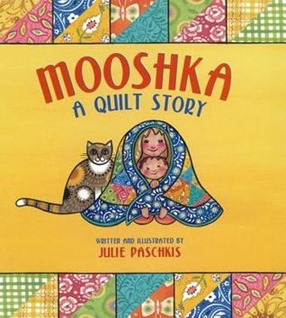
Review: Mooshka, a Quilt Story by Julie Paschkis

mooshka

Mooshka, a Quilt Story by Julie Paschkis

Karla loved her quilt that her grandmother had made for her from scraps.   Karla had named the quilt Mooshka.  Mooshka kept her warm at night and smelled just right.  But the most special thing that Mooska could do was talk.  Mooshka would wish Karla sweet dreams and in the morning invite her to pancakes.  If Karla couldn’t sleep at night, Mooshka would tell her the story of any patch on the quilt.  There were playful stories from tablecloth scraps, romantic stories from a bandana, exciting stories from a red scrap.  When baby Hannah moved into Karla’s room, Karla was upset.  She tried to get Mooshka to soothe her with a story, but Mooshka would not speak.  Then when Hannah woke up crying and could not be settled, Karla found that Mooshka might be able to share stories with other people too.

Paschkis has created a book that speaks to the power of story and family.  There is a wonderful spirit of discovery and sharing throughout the book as family stories are shared.  The book has a circular feel, coming to a satisfying close that makes the circle complete.  This sense of place, history and story brings a richness to the book.

What is most distinctive about the book is its art.  Done in ink and gouache, each page is bordered in patchwork, giving the entire book a warm and cozy feel.  The patterns also offer a lot of color, making a feast for the eyes as each page is turned. 

A warm book about quilts, family and stories, this book is ideal for reading under your own quilt and sharing your family stories there.  Appropriate for ages 4-6.

Reviewed from copy received from Peachtree Publishers.

Review: Kindred Souls by Patricia MacLachlan

kindred souls

Kindred Souls by Patricia MacLachlan

Billy has lived on the farm his entire life.  He was raised in the sod house that is now tumbled down and covered by weeds.  Billy is the center of his grandson Jake’s world, especially their walks around the farm together.  Jake gets to see the farm through Billy’s eyes and spend time as his kindred soul.  When Billy gets sick, Jake isn’t worried.  He knows that Billy will live forever.  There’s only one wish that Billy has ever spoken about and that is having another sod house built on the farm.  As Billy recuperates in the hospital, Jake and his older brother and sister decide to build a house for him.  But the job is huge and Billy is coming home soon.  Can they pull off the special surprise?

MacLachlan excels at creating great depth in small packages.  This is another of her very short books that plunges readers into a family and immediately takes up space in your heart.  There is the beauty of a long life lived on a farm that is almost spiritual.  There is a young family that has an elder as their center.  And then there are the small moments that create their days and weave together a story that is bittersweet in the best way.

This small book looks at the role of grandparents in the lives of children in a quiet yet powerful way.  Billy is the center of the book, since he is the center of Jake’s world.  The book, told in the first person by Jake, also explores connections between generations that are strong and true.  The sense of kindred spirits is strong but never overplayed.  This entire book exudes a quiet strength that makes for a compelling read.

A strong book that would make a great read-aloud (especially by grandparents), this book is a beauty.  Appropriate for ages 7-9.

Reviewed from library copy.

Review: The Humming Room by Ellen Potter

humming room

The Humming Room by Ellen Potter

When Roo’s parents are murdered, it’s her ability to hide that saves her, as she retreated to her favorite spot under their trailer.  There she can look at the items she has “collected” or stolen, and she can press her ear to the ground to hear the tiny movements of animals, worms and roots.  After spending some time in foster care, Roo is taken to live on an island with her wealthy uncle who looks very similar to Roo’s father but with none of the carefree spirit her father had.  The island is on the St. Lawrence and the house used to be a tuberculosis sanatorium.  Now Roo is left there with little attention from her often-away uncle, and two servants.  The island is filled with life, including tantalizing glimpses of a wild boy who seems to live on the river.  Roo has to discover the truth of the strange house and the many secrets it holds.

Potter has stated that this is a novel inspired by The Secret Garden, and readers familiar with that work will definitely see it woven into this story.  At the same time, this book stands on its own beautifully.  It is a delightful blend of character and setting.  Roo is a prickly child, one who would be difficult to relate to except for her connection to nature.  That small piece of her character alone makes her human and accessible for the reader.  She is also prickly for very good reasons, including her parents’ death but also her misery of a life before their death.  The reader understands Roo deeply.   The secondary characters are all quirky and fascinating as well, especially the wild boy.

Then there is the setting.  Potter brings the St. Lawrence, the island, and this house to life.  This story could not be set anywhere else, as the setting is so closely married to the story.  The river is a large part of the book, including Roo’s growing understanding of its moods and the isolation of the island.  The house is central to the story as well, brooding and huge, its very walls hiding secret doors to wonders.  Then there is the garden itself, because of course there is a secret garden, and its rebirth that echoes Roo’s. 

Haunting and lovely, this book unfolds like the petals of a flower as each new discovery is made.  Environmentalism permeates the book in a gentle, green way that leaves readers wanting to connect with nature and preserve it without ever being preached to about the issue.  This is a delicate, wondrous read that is sure to be a hit with fans of The Secret Garden or those of us who are already fans of Ellen Potter.  Appropriate for ages 9-12.

Reviewed from copy received from Feiwel & Friends.

Review: Penny and Her Song by Kevin Henkes

penny and her song

Penny and Her Song by Kevin Henkes

Joining the beloved Chrysanthemum, Lilly, Owen and Wemberly is a new mouse character from the incredible Kevin Henkes.  This mouse is named Penny and she has a song to sing.  Unfortunately when she gets home, the babies are sleeping and she’s not allowed to share her song with her mother or father.  Later, she tries to share the song during dinner, but her parents ask her to wait until they are done eating to sing.  Finally, after dinner, Penny shares her song.  Her parents sing it too, they dress up in costumes, and the babies have a surprise reaction too!

Done in short chapters, this is more a beginning reader than a picture book.  Penny is a delight of a character, who when told she has to wait does not complain but tries to find new solutions that will let her sing without breaking the rules.  The final scenes with her parents happily joining in singing demonstrates the love that comes with rules and structure without any harshness being needed.  The illustrations are done in Henkes’ signature style, which is sure to delight all. 

A happy welcome to Penny as she joins this beloved mouse family.  Appropriate for ages 4-6.

Reviewed from library copy.

Review: Ellen’s Broom by Kelly Starling Lyons

Ellens Broom

Ellen’s Broom by Kelly Starling Lyons, illustrated by Daniel Minter

After slavery ended, Ellen’s parents’ marriage would finally be recognized by law.  Until then, no slave marriages were seen as legal.  The broom had always hung over the fireplace mantel in their home and all of the children knew the story of their parents jumping the broom and becoming man and wife.  When the family set off to make the marriage legal, all four children came along and Ellen was honored to carry the broom.  As their parents were about to be married, Ellen and her sister ran outside and decorated the plain straw broom with flowers and her mother carried the broom as a bouquet.  When her parents were married, Ellen knew that the ceremony wasn’t complete until they had once again jumped the broom together as a couple. 

This lovely picture book looks at Reconstruction, a period not often featured in picture books.  The depiction of a loving family who have survived slavery and are rejoicing in their new rights and freedoms is the center of the book.  Lyons does not shy away from showing the lingering shadows and effects of slavery, though they are shown more as memories and concerns, making them appropriate for the young audience.

Minter’s illustrations have such a delicate line that at first they do not seem to be block prints, but they are.  The bright colors and play of light and shadow make for a vivid read.  The wood grain of the walls alone are a masterpiece of line and color.

This picture book embraces family, tradition and looks to the future.  It is a gorgeous book that addresses a time in history that is often overlooked for young readers.  Appropriate for ages 5-7.

Reviewed from copy received from G. P. Putnam’s Sons.

Review: Another Brother by Matthew Cordell

another brother

Another Brother by Matthew Cordell

Davy was an only child for four years.  His parents paid close attention to everything he did and loved it all.  It all changed when Davy got a little brother, Petey.  Petey distracted Davy’s parents from everything he did!  And if Petey wasn’t bad enough, more little siblings started to arrive until Davy had 12 brothers!  All of them copied whatever Davy did.  They played with the same toys, had the same things for breakfast, walked like he did, and even ran after him when he tried to escape.  It drove Davy crazy.  But what would happen when those same little brothers decided not to copy Davy anymore?  It just might be worse!

Cordell’s zany book has an awesome sense of humor.  The book takes having a little brother to an extreme with an entire flock of brothers messing up Davy’s life.  Children with younger siblings will immediately recognize the truth of the story behind all of the humor.  Add in the references to vomiting, potty and burping and you have a picture book that is sure to be a hit when read aloud. 

Cordell’s illustrations are fine-lined and detailed.  They will work best with small groups or one-on-one since much of the humor is visual.  The rainbow-dotted sheep, the small details of their lives, and the touches like the balloon in front of the moon towards the end of the book all add up to a book that is designed to be adored and read again and again.

An outstanding pick for children dealing not with new infants but with the annoying little brother that follows them everywhere, though the humor alone will give it universal appeal.  Appropriate for ages 4-6.

Reviewed from copy received from Feiwel & Friends.

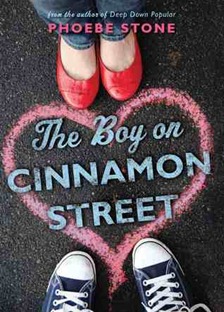
Review: The Boy on Cinnamon Street by Phoebe Stone

boy on cinnamon street

The Boy on Cinnamon Street by Phoebe Stone

When Louise orders yet another pizza for dinner, a new boy delivers it.  When Louise sees the delivery boy, she feels something shift and change, but ignores it.  Louise has built a safe world for herself, living with her grandparents.  She has given up gymnastics and tumbling.  She doesn’t see her old friends from her old neighborhood.  Her best friend tries to convince Louise that she has a crush on the delivery boy, but it doesn’t feel like that at all.  Louise continues to get signs that someone likes her though, and it might be that delivery boy after all.  But before Louise can be ready for any sort of relationship, she has to come to terms with the family secret that she is doing her best to hide from.

Stone’s writing shows readers that something is wrong before Louise ever comes close to realizing it consciously herself.  There are clues sprinkled throughout the book, cleverly leading readers to sleuth out what happened before the book reveals it.  Nicely, that is not the heart of the book.  Rather the heart is Louise herself, a girl who has blocked her memories, created a new life, and finds the construct crumbling around her.

This book centers on Louise, but it also has some other amazing characters in it.  Louise’s best friends are brother and sister, Henderson and Reni.  They both support her, embrace her in their normal family life, and stand by her as she realizes the truth.  My favorite characters are Louise’s grandparents, who stay jovial and supportive, never pushing Louise too far and always being there when she needs them.  They are engaging, lively and charming, just what Louise and the reader needs.

My only quibble is that the sweet cover does not speak to the depth of the book itself, which wrestles with dark subjects, memory and survival.

A character-centered book, this tween read is compelling, romantic and rich.  Appropriate for ages 10-13.

Reviewed from ARC received from Scholastic.