Review: Tia Isa Wants a Car by Meg Medina

tia isa wants a car

Tia Isa Wants a Car by Meg Medina, illustrated by Claudio Munoz

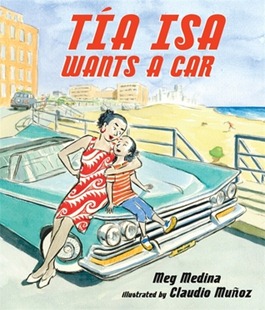
A little girl’s Tia Isa wants to get a car in order to take the family to the beach.  She wants one that is the color of the ocean with pointy wings at the back.  But Tio Andres laughs at the idea, calling it “ridiculous.”  They don’t have much money, but head to a car dealer where they find out they need to save more.  So the little girl sets out to help.  She stacks fruit at the store, feeds people’s pets, and teaches Spanish.  She waits until her money sock is bulging full and then surprises her Tia Isa.  Immediately, they run to the car dealer where they find just the right car way in back near the fence. 

A story of family and the importance of saving money for your dreams, this book will resonate with children who are saving their money for a large purchase as well as children from families where saving money is difficult but vital.  Medina writes with lovely imagery that creates a very vivid reading experience.  Readers discover that Tia Isa smells of lemon pies from the bakery where she works, that the car dealer smells of tar, and that work boots resemble ogre shoes. 

Munoz’s illustrations depict an urban neighborhood of apartments where neighbors help one another.  There is a feeling of safety in the illustrations, offering that rare glimpse in picture books of urban life without urban decay.  The illustrations of the family have that same feeling of warmth and belonging.

Dreams, savings, waiting and helping: this book speaks to all of those and ends with a refreshing ocean breeze.  Appropriate for ages 4-6.

Reviewed from library copy.

Also reviewed by There’s a Book.
Review: Pregnant Pause by Han Nolan

pregnant pause

Pregnant Pause by Han Nolan

Released September 19, 2011.

Eleanor has always made the worst decisions but this one may top them all.  She’s now pregnant and married to her boyfriend.  Oh, and stuck in a cabin, at a weight-loss camp, with her in-laws who definitely don’t approve of her.  Her parents have left her to return to Kenya and their missionary work with AIDS infants.  Everyone wants Eleanor’s baby.  Her older sister who has been struggling with infertility wants the baby.  Her in-laws who lost a child in infancy want it too.  But Eleanor and her husband are the only ones who can decide what they are going to do.  As Eleanor works at the camp with the children, she learns that she has a real skill with kids.  And of course, she does it in her own way.  Now she just has to figure how to handle her marriage, pregnancy, and a baby.

Nolan’s writing is exquisite.  She has created a protagonist in Eleanor who is definitely a hero, but also challenges the reader with her anger, her biting wit, and her choices.  Eleanor reads as a real person, with self-doubts and real emotions that originate naturally from the story line.  Nolan writes with a confidence and skill here, showing that there is life beyond pregnancy but it is filled with difficult choices and unexpected events.

A strong and riveting look at teen pregnancy, this book reaches far beyond a single issue and straight to the heart of a compelling character.  Appropriate for ages 14-17.

Reviewed from ARC received from Houghton Mifflin Harcourt Children’s Book Group.

Also reviewed by:

Review: Little Pig Joins the Band by David Hyde Costello

little pig joins the band

Little Pig Joins the Band by David Hyde Costello

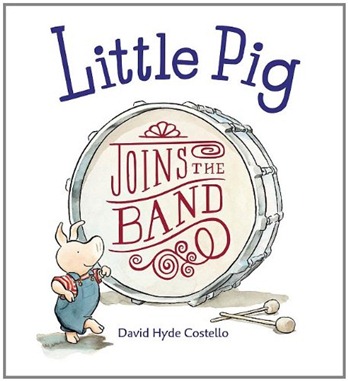
His family all call Jacob, Little Pig, and he is the smallest in his family.  So when his siblings get out his Grandpa’s old marching-band instruments, Little Pig has trouble finding one that fits him.  He’s far too small for the drums, too little for the trumpet and trombone, and don’t even ask about the tuba!  All he can do is watch as his older brothers and sisters march around the room.  But when they come to a crashing stop, Little Pig knows just how he can join the band after all.

This simple story speaks to everyone finding their own niche and value in a family.  Here, Little Pig finds the special place for himself rather than the older children or adults helping him.  It makes for a very powerful message for young children, that not only do they have value but they can discover it on their own. 

Costello writes with simplicity and a solid feel.  His story has small, clever asides that are filled with puns as well.  His art is friendly and cheerful.  Little Pig has an oversized snout, small eyes and expressive ears.  Even the older children are treated as individuals in the art, with one decked out in hat and a boa.  I can see more stories about the children in this family.

A strong story about finding your place and becoming a leader, this book has a cheery feel that is very appealing.  Appropriate for ages 3-5.

Reviewed from copy received from Charlesbridge.

Also reviewed by

Review: A Stranger at Home by Christy Jordan-Fenton

stranger at home

A Stranger at Home: A True Story by Christy Jordan-Fenton and Margaret Pokiak-Fenton, illustrated by Liz Amini-Holmes

This sequel to Fatty Legs takes place after Margaret has spent two years at a residential school.  As Margaret finally returns home to her family, she does not expect her mother not to recognize her or for her transition back into the family to be so difficult.  She can’t eat the food her family eats because her stomach rejects it.  She has forgotten how to speak their language and can only talk in English.  The mukluks hurt her feet and she returns to wearing the canvas shoes she was given at school.  Slowly, she begins learn once again the culture that she had lost.  But then she faces the heartrending choice of whether to return to school with her little sisters or allow them to go alone.  This true story speaks to the tragedy of residential schools on Native peoples, an impact they are still recovering from.

A large part of the success of these books comes in their writing.  It is simply written with large, welcoming print.  The writing is matter-of-fact, not laden with imagery.  It is that straight honest writing that truly captures the loss and the pain.  It doesn’t allow a reader anywhere to hide, nowhere to duck away from the truth. 

The book does deal with subjects that are large and complex.  Yet the writing makes them infinitely readable and relatable.  Seeing the situation through Margaret’s eyes allows it to be personal and very effective.

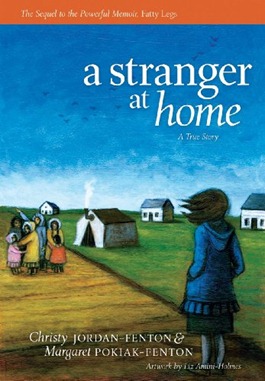
The illustrations are an intriguing combination of historical photographs and drawings.  Where the photos are often in black and white, the illustrations themselves are done in deep colors that show the beauty of the landscape as well as the conflict within Margaret’s family. 

A strong sequel to the original, this book shows very clearly the lasting damage created by residential schools.  Appropriate for ages 8-12.

Reviewed from copy received from Annick Press.

Review: Blood Wounds by Susan Beth Pfeffer

blood wounds

Released September 12, 2011.

Blood Wounds by Susan Beth Pfeffer

Willa’s life may not be perfect, she lives in a blended family with sisters who get their expensive hobbies and trips paid for by their mother, while Willa doesn’t get those opportunities.  Their family is happy though.  Of course, there’s a reason that Willa feels the need to cut, so maybe things aren’t as good as they seem.  Then one day, with a series of murders in a faraway state, Willa’s life is thrown into crisis.  Her biological father is on the run after killing his wife and children, and he’s probably headed to get Willa next.  As the crisis throws their life into turmoil, Willa discovers more about her family than she’d ever known, including secrets that answer a lot of the questions she’s never dared to ask.

Pfeffer has created a book that starts with a thrilling premise but that turns out to be less of a thriller and more of a psychological look at a teen girl who has to deal with the aftermath of her father’s madness.  Willa is a very intriguing and complex heroine.  She struggles to be the perfect daughter, never revealing what she really thinks to her family.  On the inside though she is filled with doubts, with unvoiced thoughts, and with resentment.  With her father’s murders her life begins to reflect more of her inner world, becoming just as confused and tumultuous. 

The writing here is very well crafted.  With so many themes: blended families, cutting, murder and forgiveness, it could have become muddled.  Instead the themes support one another, creating a tapestry of interwoven ideas that strengthen one another. 

Readers will pick the book up for the thrilling premise and then be riveted as they discover a much more complicated read than they were expecting.  Appropriate for ages 13-15.

Reviewed from ARC received from Houghton Mifflin Harcourt.

Also reviewed by

Review: Lucky for Good by Susan Patron

lucky for good

Lucky for Good by Susan Patron

This conclusion of the Lucky trilogy will be bittersweet for fans of the series.  Happily, there is one more book with the vivacious Lucky and the intriguing extended family of Hard Pan.  Sadly, it is the final one.  In this book, Lucky struggles with the unknown.  Brigitte’s new café is closed due to a violation of a county ordinance, her best friend is headed to England for the summer, and she even punches a boy.  That ends up with her in serious trouble and she is forced to do a family tree.  That brings up even more questions for Lucky, who doesn’t know how she will handle researching the side of her estranged father.  But nothing keeps Lucky down for long and soon all is heading towards solutions, but not without a few more bumps in the road to keep it all interesting.

Patron does not shy away from difficult topics in this final book.  She deals with the universal themes of family and community as she has in her previous novels.  And what a community it is!  I think all readers of the Lucky series hope to move to Hard Pan, despite the dried out sandwiches.  But Patron explores religion in this novel in a very frank and honest way, voicing the questions that children (and adults) have when they meet someone who believes in a more judgmental universe.  I applaud the courage and bravery of Patron in being so open about these questions, something that young readers will love as well.

Patron also excels at creating characters and all of your favorite characters return in this novel, plus a few new ones.  Lucky is a heroine with real spunk, with her own world view, and a strong sense of self.  Even in her moments of doubt, Lucky never shies away from being exactly who she is. 

An impressive conclusion to the Lucky trilogy, fans of the series will have to have this one.  And for me, I can’t wait to see what world Patron will create for us next.  Appropriate for ages 8-12.

Reviewed from copy received from Atheneum Books for Young Readers.

Review: Island’s End by Padma Venkatraman

islands end

Island’s End by Padma Venkatraman

A remote island in the Bay of Bengal is the setting for this novel by the author of Climbing the Stairs.  Uido is a teen who can communicate with spirits.  Just before strangers arrive at their island, Uido dreams of it.  The tribe has conflicted feelings about the strangers, some are drawn to the technology of their fast boats and matches, while others see the end of their ways if the new ways are adopted.  During this confusing time, Uido studies to become her tribe’s spiritual leader.  There is danger in the studies, from braving the dangers of the island to finding her spirit animal.  But nothing is as dangerous yet beguiling as the strangers and their new ways, as Uido is soon to find out. 

Venkatraman creates a vivid world here surrounded by water and coral reefs.  It is a world where everything is different.  The island itself is a character in the book as seasons turn, Uido journeys across the island, and finally in the climactic ending scenes.  The island is beautiful, wild, untamed and irresistible.

Uido is a heroine who faces many self-doubts, but rises to the challenges she is faced with.  She has a spirit herself that is true and strong.  She struggles with a friend who doesn’t understand her, a brother who is jealous, and the loneliness of being away from her family.  Plus the allure of the modern world.  Yet in Uido, readers will also see a young woman who is tied to the traditional ways in a strong and compelling way.

Beautifully written, this book is a journey into an unknown, primitive world where readers will discover a radiance and wonder.  Appropriate for ages 13-15.

Reviewed from ARC received from Penguin Young Readers Group.

Book Review: A Monster Calls by Patrick Ness

monster calls

A Monster Calls by Patrick Ness, from an original idea by Siobhan Dowd, illustrated by Jim Kay

Released September 27, 2011.

Conor awoke at 12:07, just after midnight, from his nightmare, the one he had been having for years.  Then he realized that something was calling his name.  It was a monster, but not the monster from his dreams.  It was another monster, a monster who came walking to tell him three stories and then Conor had to tell him the fourth and final story.  And it had to be the truth.  Conor had not told anyone the truth for some time, not since his mother had first gotten sick.  Now she was worse again.  So Conor turned to the monster in the hopes that he could save her, that that was what had brought the monster walking.

Ness has created a powerful book from the final idea that Siobhan Dowd left before she died.  It is gut wrenching on so many levels.  You have a monster who is breathtakingly real, a boy who is disappearing into his mother’s illness, and a story of cancer and all of the feelings and emotions it creates and doesn’t allow to be expressed.  This is a book about the time before the loss, the anguish of the waiting, the hollowness not only inside the surviving family but around them as well, and the anger that is a part of grief too. 

Ness does not duck away from anything difficult here, rather he explores it in ways I haven’t seen before.  He takes the darkness and makes it real, makes it honest, creates truth from it and lays it all bare.  It is a book that is difficult to read but too compelling to put down.

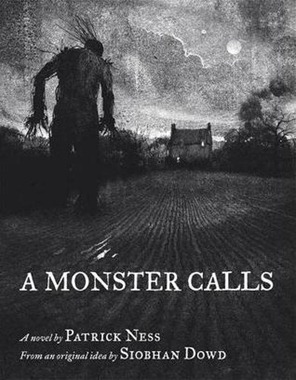
Kay’s art runs throughout the book, framing the text.  It helps create a mood for the entire work, one of darkness and lightness too.   He plays with such darkness in his art here that it is sometimes a matter of black and blacker.  The art, done just in black and white, speaks to the power of the monster, the blaze of life, and the fragility of it as well.

I simply can’t say enough good things about this book.  It is a stunning work that truly does tribute to Siobhan Dowd’s idea.  Appropriate for ages 12-14.

Reviewed from ARC received from Candlewick Press.

Also reviewed by:

Book Review: The Great Big Book of Families by Mary Hoffman

great big book of families

The Great Big Book of Families by Mary Hoffman, illustrated by Ros Asquith

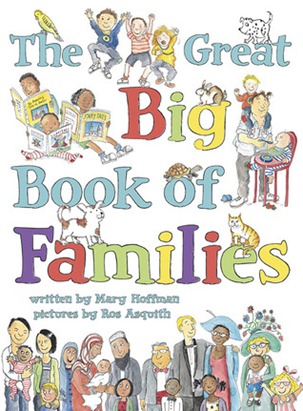
This book celebrates all of the different sorts of families there are.  It starts with a stereotypical family of blonde, white mom and dad, two kids (a boy and a girl), a dog and a cat.  They even come complete with the picket fence and apple tree.  Turn the page and you are in reality with families of different colors, single parents, grandparents, two mothers, two fathers, and adoptive families.  The book then moves on to family sizes, different homes, different ways to go to school, different ways parents work, the holidays families take, the food we eat, clothes, pets, hobbies, and much more.  The book ends by expressing a very important message that families change.  So what does your family look like today?

Another facet of this book is the celebration of families of different incomes and wealth.  Nothing is put down, just mentioned as different from one another.  Children may not notice the differences, but if you are a child struggling with poverty, it is good to see yourself represented here matter-of-factly and honestly.  Hoffman’s entire text is written in this straight forward way, she is inclusive, expansive and above everything non-judgmental. 

Asquith’s illustrations have a nice sense of humor that keeps the book from being too earnest.  They have a quirky feel, a silliness that makes the book a pleasure to read.

Every library needs a copy of this warm, welcoming book where all children will see parts of themselves represented.  Appropriate for ages 4-7.

Reviewed from copy received from Dial Books.