Book Review: Worms for Lunch? by Leonid Gore

worms for lunch

Worms for Lunch? by Leonid Gore

Through bright colors and die cut illustrations, young readers explore what different animals eat.  The book begins with the question of “Who eats worms for lunch?”  A mouse declares that he doesn’t eat worms, instead he likes cheese.  A relieved worm disappears from the page.  Then a cat spots the mouse, and says that that’s what she would like for lunch.  She ends up with a bowl of milk.  The cow then declares that milk may be good, but grass is better.  On the book goes, moving from one animal to the next until finally the question of who eats worms for lunch can be answered! 

This entire book has a great sense of play and humor about it.  Every other page has a die cut, making the book more enticing for young children to experience.  The simple text and the bright colors combine into a book that is just right for toddlers to enjoy.  They will enjoy turning the page and having the story change too. 

With its large illustrations, this would work well with a group of children.  A good pick for a toddler story time about food.  Appropriate for ages 2-4.

Reviewed from copy received from Scholastic Press.

Also reviewed by

Book Review: Betty Bunny Loves Chocolate Cake by Michael B. Kaplan

betty bunny

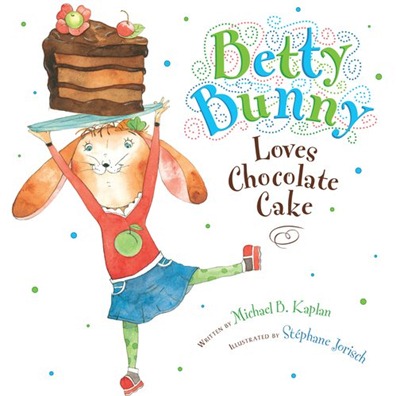
Betty Bunny Loves Chocolate Cake by Michael B. Kaplan, illustrated by Stephane Jorisch

Betty Bunny’s parents are always telling her that she’s a handful.  Since she knows they love her very much, she is certain that being a handful is something very, very good.  One day, her mother offers chocolate cake for dessert.  Betty Bunny refuses to try it at first, because it is new, but then gives in.  She realizes that it is very delicious, so delicious that she decides that she will marry chocolate cake.  The next day, she is obsessed with chocolate cake, unable to concentrate at all at school.  Once she got home, she was told she would have to eat a healthy dinner before she could have cake.  When her siblings tease her, Betty gets angry and throws food.  She’s sent to her room where she continues to think only of cake.  The next day, she is told there is a piece of cake just for her waiting in the refrigerator if only she will be patient through the day.  Betty Bunny knows the cake will be lonely all day, so she puts it in her pocket.  At home that evening, she realizes it has become a goopy mess in her pocket.  Her mother tries again, leaving a piece of cake just for her.  What in the world could Betty do next?

I know that this book will have some parents frustrated because it is not a picture book that demonstrates exemplary behavior from the children in the story.  But that is where the appeal of this book is for me.  Betty Bunny reads as a real child with an obsession.  She cries, gets angry, and thinks about it all the time.  But this book is not just about a child obsessed.  It is also the story of a family with older siblings and parents who use humor and clever approaches to deal with a child. 

The writing has wonderful moments built into it.  Betty’s insistence that she will marry chocolate cake because she loves it so much rings very real.  Her brother’s teasing about that over the course of days also reads as true.  It is a picture book that is written by people who have children, love children, and appreciate the humor that comes with them.

Jorisch’s illustrations are done in pencil, ink, watercolor and gouache.  They have a great mix of organic watercolor feel and angular modernism.  There is a bright warmth to them thanks to how colorful they are and a pleasant busyness that depicts the active family.

Highly recommended, this is not a book for parents who want an example for how their children should act.  But it is a great read-aloud filled with chocolate, sweets, temper tantrums and family.  Appropriate for ages 4-6.

Reviewed from copy received from Dial Books for Young Readers.

Also reviewed by

Book Review: Rah, Rah, Radishes! by April Pulley Sayre

rahrahradishes

Rah, Rah, Radishes! A Vegetable Chant by April Pulley Sayre

Get into the summer veggie crunching mood with this book that celebrates vegetables of all sorts! 

Rah, rah, radishes! Red and white.

Carrots are calling.  Take a bite.

Oh boy, bok choy! Brussels sprout.

Broccoli.  Cauliflower.  Shout it out!

With a rhythm that is great fun and contagious, this book will have even the most dubious children cheering for vegetables too.  

Sayre pairs her rhymes with bright photographs of vegetables from farmer’s markets.  The freshness is apparent as is the abundance.  It’s an ideal setting for celebrating farming and food.  Her photographs are as crisp as the pea pods and as colorful as the peppers. 

A great introduction to trying new foods or visiting a farmer’s market, this book is a celebration of good eats.  Yum!  Appropriate for ages 2-4.

Reviewed from copy received from Simon & Schuster.

Also reviewed by:

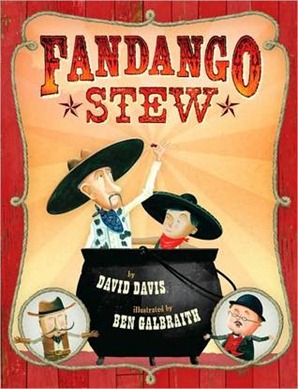
Book Review: Fandango Stew by David Davis

fandangostew

Fandango Stew by David Davis, illustrated by Ben Galbraith

A wild west version of Stone Soup, this book will have you singing the praises of Fandago Stew too.  Luis and his grandfather, Slim, come to the town of Skinflint with their stomachs already rumbling with hunger.  But they also have a plan, Fandango Stew.  Unfortunately, the local sheriff is not happy to have them in town and tries to run them out.  But he agrees that Luis and Slim can boil water and throw in their bean.  Slim and Luis break into song “Chili’s good, so is barbecue, but nothing’s finer than Fandango Stew!”  One-by-one the people of Skinflint begin to contribute, shamed into it when Slim and Luis talk about the Fandango Stew they made in other towns and the generosity shown there.  Well, Skinflint may be frugal, but no one calls them stingy!  As each new component is added, Slim and Luis reprise their song, adding new harmony parts.  In the end, you know the story of delicious stew created by a community but this time it has some western seasoning added too.

Davis has created a fun and stylized version of the traditional tale.  The incorporation of the western setting is well developed and adds an interesting dimension to the story.  As the story and the stew develops, the inclusion of the entire community and their pride and willingness to turn it into a party make for a jubilant read.  The use of the song after each addition to the stew adds a strong structure to the book as well.

Galbraith’s illustrations are filled with texture and color.  Everything from the ropes to the boards of the houses to the corrugated roofs add to the rich feel.  As the book progresses, the illustrations move from a sepia toned sparse color to richer colors. 

A rootin’ tootin’ good recipe for a book!  Appropriate for ages 4-7.

Reviewed from library copy.

Also reviewed by BooksForKidsBlog.

Book Review: The Cazuela That the Farm Maiden Stirred by Samantha R. Vamos

cazuelafarmmaiden

The Cazuela That the Farm Maiden Stirred by Samantha R. Vamos, illustrated by Rafael Lopez

This is a fresh, fabulous cumulative tale that is made spicier and more interesting thanks to the Spanish sprinkled liberally throughout.  It is the story of a farm maiden who stirred a pot.  Once she started stirring, all of the animals wanted to help with what she was cooking.  The cow gave milk, the hen gave eggs and zested the lime which was picked by the donkey who was carrying the duck to the market.  Eventually everyone is waiting for the treat to be finished until they started playing music and dancing.  Then no one was watching or stirring the pot!  Thank goodness that they returned just in time to enjoy the arroz con leche that they had all cooked together.

When I read this book to myself silently it really didn’t work, but read aloud it merrily dances along, even with my very imperfect Spanish pronunciation.  For classes in our community, the blend of Spanish and English is very desirable.  Happily, the Spanish here forms the real foundation of the story rather than just being extra words that are thrown in.

Lopez’s art is so vibrant and warm.  The sun shines when you open the book, thanks to the use of a beautiful yellow for the majority of the background.  Add to it the purple clouds tinged with red, the orange ground, and the vibrant green of the plants, and you have a book where the colors are filled with heat and spice.

A rollicking picture book that celebrates Spanish and English mixed together sweetly, just like the perfect arroz con leche.  Appropriate for ages 3-5, and in language classes for older children.

Reviewed from copy received from Charlesbridge.

Check out the book trailer to get a feel for the book and the illustrations:

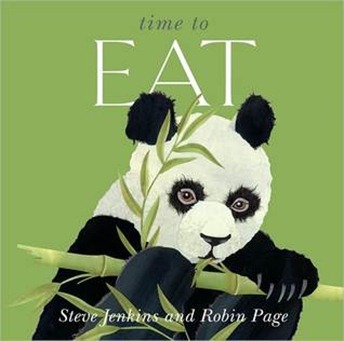
Time to Eat: Nature and Nibbles

timetoeat

Time to Eat by Steven Jenkins and Robin Page

Jenkins and Page continue their collaboration with a new series of nature books for young children.  The other two books in the series are Time for a Bath (coming in May) and Time to Sleep (just released).  In this book, readers learn about the many strange and different things that animals eat.  From the rocks that an ostrich has to eat to chew its food to the tapping thin fingers of an aye-aye looking for lunch, the facts are fascinating. 

Those facts are paired with Jenkins’ illustrations done in paper collage.  As always, his collage work captures the texture of fur, the softness of feathers, and the smoothness of skin.  They manage to be simple yet demonstrate the complexity of the animals. 

Make sure to turn to the end of the book for more details about the featured animals.  The facts included in the body of the book read aloud very well, offering just enough detail to be interesting and yet to move along quickly. 

This is a great book to add to any library’s nature section and to keep on hand for any nature or animal story times you will be doing.  The dung beetle alone is sure to get children intrigued!  Appropriate for ages 4-7.

Reviewed from library copy.

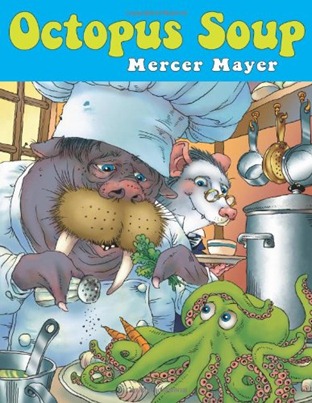
Octopus Soup: A Yummy Wordless Treat

octopussoup

Octopus Soup by Mercer Mayer

When an octopus climbs up an anchor line and into a fisherman’s basket, it causes all sorts of chaos.  The octopus is flung onto the head of someone cleaning the street and from there is chased through a window.  Taking refuge in a pitcher of water, the octopus is discovered by a chef with a taste for octopus soup.  A chase ensues, ending with the octopus hanging from the dock until it drops into the chef’s waiting soup pot.  But don’t fret, there is yet another twist in this tale.

Mayer’s latest features vaudeville physical humor and a timeless story.  The wordless story has more than enough humor to keep children giggling, enough tension to keep them wondering what will happen, and more than enough appeal for young readers. 

Hand this to children too young to be reading yet who want a book they can “read” on their own.  Appropriate for ages 4-6.

Reviewed from library copy.

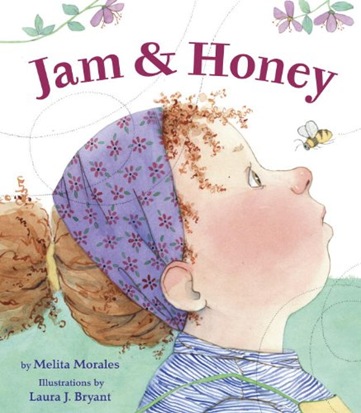
Jam & Honey: Natural Sweetness

jamhoney

Jam & Honey by Melita Morales, illustrated by Laura J. Bryant

This quiet, gentle book tells the story of a visit to an urban berry patch from two points of view, a girl and a bee.  The girl is headed to the berry patch to pick berry to make into jam.  Her big worry is running into bees, which she does.  But she remembers what her mother told her about staying still and that the bee was interested in nectar not in her.  The bee is heading to the berry patch for nectar to make into honey.  He is worried about running into a human there, which he does.  But he remembers that humans are interested in the berries, so he just flies past.  This parallel story offers a glimpse of urban gardening and emphasizes the importance of our food and other creatures.

Morales has written the book in a verse format that has enough rhyme to make it friendly and bouncy.  There is a rather jaunty tone to the book, making the encounter with the bee less scary than it could have been.  The emphasis is on making food, whether it is by the girl or the bee.  The two halves of the book are written in very similar verse, often repeating patterns from the earlier one.  This ties the two stories together even more firmly.

Bryant’s art makes sure that the reader knows that the book is set in an urban setting without covering it in graffiti or garbage.  Instead, we see a warm friendly neighborhood filled with flowers, pigeons, and bees.  She imbues the illustrations with a natural feel, always having the reader look past greenery and through plants. 

A great pick for insect units or story times or ones about food.  It could also happily be used as a late summer story when the berries are plump and ripe.  Appropriate for ages 3-5.

Reviewed from copy received from Random House.

Jake Goes Peanuts: Sticky Silliness

510wgCS0ZRL

Jake Goes Peanuts by Michael Wright

This third Jake book is a yummy choice.  Jake was a kid who didn’t like a lot of foods.  In fact, he only liked one.  Peanut butter.  It’s all he wanted to eat for any meal.  So his parents hatched a peanut-buttery plan to fix the situation.  For an entire week, everything that Jake ate would have peanut butter in it.  It sounded like a great plan to Jake!  There was peanut butter roast, peanut butter pancakes, peanut butter soda cooled by peanut butter ice, peanut butter turkey.  Even Jake’s dog got to try peanut butter dog food, but his bowl got stuck on his head.  But even peanut-butter loving Jake could not take one more bite by the end of the week.  Though he only ate one or two lima beans and his mother’s tuna casserole is still frightening.

Written with a big dose of humor, this book is jaunty and great fun.  Written in rhyme, the book bounces along without ever getting stuck in a peanut butter jam.  Wright’s illustrations are modern and add to the humor.  The expressions of the parents are priceless, often with eyes half-lidded and apparently stunned.  Wright is not afraid to take the scenario to an extreme, which will delight young children, especially the comment about peanut-butter poop. 

A very funny peanut butter romp, this book is appropriate for ages 3-5.

Reviewed from copy received from Feiwel & Friends.

Also reviewed by Kiss the Book.