Review: Burning Blue by Paul Griffin

burning blue

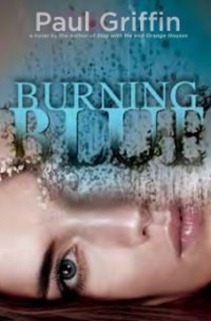
Burning Blue by Paul Griffin

Nicole was a beautiful girl, the prettiest in the school.  But that all changed when someone threw acid in her face at school.  Nicole didn’t know who did it, because she didn’t see anything other than the bottle aimed at her face.  Her boyfriend was nearby, the janitor seemed to know not to touch her, and a teacher was around too.  Quiet loner, Jay decides to figure out who did this.  He sees beyond her wounds, realizing that there is a lot more to Nicole than her lost beauty.  Jay is a hacker, able to get into government databases and trace people’s activities online.  As he gets closer to the truth of the attack, he and Nicole grow closer too.  Now he has everything to lose, especially as Nicole seems to be a suspect herself. 

Griffin nicely creates a lot of tension and mystery in this story of disfigurement and beauty.  Told from Jay’s point of view with insets from Nicole’s journal, this novel asks difficult questions about beauty, what lies beneath it, and the envy that it produces.  The question of who attacked Nicole stays in Jay’s focus, but the reader will equally enjoy the growing relationship between Jay and Nicole.

Jay is a fascinating character.  He is a hacker who pretends to know nothing about computers.  Some of his online conquests seem a bit to simple and easy, but with that aside, the hacking forms an intriguing basis for a detective to work from.  He is able to make breakthroughs and discover information that otherwise would be impossible.  But beyond the actual hacking, Jay lives a tattered life with his father after his losing his mother, and struggles with epileptic seizures.  His is a life lived alone by choice, until Nicole enters it.

A strong introverted and geeky character at its heart, this novel is a fine mystery but much more too.  Appropriate for ages 13-16.

Reviewed from copy received from Dial Books.

Review: A Certain October by Angela Johnson

certain october

A Certain October by Angela Johnson

Johnson continues to write powerful books in a short format.  Here we meet Scotty, a teenage girl who thinks of herself as rather bland, like tofu.  The people around her seem more vibrant and complex like her little brother who has autism and enjoys trains, being naked, and eating cookies.  Her best friends too seem to be more interesting to Scotty.  Then in October everything changes because of a train accident.  Scotty’s little brother is injured severely and another boy is killed. Scotty feels responsible for both of them, though she barely knew the other boy.  This is a story that takes the small details of life and then shows how a single event can tear through, changing life forever.

Johnson writes like a poet, using unique symbolism to make her points.  Scotty sees herself as tofu, bland until someone else adds flavor.  Readers though will immediately understand that that is how Scotty views herself, not how the she actually is.  Instead Scotty is an intriguing mix of teen angst, intelligence, and a big heart. 

Johnson writes her characters in real life.  They all read as real people, not even the parents becoming stereotypical.  The teen boys are just as human as the main character, treating the girls with respect and friendship.  It’s a refreshing change to see male secondary characters who are more than a stereotype too.  When Scotty is grieving, the power of family and friendship together is obvious.

With its dynamic cover and short length, this book is sure to be picked up by teen readers.  Here they will find a strong heroine who is intensely and utterly real.  Appropriate for ages 13-15.

Reviewed from copy received from Simon & Schuster.

Review: The Cavendish Home for Boys and Girls by Claire Legrand

cavendish home

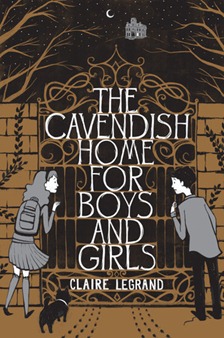
The Cavendish Home for Boys and Girls by Claire Legrand

Victoria has always tried to be the best that she can be with her perfect hair, great grades and neat room.  So when she gets a B in music, she is distraught and refuses to show her parents her report card.  Lawrence, her one and only friend, doesn’t have the same appreciation for perfection.  He’s a musician who is often untidy and has a habit of humming constantly.  As Victoria obsesses about her grades, she starts to notice that strange things are happening around town.  Some of the students at her school have disappeared and no one seems to care.  When Lawrence disappears and his parents are unconcerned, Victoria realizes that there is something horribly wrong.  She knows it must have to do with the Cavendish Home for Boys and Girls, an orphanage which never seems to have any children around.  In Mrs. Cavendish, Victoria finds another person with a will for order and perfection.  In Victoria though, Mrs. Cavendish may have met her match.  As this book turns from mystery to horror, readers will taken on a frightening ride.

From the endpaper that is designed with bugs to the bugs scattered along randomly inside the book, readers will realize that this is a little darker than most mysteries.  It begins as a classic story of a girl who is top of her class and fairly self-centered.  She is likeable despite these faults thanks to her natural inquisitiveness and bravery.  As the book becomes more dark and creepy, Victoria rises to the challenge, turning into a heroine before your eyes.  It’s a credible and impressive transformation.

Legrand slowly builds the tension in the book, creating a story that you can never quite relax into.  A great example of this is on page 83:

Outside, the streets glistened. Storm clouds sat fat, black, and heavy all along the sickly yellow sky. Victoria wondered if they would ever break or if they would just keep spitting bits of rain forever when no one was looking. She tightened her grip on the umbrella beneath her raincoat and tried not to think about how it felt like the trees were watching her.

It’s a book that twists and turns, becoming the unexpected. At several moments, I thought I had figured it out and the doubted that that would be the outcome in a children’s book.  Children will delight though in realizing that Legrand does not shy away from the horrid, the frightening and the disgusting. 

This is a wild ride of a book clothed in a classic mystery disguise.  Get it into the hands of children who enjoy a good shivery read.  It’s perfect for reading at night under the covers, if you are brave enough.  Appropriate for ages 11-13.

Reviewed from copy received from Simon & Schuster.

Review: Bear Says Thanks by Karma Wilson

bear says thanks

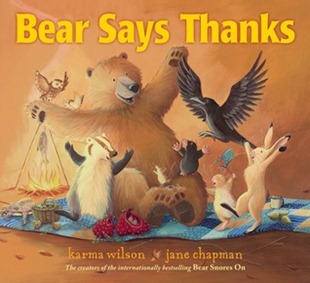
Bear Says Thanks by Karma Wilson, illustrated by Jane Chapman

The Bear series by Karma Wilson continues to impress with its latest entry.  There are only a few children’s picture book series that have maintained the quality of both writing and illustration as this series has.  In this latest tale, Bear has an idea to create a big feast and invite his friends over to share.  The only problem is that Bear has nothing in his cupboard at all.  Mouse shows up with a pie to share, and Bear says “Thanks!”  Bear continues to fret that he has nothing to share when Hare pops by with a batch of muffins to share.  Badger then arrives with fish, Gopher and Mole bring warm honey nuts, and Owl, Raven and Wren have herbs for tea and pears to munch.  But with no food to offer at all, what in the world can Bear give his friends?

I’ve always enjoyed the rhythm of this series and the repetition that makes them ideal to read aloud to toddlers.  There is also a wonderful friendly warmth to the books, captured both by the colors of the illustrations and the story itself.  That same warmth is here, friends offering food and sharing time with one another with no expectations.  Chapman’s illustrations stay true to the series, offering pictures large enough to share with a group.

While this book is perfect for Thanksgiving story times, I’d also use it throughout the year when talking about sharing.  This is a bear’s den that any of us would love to crawl into and spend some time in no matter what time of year it is.  Appropriate for ages 2-4.

Reviewed from copy received from Margaret K. McElderry Books.

Review: Ask the Passengers by A. S. King

ask the passengers

Ask the Passengers by A. S. King

Astrid wishes there was someone who could just listen to her without pressuring her.  Her mother is too pushy and driven to confide in, her father too withdrawn and high.  Her younger sister makes jokes that would make it impossible for Astrid to tell her the truth.  The truth is that Astrid has been kissing a girl and may just be in love with her.  But Astrid isn’t sure that she is really gay.  It may be that she just loves Dee for being Dee and not because they are both gay.  To make matters worse, Astrid’s best friends are in a fake relationship to keep their own secrets.  Astrid spends a lot of time on the picnic table in her backyard watching the planes fly overhead.  She beams them her love, tells them her secrets, and asks them for advice.  When the gay club that she and her friends frequent gets raided, Astrid is forced to start to confront the truth about herself, her family, and her friends.

King has captured the story of a girl questioning her sexuality here, but the story also transcends that and will reach teens who are questioning other aspects of themselves too.  It is a story that encapsulates that particular blend of wonder and fear that comes as a teen who is learning about themselves in such a private way that the rest of the world doesn’t change along with them.  Beautifully written, this is a book that speaks to the fragility and yet strength of that time.

In addition, King has created such a strong character voice here.  It rings with truth, never becoming snarky but really capturing a teen aspect.  Astrid’s messages to the plane passengers add an additional sense of magic and wonder to the story.  As she beams her love up, passengers receive it, make decisions based it, question their own lives, and react.  It adds an important dimension to the book, showing that throughout our lives people are still questioning.

This is a striking read with a vibrant heroine and a radiant point of view that itself beams with love and acceptance.  Appropriate for ages 16-18.

Reviewed from library copy.

Review: Penguin and Pinecone by Salina Yoon

penguin and pinecone

Penguin and Pinecone by Salina Yoon

One day Penguin found something strange in the snow.  It was a pinecone and realized that it was cold.  Penguin quickly knitted Pinecone a scarf that matched his, but Pinecone just kept shivering.  So Penguin headed on a journey to return Pinecone to his forest home.  When they got to the forest of towering pines, Penguin built a nest for Pinecone and a heart of stones around him.  Penguin returned home but kept wondering what had happened to his friend.  So he set off once again to find out.  Readers will be charmed by the conclusion of this tale of an unusual but heartfelt friendship.

Yoon excels at simple illustrations and simple words.  Here she has created a world of sunny friendship in the chill north.  The words are simple enough to use with toddlers and they will appreciate the love of a found object at that age too.  Yoon’s illustrations have a wonderful jolly nature, creating a world that is clearly safe and loving.

A great pick for friendship or penguin story times, this book will also work well for winter units.  Appropriate for ages 2-4.

Reviewed from library copy.

Review: Lovabye Dragon by Barbara Joosse

lovabye dragon

Lovabye Dragon by Barbara Joosse, illustrated by Randy Cecil

Once there was a girl who lived in a castle and longed to be friends with a dragon.  There was a dragon who lived far off in a cave who wanted a girl for a friend.  The girl was so sad that she wept silver tears of loneliness.  Those tears trickled all the way out of the castle and to the cave of the dragon where they awoke him.  The dragon followed the trail of silver back to the castle where he found the girl waiting for him.  The two became immediate friends, spending all of their time together.  Best friends forever.

Remarkably, Joosse does not feel the need to make the friendship between the girl and the dragon scandalous or attack it in any way.  The two of them long for one another, find one another, meet and are immediately friends, and it works.  A large part of why it works is Joosse’s writing which has them doing many things together but also explains their friendship clearly in passages like this:

On the outside, Girl is little.

On the outside, Dragon’s biggle.

But they’re just the same size

exactly the same size

in the middle.

Cecil’s illustrations are done in oils and have a wonderful richness and depth to them.  The palette is more blues and greys than many primary-colored picture books.  It plays to the sophistication of this story.  Often the girl is the only spot of bright color in her yellow dress.

This solid picture book offers a shimmering story of unlikely friendship that really works.  Appropriate for ages 3-5.

Reviewed from library copy.

Review: The Monsters’ Monster by Patrick McDonnell

monsters monster

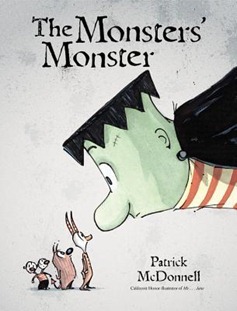
The Monsters’ Monster by Patrick McDonnell

Grouch, Grump and Gloom ‘n’ Doom just knew they were the biggest monsters around.  After all, they lived in a big castle on top of a tall mountain that overlooked a little village.  And to top it off, their favorite word to use was “NO!”  When the three little monsters got into an argument about who was the biggest and baddest monster of all, they decided to settle it.  They built their own huge monster, who came to life after a jolt of electricity.  But this big, big monster may not be exactly who they were expecting.  A great pick for Halloween tales, this is a playful and silly take on monsters.

McDonnell has created three very cross little monsters who would not scare anyone.  Yes, they are loud, grumpy and constantly arguing, but they are not frightening thanks to their small size.  Then to trump that, he has also written a large monster who could be quite frightening with a personality that will surprise.  It makes for a delight of a book.  McDonnell’s writing is perfect for reading aloud, setting the right pace and tone to make it a wild rumpus of a read.

His art is equally fun, sometimes giving full-page spreads, but also intermingling smaller illustrations filled with movement and zing.  The blotches of ink on those pages add to the hustle and bustle of the tone.  The art is playful and filled with humor.  It will work best shared with smaller groups, since so much of the fun is in the illustrations.

Get your hands on this one for Halloween reads, it’s sure to be a favorite and asked for again and again.  Appropriate for ages 3-5.

Reviewed from library copy.

Review: Pinned by Sharon G. Flake

pinned

Pinned by Sharon G. Flake

Autumn is the only female wrestler at school, but that doesn’t stop her from excelling.  Her physical strength and her mental agility are formidable.  However, she can’t seem to apply that same effort to her school work.  She is several grades behind in reading and failing math.  Adonis, on the other hand, loves school and is known as one of the smartest kids in their 9th grade class.  In a wheelchair because of birth defects that left him without legs, Adonis survived a bullying attack that almost killed him.  These two people, both struggling with big issues in their lives, tell their stories in alternating chapters.  Neither character is perfect.  Despite her strength, Autumn is needy and pushy.  Adonis is proud and disdainful of those who will not try to excel.  They aren’t really even friends, but Autumn wishes they were so much more. 

Flake has refused here to make the book you think you are reading.  She has a heroine who is strong physically and mentally, yet will make readers cringe with her headlong flirtation with Adonis.  Adonis could have been that saintlike disabled character that everyone would have recognized.  Instead here he is prickly and judgmental not only of Autumn but of everyone around him.  He lives in a life of certainty where he can peg people easily into categories.  Flake beautifully ties these characters into their families where Autumn’s parents have GEDs and also have issues with reading.  On the other hand, Adonis’ mother is educated and making sure that Adonis will have a bright future academically.  They are studies in contrasts, and yet also studies in similarities as they both struggle with disabilities.

The writing here is strong and forthright, speaking directly to the reader.  The book rests on the heads of its two narrators, both of whom see the world in a specific way that is their own.  As their relationship slowly turns into something more serious, readers will be surprised to find that not all of the loose ends are tied up neatly.  Adonis remains aloof and hyperaware of the opinions of those around him.  Autumn stays flirtatious and continues to struggle with school.  There is nothing magical here.  This is life, and it continues clearly after the book ends.

This should be very popular with middle school readers who will enjoy the complex and surprising characters as well as the thread of romance.  Appropriate for ages 13-15.

Reviewed from ARC received from Scholastic.