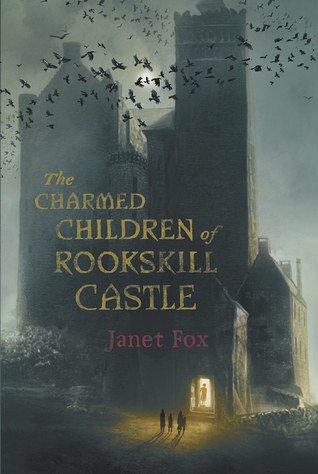
The Charmed Children of Rookskill Castle by Janet Fox

The Charmed Children of Rookskill Castle by Janet Fox

The Charmed Children of Rookskill Castle by Janet Fox (InfoSoup)

Something horrible is happening at Rookskill Castle, a remote castle in Scotland. When Kat and her two younger siblings are sent there to escape the Blitz in London during World War II, they see odd things. There are children who don’t attend classes with the others but can be seen outside fishing in an empty pool, singing in the old part of the castle or polishing silver down in the basement rooms. The Lady who runs the school is also strange, aloof and beautiful, she has hands that are cold and amazingly strong. Kat believes that there may be a Nazi spy at the school, though she doesn’t believe at all in the magic object that her aunt gave her. But things are odder than Kat could ever have dreamed and soon she has to face that there may be magic at work after all as one child after another disappears.

This tantalizing story is pure dark fun. With a glorious mix of mystery and history, there are also elements of horror that are delightful to encounter. There is real risk here, perhaps worse than death itself and that makes this book all the more impressive. Horror for children is a growing genre and here it is handled particularly well with British flavors, historical information, and plenty of hidden passages and magical relics.

As with any great horror story for children, the children here are left to save themselves. The adults are particularly unhelpful and the story explains why in a clear way. Particularly wonderful is a female protagonist who loves numbers, can solve code algorithms better than her teacher, and who can be prickly but also adores her siblings. She’s complicated and exactly the main character this story needs to really work as Kat doesn’t believe at all in magic.

Smart, intelligently written and gorgeously scary, this historical horror for children is a fantastic read. Appropriate for ages 9-12.

Reviewed from ARC received from Viking Books for Young Readers.
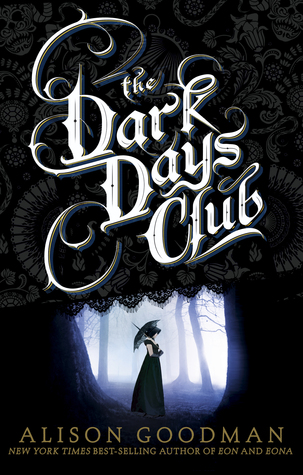
The Dark Days Club by Alison Goodman

The Dark Days Club by Alison Goodman

The Dark Days Club by Alison Goodman (InfoSoup)

The author of Eon and Eona returns with an amazing book of fantasy set in Regency London. Lady Helen Wrexhall is getting ready for her presentation to the Queen, something that her aunt and uncle are depending on to offset the claim that Helen’s mother was a traitor to the crown. Helen has also noticed that her senses are growing more acute. Soon she is told by the intriguing Lord Carlston that she has a destiny inherited from her mother that makes her one of only a few people alive who can hunt demons. As part of the upper class, Helen must figure out how to navigate the dangers and darkness she is discovering without losing sight of her place in society.

Goodman makes a great choice here, creating a Regency England setting filled with a secret layer of darkness and intrigue. She keeps the society of the time intact throughout, allowing everything else to seethe under those strict and proper restrictions. This creates a feeling of dread, harrowing danger at every turn, and the reader has no idea who to trust. Goodman keeps revealing new details and truths throughout the novel, even towards the end, creating a book that is rich and detailed.

Helen is a fabulous protagonist. She is a woman who is fighting against the strictures of her place in society already and then given a way to move forward that is exciting and tantalizing but also scandalous. It is to Goodman’s credit that Helen does not leap into action without hesitation, making her someone who really fits into her time period and setting in a natural way.

Add in a little heat with male protagonists and you have a fantasy-laced romantic novel that is luminous and riveting. Appropriate for ages 14-17.

Reviewed from library copy.

Beatrix Potter and the Unfortunate Tale of a Borrowed Guinea Pig by Deborah Hopkinson

Beatrix Potter and the Unfortunate Tale of a Borrowed Guinea Pig by Deborah Hopkinson

Beatrix Potter and the Unfortunate Tale of a Borrowed Guinea Pig by Deborah Hopkinson, illustrated by Charlotte Voake (InfoSoup)

Published to celebrate the 150th anniversary of Potter’s birth, this picture book tells the true story of an event in Potter’s childhood. Beatrix loved animals from a very young age. In fact, she and her brother had quite a collection of animals over the years from a family of snails to rabbits trained to walk on a leash. Beatrix also loved to draw and paint her animals. One day, she wanted to paint a guinea pig so she borrowed one from a neighbor. The guinea was a magnificent specimen named Queen Elizabeth. Beatrix promised to return Queen Elizabeth the next morning “unharmed.” Unfortunately though, she would not be able to keep that promise!

Hopkinson adopts a wonderfully wry tone throughout this picture book where readers know that something horrible is going to befall Queen Elizabeth. There is lovely foreshadowing from the title but also from the demise of other creatures in Beatrix’s care, including the family of snails who simply dried out and lizards eaten by birds. The pacing here is delicately balanced, allowing plenty of time for the dread to creep in as Beatrix takes the guinea pig home.

Voake’s illustrations are done in pen and watercolor, showing the world of Victorian England as well as the myriad pets owned by the Potter family. Voake includes parts of Potter’s own diaries in the illustrations, showing her detailed look at her pets and also illuminating how some of them died.

This picture book offers a humorous look at young Beatrix Potter who would become known for her images of animals living through what many children do when they care for others pets or even their own. Appropriate for ages 4-6.

Reviewed from copy received from Schwartz & Wade.

When Mischief Came to Town by Katrina Nannestad

When Mischief Came to Town by Katrina Nannestad

When Mischief Came to Town by Katrina Nannestad (InfoSoup)

Inge arrives at the small island town of Bornholm, Denmark via boat. She hasn’t eaten since the morning of the day before, thanks to missing her mother and the fish guts on the boat. Inge has never met her grandmother before, but now the two of them will be living together at her small farm. Inge brings with her plenty of laughter and trouble, but her grandmother does not seem amused by any of it. Over and over again, Inge gets into mischief, whether it is in a kicking contest with the donkey, learning how to walk in wooden shoes, or insisting that in 1911, girls can play on the grass at school too. Inge’s vibrant personality never stays down for long, but can this small island community survive her?

This book is pure silly and shimmering perfection. Inge is a marvelous protagonist, filled with life and the ability to get into great trouble even on a small farm on a tiny island. Inge is the real reason this book works so well, but so is her grandmother who proves the perfect foil for the rambunctious child. While I don’t want to spoil the book, it is the grandmother’s reaction to Inge that makes this book so special by the end.

The setting of the small Danish island also plays a huge role in the book. Set in 1911, the strict community rules rub Inge entirely the wrong way. Though some areas are moving in a more modern way, the small town keeps things traditional. With a strong focus on food, children will enjoy the changing menagerie of gingerbread creatures, the question of how thick a piece of cake should be, and the way that the grandmother feeds Inge with a beautiful determination held together by lots of cream.

A gem of a book, this would make a great read aloud for a classroom thanks to the large amounts of guffaw-level humor throughout as well as a winning young female protagonist. Appropriate for ages 8-11.

Reviewed from library copy.

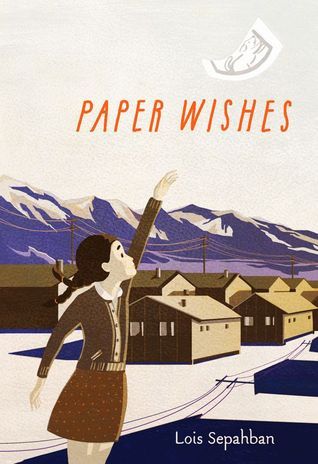
Paper Wishes by Lois Sepahban

Paper Wishes by Lois Sepahban

Paper Wishes by Lois Sepahban

Manami loves her home on Bainbridge Island where she can walk with her grandfather and his dog on the beach. Everything changes when Pearl Harbor is bombed in 1941. Manami and her family along with the other Japanese Americans are gathered up and forced to move to internment camps far from the sea. Manami’s grandfather has arranged for someone to care for his dog, but Manami cannot bear to leave him behind so she hides him in her coat. But she is not allowed to bring the dog with them. Heartbroken, when they reach the camp, Manami stops speaking entirely, unable to force words past her dusty throat. Manami keeps hoping that their dog will find them, sending pictures on the wind to him.

Told in spare and elegant prose, Sephaban captures the devastating impact of World War II policies on Japanese Americans. Losing all of their property and belongings except what they can fit into one suitcase each, the families work to put together a semblance of a life for themselves and their children. Sepahban sets this story in a prison camp that had a riot break out and one can feel the tension building. This novel manages to show the impact of loss of civil rights and also be a voice for moving forward to embracing diversity and differences.

Manami is an amazing character. Her pain is palpable on the page, her voice buried under guilt and compounded by their internment in the camp. Everything changes for her in one moment, taken from the place she loves, removed from the life she has been living. Manami has to find a way to make a new life, but it is devastating for her as she is unable to forgive herself for what she has done.

Beautiful writing, a complex heroine and a powerful story make this short historical novel worth reading and sharing. Appropriate for ages 9-12.

Reviewed from e-galley received from Farrar, Straus and Giroux and Edelweiss.

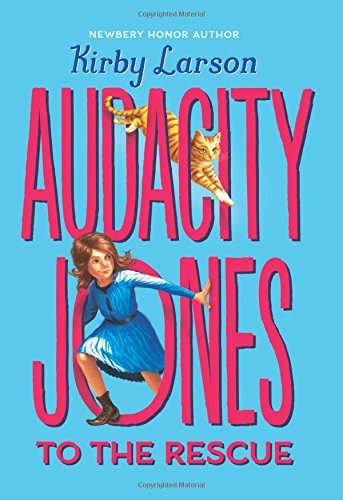
Review: Audacity Jones to the Rescue by Kirby Larson

Audacity Jones to the Rescue by Kirby Larson

Audacity Jones to the Rescue by Kirby Larson

Released January 26, 2016.

Audacity Jones is the only orphan at Miss Maisie’s School for Wayward Girls. She’s also the only student there who knows that the Punishment Room is actually a lovely library, so she is very well read. When Commodore Crutchfield visits the school and asks for a girl to take on a journey, Audie is up for the challenge. But all is not what it seems with the reason for the travel and Audie finds herself in Washington, DC with the distracted Commodore and his shifty chauffeur. As this historical novel unfurls, Audie will need to call on all of the friends she has made in her adventure to foil a plot of presidential proportions!

This historical novel takes place in 1910 when President Taft was in office and features Taft, Mrs. Taft and their son. Larson weaves real history into her novel, cleverly combining the two into a truly engaging read. The story of a poor girl brought into luxury and then used as a potential pawn in a heist is entirely engrossing. Larson’s plotting is noteworthy, allowing her merry chases and close calls but also offering enough space to give historical details that make the setting clear and important.

I fell hard for Audacity. She’s exactly the sort of girl protagonist that is engaging to read and she will remind readers of other great girl protagonists who also love books and adventures alike. She takes her place by other literary orphans who capture your heart with their spirit and determination.

A delight of a novel, this is the first in a new series from the Newbery-Honor winning author. I can’t wait to see what Audie gets up to next! Appropriate for ages 8-11.

Reviewed from ARC received from Scholastic Press.

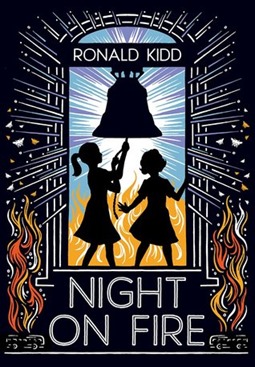
Review: Night on Fire by Ronald Kidd

Night on Fire by Ronald Kidd

Night on Fire by Ronald Kidd (InfoSoup)

Billie longs to be able to leave her small Alabama town of Anniston and head for a bigger city where things happen. She hopes to be a writer one day too. As the battle for civil rights comes right to Anniston with the Freedom Riders, Billie discovers that there is a lot more racism in her city than she had ever known. She sees it in her own father at home with the way he interacts with their housekeeper, Lavender. She sees it in her school in the way that people react to the news of the Freedom Riders and she sees it in action when the bus the Riders are aboard is attacked. Billie begins to realize that she too has certain points of view that need to change. She wants to be a rider in life, not a watcher. So when she learns that the Freedom Riders are back on the road, she and Lavender’s daughter head to Birmingham aboard the bus together. Along the way, they are faced with overt racism for being together and Billie begins to understand that her actions can have impact to support larger change.

At first I was very disappointed to see a white character as the lead in the book. Then as the book continued, I realized the power of what was being shown on the page. Kidd demonstrates through a very approachable young protagonist that racism is everywhere, even in people who do not seem to be racist at all. Billie is a great example of societal racism and someone who longs for change but can’t see their own role in the process and the subtle ways that race in Alabama during the Civil Rights Movement is so pervasive. In Billie, Kidd manages to show a modern racism that is just as toxic as the more overt kind. It is carefully done, never overplayed, and offers a space for understanding and change to happen.

Kidd brings the Civil Rights Movement to life before the eyes of the reader, placing Billie in the midst of not only the Anniston Freedom Riders riot but also in Birmingham with the Freedom Riders and Martin Luther King, Jr. In both situations, there is real violence happening and real danger of people being murdered. Kidd pays homage to the bravery of the Freedom Riders and to their cause. He shows the price of silence and the challenge to speaking up against your home and community. It is a powerful piece of historical fiction.

Rich and layered, this is not a simple book. It will challenge readers to look at themselves and their biases and prejudice. It is a book that speaks to the modern Black Lives Matter movement and that encourages everyone to become part of the solution and not witness in silence. Appropriate for ages 10-12.

Reviewed from ARC received from Albert Whitman & Company.

Review: Half a Creature from the Sea by David Almond

Half a Creature from the Sea by David Almond

Half a Creature from the Sea by David Almond

In a series of short stories, master author Almond takes readers back to the magical times of his childhood as well as our own. The stories are all set in the places that Almond grew up in. The stories range in topic, but each one offers glimpses of wonder and deep understanding. They also all speak to the power of stories in our lives, whether they are to reveal or to hide the truth. The eight stories in the book give us characters living normal yet extraordinary lives. There is the girl rejected by school and society who finds it easy to believe she comes from somewhere far away. There is the home with a monster hidden inside it where you can hear its noises if you put your ear on the wall outside. There are the boys who run miles and miles to swim in the sea on one perfect summer day. There are poltergeists mixed with soccer games, bullies mixed with heroes. It is a beautiful collection of stories which put together make up a glimpse of a world past that still is relevant in our modern one.

Almond’s writing is exceptional. This shorter form allows him to create little worlds of magic, astonishing moments of clarity, decisions that reverberate in the community. He invites us into his home, revealing in paragraphs before each story the way that the story ties to his childhood or to a place that is dear to him. It gives us a look at his process, a way to understand the fictionalizing of memories and the beauty of turning everyday into amazement. The fantasy elements are there, dancing under the cloak of faith but there still, explained but also not completely fictional. There is a delicacy to this writing and yet a robustness to the setting that work particularly well together.

One of the best short story collections I have read in a very long time, this collection is exceptional. Appropriate for ages 8-12.

Reviewed from ARC received from Candlewick Press.

Review: The Seventh Most Important Thing by Shelley Pearsall

The Seventh Most Important Thing by Shelley Pearsall

The Seventh Most Important Thing by Shelley Pearsall (InfoSoup)

Arthur can’t stand that the junk man is wearing his father’s hat, so he throws a brick at the old man and injures him. Sent to juvenile detention, Arthur has to appear in court where the junk man steps up and offers him a choice. He can either be sentenced to detention or he can do community service working with the junk man. Arthur agrees to work for the man. When he starts, all he gets is a list of items to find in the garbage. Soon Arthur is digging through the garbage himself. At first he does it with no interest at all, not fulfilling the list he has been given at all. Soon though, he is spotting treasures and keeping things like foil from his friend’s lunch. As he works on the items on the list, they grow in significance to him on a personal level and in his life. When he discovers what the man has been using the items for, Arthur is captivated and begins to work alongside him.

Pearsall has created a book that speaks to the power of one person to make a difference in someone’s life. First there is the brick being thrown, then the man saving Arthur from detention and then the story progresses and Arthur matures and he begins to save the man in return. It’s a beautiful cycle, one of caring and concern and humanity. The humility of garbage collecting is also a huge factor in the book, one that works not only to break down barriers but also to lift up the person to a different level along with the items they collect.

Pearsall also uses language impressively. She describes characters clearly and does not pontificate about the lessons to be seen in the book. Instead the story stands on its own merits and the conclusions you draw are your own. It makes it an ideal book to use with a class and will inspire discussions about right and wrong, and responsibility.

A vibrant piece of historical fiction based on a true story, this novel will be welcomed by teachers and youth alike. Appropriate for ages 9-12.

Reviewed from ARC received from Knopf Books for Young Readers.