Review: Seed by Seed by Esme Raji Codell

seed by seed

Seed by Seed: The Legend and Legacy of John “Appleseed” Chapman by Esme Raji Codell, illustrated by Lynne Rae Perkins

Two modern children are transported back in time from the busy highways filled with cars to the quiet woods of the late 1700s.  From there, the story of Johnny Appleseed, really named John Chapman, is told.  The differences between the world back then and our modern world are explored.  Then the way of life that Johnny Appleseed embraced that of using what you have, respecting nature, sharing, making peace, and reaching your destination in small steps is tied back to how important those things are still for us today.  His planting of seeds changed the landscape of our country.  The book ends asking what seed you will plant.

Codell writes with a wonderful lyricism paired with a directness.  It makes for a book that is straight-forward but also written with care to create a specific mood.  Chapman’s story is filled with legend, especially in his relationship with nature and animals.  While some of it may be tall tales, it contributes to the wonder that surrounds this man.  Codell made a choice to have some of that in her book and it works very well, distinctly noted as legend rather than fact.

Perkins’ illustrations vary from page to page.  Most of the art is done in watercolor and gouache, creating bright colored images that embrace the natural and feel clear and crisp.  Other pages incorporate burlap bags and needlework.  It’s a clever use of materials of the period that really add another dimension to the illustrations.

A beautiful look at a man who stand for much of what we are seeking in modern society.  This book reaches beyond the legend and finds the real Johnny Appleseed.  Appropriate for ages 6-8.

Reviewed from library copy.
Review: Harlem’s Little Blackbird by Renee Watson

harlems little blackbird

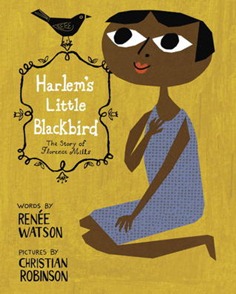
Harlem’s Little Blackbird: The Story of Florence Mills by Renee Watson, illustrated by Christian Robinson

This is a picture book biography of Florence Mills, a singer well-known during the Harlem Renaissance.  It follows her from her childhood as the daughter of former slaves in a tiny house in Washington, DC. where she was always singing and dancing.  She became known as a small girl with a big voice, but often faced racism and segregation when she was performing.  She quickly learned to use her voice for activism as well as song.  Florence became known not only across the nation but around the world for her voice.  She traveled internationally, and continued to be an activist and to give back to the poor.  Applauded for her singing, this book celebrates her good deeds just as much as her voice.

Watson writes a compelling story of a woman who was more than a beautiful songbird.  She fought back against the bigotry of her time and also gave back to the community she came from.  Watson distills Mills’ story into one that children can easily relate to.  It exposes the overt racism of a previous time and will give children much to discuss about how far our society has come and how much farther we have to go.

Robinson’s illustrations are done in cut-paper and collage.  They have a great texture to them, often showing a physical depth that is very appealing.  The colors are bright and vibrant, fitting colors for this equally vibrant woman.

A very successful picture book biography of a woman whose voice broke down barriers along with her good work.  Appropriate for ages 7-9.

Reviewed from copy received from Random House.

Review: Island: A Story of the Galapagos by Jason Chin

island

Island: A Story of the Galapagos by Jason Chin

Follow the birth of a group of islands to the present day in this book that beautifully documents the wonders of the Galapagos.  Opening with the drama of a volcanic eruption six million years ago, the book shows how plants and animals arrive at a new island in the ocean.  As time goes by, the island turns from barren rock to a place of lush green.  Specific attention is paid to the evolution of creatures and plants that are found only on these islands.  Young readers will fully understand why finch beaks grew larger, seagulls got larger eyes, and tortoise shells changed shape.  The book ends with Darwin arriving on the shores of one of the islands.  This book is a celebration of these islands and the wonders of nature.

Chin’s book offers information that is solid and fascinating packaged with illustrations that capture the details of what is being explained.  It makes for a book that is bright and energized and that is clearly nonfiction as well.  The story of the birth and life of an island makes for a magnificent tale that readers are sure to respond to.

In his art, Chin brings the reader up close to what is happening on the island.  We get to look between the mangrove roots at sharks, watch pelicans feast on fish in the lagoons, and see land iguanas float on logs to reach the island.  Even better, as I mentioned earlier, the process of evolution is detailed so that readers can see the gradual but necessary changes that occurred.

This is one incredible nonfiction book that teachers, parents and students will enjoy looking through and learning from.  Appropriate for ages 6-8.

Reviewed from library copy.

Review: I Have a Dream by Martin Luther King, Jr.

i have a dream

I Have a Dream by Dr. Martin Luther King, Jr., illustrated by Kadir Nelson

The power of Martin Luther King’s words meet the beauty of Nelson’s art in this luminous picture book.  Using lines pulled directly from the latter part of King’s famous I Have a Dream speech, Nelson shows young readers how history was made that day.  From King himself standing before the Lincoln Memorial to the seas of people listening, people of all colors standing side-by-side.  Kadir moves back and forth between capturing the magnificence of King and his speech to images of what the world being dreamed of would look like.  There are beautiful skin tones shown together as well as impressive vistas of the nation.  Pure celebration, this is a picture book that truly captures the heart of King’s speech in a way that children will be able to understand.

Nelson’s art has already won him a Caldecott Honor.  Here he has the courage to take on a famous man at his more memorable moment.  But he doesn’t just show us the history, he illuminates it.  King shines with light, stands with power, and beams with faith.  There is a humanity to him too, somehow Nelson has captured what is beneath the skin too.  Beautifully.

One of my favorite images of the book is the pair of white and black hands joined together.  Against a plain white background, the hands are such a powerful symbol.  Kadir paired those joined hands with a section about faith, so the two joined together become a prayer of their own too. 

This book belongs in every library, both for the historical power of the moment being captured, but also for its exceptional beauty and art.  Appropriate for ages 7-9.

Reviewed from copy received from Schwartz & Wade Books.

Review: Helen’s Big World by Doreen Rappaport

helens big world

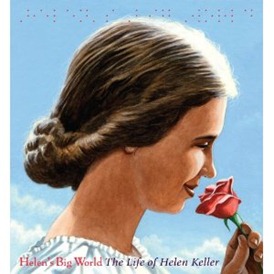
Helen’s Big World: The Life of Helen Keller by Doreen Rappaport, illustrated by Matt Tavares

This picture book biography of Helen Keller celebrates both the accomplishments of Helen Keller in overcoming her world of darkness and silence and those of her teacher Annie Sullivan.  The book begins with Helen as a small baby, before she had an unknown illness at 19 months that took her sight and hearing away.  It then moves through her attempts to continue to communicate, the frustration that caused her tantrums, and the slow progression of learning that led to the seminal moment at the water pump that connected the letters in her hand to the outside world.  Readers will see how Helen learned to write, read in Braille, and put her hands on people’s faces to feel their lips move so she could understand their speech.  The book continues to show how Helen Keller spoke up for social injustices that she felt were wrong.  This is a testament to what a brilliant mind and a great teacher can create.

Rappaport has somehow condensed the complicated story of Keller’s life into a very readable picture book that has a brisk pace and invites readers to find out more about this remarkable woman.  Throughout the book, Keller’s own words are used to illustrate points in the story.  Shown in their own font that is colorful and set apart from the rest of the text in size too, her words shine.

Tavares’ illustrations reveal the marvel of Helen Keller’s learning and education.  There is a light to the images once the learning begins that contrasts with the darkness of her earlier life.  Throughout Keller is shown experiencing the senses she does have, from the scent of a rose to the feel of the breeze on her face. 

An inspirational figure, Helen Keller continues to be a beacon for overcoming obstacles and using one’s mind.  This book is a beautiful tribute to her.  Appropriate for ages 8-11.

Reviewed from library copy.

Review: Martin de Porres: The Rose in the Desert by Gary D. Schmidt

martin de porres

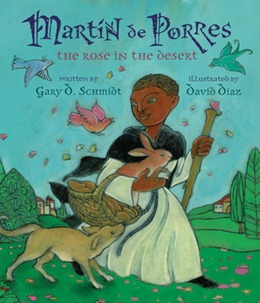
Martin de Porres: The Rose in the Desert by Gary D. Schmidt, illustrated by David Diaz

Martin de Porres was born to a former slave and a Spanish nobleman in Lima, Peru.  He lived in severe poverty in the barrios until his father took him back to Ecuador with him.  As Martin grew older, he returned to Lima and started learning to tend to the ill.  His healing power revealed itself while he was there.  Thanked for his healing, he was given the seeds of a lemon tree as a gift.  After planting the seeds, a tree grew overnight and had ripe fruit.  Word began to spread about this amazing boy.  Still, his mixed race prohibited him from becoming a priest, so he joined the Dominican Order as a servant.  He continued to heal others, eventually proving his ability and worth and becoming a priest after all.  Other stories of miracles surrounded him and he was finally canonized as a saint.  Through vivid writing and rich illustrations, the story of the childhood of this saint is told.

Schmidt’s writing warmly celebrates the wonders and miracles of Martin de Porres.  It is a story that starts with a boy who is the poorest of the poor, rejected by the priesthood and eventually ends with sainthood and life led in service to others.  In a world divided just as much between rich and poor, this story will resonate with modern young readers.

Diaz’s illustrations are filled with colors that are saturated and deep.  The deep hues of Martin de Porres’ skin are celebrated in the pages here.  Other parts of the illustrations have a feel of stained glass with sun pouring through.  The images are beautiful and celebratory.

A shining example of a picture book biography of a saint, this book will speak to modern readers as well as celebrate an amazing person.  Appropriate for ages 7-9.

Reviewed from library copy.

Review: Oh No! Not Again! by Mac Barnett

oh no not again

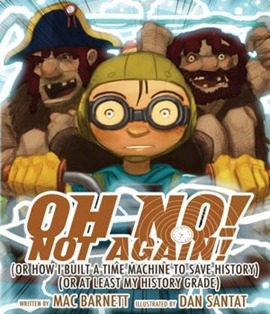
Oh No! Not Again! (Or How I Built a Time Machine to Save History) (Or at least my history grade) by Mac Barnett, illustrated by Dan Santat

The sequel to Oh No! (Or How My Science Report Destroyed the World) takes on history class.  The female protagonist messes up her perfect score on a history test by missing the first question: In what modern country do we find the oldest prehistoric cave paintings?  So she figures out a simple answer to getting a perfect score: she builds a time machine to change history so that her answer of Belgium is correct.  When she finally reaches the right point in history, she is faced with two Neanderthals who aren’t really interested in creating art.  They’d much rather stick the paintbrushes up their nose or munch on the paint palette.  Spray paint worked even less well.  When our hero heads into the cave to do it herself though, the Neanderthals highjack her time machine.  What’s that going to do to her history grade?

Fans of the first book will enjoy this one as well.  It has the same zany, wild pacing of the first.  This time the romp is through history.  Happily, the book embraces a very simple sort of history to understand, so young readers will be able to get the humor and understand the juxtapositions that make up much of the story. 

Santat brings in physical humor too, giving the book his signature pizzazz and style.  I’m a fan of the color palette that hearkens back to an old film throughout.  It has a grainy texture and then there are the light-colored lines running vertically through the images.  Very school film on reels from my own childhood. 

A clever, funny and wild ride through history from the folks who brought us the robot rampage through science.  Appropriate for ages 6-8.

Reviewed from library copy. 

Review: I, Galileo by Bonnie Christensen

i galileo

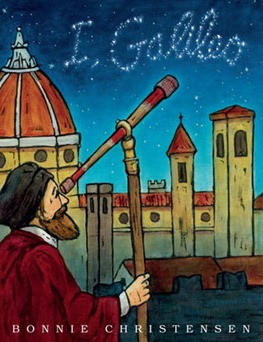
I, Galileo by Bonnie Christensen

Told in the first person, this look at Galileo’s life is made all the more personal through the unique point of view.   Galileo tells the tale from the house and walled garden he is imprisoned in.  Blind and aging, he recalls his childhood and the way that he helped his father with his musical experiments after leaving the university with no degree.  He was offered a teaching position in the same university a bit later, but he refused to be traditional and instead wore what he liked and tested Aristotle’s laws of physics.  He was soon let go of his teaching role and headed to another university where they were more interested in his experiments.  There he invented the compass and the telescope.  Looking through his telescope, Galileo discovered that the sun is the center of the universe.  It was then that his troubles truly began.  For seven years, he was bound to silence about his findings until a new man became pope.  When Galileo finally published his findings, they so incensed people that he was tried for heresy before the Inquisition.  And so the story comes back to the old man imprisoned in the walled garden.

Through a brief preface, Christensen sets the stage for the time period of Galileo’s life.  It will help modern children understand the technology that was not available in that day.   Her afterword is equally intriguing and helpful, explaining that it took almost four centuries (until 1992) for the Catholic Church to admit they were wrong to condemn Galileo.  Christensen paints a picture of the world around Galileo well.  His discoveries, his world of academia, the political and religious powers at play, and his mistreatment at their hands.  This book is exceedingly readable.

It is also lovely.  The illustrations are done in jewel tones that have a depth and richness.  They almost recall stained glass with their thicker black lines and the light that shines in each of them.  Even the image of Galileo before the Inquisition plays with light and color. 

A choice pick for libraries looking for a readable and interesting biography of this heroic scientist.  Appropriate for ages 6-9.

Reviewed from copy received from Random House Children’s Books.

Review: Brothers at Bat by Audrey Vernick

brothers at bat

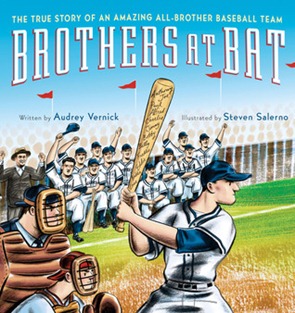
Brothers at Bat by Audrey Vernick, illustrated by Steven Salerno

In one family from New Jersey, there were 12 baseball-playing brothers: the Acerra brothers.  All of the brothers played high school baseball and their high school had an Acerra on it 22 years in a row!  In 1938, the oldest nine brothers formed their own semi-pro baseball team.  Their father coached the team and they played on dirt fields that were littered in rocks.   Each of the brothers had a different skill set than the others.  Some were slow runners but great players, others posed for the cameras naturally, one was a great pitcher that people still talk about today.  But all of them supported one another.  Then came World War II and the team disbanded as six of the brothers headed off to war.  Happily, all six brothers returned from war.  The brothers played their last game together as a team in 1952.  By that time, they were the longest-playing all-brother baseball team ever.  In 1997, the brothers were honored by the Baseball Hall of Fame.

Vernick shares this story of brothers who played together for most of their lives with a real sense of wonder and amazement at what they achieved.  The story celebrates their strong brotherhood and sense of family as well as the love of baseball.  Vernick offers all sorts of details that really create a vivid picture of the family dynamic and their lives. 

Salerno uses a vintage style for the illustrations that firmly roots this picture book in the time period.  They are colorful and action filled. 

A great non-fiction picture book for baseball fans, brothers, or people who enjoy a little sports with their history.  Appropriate for ages 6-9.

Reviewed from library copy.