This Is My Dollhouse by Giselle Potter

This Is My Dollhouse by Giselle Potter

This Is My Dollhouse by Giselle Potter (InfoSoup)

Released on May 10, 2016.

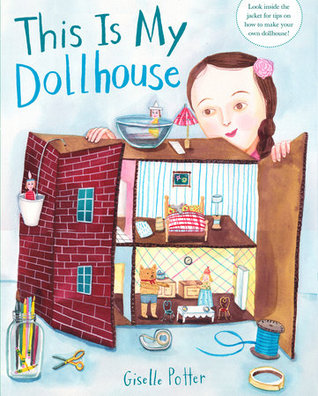
A little girl shows readers the dollhouse she has made from a cardboard box. It is filled with inventive furniture, food made from string and paper, and a set of dolls that don’t all match. The house has an elevator on the side and even a swimming pool on the roof. Then she sees her friend Sophie’s dollhouse where everything matches. The dolls all look the same, all of the rooms match with furniture that is all perfect. But when the girls play a little with the dollhouse, it doesn’t really work. When Sophie comes over, the girl is very nervous about showing her the handmade dollhouse, but soon the two girls are playing together in a way that they never did with Sophie’s perfect dollhouse.

I absolutely adored this book. It captures the wonder of creating your own toys and your own world of play. The cardboard dollhouse and all of the art supplies allows a little girl’s imagination to really soar. The book does include instructions for making your own dollhouse out of a box. And the story also shows how to make furniture from blocks and a TV from a small silver box. Children will be inspired to make their own.

The illustrations here are such an important part of the story. They clearly show that there is a warmth and homeyness to the handmade dollhouse. When the girls play with the perfect purchased one, readers will immediately feel the chill of that dollhouse and realize all that it is missing. This plays so beautifully against children’s own expectations too.

A grand picture book that will inspire creative play and the building of a place for adventures of your own. Appropriate for ages 4-6.

Reviewed from digital galley received from Schwartz & Wade and Edelweiss.

This Is Not a Book by Jean Jullien

This Is Not a Book by Jean Jullien

This Is Not a Book by Jean Jullien (InfoSoup)

Open this “book” and you will find that it is not a story and doesn’t act like a book at all. Some pages open up to be held at an angle and become computers, couches and refrigerators. Others flap like monster mouths chomping, butterfly wings flapping, and hands clapping. Still others turn upside down like the tent. It’s a book that is meant to be interacted with, seen in new ways and that becomes something new with each turn of the page.

Done in sturdy board book pages, this book will withstand being turned around, passed to other children and interacted with by small hands. Libraries will appreciate the lack of tabs and moving parts, the magic of the book is brought to life solely by the illustrations in this wordless masterpiece.

One of the most inventive and simple board books around, this one is a keeper! Appropriate for ages 1-3.

Reviewed from library copy.

Where My Feet Go by Birgitta Sif

Where My Feet Go by Birgitta Sif

Where My Feet Go by Birgitta Sif

Follow the activities of a young panda and his feet as he goes through his day. First, in the morning his feet go into yellow boots and head outside. He pretends he is walking through a jungle (actually a garden), climbing a high mountain, splashing in the ocean, and crossing a dangerous bridge. In the afternoon, his feet help feed the dinosaurs (birds), swing high in the sky, and cross a sandy desert. At night, his feet explore underwater in his bath and shoot into the sky like the stars as he listens to a bedtime story. Where do your feet go?

This picture book is told by the little panda in first person, aiding in the use of imagination throughout the book. Children will recognize their own daydreams and moments of pretend as the panda goes through his day. The book is simple and playful, inviting children to see what their own feet are up to that day.

The illustrations are hand-drawn with pencil and then digitally colored. They are filled with bright colors like the yellow boots. At the same time, they are subtle too with some parts that read as watercolors particularly in the sky. Filled with shadows to add depth, the entire book has a very unique feel.

Something special is afoot with this picture book that is sure to give children some kicks. Appropriate for ages 2-4.

Reviewed from digital galley received from Penguin Random House and Edelweiss.

Big Friends by Linda Sarah

Big Friends by Linda Sarah

Big Friends by Linda Sarah, illustrated by Benji Davies (InfoSoup)

Birt and Etho are best friends. They love to spend time together up on Sudden HIll with their big cardboard boxes playing pretend. They imagine that they kings or pirates. They run and leap, sail and fly. They can be loud or quiet together. But then one cold day, Shu brings his box up the hill and asks to join them. Etho agrees to let Shu play, but the more he joins them the more left out Birt feels. Then one night, Birt smashes his box and stops going up Sudden Hill anymore. Is there any way to fix their friendship? Maybe with some boxes and a lot of imagination!

Sarah captures the feeling of a friendship hitting a snag with great precision and care. She crafts the story so that readers will feel Birt’s sudden isolation, the way that the easy play of two children falls apart when joined by a third. Sarah uses symbolism too, particularly when Shu appears. It is a “cramping cold” day that day, foreshadowing the emotions that Birt will feel. As they play as a threesome that first day, they watch “one kestrel and two lost clouds.” This lovely writing is striking and conveys emotions so clearly.

The illustrations by Davies create an entire world for the children. There is the beauty of Sudden Hill filled with flowers and grass combined with the joy of big boxes for play. Then as the story changes, the illustrations convey Birt’s emotions. The sky turns dark and sullen. There are lonely moments back at home where he is isolated and shut in. And finally, the exultant joy at finding a way to be together again.

A lovely book about the perils and possibilities of friendship. Appropriate for ages 3-5.

Reviewed from library copy.
Review: The Dog That Nino Didn’t Have by Edward van de Vendel

The Dog That Nino Didn't Have by Edward Van de Vendel

The Dog That Nino Didn’t Have by Edward van de Vendel, illustrated by Anton Van Hertbruggen (InfoSoup)

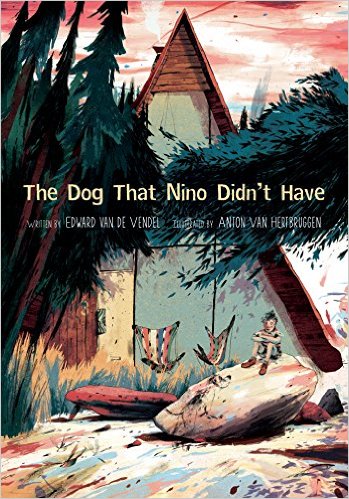
Nino has a dog, but it’s a dog he never had. It’s invisible to everyone else, but Nino can see it clearly. It’s a dog that climbs trees like a squirrel, loves deep water, and likes salty tears. But one day, that dog disappeared and a new dog took his place. It was a dog that everyone could see, one that had it’s own personality that is completely different from Nino’s other dog. Soon though, Nino is enjoying the new dog. But that doesn’t stop him from thinking up lots more animals that he’s also never had.

Just opening this book, you know you are in for a strange and beautiful treat. Originally published in Belgium, the book carries that elusive European flavor about it. The concept of an invisible friend or pet is not a new one, but as it is done here it takes on extra weight and meaning. Here, the pretend dog is a companion for a lonely boy, a comfort when he needs one, and someone who understands that he misses his father desperately. His real dog can’t quite do all of that at first, but he steadily does take over those duties just in a different way. This is a book about change, resilience and the imagination.

The art here is part of weaving that odd world. It is done in 70s angles and styles with the A-frame houses and long, low station wagons as vehicles. Even the colors hearken back to that time. The book is filled with night skies and bright hot days. Some pages are busy with details while others are open and wide white. Beautiful, strange and wondrous.

This is a strikingly unique book that will speak to anyone who is missing a parent and needs a dog of their own to help. Appropriate for ages 4-6.

Reviewed from library copy.


Review: The Plan by Alison Paul

The Plan by Alison Paul

The Plan by Alison Paul, illustrated by Barbara Lehman (InfoSoup)

Told in words that shift by one letter from page to page, this picture book is a lesson in imagination from its structure to its subject matter. A little girl makes a plan to take a plane up into space to Saturn. She lives on a farm with her dog who accompanies her everywhere. As they work on the farm, she discovers a key that unlocks her father’s photo album. There she discovers that he and her mother were pilots on The Mighty Comet. So the girl shares her plan with her father. They all work together to restore the airplane, allowing themselves time to grieve for the loss of her mother, and then all take off into the air together.

Paul demonstrates incredible restraint and control in the text of this book. Changing just one letter from page to page could result in a book that is stagnant, but instead this book explores and the story develops in a natural way. The simple text allows readers to fill in the story, to discover the key and what it unlocks, and to participate in the shared adventure. The component of the mother’s death is deftly handled, subtle and quiet.

With such simple text, the illustrations by Lehman really tell the full story. Done in watercolor, gouache and ink, they too share the quiet wonder of the text. They are done in deep colors that shimmer on the page, inviting the reader to look closely and explore.

A brilliant picture book filled with word play that is easy to read and a story with beauty and depth. Appropriate for ages 3-5.

Reviewed from library copy.

Review: Some Things I’ve Lost by Cybèle Young

Some Things Ive Lost by Cybele Young

Some Things I’ve Lost by Cybèle Young (InfoSoup)

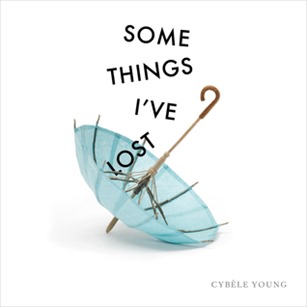
Explore a world of lost items that when lost change and grow and become something else. Figure one is a roller skate, laces flying that was last seen in the basement. Turn the foldout page to see it become something ethereal and unreal. The visor on the next page that was last seen on the lawn grows into something organic and living. One-by-one objects change into a landscape of imagination, becoming something far different than where they began but still having connections to the original object in form and color.

Done with almost no text except a description of the original items and where they were lost, this book is all about the incredible illustrations. Done in 3-D paper art, Young created not just the original object and the final transformation, but several stages in between where you see the clear connection between where we began and what it became. Part way through the book, readers will start to notice an underwater theme to the transformations, as we see coral, jellyfish, fish and anemones. There is a delicacy and luminous quality to the entire book, showing both the lack of permanence and the power of imagination.

Brilliant, surreal and completely amazing, this picture book is an inspiring look at creativity and imagination. Appropriate for ages 4-6.

Reviewed from library copy.

Review: Something Extraordinary by Ben Clanton

Something Extraordinary by Ben Clanton

Something Extraordinary by Ben Clanton (InfoSoup)

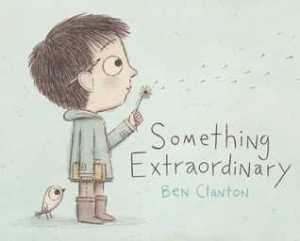
A little boy has lots and lots of different wishes that he hopes come true. He wishes to be able to fly, to breathe underwater, that the robot he drew could come to life. Then they could play together in the rain that would come in seven different colors and flavors. He wishes for fangs and a tail. He wishes to be able to talk to animals and to have lots of wild and strange pets. But in the end, he mostly wishes that something extraordinary would happen to him. Something real. And suddenly, it does!

Clanton excels at taking very simple premises for his books and making them into something engaging and intelligent. In this book, it is all about wishes and dreams with a big dollop of imagination too. The bulk of the book is spent with the boy and his wild wishes that he only hopes could come true. In the end though, the book comes down to earth and the boy just wants something amazing to happen in real life. He takes a moment then to look around himself and realizes that there are wonderful things happening right there, especially out in nature.

The artwork here is understated and subtle. Even during his wildest and most colorful wishes, the colors are muted and subdued. It isn’t until the ending when the boy realizes that there is wonder around him in real life that the colors lose their subtlety and start to really sing.

Big dreams and wild wishes may not come to fruition here, but reality is certainly “something extraordinary” in the end. Appropriate for ages 3-5.

Reviewed from copy received from Simon & Schuster Books for Young Readers.

Review: Leo: A Ghost Story by Mac Barnett

Leo a Ghost Story by Mac Barnett

Leo: A Ghost Story by Mac Barnett, illustrated by Christian Robinson

Released August 25, 2015.

Leo has lived for a long time alone in his house. Most people can’t see Leo, because he’s a ghost, but if you are reading this book you are one of the special people who can see Leo. When a new family moves into the house, Leo tries to be welcoming by bringing them tea, but the family is frightened of the floating tray. After hearing how much they dislike him because he’s a ghost, Leo leaves his house and roams the city. He is invisible to everyone until he meets Jane, a little girl with a lot of imaginary friends. She thinks that Leo is just another of them and since Leo was so hated because he was a ghost, he doesn’t correct her. The two of them have a grand time playing together and she even gives him a sheet and pillow to sleep by his side. Leo is so happy that he can’t sleep. So he heads downstairs and that’s where he meets the robber who has entered Jane’s house. But what is an invisible ghost to do to stop a robber?

Barnett immediately invites readers into his world by allowing them to suddenly “see” Leo with the first page turn. It creates a real connection with the story and makes Leo all the more tangible to the reader. Barnett excels at creating a simple story but one that has strong implications to real life running throughout. This is a delight of a light ghost story, but it is also about acceptance, honesty and embracing who you really are.

Robinson’s illustrations are light hearted. Her art is done with acrylics and construction paper. Leo himself is see-through and rendered in what looks like crayon, making him very childlike and welcoming. While Leo is pale or completely transparent, the others are all rendered in deep blue construction paper except for the pale-skinned thief.

A book about acceptance and the power of a strong imagination, this picture book will be a welcome addition to Halloween story times. Appropriate for ages 4-6.

Reviewed from copy received from Chronicle Books.