Review: How to Hide a Lion by Helen Stephens

how to hide a lion

How to Hide a Lion by Helen Stephens

Oh my, what a charmer of a book!  It is the story of a lion who comes to town to buy a hat.  But the people in town are afraid of him and chase him away.  He runs off to hide in a yard under a dog house where he is discovered by a little girl named Iris.  Iris immediately recognizes that he is a kind lion and invites him into her house.  They did their best to keep him hidden and Iris took good care of him by brushing his mane and putting a bandage on his hurt foot.  They also had a lot of fun, but that’s when they would almost be discovered.  A lion bouncing on a bed makes a lot of noise!  When Iris’ mother discovered the lion, the lion ran off.  He hid with the stone lions in front of the Town Hall.  While he was there, he saw two burglars leaving the Hall.  After the lion saves the day, everyone in town realizes what a kind lion he actually is and present him with… a hat.

Stephens has created a picture book that has a simple appeal.  The growing friendship between the lion and the little girl is done in a very organic and natural way.  Humor is sprinkled throughout as the little girl attempts to hide the lion.  Stephens also makes sure that even though the lion is kind, he is still completely a lion and an animal.  The two main characters are wonderfully different and make for compelling characters especially when paired.

The art in the book reads as vintage with their bright color washes.  The lines of the drawings are done with a light hand and are nicely simple.  This is a book that would be right at home next to Lyle Crocodile.  It reads immediately as a classic and hopefully will become one!

Too clever to be called sweet, this book is warm and friendly.  A perfect book to share with your big cat at home or to curl up like a lion and listen to.  Appropriate for ages 3-5.

Reviewed from copy received from Henry Holt and Co.

Review: Carnivores by Aaron Reynolds

carnivores

Carnivores by Aaron Reynolds, illustrated by Dan Santat

It’s hard to be a carnivore when all of the prey whispers behind your back, nobody understands the way you eat, and you are accused of sneaking around.  So a lion, a great white shark and a wolf get together to form a support group.  Their first plan is to become vegetarians, but that doesn’t go well at all.  In fact, the wolf can’t seem to find a berry bush that doesn’t have a bunny in it.  The next plan is using disguises to blend in, but one smell of the lion’s zebra breath turns the antelope against him.  Finally, the lion asked the great horned owl to speak with them.  The owl talked about accepting themselves as carnivores.  The others realize that he is right and follow his advice perfectly.

Reynolds has written a book that is screamingly funny.  Each page has laughter on it with the perfect timing of his jokes.  It begs to be shared aloud with punch lines that just have to be delivered.  Happily, the humor is edgy and truly funny, not just for small children.  With clever twists throughout the story and situations that make for very funny results, children will be delighted with this look at self-acceptance and meat eating.

Santat’s illustrations are perfection here.  Bright colored and bold, just like the humor, they add just the right touch to the book.  He manages to capture the comedy perfectly, but not allow his art to blow the punch lines prematurely.  The large format will work well with a group, but there are also details that will have to be shared too.

Clever, funny and wonderfully inappropriate, this book asks us all to accept our inner or outer carnivores.  Appropriate for ages 4-6, this would also work well as a read-aloud for older elementary kids who will love the humor and the naughtiness of the jokes.

Reviewed from copy received from Chronicle Books.

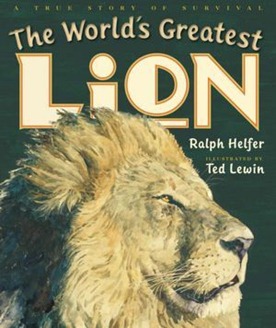
Review: The World’s Greatest Lion by Ralph Helfer

worlds greatest lion

The World’s Greatest Lion by Ralph Helfer, illustrated by Ted Lewin

This is the story of Zamba the lion, one of the most well-known animal actors in film history.  Zamba appeared as the MGM Lion as well as in many commercials and shows.  Here, the focus is on how Zamba lost his parents and his survival as an orphan cub in Africa before being found by a woman and rescued.  Zamba was allowed to roam free and grew larger and larger until she could no longer safely care for him.  Happily, she had heard about Africa USA, an organization looking for a lion.  Africa USA offered a safe haven and trained animals to not be aggressive.  Zamba arrived at the ranch owned by Ralph Helfer and slowly grew gentler.  The family’s children used him as a warm place when watching TV and his best friend was one of the dogs on the ranch.  Thanks to his rare gentle nature, Zamba worked in television and film.  Then one day, a flood hit the ranch and forced Ralph to release all of his wild animals in an attempt to save them.  Zamba led all of the animals to safety, proving himself to be the world’s greatest lion.

As author of the book, Helfer tells his own story as well as Zamba’s here.  It is the story of the organization he founded, the one that saved Zamba’s life.  Through his training, Zamba was able to live a full life, filled with danger, learning and gentleness.  The details Helfer shares add depth to the story.  His moments of adventure are exciting but it is those moments of Zamba just being a lion that really are special.

Lewin gives us gold-hued images filled with the dust of Africa.  His illustrations celebrate the connection of animal and human, especially during the chaos of the storm.  Beautifully realistic, these illustrations fully capture the love between Helfer and Zamba.

This is a picture book biography that animal-loving children will enjoy immensely.  Appropriate for ages 5-7.

Reviewed from copy received from Philomel Books.

Review: Chloe and the Lion by Mac Barnett

chloe and the lion

Chloe and the Lion by Mac Barnett, illustrated by Adam Rex

You know this book is going to be unique when you get introduced to the author and illustrator before the book begins.  Then you meet Chloe, a little girl, who is the main character in the book.  The story begins and Chloe is collecting loose change that she would use to ride the merry-go-round in the park as many times as she could.  When she headed home, dizzy from the ride, she got lost in the forest.  Then a huge lion jumped out at her!  Except Adam Rex, the illustrator, did not draw a lion.  He thought a dragon would be a much better choice.  Mac Barnett, the author, doesn’t like that idea at all and insists that this is HIS book because he is the author.  The fight goes on from there, until Mac feeds Adam to the lion that a new stand-in illustrator drew for him.  Unfortunately, he doesn’t really like the art of the new illustrator and also finds that he can’t draw well enough himself to fill in for Adam.  What is an author to do?!

I love books that break that fourth wall and take a look at the inner workings of the author/illustrator or involve the audience in an interesting way.  The book’s art and writing are so closely integrated together that it is almost impossible to review them separately.  The tone here is clean and clear until the fight scene where it becomes comically fraught with emotion.  There are running gags, funny comments and lots of humor throughout the story that make it all the more fun to read.

The illustrations are inventive and add real dimension to the book.  There are several elements at play.  There are the figures done in clay that represent the author and illustrator.  There are the flat drawings of Chloe and the lion.  Then there is a stage where the book story takes place.  It’s a wonderful mix of theater, reading, and art.

The silliness doesn’t stop at the end of the book, make sure to check out the author blurb at the back, along with the very short illustrator blurb.  This book will thrill children with its silliness, dynamic illustrations, and its clever look behind the curtain of making a picture book.  Appropriate for ages 5-7.

Reviewed from library copy.

Review: Mouse & Lion by Rand Burkert

mouse and lion

Mouse & Lion by Rand Burkert, illustrated by Nancy Ekholm Burkert

This classic Aesop fable is told with exceptional ease.  The story focuses more on Mouse than other versions, even giving him top billing in the title.  Mouse scampers right over Lion before he even realizes he is not a mountain.  And as the tale goes, Lion grants Mouse a reprieve from being eaten and sends him on his way.  In this story, Lion is captured in a hunter’s net and Mouse gnaws him free.  Set in Africa, this story features a four-striped African grass mouse rather than the expected little brown mouse.  Combined with the baobab trees, it all works to evoke Africa completely. 

Burkert’s text is beautifully done.  At first blush, his writing reads aloud so well that it seems simple.  But instead it is just written by a storyteller, who realizes exactly how words play and how to create a mood.  When Lion has captured Mouse, there is a gorgeous moment when Burkert leaves Mouse literally dangling:

Mouse spun slowly as he dangled.  He dangled as he spun.  He squinted into Lion’s mouth, feeling his warm breath, noting his yellowed teeth.

This is just one of many such times when the writing sings, the moment stretches, and the story is illuminated. 

Add to this skilled writing, the illustrations and you have quite the book.  The illustrations are strong at the same time they are delicate.  Done with fine lines, each hair on the animals is individual.  Mouse’s nose and whiskers seem to twitch.  Lion seems to snore.  There is life here in these illustrations, life that moves and breathes.  The illustrations are captivating.

Who would think that after last year’s Caldecott Award winner, libraries would want another version of Aesop’s fable.  They definitely should get this one with its beautiful combination of writing and illustration.  It too is a winner.  Appropriate for ages 4-6.

Reviewed from copy received from Scholastic.

Also reviewed by Cracking the Cover.

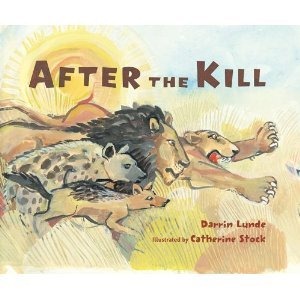
Review: After the Kill by Darrin Lunde

after the kill

After the Kill by Darrin Lunde, illustrated by Catherine Stock

Explore what happens after the lioness kills a zebra on the Serengeti Plain.  While the hunt and the kill are part of the story, they are only the beginning.  After the zebra is killed, the lion pride comes to eat and then other species start to gather.  There are the vultures who share with the lions.  Then the hyena clan that is able to drive the lions away and claim their share.  Jackals use trickery to grab some food for themselves.  The lions reclaim the carcass and continue to eat until they are sated.  Other vultures arrive.  The small scraps of flesh that remain are eaten by meat-eating beetles until the bones are white in the African sun. 

Lunde, a mammalogist at the Smithsonian Institute, creates a compelling story here.  There is no shying away from predator and prey, just a frank description of the food chain.  Nicely, Lunde injects his narrative with plenty of detail, noises, and an obvious love of his subject.  He paints a verbal picture of what is happening, helping young readers better understand what is actually happening.  The pieces of the book in the smaller font have additional scientific information that readers will find fascinating. 

Stock’s illustrations have a bright, hot quality to them thanks to the yellow tones throughout.  The heat of Africa is built into every page.  She also embraces the kill, the scavenging, and the story, creating a book filled with action-filled images.

An unflinching look at the battle for food on the Serengeti Plain, this book will be riveting for young readers.  Appropriate for ages 5-8, though this is a book that some children may find upsetting, so it is important to be aware of the sensitivity of the child you are sharing it with.

Reviewed from copy received from Charlesbridge.

Review–In Like a Lion Out Like a Lamb by Marion Dane Bauer

bauerlionlamb

In Like a Lion Out Like a Lamb by Marion Dane Bauer, illustrated by Emily Arnold McCully

Bauer has created a poetic picture book that explores the concept of March coming in like a lion and going  out like a lamb.  A lion enters a boy’s home and tromps mud across the floor.  But when the air turns warmer, the lion sneezes mightily.  On that breeze, a lamb comes in and the grass turns green.  But what will happen to the snowy lion now that spring has arrived?  Will he disappear?  Not him!  Meanwhile, the lamb is frolicking and bringing in new babies to greet the spring.

The verse is light and free, creating a poetic, friendly picture book for young children.  The idea of the lion not leaving, but instead lingering in a warm patch of sun and purring is a lovely one.  While the lamb is breezy and light, the lion asleep happily is what lingers with me afterwards, waiting for winter to return.

McCully’s art echoes the freedom of the verse and the lightness of the subject.  She uses a light touch on her lines, a freedom in her colors, and a lushness as spring returns. 

Welcome spring and the end of March with this book and hope along with all of us in Wisconsin that the snow will finally come to an end!  Appropriate for ages 4-6.

Reviewed from copy received from Holiday House.

Also reviewed by BooksForKidsBlog.

The Lion and the Mouse

The Lion & the Mouse by Jerry Pinkney

In this almost wordless book, readers revisit Aesop’s tale of the lion who spares the life of a mouse only in turn to be rescued by the mouse.  The only words on the page are animal noises that bring the African setting to life.  Readers follow the mouse right into the lion’s paws, sigh in relief at the release, and will be riveted as the capture of the lion plays out. 

Pinkney shows readers the world in focused images, revealing the view of the land the mouse has, the perspective of the lion, and foreshadowing the capture of the lion in the poacher’s net.  Each image is beautifully done, filled with details that bring the story to life and invite you to linger over them.  His pacing is done with such skill that he can create suspense with a single page turn.  From the moment of opening the cover, readers are in the hands of a master story teller who speaks through his art.

One of the best wordless picture books I have ever read, this book should be on every library’s shelf.  And with that cover, it is not going to sit there long!  Make sure you face this one out!

Reviewed from copy received from publisher.  Copy will be placed in library collection.

Also reviewed by Collecting Children’s Books, 100 Scope Notes, A Patchwork of Books, Pink Me, and Fuse #8.