3 Beginning Readers Worth Browsing

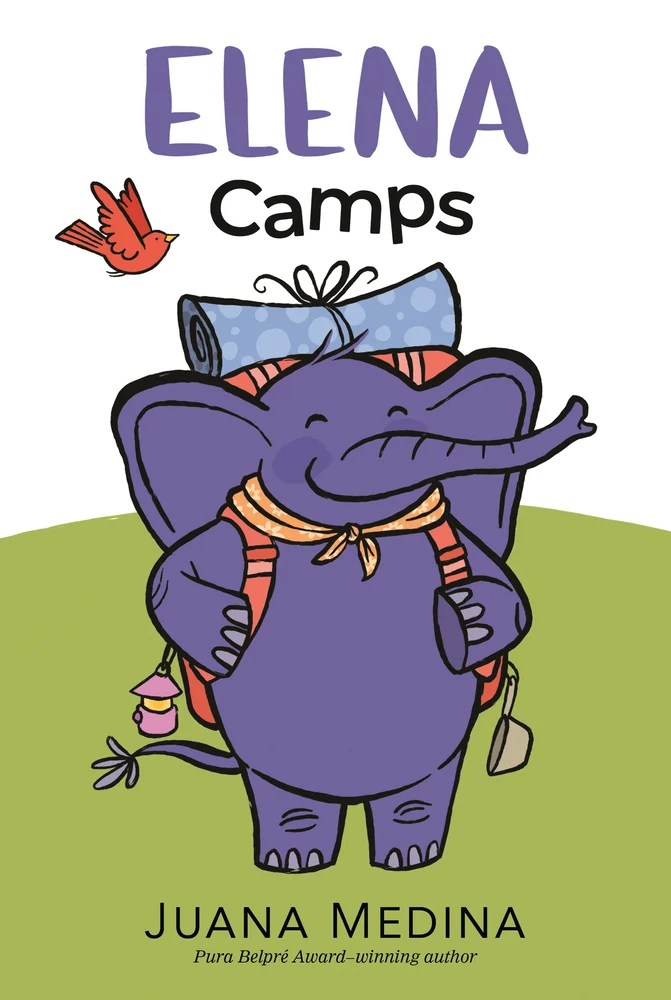
Elena Camps by Juana Medina (9781536216424)

Elena has a new tent that she can’t wait to set up and camp in! But when she tries to set it up, it doesn’t work as easily as she expects. With huge GA-BUNKs and GA-BANGs it keeps going wrong. She tries three times, but nothing works. Elena gets angry and stomps around. Sharp-eyed readers will see the instructions in many of the pictures well before a little bird mentions to Elena that they are there. Elena decides to accept the bird’s help and read the instructions and soon she is ready to camp. 

Released simultaneously in a Spanish edition, this second Elena book is just right for beginning readers. Elena’s tries to get a tent set up all on her own are shown with a broad sense of humor and the message of accepting a little help when you need it is shared frankly with readers. The illustrations are colorful and Elena the purple elephant pops on the page next to her yellow tent. 

A fun and friendly beginning reader. Appropriate for ages 4-6.

Reviewed from library copy.

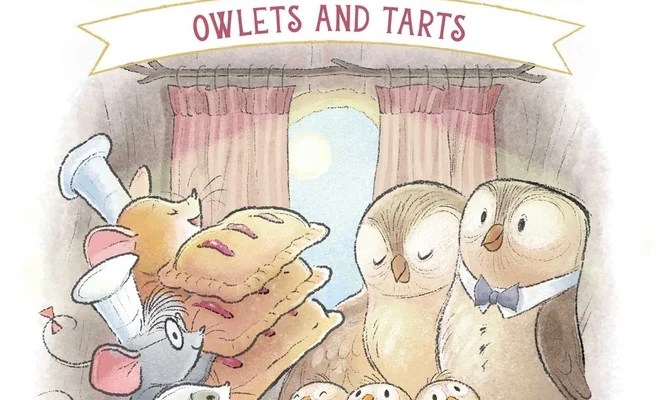
Mouse and Spoon: Owlets and Tarts by Cynthia Rylant, illustrated by Janna Mattia (9781665962193)

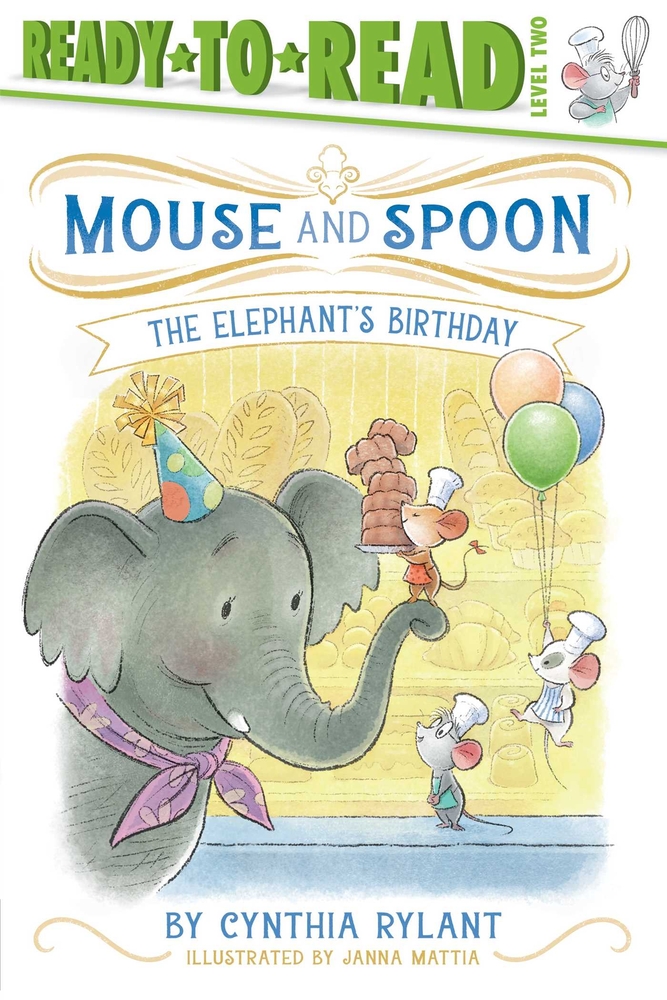
Mouse and Spoon: The Elephant’s Birthday by Cynthia Rylant, illustrated by Janna Mattia (9781665962162)

Powerhouse easy-reader creator Rylant returns with a new easy-reader series called Mouse and Spoon. Set in a bakery owned by three mouse siblings, each book focuses on a different special order that the mice must make. In Owlets and Tarts, the mice make Pillow Tarts to help the young owlets fall asleep as well as Half-Moon Buns for the owl parents. For the elephant, the request is for pound cake for the elephant’s birthday and banana bread for the monkeys. Now the mice just have to figure out how to make enough cake for an elephant! 

There is a lovely rhythm to both of these books, marking them as a pair. They start in similar ways, introducing the mice and their bakery, so it doesn’t matter what order you read them in. Then the special order arrives and the mice have to figure out how to do it. Told in very simple words and with a lovely softness to the illustrations, this easy-reader series is perfectly sweet. 

A new Rylant series to devour! Appropriate for ages 4-6.

Reviewed from library copies.
Ship in a Bottle by Andrew Prahin

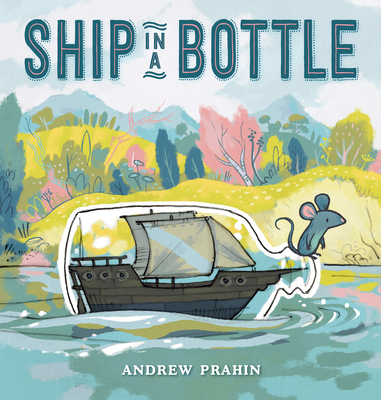
Cover image for Ship in a Bottle.

Ship in a Bottle by Andrew Prahin (9781984815811)

Mouse had been trying to live with Cat, but there were problems. Most of them from the fact that Cat wanted to eat Mouse all the time. Mouse loved her ship in a bottle, so she filled it with gingersnaps and with some help from Cat headed out into the world. Her bottle floated along and while it was sometimes peaceful, there were also attacks by rude seagulls trying to get the cookies. Mouse came to shore and met lots of new rabbit friends who loved gingersnaps, though once the cookies were gone, they sent Mouse on her way. Mouse continued downstream with nothing but a few crumbs that eventually ran out. Then a storm arrived with lightning and big waves. She came to a shore near a large city where she met a chipmunk who shared a berry and the ship. Mouse soon met many new friends who helped her, even some kind seagulls who shared. She was able to find safe sunshine, a safe place for her ship in a bottle, and a community.

Prahin’s picture book has a merry sense of humor throughout. His timing is perfect, landing some of the twists of the story with a wry grin. From the first part of the book with Cat chasing Mouse all over their house to the middle with hopes dashed, all builds beautifully to finding a place where Mouse is accepted, can help others, and finds friends. The arc of the story is very effective, offering a wonderful circle back to Cat at the end.

The illustrations do so much to reflect Mouse’s own emotions. There is the darkness and gray of the house with Cat which turns to blues, greens, and pinks as Mouse is freed to float away down the stream. When the rabbits eat Mouse’s gingersnaps and then reject her, the world turns dingy again as the storm threatens. The world brightens and fills with colors once more as Mouse finds a place she belongs.

A lovely look at community, acceptance and a watery adventure. Appropriate for ages 4-6.

Reviewed from e-galley provided by G. P. Putnam’s Sons.

Red House, Tree House, Little Bitty Brown Mouse by Jane Godwin

Red House, Tree House, Little Bitty Brown Mouse by Jane Godwin

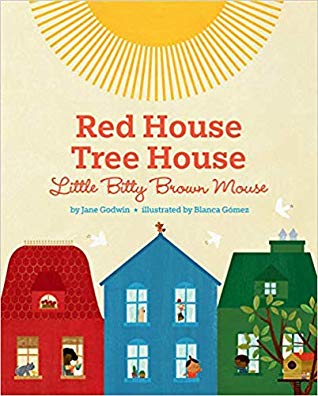
Red House, Tree House, Little Bitty Brown Mouse by Jane Godwin, illustrated by Blanca Gomez (9780525553816)

Told in simple rhymes, this book invites the youngest children to explore its pages and engage with the questions asked inside. The book begins with houses, including a little tree house for the tiny mouse. Colors are explored and then there is counting on the next page combined with more colors. The book takes readers on a bus, into the ocean, on all sorts of transportation, and asks engaging questions of the reader along the way. The book ends by inviting readers to look for the mouse hiding in every illustration.

This picture book’s jaunty rhymes are reminiscent of classic children’s books like Go Dog Go! The way that children are invited to engage with the book is wonderful and will help parents new to sharing books with children understand the sorts of questions that can be asked about the images in any picture book. Gomez’s illustrations are full of pure and bright colors that leap from the page, glowing with red, green, blue, orange and pink. The people on the pages are diverse and the urban setting where most of the book takes place is busy and friendly.

Engaging and fun, this book is best shared with only a few children so their perspectives can be heard. Appropriate for ages 1-3.

Reviewed from e-galley provided by Dial Books.

Review: I Am a Tiger by Karl Newson

I Am a Tiger by Karl Newson

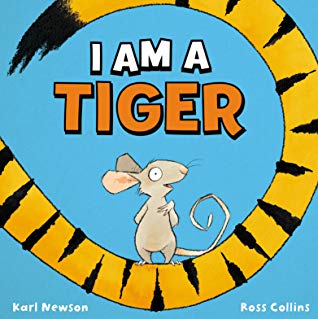
I Am a Tiger by Karl Newson, illustrated by Ross Collins (9781338349894)

Released July 30, 2019. 

A very confident little mouse declares that he is actually a tiger. The other animals don’t believe him at first, but he manages to demonstrate that he can growl like a tiger, climb trees like a tiger and even hunt for his lunch. When a real tiger comes along, the mouse declares that the tiger is a mouse! After all, the tiger has a twitchy nose, little hands and feet, and probably ate cheese recently. Mouse continues to show that he has all sorts of tiger-like skills. The defeated real tiger asks then what the other animals are and Mouse gives them all sorts of new identities, including a banana and a balloon. When Mouse leaves and gets a glimpse of himself in the water though, he realizes that he isn’t a tiger after all. Maybe he still isn’t a mouse either?

Newson’s writing is brisk and bright. Done entirely in dialogue, this book begs to be shared aloud with children. Children will love the confident little mouse and his ability to make ludicrous claims and stand by them. Mouse is a great character, becoming all the more interesting when he discovers he isn’t really a tiger after all. The twist at the end is a delight that doesn’t discourage Mouse in the least. The illustrations by Collins are large and colorful. They help tell the full story of what is happening and carry a lot of the humor too.

An uproarious picture book about a little mouse with a big imagination. Appropriate for ages 2-4.

Reviewed from ARC provided by Scholastic.


Review: Bruce’s Big Fun Day by Ryan T. Higgins

Bruce's Big Fun Day by Ryan T. Higgins

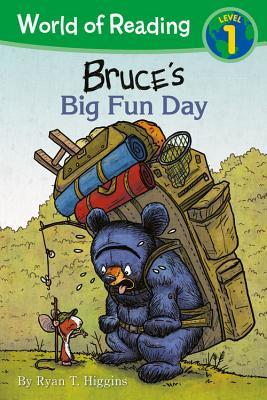
Bruce’s Big Fun Day by Ryan T. Higgins (9781368022811)

Nibbs, the mouse, wants Bruce to have a fun day, but Bruce doesn’t seem to be having any fun at all. Breakfast in bed turns into a messy disaster. The long walk is exhausting. A picnic turns into a feast for the ants. The boat ride is wet, particularly when Nibbs uses Bruce himself as the boat. They do make it back home in time for supper, but supper is too dainty and fancy for Bruce and dessert is even worse. By the time they are in bed, Bruce is very, very grumpy. Which is really nice, since Bruce loves to be grumpy. It might have been the perfect day out after all.

Higgins cleverly turns his picture book series about Mother Bruce into an easy reader format. His use of limited vocabulary is done seamlessly with the story. It helps that there is zany action on many of the pages that can be explained in Higgins’ rather dry tone in just a few words. The illustrations help too. Done in full color and with Higgins’ signature style, they show the story playing out on the page with great clarity and additional moments of silliness.

A great addition to easy reader shelves, this one is big fun. Appropriate for ages 4-7.

Reviewed from library copy.

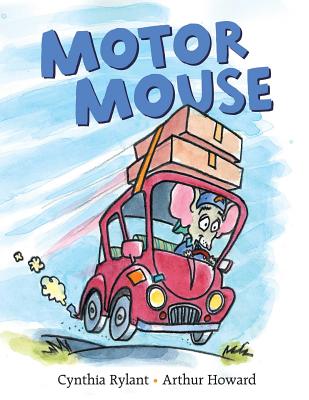
Review: Motor Mouse by Cynthia Rylant

Motor Mouse by Cynthia Rylant

Motor Mouse by Cynthia Rylant, illustrated by Arthur Howard (9781481491266)

The beloved author of many easy readers returns with the first book in a new series. Done in a larger picture book format, the book still has three short chapters inside. The first story focuses on the joy of having cake every Friday for our Motor Mouse and Telly. When they discover that their cake shop is closed one Friday, what will they do? Perhaps another sweet treat can save the day thanks to a friendly hedgehog. In the second story, Motor Mouse decided he’d rather look around than drive. He takes a cab but can’t quite figure out what he wants to see. In the end though, he moves from memory lane to a bowling alley to making a new friend. The last story takes Motor Mouse to the movies with his brother, Vincent. Vincent always orders one large popcorn and doesn’t quite manage to share it. So when he does the same thing, Motor Mouse insists on being the one to hold the bucket this time. But sharing can be really hard!

Told with Rylant’s beautiful writing that sets just the right curious tone on each of the short chapters, this is a fantastic picture book. With a look towards dealing with expectations, managing friendships, and learning to share and appreciate one another, the themes are universal for small children who are trying to navigate similar situations. The stories are gentle but also profound.

Howard, who has collaborated with Rylant on the Mr. Putter & Tabby series as well as the Gooseberry Park books, returns with his signature style. With clear black lines, the illustrations are bouncy and friendly even when situations get a little problematic. There is a constant optimism about Howard’s work that is particularly effective here.

A great start to a new series that is sure to be popular. Appropriate for ages 3-5.

Reviewed from copy provided by Beach Lane.

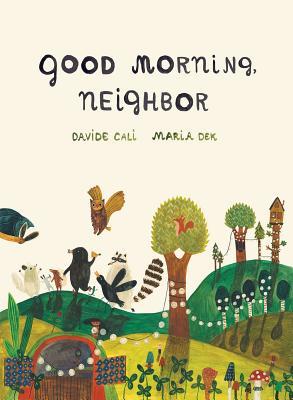
Review: Good Morning, Neighbor by Davide Cali

Good Morning, Neighbor by Davide Cali

Good Morning, Neighbor by Davide Cali, illustrated by Maria Dek (9781616896997)

One morning, Mouse wakes up and wants an omelet for breakfast. The trouble is, he doesn’t have an egg. So he asks the blackbird for an egg. Blackbird has flour, but no egg perhaps they could make a cake instead! The two set off to find an egg, and along the way, they gather more and more animals and ingredients. The dormouse has butter. Mole has sugar. Hedgehog has apples. Raccoon has cinnamon. Lizard has raisins. And finally, Bat has an egg! Owl lets them bake the cake in her oven. But when the divvying up of the cake comes into question, does Mouse get anything? After all, she didn’t really contribute something. Or did she?

This book is a clever riff on Stone Soup where everyone’s contributions come together to make something much more special. It uses repetition very nicely to give it a distinct folklore flavor. The final question of whether Mouse gets a slice of cake for initiating the idea and the entire process is an interesting one. The end will satisfy everyone except maybe hungry children who will want some apple cake themselves.

The illustrations add to the folklore appeal with their friendly animals and forest setting that is whimsically depicted. Each animal has their own personality and feel thanks to the illustrations and the way they appear on the page.

A great read-aloud choice that would pair well with autumn stories about apples and baking. Appropriate for ages 2-4.

Reviewed from library copy.

3 New Picture Books that Take Action

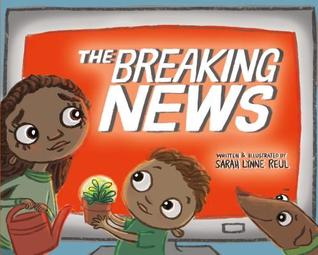
The Breaking News by Sarah Lynne Reul

The Breaking News by Sarah Lynne Reul (9781250153562)

When bad news is announced on the television, everyone in a little girl’s family gets very worried. Her parents start watching more TV and spending more time on their phones. They whisper together too. It’s all very scary. Even bedtime isn’t the same. It seems like everyone around is feeling it. At school, the little girl is inspired to try to help. But her funny show doesn’t make anyone laugh and no one seems to notice how much she is helping and being good. So she tries to do one tiny thing at a time and soon things are looking brighter even if the bad news is still around.

Told from the child’s point of view, this multicultural book offers a view of how one big bad event can color people’s days, especially those of children. There is an important empowering message here, of doing small things that add together to make a big difference, one that can spill past a family and into an entire community. Told with a simplicity and straightforward voice, this picture book reminds us all that we are not powerless even when we feel that way. Appropriate for ages 4-6. (Reviewed from library copy.)

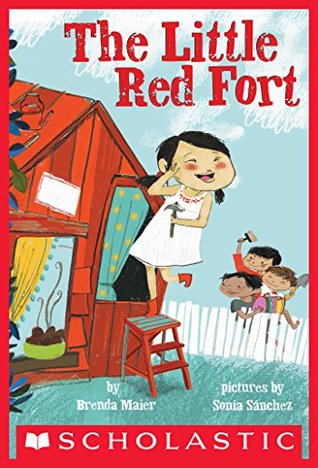
The Little Red Fort by Brenda Maier

The Little Red Fort by Brenda Maier, illustrated by Sonia Sanchez (9780545859196)

Ruby is always thinking of new ideas. When she found some old boards one day, she decided to build a fort. She asked her brothers if they wanted to help build, but they didn’t want to, so she learned how. She drew up plans, gathered supplies, cut the boards, hammered the nails. With each step, she offered to have her three brothers help but each time they refused. When her fort was finished though, they all wanted to play in it. Ruby refused to let them, since they didn’t help at all. So now it was up to the boys to come up with some great ideas and ways to lend a hand.

With the structure of Little Red Hen, this picture book celebrates a younger sister who is willing to do the work to see her vision through. She gets help along the way from her parents and grandmother. The women of the family are the ones handling the tools throughout the book, along with Ruby herself. The illustrations are done in a mix of traditional and digital media that offers a bright color palette and a layering of textures. A strong book about girls building their own future, this picture book is a gem. Appropriate for ages 3-5. (Reviewed from library copy.)

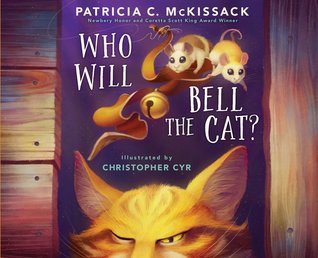
Who Will Bell the Cat By Patricia McKissack

Who Will Bell the Cat? By Patricia McKissack, illustrated by Christopher Cyr (9780823437009)

When Marmalade the cat comes into the mice’s barn, sick and hungry, the mice help to nurse her back to health. But when Marmalade recovers, she starts to hunt the mice, terrorizing them. Now the mice had to come up with a plan on how to handle the cat. Eventually Smart Mouse finds a bell and the mice create a collar for the cat, but who will be brave enough to get it around her neck. The mice try time and again and even turn to the local rats for help, but Marmalade evades each attempt. It isn’t until some dangerous humans come to the barn that the cat is belled, but at what cost?

McKissack has put her own spin on a classic fable. Her writing makes for a fable that is entirely shareable, something that begs to be read aloud to a group of children who will delight in the dangerous cat, cheer on the brave mice and then enjoy the giant humans at the end. Cyr’s illustrations are dramatic and beguiling. The fable takes on mythic proportions with the yellow-eyed and sharp-clawed villain of a cat and the plump brave mice. A great pick to share aloud with a crowd. Appropriate for ages 4-6. (Reviewed from copy provided by Holiday House.)

3 Picture Books Filled with Wild Animals

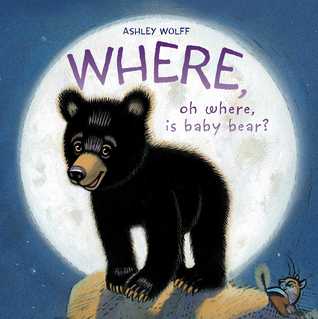
Where, Oh Where, Is Baby Bear By Ashley Wolff

Where, Oh Where, Is Baby Bear? By Ashley Wolff (9781481499163)

This picture book continues Wolff’s series on Baby Bear and his explorations of his habitat. Here, Baby Bear and his mother head out to look for food. But every time his mother looks for him, Baby Bear has disappeared. Again and again she has to call out “Where, oh where, is Baby Bear” and then her little bear responds. Readers will enjoy spotting where Baby Bear is heading and then where he is hiding as the pages turn. The repetition is handled nicely, giving the book a lovely rhythm when being read aloud. The illustrations are crisp and filled with details of their forest home. A great read aloud pick. Appropriate for ages 1-4. (Review copy provided by Beach Lane Books.)

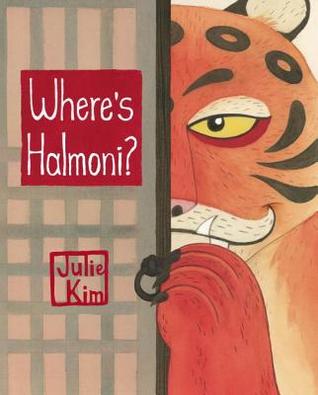
Where_s Halmoni By Julie Kim

Where’s Halmoni? By Julie Kim (9781632170774)

This picture book is done in a full-color graphic-novel style that will be appealing to children even beyond picture book age. It is the story of Korean-American siblings who head to their grandmother’s home to find her missing. They discover a magical passage in her home that leads to a world filled with creatures from Korean folklore. There is Tokki (the rabbit), Dokkebi (the goblins), and Horanghee (the tiger). As the children figure out how to get past each of the creatures using snacks and games, they come close to learning their grandmother’s secret. Sharp-eyed children will realize what happens to the fox at the end of this Korean adventure. The appeal of folklore combined with a modern graphic-novel style makes this book a winner. Appropriate for ages 5-9. (Reviewed from library copy.)

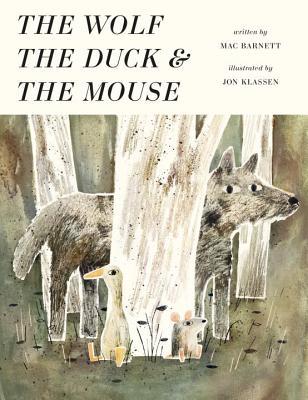
The Wolf, the Duck & the Mouse by Mac Barnett

The Wolf, the Duck & the Mouse by Mac Barnett, illustrated by Jon Klassen

When a mouse is gobbled up by a wolf, he discovers there is life after being eaten. Inside the wolf’s stomach, a duck is already living. The duck has a bed, a table, tablecloth, chairs and much more. The duck likes being inside the wolf, because he no longer has to worry about being eaten, since it’s already happened. Soon the mouse has decided to stay and the two have a dance party to celebrate. Unfortunately, this makes the wolf’s stomach hurt. He is spotted by a hunter and soon all three animals are in danger as the hunter takes aim. What can be done to save them all? It will take all three to save the day. Barnett has the perfect rather dark humor to work with Klassen’s illustrations. The story has a mix of fun and fate that will have readers guessing right up until the end. Appropriate for ages 4-6. (Reviewed from library copy.)