Review: Wild Berries by Julie Flett

wild-berries

Wild Berries by Julie Flett

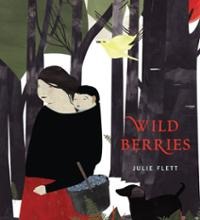
Clarence has gone berry picking with his grandmother since he was a baby.  Now he is big enough to carry his own bucket as they walk and sing.  The two of them pick the berries, Grandma looking for the sweet ones and Clarence for the bigger, sour ones that pop.  They pick the berries and eat the berries.  Then Clarence looks around the woods and sees different insects, spiders, and a fox.  It is time to go home, they say thank you and walk back home together.

This book weaves Cree into the story, separating the words out and providing pronunciation information at the end of the book.  Even these few Cree words evoke a different feeling, a new rhythm that is powerful.  Flett tells a very simple story here about going out to pick berries in the forest.  Yet it is a timeless story, one the embraces wildlife, the environment, and giving thanks for the bounty of nature. 

Flett’s art is a beautiful mix of cut paper collage, texture and painting.  She manages to show the depth of the woods without darkness.  She uses bright colors that pop on Grandma’s red skirt and the red sun in the sky.  The grass is drawn in individual blades and the tree bark varies from paper art to marker lines.  Put together, it is a rich and beautiful book.

Simple, powerful and honest, this picture book celebrates Cree and nature together.  Appropriate for ages 2-4.

Reviewed from library copy.
Review: Parrots Over Puerto Rico by Susan L. Roth

parrots over puerto rico

Parrots Over Puerto Rico by Susan L. Roth and Cindy Trumbore

This exceptional nonfiction picture book tells the story of the Puerto Rican parrot.  It is a bird that has flown over Puerto Rico for millions of years but almost became extinct in the 1960s.  The book tells of the changes that came to Puerto Rico and its environment thanks to settlers, wars, hunting, and foreign invasive species.  Forests began to disappear too, so the parrots were limited to living in just one place.  By 1967, only 24 parrots lived in Puerto Rico.  With them almost extinct, people started trying to save the parrots.  The book tells the story of rescued parrots, storms and the dedicated scientists who figured out how to save this species from disappearing entirely.

Roth and Trumbore tell this story deftly.  They focus on what was almost lost, a sky crowded with these blue and green birds.  The book explores the history of Puerto Rico, tying it closely and innately into the story of the parrots themselves.  The entire book is fascinating and becomes even more compelling when the story turns to the rescue efforts.  Small victories such as saving a young parrot’s wings are celebrated, while the larger effort is also looked at in detail. 

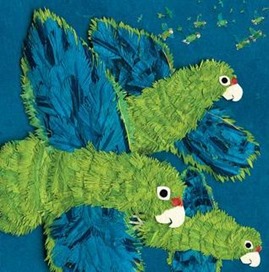
Roth’s collages are exquisite.  She captures the beauty of the birds, as you can see from the cover image above, but also the beauty of Puerto Rico itself with all of its lush greens.  The book is beautifully designed as well.

A dazzling nonfiction book that will be welcome in classroom discussions and units about conservation and environment.  Appropriate for ages 7-9.

Reviewed from digital copy received from Lee & Low and Edelweiss.

Review: Snowcial by Chelsea Prince

snowcial

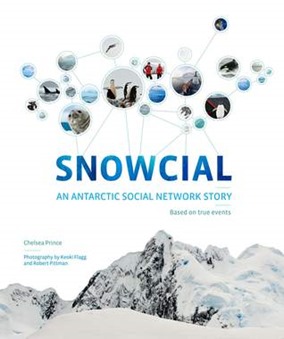
Snowcial: An Antarctic Social Network Story by Chelsea Prince, photography by Keoki Flagg and Robert Pittman

This nonfiction book follows the journey of a family to visit the Antarctic Peninsula.  They travel aboard an icebreaker ship that has an ice breaking hull but sails only in warmer temperatures.  Along the way, the children in the family, Anna and Rory explore the ship.  They watch the different birds that follow the ship and find out information on their habitat and how they survive out at sea.  Soon they are seeing icebergs, glaciers and lots of snow and ice.  They also get to visit places where penguins and seals live.  They even spot some killer whales hunting in the ocean.  A mix of science and exploration, this book invites readers along on a journey to an icy world that is full of life.

Price sets just the right tone with her book.  She writes with a merry voice, one that invites children reading the book to learn right alongside her and her characters.  Throughout the book there is a sense of adventure and a strong tie to information and science.  This is a book that teaches in an easy and welcoming way.

While Price sets the tone, the incredible photography from Flagg and Pittman truly capture the setting.  Their close ups of wounded penguins, hunted seals, and the activity of a penguin colony truly allow readers to see Antarctica up close.  Their photography is visually beautiful but also a way to learn more about this incredible place.

Brilliant science nonfiction, join the journey to Antarctica with this gorgeous book.  Appropriate for ages 7-9.

Reviewed from copy received from Chelsea Print and Publishing.

Review: See What a Seal Can Do by Chris Butterworth

see what a seal can do

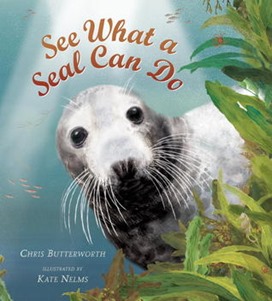
See What a Seal Can Do by Chris Butterworth, illustrated by Kate Nelms

This nonfiction picture book follows a gray seal through its day.  The seal starts off on shore where it is flumping along the sand, seeming slow and sleepy.  Then it enters the water and what seemed awkward on land makes it able to swim with incredible grace.  As the seal swims, readers learn about their different anatomy, including their ears, whiskers, fins and blubber.  At the bottom of the ocean, the seal eats fish and then eats more on its way up to the air again.  Returning to the beach, the seal is ready for another nap. 

Butterworth truly celebrates this animal in her book.  She writes with a mix of prose and poetry, making sure that readers understand how fascinating seals are.  Throughout, she uses metaphors to make sure that children relate to the animal.  Blubber is compared to a warm blanket.  The seaweed at the bottom is a forest.  The seal swims like a rocket in the water. 

There are many science picture books that use the format of larger text for the basic story and then smaller text for more details.  Perhaps best about this book is that Butterworth uses both sections of the book to share scientific information, too often the science is left mostly to the smaller text and younger readers miss out on the fascinating facts.

The artwork by Nelms is simply exquisite.  Just like the seal, the book really comes alive in its underwater scenes. Nelms manages to offer lots of small details to look at, but also to capture the wavering light and softness of water.  There are illustrations throughout that have a beautiful depth to them, inviting us to hidden places under the water.

A beauty of a science book, this celebration of seals gets my enthusiastic seal of approval.  Appropriate for ages 4-6.

Review: Eat Like a Bear by April Pulley Sayre

eat like a bear

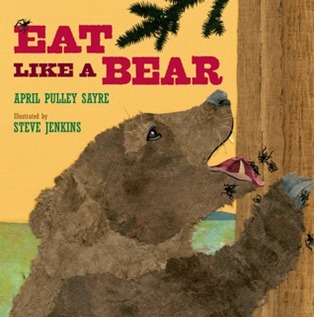
Eat Like a Bear by April Pulley Sayre, illustrated by Steve Jenkins

Released October 22, 2013.

Can you eat like a bear?  It means you will wake up very hungry in early spring and have to dine on sandy plants and frozen dead bison meat.  In May, you will have dandelions and cow parsnips to munch but you will still be hungry, so you eat some ants.  You will also eat clover and fish in icy streams for a meal of trout.  In July you will catch a squirrel you dig out of the dirt and in August you will have moths to munch.  September brings berries and October pinecones.  Then it is time to sleep for the winter, full with all of the various meals you have eaten for the rest of the year.

Sayre makes this book such fun to read.  She takes scientific information about what bears eat and makes it very accessible for a preschool audience.  She uses repetitive structures throughout the book, having the bear dig and pull to find food again and again.  This doesn’t just create a friendly structure for small children, it also underlines the fact that animals are in constant search for food.  Sayre also makes the book inviting by using the second person format, asking children if they can really eat like a bear.  I suspect many will stop saying yes when the ants, squirrels and dead bison appear in the diet.

The art of Jenkins is always beautiful, but he outdoes himself with the depiction of the bear.  I shared this book aloud with my son and we both spent time lingering over the first image of the bear.  Jenkins has managed to use the torn paper as fur, not only along the edges of the bear’s body but on its body too.  The result is fur so plush that you feel like your hand should sink into the page.

A glorious look at bears, this book is a fantastic introduction to a creature, its habitat and its diet.  Appropriate for ages 4-6.

Reviewed from copy received from Henry Holt & Co.

Review: Rotten Pumpkin by David M. Schwartz

rotten pumpkin

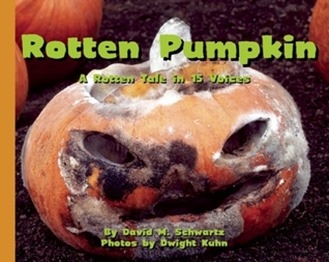
Rotten Pumpkin: A Rotten Tale in 15 Voices by David M. Schwartz, photos by Dwight Kuhn

A dynamic mix of story and nonfiction, this book follows the life of a pumpkin.  He has his shining moment as a jack-o-lantern lit for Halloween, but then is put into the compost.  That is where the story gets interesting.  First he is chewed on by mice, squirrels, slugs and vomited on by flies.  Now he looks a lot different and has fungi growing.  The various molds introduce themselves, explaining what they do, including the fascinating Penicillium.  Sow bugs, earthworms, slime mold and yeast work on the pumpkin too.  It is left as just a pile of seeds and little else.  Until spring arrives!

Schwartz shows readers just how fascinating science is with his in-depth descriptions of the decomposition process.  Children will adore the explanation of how flies taste and eat, the process of earthworm poop, and all of the molds seen up close.  But this book goes far beyond the gross and takes the reader right through the entire process, detailing it with interesting moments throughout. 

The photographs by Kuhn are particularly useful in a book like this.  Capturing the changing face of the pumpkin as it molds over adds real interest visually to the title.  At the same time, the close up images of yeasts and slime mold are grossly gripping.

Perfect for autumn and Halloween, this book will have kids looking at their slumping pumpkins with new eyes.  Appropriate for ages 6-9.

Reviewed from library copy.

Review: Volcano Rising by Elizabeth Rusch

volcano rising

Volcano Rising by Elizabeth Rusch, illustrated by Susan Swan

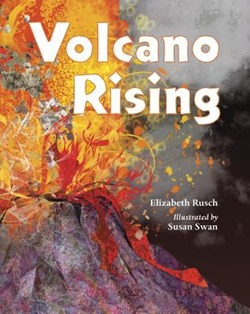
Volcanoes can seem destructive, but in this nonfiction picture book they are shown to be sources of creation as well.  The process of eruption and magma is described and the book looks at the fact that different volcanoes move at different speeds.  The book is written in two levels, one for more of a picture book audience and the other for elementary students ready for detailed information.  While the simpler part stays general, the more detailed information includes specific volcanoes and stories of their eruptions.  The book makes volcanoes interesting rather than frightening, looking at how ash restores fields and how most creative eruptions can be out-walked by people.

Rusch’s two levels of text really stand apart from one another.  The simpler version really reads as a playful picture book complete with sounds.  It does still offer facts and information, but the deeper text is filled with those.  That longer text loses the playfulness of the shorter but is a wealth of information on volcanoes that even young enthusiasts will find fascinating.

Swan’s illustrations are done in cut paper and have a vivid color that really makes the volcanoes pop.  She shows various volcanoes in her art, contrasting them with one another nicely.  It is the images of eruptions that really explode on the page and will delight readers.

A double-layered book that can be shared in a storytime or in a science classroom.  Appropriate for ages 3-8.

Reviewed from copy received from Charlesbridge.

Review: Lifetime by Lola M. Schaefer

lifetime

Lifetime: The Amazing Numbers in Animal Lives by Lola M. Schaefer

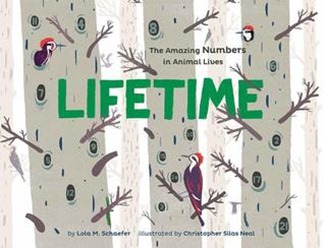
Take a unique look at what animals will do in a single lifetime in this book that combines counting, math and fascinating scientific facts.  The book focuses on how many times a single animal will do a behavior during their life.  The facts are based on estimations and opens with a description of how the numbers were figured out and explaining that each individual animal will be different than the estimate.  The book opens with one spider’s egg sac, the sole one she will create in a lifetime.  It then goes to the ten antlers that a caribou will grow and shed and moves on by tens.  The book ends with one thousand tiny baby seahorses, the number a single male seahorse will carry and birth. 

This is a spectacular way to introduce averages to children and estimation.  It is a celebration of the information that mathematics can provide to us about nature.  Schaefer has selected a wide variety of animals and intriguing facts about each of them.  Readers can find more in-depth information on the animals at the back of the book.  They will also find more information on averages and math there. 

Schaefer’s art adds to the appeal of this book.  Her illustrations have a boldness to them, a graphic quality that really works.  They are flat and vibrant, clearly laying items on the page for counting.  The book is a joy to page through since each page offers a new animal, a new habitat to see.

One of the most visually stimulating and smart concepts for a nonfiction picture book, this one is sure to beat the averages and be read more than once.  Appropriate for ages 4-6.

Reviewed from copy received from Chronicle Books.

Review: Miss Maple’s Seeds by Eliza Wheeler

miss maples seeds

Miss Maple’s Seeds by Eliza Wheeler

This book will sweep you up like a breath of brisk autumn air.  Miss Maple is a little woman who spends her entire summer searching for seeds that have not gotten planted in the spring.  She brings them back to her maple tree and nurses them back to strength.  She washes them off, warns them to take care because they are so small, takes them on field trips to learn about being a seed, and reads them bedtime stories.  In winter they all burrow down together and fill the time with songs and stories.  Then when spring arrives, the seeds learn to dance in the rain and sink into muddy ground.  In May, it is time for the seeds to find the places they will grow, so Miss Maple launches them off.  Miss Maple then starts her journey with the seeds all over again, heading off on the back of a bluebird to find another year’s worth of stranded seeds.  Lovely and warm, this picture book is a joyous celebration of the seasons and the plants around us.

Wheeler has created a tiny motherly figure in Miss Maple, someone who loves and cares just for the good of the earth.  As the book progresses, she becomes almost a Mother Earth figure as her world turns with the seasons.  Wheeler’s writing is filled with wonderful small moments and details.  Miss Maple reads bedtime stories “by firefly light” and during the winter her animal neighbors share “supplies of hot maple syrup, old corn husks, and juicy fruit rinds.” 

Her illustrations show that same attention to detail.  This small world is filled with little touches that make it come alive.  The frogs in the nearby pond have a house in a log complete with front door and paned windows.  The seeds all sleep in small, cozy beds that are perfectly designed for seeds their size.  Then when Miss Maple launches the seeds off, she does it with winged baskets and other vessels that glow and float on the water.  This is a completely formed world that all readers will want to linger in.

Cozy and lovely, this picture book is a celebration of seasons and the earth, but it is also a reflection on the skill and care of nurturing.  Get this one for your Earth Day units and pull it out when covering seasons too.  Though I think it would be best of all curled up under warm blankets and watching autumn arrive.  Appropriate for ages 3-5.

Reviewed from copy received from Nancy Paulsen Books.