Review: Bird Talk by Lita Judge

bird talk

Bird Talk: What Birds Are Saying and Why by Lita Judge

Incredible displays of feathers, bright-colors and complex songs are all ways that birds communicate and try to find a mate.  Some birds puff and strut, others have large wattles, and still others drum on a branch with a stick.  Once birds have found that mate, they communicate their pairing to others using dances, clattering bills, or by providing food for one another.  When eggs and baby birds arrive, the parents use flashing wing colors, trickery or pretending to be wounded to lead predators away from their young.  The parents teach their babies to eat, fly and more with clucks, demonstrations, and plenty of talk.  Celebrate the birds that live around your house as well as exotic birds that have amazing ways of communicating.

Judge has written a very detailed but also very readable book about birds.  It has a wide range of species that are all intriguing in the way they communicate with one another.  This makes the book engaging and great fun to read.  At the end of the book are even more facts about the birds, that share their habitat and range.   Judge’s illustrations have a wonderful playfulness to them, but also display the beauty of the birds with accuracy and skill. 

A great pick for children’s nonfiction collections, this is an inviting book about wildlife that will give new and intriguing information to young nature lovers.  Appropriate for ages 8-10.

Reviewed from copy received from Roaring Brook Press.

Review: Ocean Sunlight by Molly Bang

ocean sunlight

Ocean Sunlight: How Tiny Plants Feed the Seas by Molly Bang and Penny Chisholm

Following her Living Sunlight book, this continues the story of how the sun makes life on earth possible.  Here, the focus is on the ocean and the role that sunlight plays even in the darkest depths of the sea.  The story starts with photosynthesis and food chains on dry land, then moves to the water.  Bang asks where the green plants in the ocean are except for the seaweed.  Then she shows the tiny phytoplankton that make up the plants of the sea.  The food chain is shown and the book then turns to the darkness of the deep and how the food chain works even in blackness.  It is beautiful science. 

Bang successfully combines poetry and science in this enticing picture book. Her tone is inviting, inquisitive and filled with wonder at the amazing things that happen due to our sun.  The book is written from the point of view of the sun itself and how its energy reaches everywhere on earth.  It is a celebration of the sun and of the oceans themselves too.

Chisholm’s art ranges from the glow of the yellow sun to the black deep of the ocean.  Everywhere, even in the darkness, you can see the energy of the sun.  When the phytoplankton are displayed, Chisholm shows them up close in all of their wonderful detail.  Then the energy of the sun dances above the waves in yellow dots.  The entire book sings with energy and light.

This book is a tribute to science and nature.  It’s a readable and very understandable look at the complex systems that make our lives possible.  Appropriate for ages 5-8.

Reviewed from library copy.

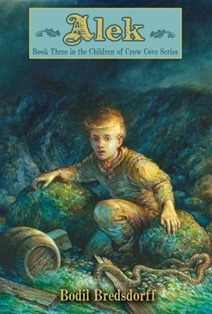
Review: Alek by Bodil Bredsdorff

alek

Alek by Bodil Bredsdorff

This final book in The Children of Crow Cove series has Doup as the main character.  Doup came to Crow Cove as a child with the Crow-Girl.  He has lived there all of his life but misses his older brother Ravnar who has moved away.  Doup reclaims his birthname of Alek and heads off with his father to town to find Ravnar.  They discover his empty home that is dirty and dank. Ravnar only appears when his boat is in harbor, otherwise he is out fishing for a living.  Alek’s father leaves him with Ravnar and returns to Crow Cove.  But one night, Alek witnesses a shipwreck on the beach where the sailors were tricked into beaching the boat.  He then sees a man murdered and discovers a young girl hiding away from the beach.  Alek takes the girl home with him, though she doesn’t speak his language.  Young Alek has to figure out what happened and then what to do about it.

I’ve adored this series for some time.  The writing is so natural and easy.  It is steeped in its seaside setting and filled with small details that bring their world to life.  This final book has plenty of action to move the story along, but it still remains a book about everyday life and creating a family out of the people who are with you.  From the small details of hunting and farming to information on meals and shopping, this book like the others in the series is a small book filled with the largeness of a life well led.

Definitely start with the first in the series.  As the series moves forward, the characters grow and age, offering a look at the results of their decisions in earlier books.  The strength of these books are in the complex characters, the fine details and the glory of the natural setting.

This is a fittingly strong final volume in a delight of a series.  Appropriate for ages 10-12.

Reviewed from copy received from Farrar Straus Giroux.

Review: Baby Bear Sees Blue by Ashley Wolff

baby bear sees blue

Baby Bear Sees Blue by Ashley Wolff

Baby Bear wakes up next to his mother in the den.  Sunlight peeks into the den, warming him and Baby Bear sees yellow.  At the entrance to the den, the oak tree waves its leaves at him, and he sees green.  The jays in the trees are blue.  The trout in the stream is brown.  The scent of the strawberries leads him to discover red.  The tickle of a butterfly on his fur shows him orange.  The storm clouds are gray, but then they leave behind a rainbow.  Finally, at the end of his day, Baby Bear sees nothing but black.

Wolff has created a lush and rich picture book that truly celebrates colors in very natural way.  All of the elements of color seem unforced and honest.  She embraces cadences that roll off of the tongue, giving this book a wonderful rhythm.  The patterns create a book that will be loved by toddlers who will enjoy exploring colors alongside Baby Bear. 

What makes this book really work are the illustrations that are linoleum block prints painted by hand with watercolor.  This creates a combination of strong black line and foundation and then colors that have light and glow on the page. 

A top pick for color concepts, this book is a work of art that has plenty of toddler appeal.  Appropriate for ages 2-4.

Reviewed from library copy.

Review: The Family Tree by David McPhail

family tree

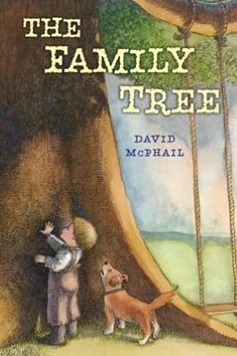
The Family Tree by David McPhail

This is the story of a very special tree.  It was left standing when the rest of the space was cleared to build a house many years ago.  This tree would shelter the little house.  It witnessed many changes over the years as horse and wagon changed to cars.  There were births and deaths on the farm, until finally it was the great-great grandson of the original building of the home who lived there.  The tree still stood, strong and straight.  But then it was threatened as a new road was planned that would run right through it.  The grandson refused to let the tree be cut down, and wild animals join him to keep it from happening.  So the road plans must be changed and the tree continues to grow now by the large bend in the road.

There is something to be said about a picture book that decides to tell the story that feels right, the one that resounds in your bones, rather than the one that would happen in real life.  When I saw the bulldozers in the book, I braced myself for heartache, or for the story to turn into that of growing a new tree from an acorn that originated with this tree.  But instead McPhail told a story for tree lovers of all ages, who wish that there were bends in the big highways to keep huge old trees alive. 

McPhail’s writing is simple and straight-forward.  He tells the story with a great matter-of-fact tone that belies the wildlife appearing and the wonder of the tree standing.  His art is signature McPhail with its fine ink lines and watercolor softness.  It has both the clarity of the modern day and the softness of memories.

Get this into the hands of those who hug trees.  They are guaranteed to love it.  Appropriate for ages 3-5.

Reviewed from copy received from Henry Holt and Company.

Review: The Conductor by Laetitia Devernay

conductor

The Conductor by Laetitia Devernay

This wordless picture book is tall and narrow, just like the trees featured within.  A man enters a forest of trees that are shaped like lollipops with long trunks and round tops.  He climbs to the very top of one tree and raises his hands.  Suddenly, birds start to appear, formed from the leaves of the trees.  They fly off leaving holes in the tree leaves shaped like them.  The leaf patterns are on their wings and they fly above the conductor in a variety of formations.  Until eventually they are gone, and all that are left are the blank trees.  The man climbs down and plants a seed that quickly grows into a tree.  As he is planting, the birds return to the trees, covering them once again in leaves.  The man leaves the forest just as he has found it, but with one more small trees.  It’s a beautiful look at the environment and the impact humans can have if they choose.

The art here is wonderfully done.  It has a limited palette of just yellow, green, black and white.  The juxtaposition of tree leaves and flying birds is spectacular visually and surprising at first.  It lifts the book to a more surreal place, a world where you are unsure what could possibly happen next.  The fine lined art, the scale of the book and the gentle theme all work well together, creating a memorable whole.

A surprising wordless picture book that is a work of art, this book would work well in art curriculum or as a quiet, beautiful book to share.  Appropriate for ages 3-5.

Reviewed from copy received from Chronicle Books.

Review: Seed Magic by Jane Buchanan

seed magic

Seed Magic by Jane Buchanan, illustrated by Charlotte Riley-Webb

Rose and her brothers make fun of the old man who feeds the pigeons all day long from his wheelchair.  When Rose asks him why he likes pigeons so much, he tells her how beautiful they are.  But Rose can’t see it at all; she thinks that gardens are much more lovely than birds.  So Birdman gives her some seeds to put outside her window and grow a garden on her windowsill.  Rose knows that it won’t work, since there’s no dirt for them to grow in, but Birdman is insistent that they will grow a garden on her bare windowsill.  Her brothers make fun of her for even trying, but Rose starts to dream of the incredible flowers that could sprout there.  Then one day, something magical does happen, much to her surprise and delight.

Buchanan’s writing is poetic.  It has a strong rhythmic quality that beats to the heart of the urban setting perfectly.  She plays with imagery, describing the sunflower seeds as “black as tar, slick as oil” as Birdman share them with Rose.  This is a book that speaks to the power of making connections, rather than dismissing those around us.  It is also about beauty and seeing it in the most unlikely places.

The illustrations have a wonderful texture and thickness to them, the paint layered and deep.  Riley-Webb uses plenty of color to depict the urban park: greens, blues, and rich browns.  There is movement to her illustrations from the people, the birds and the gardens.  It is a fresh way to show a city, rather than the cold of concrete.

This book celebrates nature in an urban setting and the sharing of beauty.  Thanks to the rhythm of its writing, it’s a great read-aloud as well.  Appropriate for ages 4-7.

Reviewed from copy received from Peachtree Publishers.  

Review: Kate & Pippin by Martin Springett

kate and pippin

Kate & Pippin: An Unlikely Love Story by Martin Springett, illustrated by Isobel Springett

When Pippin, a fawn, is abandoned by her mother, photographer Isobel Springett found her crying for help.  She took Pippin home and placed her by Kate their old Great Dane.  The two immediately bonded:  Pippin thought she had found a new mother and Kate started to mother her even though she had never raised any puppies of her own.  Pippin learned to drink from a bottle and when she got bigger started to adventure outside.  One evening, Pippin disappeared into the forest and didn’t return for bedtime.  Kate was very concerned, but the next morning Pippin came back just in time for breakfast.  Pippin returned to the woods every night after that, returning to the farm almost every morning to eat and play.  As she grew into an adult deer, she still continued to return to visit Kate and play.  She even still comes into the house once in awhile for a visit. 

This is one of the most lovely picture books about a relationship with a wild animal that I have seen.  I especially appreciate that Pippin was allowed to continue to be a wild deer, returning to the forest and being allowed to create a relationship on her own terms.  It’s definitely refreshing to see.  Here the human and dog were able to rescue, aid but also step back and not absorb this little creature.  The relationship that emerges is breathtakingly touching, seeped in fragility yet incredibly strong.

A large part of the success here are the photographs of this tiny deer bonding with the enormous dog.  By the end of the book, the animals are the same size.  It is clear that both of them adore one another on a deep level, and one that is delightfully separate from the humans. 

This nonfiction picture book reads like fiction, making it a great pick for a touch of nonfiction in a story time.  It’s a story that children will relate to easily and naturally.  Appropriate for ages 4-7.

Reviewed from copy received from Henry Holt and Company.

Review: House Held Up by Trees by Ted Kooser

house held up by trees

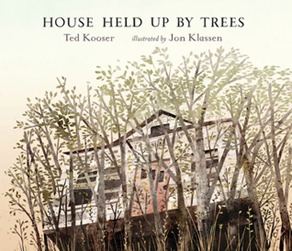
House Held Up by Trees by Ted Kooser, illustrated by Jon Klassen

This is the story of a family and a house.  When the house was new, it stood upon a newly planted lawn where the trees had been removed.  It was bare, not even a stump left behind.  On either side of the bare lot were trees of all sorts, the kind that spread seeds and scents.  Two children lived in the new house and often played in the trees at the edges, watching their father care for the lawn.  Their father mowed down all of the small tree seedlings before they could get started at all.  But the children grew up, the man moved away to be closer to them, and the house was left alone.  Alone except for the trees, which grew and took over the barren lawn, and eventually lifted the house high on their shoulders.

Kooser writes with amazing depth here, each sentence resonant with meaning and feeling.  While the book can be read more lightly, the joy here is in that dark deep that lies behind the lines.  The story plays with man vs. wilderness, the American obsession with lawns, children being pulled to the edges to find their own wild spaces, and the return to nature in the end.  The writing is beautiful because of that ever-present ache that is there, the tug of the trees, the dance of the seeds.

Klassen has illustrated this book with such delicacy that it shows he feels that same amazing pull.  He lets us peek at the house from the shelter of the woods, our eyes almost aching with the bareness in the sun.  He captures the tree seeds in flight from high above, allowing us to fly with them and plant ourselves too.  He plays with light, shadow and darkness, just as Kooser does. 

This book is poetry, without the stanzas.  It is a picture book that has depth, courage and looks deeply into our relationship with nature and with our families.  Beautiful.  Appropriate for ages 7-10.

Reviewed from library copy.