Review: Into the Outdoors by Susan Gal

into the outdoors

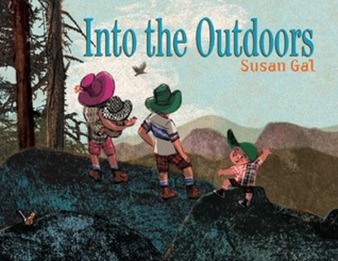
Into the Outdoors by Susan Gal

Learn your prepositions in the fresh air with this book that takes us up into the mountains and down into the forest.  A family heads out on a camping trip.  Along the way they go over a bridge and under the trees.  Once they reach the woods, they head out on a hike, following a trail around the lake, across a stream, and between some large rocks.  They return to their campsite and the fire, where the animals they saw on their hike have followed them back.  The entire book is playful and fun.

Gal has managed to structure a fine little story out of her prepositional phrases.  The family moves through their day, exploring the natural world.  While the book would be of use with prepositions and prepositional phrases, it is also a gem of a short read all on its own. 

Gal’s illustrations lift this book up, giving it a modern freshness that is not without whimsy.  From the very friendly and approachable animals, to the grin of the baby riding in its sling, this book has a merry and jaunty feel that one gets outdoors.

An enjoyable prepositional outdoor hike, this cheerful title will be embraced as a learning tool but also as a great bedtime read.  Appropriate for ages 3-5.

Reviewed from copy received from Alfred A. Knopf.

Review: No Two Alike by Keith Baker

no two alike

No Two Alike by Keith Baker

Starting with the fact that no two snowflakes are alike, though they almost are, this book merrily explores the snowy woods.   Things are found in pairs, and pointed out to be different from one another.  No two nests are the same, no two tracks in the snow.  Branches and leaves are all different from one another.  Throughout nature it’s the same.  Even the two very similar little red birds who accompany the reader on the trip through the snow are shown in the end to be different from one another, “Almost, almost… but not quite.”

Just right for toddlers, this book looks at things that may seem the same but upon closer inspection are actually different.  Baker’s writing is simple and effortless, gliding through the story with just enough support to carry the book.  The rhythm and structure of the book also help make it a great read aloud.

His illustrations are equally light and cheery.  The two red birds are merry companions for young readers as they explore the snowy woods together.  Readers can stop and take the time to see the differences between things for themselves. 

This book could be used in several ways.  It could be used to explore differences in objects or for walks in nature to explore how each object is different.  It can also be used as a gentle way to enter conversations about how we as people are all different too in many ways. 

This sweet, jolly book makes is worth a warm snuggle on a wintry day and a walk in the winter weather to look up close at nature.    Appropriate for ages 1-3.

Reviewed from library copy.

Review: Just a Second by Steve Jenkins

just a second

Just a Second: A Different Way to Look at Time by Steve Jenkins

Jenkins always manages to make science and nature even more fascinating than it usually is.  In this book, he shows the passage of time in unique and  intriguing ways that will get young scientists thinking differently.  What happens in one second?  Well, in that second a bat can make 200 calls or hummingbird beats its wings 50 times.  What happens in one minute?  In a minute a grizzly bear can charge up to one half-mile or a skydiver falls 2 miles during free fall.  How about an hour?  A day?  A week?  Longer?  For all of these, Jenkins selects intriguing examples of what happens during that time period that will have you thinking about time and what can be done in ways you never expected.

Jenkins’ paper collage art is on display here, vibrant against the plain backgrounds of the pages.  His exacting art uses pattern, subtle color changes and textures to great effect.  His collage work is done with such attention to detail that it often doesn’t look like cut paper work.  It is as beautiful as his work always is.

Jenkins has selected fascinating bits of trivia to put on display here.  This book will not give you the complete story of the natural examples, but will definitely open readers’ minds to new ways of looking at time and action.  It is one of those books that invites you to explore the ideas that capture your imagination further in other places. 

A great gateway book that broadens the mind, this nonfiction book is appropriate for ages 5-9. 

Reviewed from library copy.

Review: Swirl by Swirl by Joyce Sidman

swirl by swirl

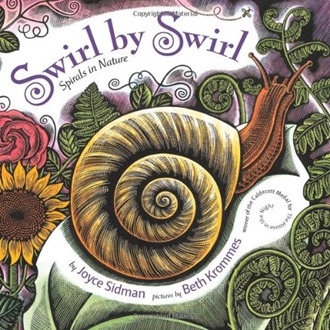
Swirl by Swirl: Spirals in Nature by Joyce Sidman, illustrated by Beth Krommes

Two incredible talents worked together to bring us one of the most stunningly lovely books of the year.  It explores the different ways that spirals and swirls appear in nature.  There are the animals curled up for the winter underground, shells, unfurling ferns, hedgehogs, octopus tentacles, whirlpools and tornadoes.  This book is a masterpiece of simplicity and complexity, just like the swirls that it speaks about.

With verse by Joyce Sidman, winner of a Newbery Honor and illustrations by Caldecott winner Beth Krommes, this book is immediately something special.  The two have brought readers a poem spiraled inside intensely lovely images.  One gets the sense of unwinding a spiral when reading the verse, as it loops and dances.  The illustrations too are filled with a movement that is natural and free.

There is a simplicity about the verse that is misleading.  Sidman’s verse is tight and well crafted, showing a restraint and skill.  Krommes’ illustrations on the other hand are filled with details, lines of motion, and jewel tones.  Astonishingly lovely, the illustrations have a fully dimensional feel to them and celebrate the swirl and spiral to great effect.

Highly recommended, this book successfully celebrates shape, design, science and nature in a single beautiful work.  Appropriate for ages 3-6.

Reviewed from library copy.

Check out the book trailer to see the illustrations for yourself:

Also reviewed by:

Review: Questions, Questions by Marcus Pfister

questions questions

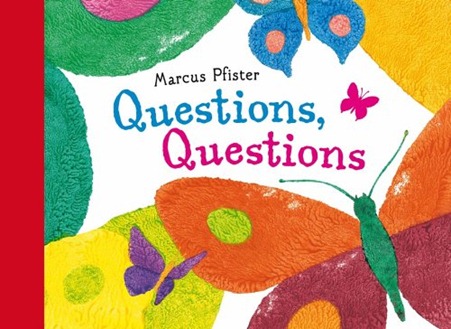
Questions, Questions by Marcus Pfister

This colorful book asks question after poetic question about our world.  The questions range in subject, but are all simply and beautifully written:

What makes fire burn red and gold

and makes it much too hot to hold?

and

Does a whale make up a song

so other whales will sing along?

Told in gentle verse, the book celebrates life, including whales, fish, seeds, butterflies and much more.  The simplicity and tenderness of this book make it exceptional.

Pfister’s art work is done with a different technique here.  He explains it in an author’s note at the end of the book.  He transferred his drawing to cardboard and then used the cut outs to stamp with acrylic paints.  The result are intriguingly textured illustrations that are bold and colorful.  On each page there is also a foil element, though I find the illustrations themselves to be far more interesting.

A lovely poetic book that is worth sharing, it is appropriate for ages 2-4.

Reviewed from library copy.

Board Book Reviews

American Modern Books shared two new board books that are coming out in September.  Both have a modern art vibe that is captivating:

colors harper counting in the garden

Colors by Charley Harper

This is the third board book by Harper and follows his alphabet and counting books.  Here the colors correspond to animals and natural colors in the illustrations.  There are red birds, blue water, orange leaves, and a yellow moon.  There are also some more man-made items in the book like fire hydrants, cars and hats.  The design here is very successful with the small size of the board book format creating a very nice frame around the illustrations.  There is also a lot of variety in the images, though all are thoroughly modern.

Counting in the Garden by Emily Hruby, illustrated by Patrick Hruby

This counting book counts visually as well as in the text of the book.  Steadily count from 1 to 12 with items from the garden.  After each new number is counted, readers turn the page to see that item added to the garden.  What starts as a green and brown, but fairly open and plain field becomes robust and crowded with plants.  The illustrations are strong with plenty of color and lots of energy.  They have modern lines and are very clean and clear.

These two books are sure to please parents looking for books that they too will enjoy reading again and again. 

Reviewed from copies received from AMMO.

Book Review: At This Very Moment by Jim Arnosky

atthisverymoment

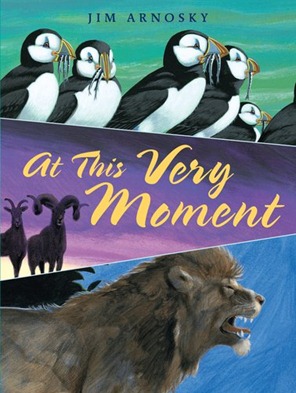
At This Very Moment by Jim Arnosky

Every moment that a child is doing something during their day, animals are doing things too.  This book reminds us to think about the entire world, even when doing something as normal as taking a drink.  A deer might be sipping from a stream at just the same moment.  When children are eating, animals are eating too, after catching their meals or gathering them.  As evening comes and children head to bed, animals are getting tired too and sleeping in their own ways and beds.  This is a gentle, reassuring book that celebrates our connections to nature, the environment, and the world at large.

Arnosky uses a gentle verse that is rhyming but also free to create the connections between children and the natural world.  The book begins by reminding readers that every single day there are amazing things happening, then it goes on to show that we are all part of those amazing moments.  It is a book that will have readers mindful of what they are doing and what that means in the larger world, without ever becoming didactic about it.  The endpaper of the book has Notes on Animals, explaining Arnosky’s connection with the animals he has depicted in the book.

Arnosky’s paintings are rich and deep, the colors ranging from yellows to deep blues and purples.  They all capture the natural world with a beauty and accuracy. 

This is a celebration of the connectivity of our world, one that children will relate to easily.  Appropriate for ages 5-8.

Reviewed from copy received from Dutton Children’s Books.

Book Review: Meadowlands by Thomas Yezerski

meadowlands

Meadowlands by Thomas F. Yezerski

This nonfiction picture book tells the story of the history of the wetlands that are now known as the Meadowlands in New Jersey.  From hundreds of years ago, when the wetlands had 20,000 acres of marshes through to the 1800s when the land was drained and filled in with dirt to the 20th century when the industries came to surround the Meadowlands with their factories.  The wetlands were used as a garbage dump, filled with waste and filth.  It became a problem area in New Jersey until the state decided that it needed to be cleaned up.  By 1985 with the clean up and then the developers, there was less than 7000 acres of wetlands left.  But the wetlands began to recover, with time the lack of pollution and the rivers and tides cleaned the water and allowed plants, birds, fish and animals to return.  This is a celebration of wetland recovery and the strength of the ecosystem as well as a stirring call to action.

Yezerski offers just the right amount of information here for an elementary-aged audience.  From the brief history of when the wetlands were unchanged, readers see how steadily the impact of humans deteriorated the size and quality of them.  The garbage portion of the story is startling, stark and brief, indicating the small amount of time it took to do such extensive damage.  When the book turns to the recovery of the Meadowlands, the tone lifts and the text turns to celebrating the nature returning to the area.

The pages of the book are bordered with objects pulled from that illustration.  So the two-page spread of the 1800s is bordered with a knife, musket, scythe, trap, kettle, muskrat and more.  This adds to the feeling of time changing and the area changing along with it.  The watercolor illustrations are often looking at the wetlands from above, showing the devastation and changes.  Beautifully, as the wetlands recover, the illustrations become more close and intimate with the wetlands and the animals.

Get this one on your elementary nature and ecology shelves.  It is a readable and very successful look at wetland renewal for children.  Appropriate for ages 7-10.

Reviewed from copy received from Farrar, Straus & Giroux. 

Book Review: In the Meadow by Yukiko Kato

inthemeadow

In the Meadow by Yukiko Kato

A little girl and her family head to the river to play.  On the shore, she spots a butterfly but when she tries to touch it, the butterfly flies away.  The little girl follows into the meadow, filled with tall grasses.  The grass tickles, trips, and sways.  It is almost like a green sea around her, growing so tall that only her hat and face can be seen.  The butterfly disappears, but a grasshopper lands on her arm and jumps away again.  The little girl is alone in the tall grass, so she closes her eyes and listens to the noises of the meadow.  And then she hears one more noise, her mother’s voice calling to her.

This picture book explores nature in a very personal way.  All of the senses are involved in the description of the meadow, from the scent of the crushed grass under her feet, the way the grass feels on her skin, the way the grass looks as it sways, to the sounds of the meadow and its creatures.  This immerses the reader in the experience of the meadow, both its beauty and the way you can lose yourself in it.

Kato’s words are simple, perfect for small children.  They reveal the meadow slowly, building it into a full experience.  Her illustrations are done in acrylic paints and oil pencils.  They are done in delicate lines, yet have a freedom, a naturalness.  The vast green of the field, dances on the page, at times detailed and at other times simply an expanse.

This lovely book is ideal to use with toddlers and preschoolers who will see themselves in the meadow.  It would be a great piece to use with an art project where children draw their own meadows, or even build collages from found grasses.  But primarily, it is a fresh, wonderful look at nature from a small child’s point of view.  Appropriate for ages 3-5.

Reviewed from copy received from Enchanted Lion Books.

Also reviewed by Biblioreads and featured in 7 Imp.