Book Review: In the Meadow by Yukiko Kato

inthemeadow

In the Meadow by Yukiko Kato

A little girl and her family head to the river to play.  On the shore, she spots a butterfly but when she tries to touch it, the butterfly flies away.  The little girl follows into the meadow, filled with tall grasses.  The grass tickles, trips, and sways.  It is almost like a green sea around her, growing so tall that only her hat and face can be seen.  The butterfly disappears, but a grasshopper lands on her arm and jumps away again.  The little girl is alone in the tall grass, so she closes her eyes and listens to the noises of the meadow.  And then she hears one more noise, her mother’s voice calling to her.

This picture book explores nature in a very personal way.  All of the senses are involved in the description of the meadow, from the scent of the crushed grass under her feet, the way the grass feels on her skin, the way the grass looks as it sways, to the sounds of the meadow and its creatures.  This immerses the reader in the experience of the meadow, both its beauty and the way you can lose yourself in it.

Kato’s words are simple, perfect for small children.  They reveal the meadow slowly, building it into a full experience.  Her illustrations are done in acrylic paints and oil pencils.  They are done in delicate lines, yet have a freedom, a naturalness.  The vast green of the field, dances on the page, at times detailed and at other times simply an expanse.

This lovely book is ideal to use with toddlers and preschoolers who will see themselves in the meadow.  It would be a great piece to use with an art project where children draw their own meadows, or even build collages from found grasses.  But primarily, it is a fresh, wonderful look at nature from a small child’s point of view.  Appropriate for ages 3-5.

Reviewed from copy received from Enchanted Lion Books.

Also reviewed by Biblioreads and featured in 7 Imp.

Review–Planting the Wild Garden by Kathryn O. Galbraith

plantingwildgarden

Planting the Wild Garden by Kathryn O. Galbraith, illustrated by Wendy Anderson Halperin

This lovely book moves from the steady and deliberate planting of seeds by farmers to the ways that seeds are planted in nature.  The seeds sweep along the in the wind.  They are dropped by birds eating from the seed heads.  They pop and snap to new places.  They are carried on the coats of animals.  They are planted by squirrels hiding them for winter.  Told in a poetic voice with images that evoke nature in all of its beauty, this book is one to be treasured.

Galbraith’s writing is leisurely and lovely, lingering on each of the moments that spread seeds across nature.  She explains each instance in detail, offering noises, specific plant names, and building moments that readers themselves can feel and be in for a bit.  She also skillfully blends in animals in each setting, bringing it further to life.

Halperin’s style works very well with this subject matter.  She plays with light and dark, draws the animals and plants described in the text.  Through her fine-lined and gently colored images, nature comes to life.  One of her most successful pages is early in the book, capturing the movement of the wind in colors and lines.

A natural, lovely look at seeds and planting in the wild, this book is a gorgeous tribute to wilderness.  Appropriate for ages 4-7.

Reviewed from copy received from Peachtree Publishers.

Also reviewed by:

Time to Eat: Nature and Nibbles

timetoeat

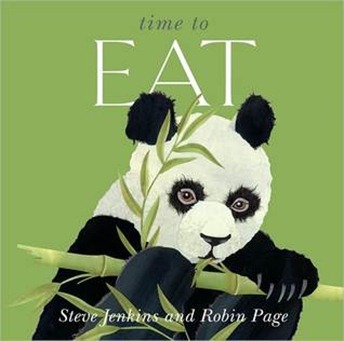
Time to Eat by Steven Jenkins and Robin Page

Jenkins and Page continue their collaboration with a new series of nature books for young children.  The other two books in the series are Time for a Bath (coming in May) and Time to Sleep (just released).  In this book, readers learn about the many strange and different things that animals eat.  From the rocks that an ostrich has to eat to chew its food to the tapping thin fingers of an aye-aye looking for lunch, the facts are fascinating. 

Those facts are paired with Jenkins’ illustrations done in paper collage.  As always, his collage work captures the texture of fur, the softness of feathers, and the smoothness of skin.  They manage to be simple yet demonstrate the complexity of the animals. 

Make sure to turn to the end of the book for more details about the featured animals.  The facts included in the body of the book read aloud very well, offering just enough detail to be interesting and yet to move along quickly. 

This is a great book to add to any library’s nature section and to keep on hand for any nature or animal story times you will be doing.  The dung beetle alone is sure to get children intrigued!  Appropriate for ages 4-7.

Reviewed from library copy.

Family Pack: Poetic Nature

familypack

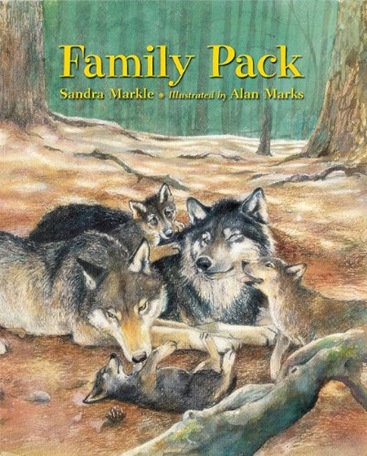
Family Pack by Sandra Markle, illustrated by Alan Marks

This book captures the real-life story of wolves being reintroduced to Yellowstone National Park.  The focus of the story is one young female wolf who finds herself suddenly separated from her pack and alone in a new place.  Her tracks are the only wolf tracks she sees, she is the only wolf she smells.  Without a pack, she cannot hunt the way she is used to, so she survives mostly on mice.  As she becomes an adult, she discovers another wolf, a male.  The two of them become a mated pair and eventually have a family in Yellowstone.  One lone wolf has created her own pack.

Markle’s verse in the book really shines, illuminating the loneliness of this young wolf’s new life, her troubles with hunting larger game, and her growth into an adult wolf.  The poetry is filled with imagery that enlivens the book, making the cold and loneliness tangible to readers. 

Marks’ illustrations are equally successful.  He captures the setting beautifully from the towering trees to the wide open spaces.  In his illustrations, Yellowstone becomes just as real as the wolf herself, almost another character in the story.  The vistas and close-ups he has created here give readers a very unique perspective on the life of this wolf.

Highly recommended, this book will work well for slightly older children because of the depth of the verse.  It will work well in units about preservation and ecology.  Appropriate for ages 6-8.

Reviewed from copy received from Charlesbridge.

Jam & Honey: Natural Sweetness

jamhoney

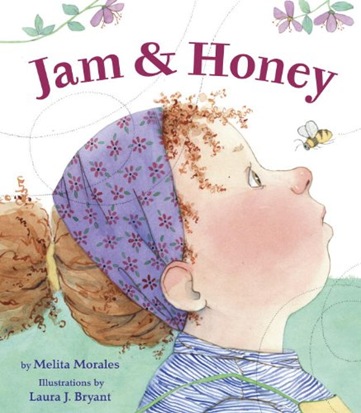
Jam & Honey by Melita Morales, illustrated by Laura J. Bryant

This quiet, gentle book tells the story of a visit to an urban berry patch from two points of view, a girl and a bee.  The girl is headed to the berry patch to pick berry to make into jam.  Her big worry is running into bees, which she does.  But she remembers what her mother told her about staying still and that the bee was interested in nectar not in her.  The bee is heading to the berry patch for nectar to make into honey.  He is worried about running into a human there, which he does.  But he remembers that humans are interested in the berries, so he just flies past.  This parallel story offers a glimpse of urban gardening and emphasizes the importance of our food and other creatures.

Morales has written the book in a verse format that has enough rhyme to make it friendly and bouncy.  There is a rather jaunty tone to the book, making the encounter with the bee less scary than it could have been.  The emphasis is on making food, whether it is by the girl or the bee.  The two halves of the book are written in very similar verse, often repeating patterns from the earlier one.  This ties the two stories together even more firmly.

Bryant’s art makes sure that the reader knows that the book is set in an urban setting without covering it in graffiti or garbage.  Instead, we see a warm friendly neighborhood filled with flowers, pigeons, and bees.  She imbues the illustrations with a natural feel, always having the reader look past greenery and through plants. 

A great pick for insect units or story times or ones about food.  It could also happily be used as a late summer story when the berries are plump and ripe.  Appropriate for ages 3-5.

Reviewed from copy received from Random House.

Big Belching Bog: A Quiet Exploration

51k29LnkjvL

Big Belching Bog by Phyllis Root, illustrations by Betsy Bowen

Through this picture book, readers get to explore the wonders of a bog.  Root uses free verse to invite readers deeper into the bog, discovering the plants and creatures that live here.  Small moments of life in the bog are captured in the poetry, sights and sounds are shared and wondered at.  The book and the bog have a graceful slow pace that make one take ones time and savor.  And through it all, there is something coming, something to look forward to, something that only we might witness.  This small touch of foreboding makes the book all the more pleasurable to read.  A book for children who love nature, animals and plants, this is a rich look at the quiet bog.

Root’s verse works as if it is small poems on each double page spread rather than one long poem that runs the length of the book.  These small pieces of verse make the book more readable and allow the reader to see the tiny pieces of the bog which in turn make up the whole.  This is a book that encourages you to slow down, linger, listen and watch so that you really understand the place that you are.  The book ends with details about bogs and the animals and plants seen in the book.

Bowen’s illustrations are woodcut prints that have great deep colors and thick lines.  A hermit thrush travels through each page with the reader, often cocking its head in a thoughtful way.  The illustrations capture the beauty of the bog and also that swampy feeling, the tug on your boots, the dampness that surrounds you. 

Both verse and illustrations work as a celebration of the bog, inviting readers to visit and discover the surprise themselves.  Appropriate for ages 4-6.

Reviewed from library copy.

Tropical Rainforests: Beautiful Nonfiction

9780061142536

Tropical Rainforests by Seymour Simon

Veteran children’s nonfiction author, Seymour Simon, returns with this Smithsonian Institution book on rainforests. With full color images featuring interesting wildlife and grand expanses of forest, the book is an enticing introduction to tropical rainforests for children.  The importance of rainforests for the entire planet is woven into the particulars about the animals and plants that can be found there.  Making up just 2% of the earth’s surface, these forests are home to millions of insects, plants and animals.  Simon reveals their uniqueness and beauty as he writes with passion about their importance. 

Though he is writing nonfiction, Simon writes with an almost poetic voice.  He has a graceful sense of wonder in his prose, never allowing the rainforest to be reduced to a list of creatures that inhabit it.  Instead, Simon waters the book with plenty of facts, offers a sunshine of lovely little moments (like the way that you can hear the army ants hiss because there are so many of them) and brings out the beauty with the lush photography.  This is a science book for real science lovers, where the science is the loveliness of the world around us with so many details that make it amazing.

Unlike most science books, this one reads aloud very well.  Though you will find yourself stopping regularly to discuss an interesting point or take a closer look at an image.  A book that is sure to warm up wintry days, this is a scientific vacation to the rainforest.  Appropriate for ages 5-8.

Reviewed from copy received from HarperCollins.

Also reviewed by A Patchwork of Books

Big Night for Salamanders

Big Night for Salamanders by Sarah Marwil Lamstein, illustrated by Carol Benioff

On a rainy spring day, a young boy comes home hoping that this will be the Big Night.  After dinner, the boy gets his raincoat on and a flashlight covered in pink plastic to lessen the glare.  He and his parents head out to the wet road in the dark.  In the dark and the rain, the family help salamanders cross the road safely as they move from forest to pond to lay their eggs.  But some of the cars are going so fast that it is dangerous not only for the salamanders.  So the boy creates a sign that says “Go Slow, Salamander Crossing!”  It is indeed a Big Night.

The story of the boy is presented side-by-side with information on what the salamanders are doing.  Readers get insight into the animals, told in a much more poetic and flowing way than the human story.  It makes for a lovely contrast with one another where not just the font and the content tell the different stories but also the tone and writing style.

Benioff’s illustrations are equally at home with the humans and the salamanders.  It is a pleasure seeing a child of color in a story where there is no mention of it at all.  Her art is bold enough to work with groups, and this book as a whole is ideal for reading aloud in storytimes about spring or salamanders.  All children will reach the end of the book wishing that they too could shepherd salamanders across a road at night.

A lovely science story book, this book successfully marries science into a picture book story.  Appropriate for ages 4-6.

Reviewed from library copy.

Also reviewed by:

The Buffalo Are Back


The Buffalo Are Back by Jean Craighead George, paintings by Wendell Minor

This is the haunting story of the loss of the buffalo herds that once thundered across the United States.  It is a story of the buffalo, the prairies and the Native Americans.  The Indians knew how to care for the grasslands and by caring for the grass, they took care of the buffalo which they depended on for survival.  So when the Indians stood against the American government and its settlers, defending the land, the government ordered the buffalos killed off.  Now the settlers battled the grass, tearing it up to create farmland.  Farmland that was doomed to become the Dust Bowl when the very soil crumbled to dust and locusts attacked their crops.  But the buffalo were not exterminated.  With Teddy Roosevelt came change and a love of the buffalo. Now there is a return of the buffalo and the grasses.

George captures a tumultuous and horrible history in this book for children.  She manages to take an overwhelming loss and condense it into something that is understandable for young children.  Her words are powerful, evocative and beautiful.  She captures the fragility of nature and earth with spirit and honesty.  The paintings by Minor take this book to another level.  His depictions of the glorious buffalo, the endlessness of the prairie, and the horrors of destruction are breathtaking.  His virtuoso art brings the entire history to life.

In the end, this book is about hope.  It is about the fact that we have choices to make, and that we can make a difference.  Beautiful and stunning, we must be part of creating the future this book tells us of.  Appropriate for ages 7-10.

Reviewed from copy received from Dutton.