Review: Enormous Smallness by Matthew Burgess

Enormous Smallness by Matthew Burgess

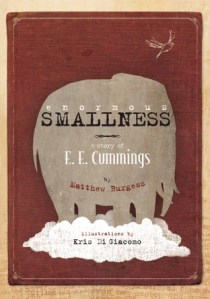
Enormous Smallness: A Story of E.E. Cummings by Matthew Burgess, illustrated by Kris Di Giacomo (InfoSoup)

This picture book biography of the great poet E. E. Cummings is exceptional. Focusing on Cummings’ early years primarily, the book invites young readers to view their own world with wonder and to try to put it into words. As a young boy Cummings was already creating poetry, starting at age three. His mother wrote down his poems for him as he recited them aloud. His imagination extended to art as well, but his real love was words which he approached very playfully, often creating his own words or mashing ones together into new ones. The book emphasizes the hard work that Cummings put into his craft, including spending lots of quiet time observing the world around him for inspiration. After graduating from Harvard, Cummings headed to New York City where he found new inspiration all around him. He served in World War I and published his first books soon after the war ended. His poems were both loved and controversial as he toyed with form and words. Filled with Cummings’ poems as examples, this picture book is a joy to read.

Burgess does a great job with his prose which introduces the young Cummings and his early poems and then follows him as he grows older and his poems grow with him. I appreciate that the book was not attempted to be written using Cummings’ unique style. Rather it is a book that pays homage to the art, the inspiration and the man himself. Spending so much time on Cummings’ youth makes the book much more appealing to young readers who will find inspiration both in Cummings’ age when he began to write and in his poems simplicity.

The art by Di Giacomo is filled with textures and patterns. Words dance across the page, playful and light. They often break free of the lines of prose, merging to be part of the art itself. Words float up on breezes, lengthen with hot summer days, and zing with the style of New York City.

A fabulous biographical picture book, this book is a great introduction to E.E. Cummings and his work. Appropriate for ages 6-9.

Reviewed from copy received from Enchanted Lion Books.

Review: The Lightning Dreamer by Margarita Engle

lightning dreamer

The Lightning Dreamer by Margarita Engle

Margarita Engle, award-winning author of verse novels, continues her stories of Cuba.  In this book, she explores the life of Gertrudis Gomez de Avellaneda, also known as Tula, who becomes a revolutionary Cuban poet.  Raised to be married off to save the family financially, Tula even as a young girl relates more closely with slaves and the books she is reading than with girls of her own age and her own social standing.  As she reads more and more, sheltered by both her younger brother and the nuns at the convent, Tula starts to explore revolutionary ideas about freedom for slaves and for women.  In a country that is not free, Tula herself is not free either and is forced to confront an arranged marriage, the brutality of slavery, and find her own voice.

Engle writes verse novels with such a beauty that they are impossible to put down.  Seemingly light confections of verse, they are actually strong, often angry and always powerful.  Here, Engle captures the way that girls are asked to sacrifice themselves for their families, the importance of education for young women, and the loss of self.  She doesn’t shy away from issues of slavery either.  At it’s heart though, this novel is about the power of words to free people, whether that is Tula herself, her brother or a family slave and friend.

Highly recommended, this is another dazzling and compelling novel from a master poet.  Appropriate for ages 12-15.

Reviewed from digital galley received from NetGalley and Houghton Mifflin Harcourt.

Review: Emily and Carlo by Marty Rhodes Figley

emily and carlo

Emily and Carlo by Marty Rhodes Figley, illustrated by Catherine Stock

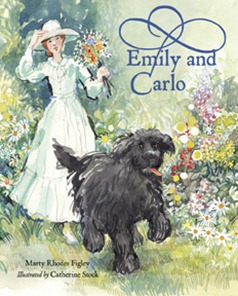
When Emily Dickinson was 19 years old, she was lonely in the big home in New England since her siblings were off at school.  So her father bought her a puppy that she named Carlo.  The quiet and reclusive poet was an odd match with her bounding, huge Newfoundland.  Carlo gave Emily more courage to be out and about, visiting others.  He was with her always, a large drooling dog.  They explored Amherst together with its woods, meadows and ponds.  Their time together inspired her poetry, as shown in this book through stanzas that she wrote.  This friendship with a dog makes this literary figure much more human and approachable for children.  It’s a very special way to see an author.

Figley truly found the key to Emily Dickinson’s personality for children.  All it took was a large messy dog to break through into Dickinson’s quiet, contemplative world.  Interspersing the verse with the story also makes this a friendly window into Dickinson’s work.  The book maintains a fresh, light tone throughout, showing the two friends aging together.

Stock’s art is a radiant mix of playfulness and contemplation, matching the subject matter beautifully.  It shows the deep connection of woman and dog, the natural world they explored, and pays homage to the verse that is embedded in the book. 

A simply lovely look at Emily Dickinson through her love of a pet, this book should be used with anyone working with Dickinson’s poetry and children as a lens through which to view the person and her writing.  Appropriate for ages 6-8.

Reviewed from copy received from Charlesbridge.

Book Review–Pablo Neruda: Poet of the People by Monica Brown

pabloneruda

Pablo Neruda: Poet of the People by Monica Brown, illustrated by Julie Paschkis

Follow the transformation of a young boy named Neftali into the poet Pablo Neruda.  The book starts with Neruda’s childhood and moves through his life as he begins to write poetry in his signature green ink.  His connection to nature is emphasized throughout the book from his love of the sea to the stones of Chile.  It also speaks to his love of children and his growth into a fighter for workers’ rights.  This is a lovely, quick glimpse of an amazing poet.

Brown’s words are simple and accessible to children.  She manages to explore Neruda’s inspirations without losing her young audience.  Rather she talks in detail about what inspired his poetry, what he meant as a person, and where he came from.  It is a powerful way to look at Neruda and his work.

The art by Paschkis is extraordinary.  Her paintings combine moments throughout Neruda’s life with words.  The words grow on leaves and trees.  They show in the sun and the moon.  They form the very ground.  It is an expressive way to show the power of words in Neruda’s life as well as how they came from all that surrounds him.

Explore Neruda through beautifully simple text and illustrations that have words streaming through them.  Appropriate for ages 5-8.

Reviewed from copy received from Henry Holt.

Dave the Potter: Artist, Poet, Slave

51rAQjGiR L

Dave the Potter: Artist, Poet, Slave by Laban Carrick Hill, illustrated by Bryan Collier

Dave the Potter was an outstanding artist, poet and potter whose influence is still evident in South Carolina pottery.  He lived in the 1800s and created his pottery with amazing skill, building enormous pots that could up to 40 gallons.  He was one of only two potters known to have the strength and skill to create such large pieces.  Dave was also a poet, inscribing his verse on his pottery, offering two lines of poetry and then a date.  His poems have the beauty and simplicity of Haiku and offer a unique perspective of a poet surviving in slavery.  This is a picture book that makes an important figure in history come alive, revealing his art and poetry for children. 

Hill has created a free verse of his own to tell the story of the life of Dave.  Hill’s verse is simple and striking, drawing together the connections between the simple ingredients of the clay and what it can become and the simple life of a slave and the wonder of what Dave created.  The poem leads children through the stages of making a pot from the gathering of the clay to the magic and work of creating pottery.  The book ends with more of Dave’s poetry as well as an author’s note and an illustrator’s note.  All of them speaking to the influence and importance of Dave the Potter.

Collier’s art work here is stunningly beautiful.  His watercolor and collage art speaks to the strength of Dave, the skill of his hands and the glory of his work.  The colors are rich and deep, filled with a warm earthiness that evokes pottery and clay. 

A radiant tribute to an artist, this picture book echoes the transcendent artist that Dave was.  Appropriate for ages 5-8.

Reviewed from library copy.