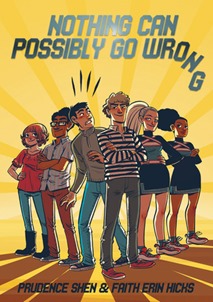
Review: Nothing Can Possibly Go Wrong by Prudence Shen

nothing can possibly go wrong

Nothing Can Possibly Go Wrong by Prudence Shen and Faith Erin Hicks

Released May 7, 2013.

Nate and Charlie are friends, but mostly it’s about sharing a ride to school.  Then when the cheerleaders threaten Nate’s robotics competition, Charlie is caught up in the middle of the conflict.  Nate decides to run for Student Body President and Charlie’s cheerleader ex-girlfriend forces him to run against Nate.  Things quickly get out of control in this jocks against the geeks sort of storyline that ends with both groups stripped of their school funding.  Now the only way forward is to work together to fund and build a robot that can win the robot death match.  And of course, just like with all plans, nothing can possibly go wrong.

The storyline could have been cliché, but it steps away from that fairly quickly and into much more intriguing collaborative efforts.  Shen and Hicks have created a great gang of characters here.  Nate is laid back and really the normal one of the group.  Charlie is alpha-geek, neurotic, ballsy and intellectual.  Mix in the cheerleaders who are clearly at the top of the popular food chain, and this is regular high school on steroids.  While some of the characters are left as stereotypes, Charlie and Nate are well developed and interesting. 

The art is hip and fun.  Done in black and white, the images play up the funny moments beautifully and often the dance of words and image is sheer perfection.  It’s hard to believe that it was done by two people rather than just one.

Geeks and jocks alike will enjoy this one, after all who doesn’t love to see a robot death match!  Appropriate for ages 13-15.

Reviewed from copy received from First Second.
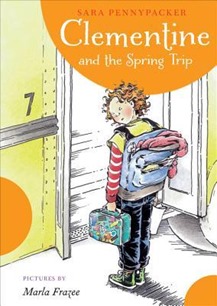
Review: Clementine and the Spring Trip by Sara Pennypacker

clementine and the spring trip

Clementine and the Spring Trip by Sara Pennypacker

In the latest installment of the Clementine series, which happens to be one of my all-time favorite series, Clementine is taking a spring field trip with her class to Plimoth Plantation.  Clementine has agreed to be partners with her friend Margaret on the trip, mostly because the fourth graders have a rule that you have to eat without making any noise.  Margaret wants to partner with Clementine too, since Clementine doesn’t mind dirty things at all and Margaret most definitely does.  Then a new classmate comes along and complicates things.  Olive has her own language that she teaches everyone and is well on her way to being very popular, when she is paired with Clementine for the field trip.  With all of their plans in disarray, what will happen on the field trip?

Just as with all of the Clementine books, Pennypacker has created a modern girl living in a modern family.  She merrily inserts levity throughout the book from the cleaning of the statues in the park to the stinky bus they have to take on the field trip.  The character of Clementine continues to be complex, artistic and monumentally creative.   This of course can lead to getting into trouble, but what jolly trouble it is!

This series belongs in every school and public library.  Get it into the hands of creative kids and those who want a good giggle.  Appropriate for ages 7-9.

Reviewed from library copy.

Review: Lester’s Dreadful Sweaters by K. G. Campbell

lesters dreadful sweaters

Lester’s Dreadful Sweaters by K. G. Campbell

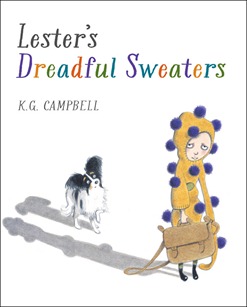
When Cousin Clara’s cottage was eaten by a crocodile, she moved in with Lester and his family.  No one knows quite whether she is actually their relative, but she stayed with them anyway.  She brought her knitting along with her.  She just sat and knitted all the time, until one morning she announced that she had made Lester a sweater.  It was horrible, an ugly yellow with one arm far too long and purple pom-poms dotted all over it.  Lester was made to wear it to school where the others made fun of him, of course.  That sweater mysteriously shrunk in the laundry.  But the next morning, there was another sweater.  This one was pink with strange upside down pockets.  That one got caught in the mower.  Every time Lester did away with one awful sweater, another appeared to take its place, until one morning he awoke to a mountain of sweaters.  He did what anyone would do, and murdered them quietly with a scissors. But even then, there was one left intact.  There doesn’t seem to be anything Lester can do to end the parade of awful sweaters, but there just may be a solution in a most unlikely place!

This is a dynamite picture book that has a fabulous strangeness about it that works particularly well.  There is the oddness that Lester has already.  He keeps lists of dangerous things that start with the letter C and collects items for the Lost & Found he has.  He is particular about his socks being even and keeping his hair tidy.  He could be an unlikeable character, but those little oddities as set aside when the horrible sweaters start coming.  One immediately understands Lester’s desperation to get rid of the sweaters without confrontation and as the story unravels, it gets more and more fun to read.

Campbell’s art adds to the strangeness of the book.  She has strange objects set around the house: a pickaxe near the front door, a Viking helmet in the Lost & Found.  The pages are done in a matte finish that adds to the vintage feel, the Victorian feel of the book.  And yet, there is that unwavering sense of humor, that lifts everything to feel modern too.

For slightly older children than most picture books, this would make a great read aloud for elementary classrooms.  There is plenty of humor, moments of surprise, and a great ending that I refuse to even hint at.  Appropriate for ages 5-7.

Reviewed from library copy.

Review: Each Kindness by Jacqueline Woodson

each kindness

Each Kindness by Jacqueline Woodson, illustrated by E. B. Lewis

During a snowy winter, a new girl came to class.  Maya wore ragged clothes and a broken shoe that wouldn’t keep her foot dry in winter snow.  The new girl was put next to Chloe, who refused to even look at her, moving far away in her seat and looking out the window.  Day after day, Chloe never smiled or looked back.  Maya kept trying, offering her new jacks she got for her birthday, but the girls all refused to play.  Maya ended up playing alone.  Then Maya was gone, her seat empty.  That day, the class learned about kindness, about the way it ripples like a pebble dropped into water.  The children were each given a small stone to drop in and tell the class about a kindness they had done.  Chloe couldn’t think of any, her mind filled with the way she had treated Maya.  As the days went by, Chloe hoped that Maya would return so that she could smile back.  But then they heard that Maya had moved away.  Chloe would not be able to return that smile.

Woodson does not pull back on her message here.  She speaks directly to the sort of bullying that groups of girls are best at, ignoring and dismissing.  Readers will immediately feel for Maya, who has done nothing at all to earn the scorn of the girls, except wear the wrong clothes.  But Woodson also makes sure that we feel for Chloe too, using her as the narrator for the story.  This works particularly well in the latter part of the book, where she is hopeful she will be able to right the wrong she has done. 

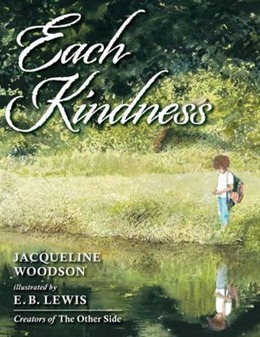
Lewis’ art is realistic and quite simply amazing.  He shows us through his images Maya’s side of the story, starting with her refusal to look at the class when introduced, her hopeful smile before Chloe turns away, and her isolation as the seasons change.  After Maya leaves, Chloe is shown as the isolated one, alone on a blank white page, solitary in nature. 

The power of this book is in the ending, where it does not wrap up happily with Maya returning and being embraced by the Chloe and her friends. Instead, it ends realistically with deep regrets and hope that Chloe will respond differently next time. This is a book sure to trigger discussions when shared with a class. I can see talking about bullying, kindness and differences.

Highly recommended, this is a powerful book that is worth sharing and discussing.  Appropriate for ages 6-8.

Reviewed from copy received from Penguin.

Review: Ready for Pumpkins by Kate Duke

ready for pumpkins

Ready for Pumpkins by Kate Duke

Hercules, or Herky for short, learned a lot being the classroom guinea pig in Miss MacGuffey’s first grade.  He learned to paint, he learned about Halloween, but best of all, he learned that he could plant a garden from seeds.  And Herky had seeds from the Halloween pumpkin that he had saved in his cage.  So when he was taken for the summer out to the country, he knew he just had to plant his own garden.  He met Daisy, a rabbit, who helped him find a sunny place to plant the seeds.  Herky dug up the dirt, planted the seeds, and watered them.  But then he had to be patient as they grew, and that was the hardest part!  The plants grew, flowers appeared, and finally pumpkins.  But Herky had to return to school before they turned orange!  Will he ever know how his pumpkins turned out?

This is a charming mix of classroom pet story and gardening.  Duke makes Herky quite a character.  He’s impatient to the point of digging up the seeds to see what is happening, angry when the birds and beetles attack his garden, and yet he is also hard working enough to make a garden in the first place.  The writing is simple and reads aloud easily, making this a good book to share with a fall class.

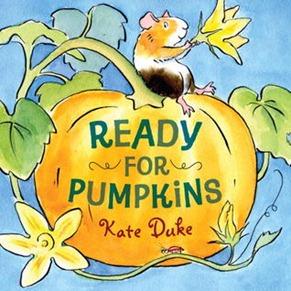
Duke’s art is full of simple lines and bright colors.  As the garden grows, she shows the wild beauty of the pumpkin vines, their many flowers and the slow process of pumpkins growing to maturity.  Daisy and Herky are engagingly drawn little creatures whose growing friendship mirrors that of the garden.

A great pick for pumpkin season or as an addition to spring growing books too.  Appropriate for ages 3-5.

Reviewed from copy received from Random House.

Review: A Gold Star for Zog by Julia Donaldson

gold star for zog

A Gold Star for Zog by Julia Donaldson, illustrated by Axel Scheffler

Zog is a young dragon who desperately wants to win a gold star in his dragon classes.  Unfortunately, he isn’t having much luck.  Flying classes ended with him crashing into a tree, though he was patched up with a band-aid from a young girl.  In Year Two, Zog learned how to roar.  The same girl, a little older now, offered him a peppermint for his scratchy throat after he tried too hard.  The next year, Zog learned how to breathe fire but set his own wing on fire.  Again, the girl was there to bandage his wing.  The final test was to capture a princess.  Zog tried and tried, but could not manage it.  The girl showed up and revealed herself as a princess and offered to be captured by Zog.  Zog got a gold star from his teacher, and the princess revealed herself to want to be a doctor instead.  To find out how it all works out, you will have to quest into the story for yourself.

Told in a rhyme that is great fun to read aloud, this book is fanciful and humorous.  Donaldson has nicely melded dragons and princesses with a classroom setting, achievement and aspiring to be something else.  The princess character is nicely integrated throughout the story, though at first readers are not sure she is anything other than a girl with a medical kit.  That reveal is done nicely and then her further dreams to be something else add a freshness to the tale.

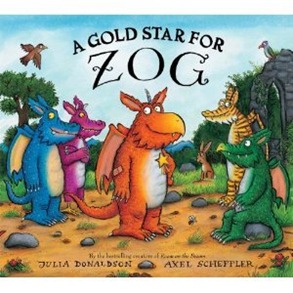
Scheffler has created zingy art filled with bright colors, action and plenty of prat falls.  The class of dragons in a rainbow of colors alone is enough to brighten any book.  Scheffler’s style keeps the dragons friendly and cartoon-like, making the book particularly fun to read. 

A great pick for reading aloud to elementary and preschool classes, this book’s dragons and humor will have it soaring high.  Appropriate for ages 4-6.

Reviewed from library copy.

Review: Lulu and the Duck in the Park by Hilary McKay

Lulu and the Duck

Lulu and the Duck in the Park by Hilary McKay

Lulu loves animals, so she can’t understand it when people don’t love every animal, like her teacher Mrs. Holiday.  In fact, Mrs. Holiday has asked Lulu to never bring an animal to school again after an incident with her dog.  When their class is heading back through the park after swimming, something awful happens.  Two dogs run rampage through the ducks’ nests in the park, scaring the ducks, ruining their nests and smashing eggs.  So when Lulu sees the duck egg rolling down the hill, she just does what comes naturally and puts it into her pocket.  Once back at school though, it is hard to figure out how to hide an egg without smashing it.  It becomes even harder when the duckling decides to hatch!

McKay is one of my favorite British authors, capturing the unique qualities of her characters with a distinct merriment.  In this short novel perfect for beginning readers, she changes the perspective up sometimes by offering Mrs. Holiday’s point of view too.  It is done with a lot of humor and children will easily make the transition between Lulu and her teacher. 

The writing is simple but great fun to read.  There are plenty of jokes and moments of seriousness too that both help keep the book moving forward.  It is a trick to offer depth of story in such a brief book, but McKay manages it.

I look forward to the next Lulu book and the trouble that she gets into there.  Appropriate for ages 7-9.

Reviewed from library copy.

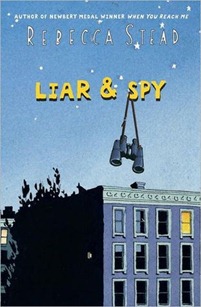
Review: Liar & Spy by Rebecca Stead

liar and spy

Liar & Spy by Rebecca Stead

In the first book following her award-winning When You Reach Me, Stead again writes a clever book that slowly reveals its truths to the reader.  It is the story of Georges, named after Georges Seurat, whose family is forced to sell their home after his father loses his job.  Because of this, his mother is away all the time, picking up double shifts at the hospital to make ends meet.  It is at the new apartment that Georges meets Safer.  They first meet at a meeting of the Spy Club after Georges’ dad responds to a note in the laundry room.  As the boys become better and better friends, their spy games escalate too.  Soon the question becomes what it takes to be friends with a liar, and who that liar is.

Stead writes such layered books that they become almost more about exploring the layers than about the underlying story.  Here the story is Georges and his friendship, but it is also about denial, coping and fear.  Stead uses the pointillism of Seurat as a symbol that runs through the book.  Does one focus on one specific thing or on the larger picture or both at the same time.  Stead’s writing is careful and beautifully crafted.  Everything serves a purpose in the story, making it a delight to read.

Georges is a fascinating character.  Towards the beginning of the book, readers will understand that something else is happening with his mother other than double shifts.  Georges, though, is unwilling or unable to face whatever it is.  This gives the book a layer of doubt and even sadness that makes for an uncommon read.  This is magnified by his father’s absence as well and by the bullying he receives at school. 

A virtuoso novel for middle graders, this book is elegantly crafted, exceptionally written, and unforgettable.  Appropriate for ages 10-12.

Reviewed from digital galley received from NetGalley.

Review: The Art of Miss Chew by Patricia Polacco

art of miss chew

The Art of Miss Chew by Patricia Polacco

Polacco continues to explore her childhood in picture book form in this tribute to a teacher.  In school, young Patricia struggled with her grades, specifically when taking tests.  Luckily, she had a teacher, Mr. Donovan, who was willing to give her extra time to finish.  That little change allowed Patricia to get better grades.  Mr. Donovan was also the first teacher to recognize her artistic talent.  He connected her with an art program run by Miss Chew.  Miss Chew talked about learning to see, working with line and pressure, and taking their sketchbooks with them everywhere.  Patricia soaked all of this up like a sponge.  But then Mr. Donovan’s father died, and the substitute teacher would not give her more time to finish her tests.  She even threatened to pull Patricia out of her special art class.  Happily, Miss Chew was there to come to the rescue!

Polacco has continued to write about her challenges with school and about how a single amazing teacher changed her life again and again.  Her books are a testament to the power of teachers to make a difference in a child’s world, but in turn they are also a look at the emergence of a gifted artist who works hard and makes her own special place too.  In my eyes, it is the combination of Polacco and her teachers that is magical.

The art is done in Polacco’s signature style that is artistic, evocative and realistic too.  As she speaks about art, she demonstrates it in her art in the book.  Readers will notice how she captures shadow and light and plays with perspective too.  It is a very engaging way to create a quick art lesson in the middle of a story.

Art teachers will love this as a gift, but they will also enjoy sharing it in their classrooms.  Bravo for Miss Chew and all of the other great teachers out there who do this work every day.  Appropriate for ages 5-7.

Reviewed from copy received from G. P. Putnam’s Sons.