Review: The Promise by Nicola Davies

promise

The Promise by Nicola Davies, illustrated by Laura Carlin

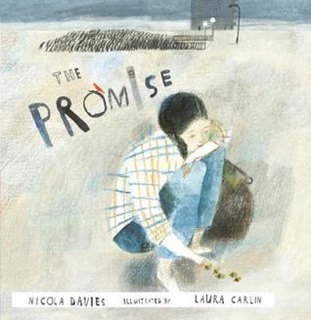
In a gritty city filled with dust and yellow wind, a girl survives by stealing from other poor people.  Her life was just as dust filled and ugly as the city around her.  Then one night, she saw an old frail woman with a fat bag walking along.  She would be an easy mark, so the girl tried to get the bag away from her.  The old woman held on tightly, but eventually asked the girl to promise to plant them and she could have the bag.  The girl promised.  In the bag were only acorns, nothing to eat, no money to spend, but a wealth of trees.  So the girl started planting them one by one, and nothing changed for a long time.  Then green sprouts started to appear, then trees grew and green returned to the broken city.  But the girl had already left, going to other cities that needed a forest too.  Until one night she had her fat bag of acorns with her, and a young person tried to steal it from her.  All it took was another promise and she let them have the bag.

This allegory is lovely.  The setting is hauntingly familiar, a war zone where all that is left behind is the dust and rubble of war and people who cannot escape the city or see a future beyond it.  The transformation of the theft of property into a promise is stunning.  Simple and profound, it is courage, passion and change all wrapped into a single act.  I also love the moments before the trees appear, the anticipation, the question of whether it will work, the effort before the payoff.  And then the fact that the girl leaves to go to other cities, makes this entire story less about her than about her deeds.  It’s one intelligently written book that works so well.

Carlin’s illustrations are done in muted grays and sands, they are images that suck the color out of the day, cover you in their dust.  And yet, they are also filled with hope.  When that first green hits the page, it’s like you can smell it in the air.  Then the transformation that is so colorful, so fresh. 

This radiant allegory would be appropriate for classrooms learning about allegories or about peace.  Appropriate for ages 7-9.

Reviewed from library copy.
Review: Salt by Helen Frost

salt

Salt: A Story of Friendship in a Time of War by Helen Frost

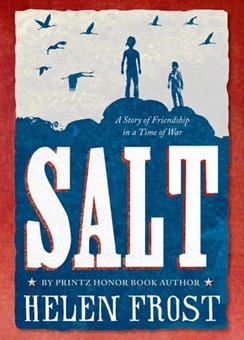
In 1812 in Indian Territory, two boys forge a friendship over hunting, fishing and survival of their families.  James’ family runs the trading post at Fort Wayne, living right outside the walls of the fort.  Anikwa’s family, members of the Miami tribe, has lived on this land for generations.  Now two armies are heading right to Fort Wayne to battle, the Americans and British will meet for a critical battle.  The question becomes whose side the Miami will be on when the battle occurs.  But even more deep is the question of whether the friendship between the two boys and their two families can survive this battle and the losses that it brings.

Frost has mastered the verse novel, creating a work that functions as beautiful poetry with profound depths and also as a complete novel.  Frost puts a human face on history in this novel that tells the story of a major battle in the war of 1812.  By the time the soldiers arrive, readers care deeply for both boys and their families.  So when the destruction starts, the wounds are real and the losses far beyond numbers.  The poems show readers the beauty of the landscape, the bounty of the land, and all that is possibly lost afterwards.

Frost writes from both boys’ points of view in alternating poems.  So the lifestyle and losses of both families is shown from their own points of view.  Anikwa’s poems are done in a poetic form that creates a pattern on the page.  Frost explains in her notes at the end that this is to mimic Miami ribbon work.  Without knowing this while reading, I could still see the square form of James’ poem representing the fort and the home he lived in next to the motion-filled form of Anikwa’s poems that exuded nature. 

An exquisite verse novel that fills history with real people and war with real loss.  Appropriate for ages 11-13.

Reviewed from library copy.

Review: Year of the Jungle by Suzanne Collins

year of the jungle

Year of the Jungle by Suzanne Collins, illustrated by James Proimos

Collins, author of The Hunger Games series, takes on a completely different writing challenge in this autobiographical picture book.  Suzy’s father is sent to fight in Vietnam when she is a little girl.  He will be gone for a year, but Suzy isn’t sure exactly how long a year is.  At first, her father sends lots of friendly postcards, but over time they change.  He even mixes up her birthday with her sister’s something he would never have done if he was home.  The the postcards stop altogether and Suzy catches a glimpse of the war on TV.  She starts to forget what her father looks like and is scared of many things.  Then suddenly, her father is home.  But he doesn’t look the same and doesn’t act quite the same either.

This book is so timely for children dealing with deployments in their own family.  Collins writes directly from her childhood persona, delving right into the fears that haunt children, the loss of control and the lack of contact.  It is her writing that makes this book work, her honesty about her emotions and the frankness with which she grapples with the challenges of having a parent fighting overseas.

Proimos’ illustrations are cartoony and rough.  The most successful are double-spreads that take on Suzy’s fears directly, placing them on a black landscape that is filled with tanks, animals, helicopters, and more.  They emanate danger and contrast directly with the more colorful other pages.

Though the book is about Vietnam, it has a universal message for children left behind worried about a deployed parent.  Timely and honest, this is a book that belongs in every public library.  Appropriate for ages 6-9.

Reviewed from copy received from Scholastic Press.