Review: Little Red Riding Hood by Sybille Schenker

little red riding hood

Little Red Riding Hood by The Brothers Grimm, illustrated by Sybille Schenker, translated by Anthea Bell

This follow-up to the illustrator’s gorgeous rendition of Hansel and Gretel continues to show her amazing skills with cut paper illustrations.  The cover the book is pure black with cut outs that reveal a red and white pattern behind.  It’s rather like opening a door into another world.  The story is the traditional one, told in a simple way that highlights the more dramatic moments.  Be prepared for the traditional ending with the wolf killed, his body cut open and then refilled with stones so that he dies.  This is not a modernized and gentle version at all.  Yet that works particularly well with these incredible illustrations and the wonder they evoke. 

Schenker plays with her cut paper throughout.  There are times when the page is entirely cut through, into patterns.  Other times the illustrations are cut paper but the page is whole.  You will find yourself running your hands over the page to see if the cuts are actual or simply visual.  She shows such skill throughout creating moments that change as you turn the page and they become even more dazzling as you look back through the cuts.  My favorite page turn is when the wolf eats Little Red Riding Hood, it’s an astonishing change that works oh so well.

Wundergarden has some illustrations online from Schenker.  Here are ones from this book:

If you are looking for a version of Little Red Riding Hood to treasure, this is it.  It may not last for long on public library shelves, but it is a book that will be loved by those who discover it.  Appropriate for ages 4-6.

Reviewed from library copy.
Review: Ninja Red Riding Hood by Corey Rosen Schwartz

ninja red riding hood

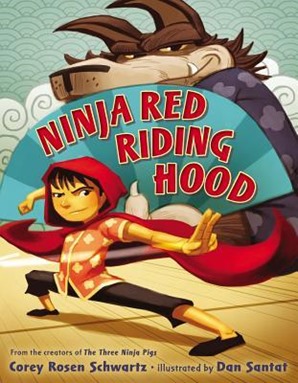
Ninja Red Riding Hood by Corey Rosen Schwartz, illustrated by Dan Santat

This companion to The Three Ninja Pigs mixes ninja training, wolves and girls in red capes into one great homage to the traditional tale.  Wolf can’t catch any animals to eat.  They all defeat him with their ninja skills, so he decides to get training himself.  After practicing for hours, he heads into the woods where he sees Riding Hood carrying a treat to her grandmother.  He suggests that Riding Hood pick some flowers for her grandmother, and dashes off to the grandmother’s house himself.  She isn’t home, so he puts on her clothes.  After Riding Hood slowly realizes that this is not her grandmother in a wonderful mix of traditional and martial arts storytelling, it is revealed that Riding Hood has also had ninja training.  But when the two are evenly matched, it will take one butt-kicking grandmother to save the day.

Schwartz mixes the traditional tale with ninja skills and martial arts to form a tremendously fun book that happily does not leave the original story too far behind.  The moments of the story where the original story is followed closely are quickly turned into a more Japanese and ninja storyline.  Cleverly mixed, one never quite knows what is going to happen from page to page, making it all the more delightful to read and even better to share with a group.

Santat’s art has his signature modern style.  He has a natural feel for comedic timing and that is used extensively in this book.  He mixes in Japanese touches throughout, from the dojo to grandmother’s traditional Japanese home.  Bright, bold and filled with action, this book begs to be shared.

Another successful twisted tale, let’s hope there are more ninja folk tales coming!  Appropriate for ages 4-6.

Reviewed from library copy.

Review: Carnivores by Aaron Reynolds

carnivores

Carnivores by Aaron Reynolds, illustrated by Dan Santat

It’s hard to be a carnivore when all of the prey whispers behind your back, nobody understands the way you eat, and you are accused of sneaking around.  So a lion, a great white shark and a wolf get together to form a support group.  Their first plan is to become vegetarians, but that doesn’t go well at all.  In fact, the wolf can’t seem to find a berry bush that doesn’t have a bunny in it.  The next plan is using disguises to blend in, but one smell of the lion’s zebra breath turns the antelope against him.  Finally, the lion asked the great horned owl to speak with them.  The owl talked about accepting themselves as carnivores.  The others realize that he is right and follow his advice perfectly.

Reynolds has written a book that is screamingly funny.  Each page has laughter on it with the perfect timing of his jokes.  It begs to be shared aloud with punch lines that just have to be delivered.  Happily, the humor is edgy and truly funny, not just for small children.  With clever twists throughout the story and situations that make for very funny results, children will be delighted with this look at self-acceptance and meat eating.

Santat’s illustrations are perfection here.  Bright colored and bold, just like the humor, they add just the right touch to the book.  He manages to capture the comedy perfectly, but not allow his art to blow the punch lines prematurely.  The large format will work well with a group, but there are also details that will have to be shared too.

Clever, funny and wonderfully inappropriate, this book asks us all to accept our inner or outer carnivores.  Appropriate for ages 4-6, this would also work well as a read-aloud for older elementary kids who will love the humor and the naughtiness of the jokes.

Reviewed from copy received from Chronicle Books.

Family Pack: Poetic Nature

familypack

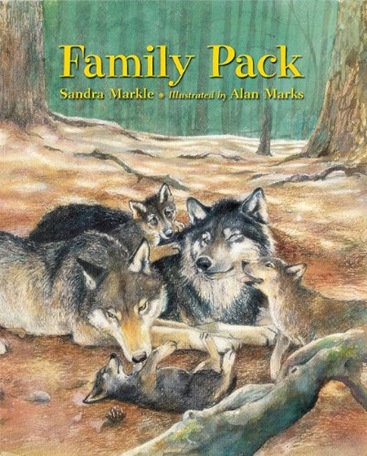
Family Pack by Sandra Markle, illustrated by Alan Marks

This book captures the real-life story of wolves being reintroduced to Yellowstone National Park.  The focus of the story is one young female wolf who finds herself suddenly separated from her pack and alone in a new place.  Her tracks are the only wolf tracks she sees, she is the only wolf she smells.  Without a pack, she cannot hunt the way she is used to, so she survives mostly on mice.  As she becomes an adult, she discovers another wolf, a male.  The two of them become a mated pair and eventually have a family in Yellowstone.  One lone wolf has created her own pack.

Markle’s verse in the book really shines, illuminating the loneliness of this young wolf’s new life, her troubles with hunting larger game, and her growth into an adult wolf.  The poetry is filled with imagery that enlivens the book, making the cold and loneliness tangible to readers. 

Marks’ illustrations are equally successful.  He captures the setting beautifully from the towering trees to the wide open spaces.  In his illustrations, Yellowstone becomes just as real as the wolf herself, almost another character in the story.  The vistas and close-ups he has created here give readers a very unique perspective on the life of this wolf.

Highly recommended, this book will work well for slightly older children because of the depth of the verse.  It will work well in units about preservation and ecology.  Appropriate for ages 6-8.

Reviewed from copy received from Charlesbridge.

Big Wolf & Little Wolf: The Little Leaf that Wouldn’t Fall

Big Wolf & Little Wolf: The Little Leaf that Wouldn’t Fall by Nadine Brun-Cosme, illustrated by Olivier Tallec

Released December 2009.

This sequel to the lovely Big Wolf & Little Wolf continues the story of their friendship.  Little Wolf spots a special leaf in the spring and wants Big Wolf to climb up their tree and bring it down.  Big Wolf tells him to wait, that it will fall.  Little Wolf asks again in the summer and autumn, as the leaf turns into a deep green and then a soft brown.  When winter arrives, the leaf is still up in the tree, now a black color.  Then one day, Big Wolf decides to climb the tree and bring down the leaf for Little Wolf.  After a harrowing climb, Big Wolf reaches the leaf and it crumbles to pieces.  Beautiful pieces.

Brun-Cosme’s prose is lovely, spare and yet manages to be dynamic too.  She evokes the seasons, colors and wonder of each time of year without becoming maudlin at all.  There is the drama of Big Wolf’s climb and the unexpected resolution of the story that is surprising but fitting.  The first book was about the awkwardness of new friendship.  This second book is about a deepening connection and the beauty of togetherness. 

Tallec’s illustrations are less colorful this time, sticking to a more natural palette of colors.  But they still have an expansive feel, a clear sense of space, and they play with perspective.  They are simple but dynamic, just like the text.  A lovely combination.

Highly recommended, this series has its own unique feel and style.  These are quiet books, filled with natural beauty and deep connections.  Appropriate for ages 4-7.

Full disclosure:  My review of the first book is blurbed on the jacket of this second.  A great surprise to discover!

Reviewed from copy received from publisher.

Big Wolf & Little Wolf

Big Wolf & Little Wolf by Nadine Brun-Cosme, illustrated by Olivier Tallec

Big Wolf lived all alone at the top of a hill under a tree.  But then one day, Little Wolf came and stayed under Big Wolf’s tree.  The two wolves didn’t talk, but they watched each other.  When night fell, Big Wolf shared a small corner of his leaf blanket with him.  In the morning, Little Wolf climbed the tree following Big Wolf and did exercises together.  Big Wolf shared his meal with Little Wolf but still never talked with him.  Big Wolf headed out for his walk, looking back and seeing Little Wolf get smaller and smaller in the distance.  When he returned to the tree though, Little Wolf was gone.  Big Wolf was shocked, astounded to find that he missed Little Wolf deeply.  So what is a lone wolf to do when he finds himself to be more of a LONELY wolf?

Brun-Cosme has created a picture book with a unique feel. Her wording is simple and almost bare.  It is through that very minimalist writing that the emotions are really clear and powerful.  It is also a format that works well for a lone wolf and his simple life.  Tallec’s art is different here than in some of his other work (like Rita and Whatsit).  He uses paint to create a world of open fields and wide skies, but plays with color to make it a world in a vivid palette of pinks, yellows, blues, and greens.  This depth of color and strong lines make the illustrations a foil for the simple words. 

This book speaks to the lonely of us, the confused, the awkward.  It is a picture book that every child will understand whether they have been Little or Big.  Appropriate for ages 4-6.