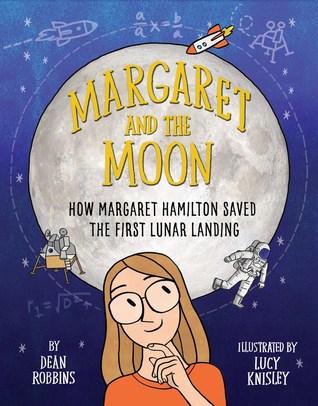
Margaret and the Moon by Dean Robbins

Margaret and the Moon by Dean Robbins.jpg

Margaret and the Moon: How Margaret Hamilton Saved the First Lunar Landing by Dean Robbins, illustrated by Lucy Knisley (9780399551857, Amazon)

This nonfiction picture book tells the story of Margaret Hamilton and her work on computers. When Margaret was a girl in the 1930s and 1940s, she wondered why girls weren’t studying science and math, so she did. She went to MIT and started working on computers back when they required handwriting code and the computers filled entire rooms. She eventually went to NASA where she programmed computers to help astronauts travel to the moon and connect to one another in space. When Apollo 11 came and astronauts were going to land on the moon, Margaret wrote the programs to get them there and back safely. In fact, when disaster struck it was Margaret’s programming that kept everyone safe and accomplished the goal.

Robbins writes with a celebratory tone in this biographical picture book. His appreciation for Margaret’s ability to ask tough questions and figure out answers is clear. Throughout, he keeps the tone playful and light, showing the hard work behind the accomplishments, and her inquisitive nature as the keys to her success.

It is great to see graphic novelist Knisley illustrating children’s books. Her illustrations match the tone of Robbins’ writing, keeping the entire book light and celebratory. The amount of work done by Margaret is staggering and is shown by Margaret next to a pile of papers that showed the length of her code. That same image is repeated as a photograph at the end of the book.

A wonderful example of women in STEM, this picture book speaks to the power of brains and determination. Appropriate for ages 6-9.

Reviewed from e-galley received from Edelweiss and Knopf Books for Young Readers.

Lighter Than Air by Matthew Clark Smith

Lighter Than Air by Matthew Clark Smith

Lighter Than Air: Sophie Blanchard, the First Woman Pilot by Matthew Clark Smith, illustrated by Matt Tavares (9780763677329, Amazon)

This picture book biography tells the story of Sophie Blanchard, the first woman to fly on her own. In the 18th century, France was filled with “balloonmania.” Every balloonist was male and they were breaking records. Meanwhile, a girl was growing up by the seaside and dreaming of flight. When she met the famous balloonist Jean-Pierre Blanchard, the two realized they had a shared passion for flight. They were soon married and started flying together. After two shared flights, Sophie went up alone and became the first woman to fly a balloon solo. Her husband died from a heart attack and fall from a balloon and Sophie stopped flying for awhile. Eventually, she flew again and earned a living with her flight. Napoleon made her Aeronaut of the Official Festivals and Chief Air Minister of Ballooning.

Smith offers exactly the right amount of detail in this picture book. The dangers of ballooning are mentioned but not dwelled upon, just like the death of Jean-Pierre. Sophie’s own death in a balloon is only mentioned in the Author’s Note which also speaks to how little is actually known about her despite her accomplishments. Her childhood, in particular, is unknown and Smith created some of the details himself. Throughout the book, it is the wonder of human flight that is the focus and that unites Sophie’s adult life with her childhood dreams.

Tavares has illustrated this picture book with period details that capture the balloons and the fragility of the baskets. In other illustrations, he captures the sky and the expanse that Sophie is flying into. Two illustrations mirror one another with darker skies as Sophie dreams as a girl of flying and when she returns to flight after her husband’s death.

An important picture book about a brave and groundbreaking woman who refused to be limited by the rest of the world. Appropriate for ages 6-8.

Reviewed from library copy.

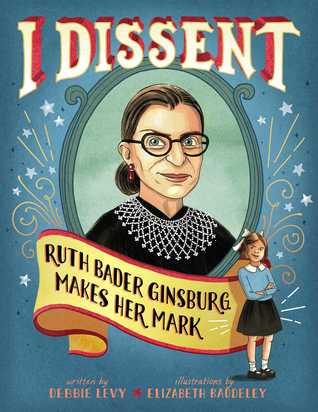
I Dissent by Debbie Levy

i-dissent-by-debbie-levy

I Dissent: Ruth Bader Ginsburg Makes Her Mark by Debbie Levy, illustrated by Elizabeth Baddeley (InfoSoup)

The life of Supreme Court Justice Ruth Bader Ginsburg is told in this first picture book about her. Ruth grew up in Brooklyn in the 1940s where her mother took her to the library so she could learn. She was taught that girls could do anything they wanted. As a Jewish girl, Ruth knew racism with signs posted that Jews would not be served at specific establishments. Ruth learned that there were limits to what she was sometimes allowed to do, and sometimes she won when she protested and sometimes things stayed the same. She went to college in the 1950s when most women did not attend. She was one of nine women in her law school class of over 500. She went on to become a law professor even though she had a baby daughter at home. She was appointed to the Supreme Court in 1993 and has continued to be a voice for change and equality. She has made a difference in the country by being willing to disagree.

Levy cleverly uses the framework of one disagreement or dissent after another to frame Ginsburg’s life. From her mother originally disagreeing with how girls were meant to be raised to the way that Ginsburg and her husband’s roles in their marriage to the work she has done in courtrooms and the justice system. There is a clarity to the writing that keeps it very readable and Ginsburg is a great figure for children to know better.

Baddeley’s illustrations capture the expectations of the 1940s and 1950s in images and move into 1970s showing that Ginsburg continued to break the rules. There is a merriment to the illustrations that captures Ginsburg spirit and her intelligence as well.

A robust look at an amazing woman’s life, this is one for every library. Appropriate for ages 7-9.

Reviewed from copy received from Simon & Schuster Books for Young Readers.


Finding Wonders by Jeannine Atkins

finding-wonders-by-jeannine-atkins

Finding Wonders: Three Girls Who Changed Science by Jeannine Atkins (InfoSoup)

This compelling verse novel tells the story of three girls who grew up to be women who made their own personal mark on science. There is Maria Merian, a girl born in 1647 who loved nature. Through careful observation, she discovered the metamorphosis of butterflies. Her artistic talents also helped document the life cycles of insects. Born in 1799, Mary Anning helped her father collect stone curiosities in England. When she saw a huge creature in the rocks, she discovered the first of the many fossils and dinosaurs she would uncover during her life. Born in 1818, Maria Mitchell grew up helping her mapmaker father in Nantucket. Exploring the night sky together, she spent years looking through her father’s telescope before discovering a new comet. All of these women battled societal expectations and familial pressures to become the scientists they were.

Atkins uses verse to directly tell the stories of these girls, the way they were raised and how they grew to become scientists. Readers unfamiliar with them will be amazed that they were able to reach such prominence in the time periods they lived and that their fathers were the ones who allowed them the freedom to learn and explore. These women demonstrate that through tenacity and determination one can become exactly who they were meant to be, despite almost everyone disapproving. The tales are inspiring and insightful.

Atkins has chosen three women whose stories work particularly well together. There are commonalities between them even though they span more than a century and involve different types of scientific endeavors.  The strong focus on faith in all of the stories shows the way that scientists even today must reconcile their religious beliefs with scientific truths. Faith is handled with a frank sincerity here, an important part of family and life, but also something that can be personal to an individual.

Beautifully written, these brief glimpses of amazing women in science will introduce new sources of inspiration to young readers. Appropriate for ages 9-12.

Reviewed from copy received from Atheneum Books for Young Readers.

Miss Mary Reporting by Sue Macy

Miss Mary Reporting by Sue Macy

Miss Mary Reporting: The True Story of Sportswriter Mary Garber by Sue Macy, illustrated by C. F. Payne (InfoSoup)

Mary Garber was one of the first female sports journalists in the United States. At a time when women were not newspaper reporters, Mary was a sports reporter. Her big break came during World War II when the men were sent to war. After the war, Mary was moved to a news desk but then a year later permanent came back to sports. She was there to witness Jackie Robinson join the Brooklyn Dodgers. Mary herself was barred from the press box and forced to sit with the coaches’ wives rather than the other reporters until her editor complained. Locker rooms were also a challenge. Mary continued writing about sports for more than 50 years, retiring in 2002. Along the way she garnered awards and honors and a reputation for being fair and unbiased.

Macy captures the story of this groundbreaking woman beautifully. The tone is playful and humble with Garber’s quotes often given credit and thanks to others rather than taking praise for herself. At the same time, one understands the courage it took for Mary to continue doing this job in such a male-dominated field. This story is inspirational in the best possible way.

Payne’s illustrations add to the playful feel of the title and the humor. Mary is shown as very petite, dwarfed by those around her. Yet she is clearly the center of attention on the page, her face lit from within by her big eyes and large glasses. Her short hair and can-do attitude mark her uniquely on the page as well.

A great picture book biography to share with children who enjoy sports or writing. Appropriate for ages 7-9.

Reviewed from copy received from Simon & Schuster.


The Passion of Dolssa by Julie Berry

The Passion of Dolssa by Julie Berry

The Passion of Dolssa by Julie Berry (InfoSoup)

The author of All the Truth That’s in Me returns with another historical novel that once again speaks to the role of women in history. Here we follow the story of two very different young women in medieval France. There is Dolssa, born to wealth who speaks directly with Jesus and who gains the attention of the Church who brands her as a heretic and sentences her to death. There is Botille, who is a matchmaker and who owns a tavern along with her two sisters in a small seaside town. When their two stories collide, Botille discovers a person who both brings miracles and doom along with her.

Berry has created a novel that shows how power worked in the Middle Ages with two young women who are both products of their society and also find themselves outside of it some of the time. The two young women are as different as can be, both in their backgrounds and in their beliefs, but still between them there is a sisterhood that cannot be denied and a love that is transcendent.

Each of the women is fully formed on the page, shown in all of their questioning, their doubts and their beliefs. While Dolssa is certainly a different creature than Botille, it is the two of them together that is so brilliant it can be painful to read, particularly because there is no doubt that they are risking everything to support one another. Berry makes sure that readers understand the way that the Crusades and then the Inquisition worked, the holy people left to starve due to their heresy and the flames and torture that accompanied their work in France. It is a world of cruelty, particularly for two young women who have the audacity to think for themselves.

Brilliantly crafted, well researched and filled with the darkness of impending doom yet lit brightly with faith and miracles, this is a wrenching historical read. Appropriate for ages 14-18.

Reviewed from ARC received from Viking.


Elizabeth Started All the Trouble by Doreen Rappaport

Elizabeth Started All the Trouble by Doreen Rappaport

Elizabeth Started All the Trouble by Doreen Rappaport, illustrated by Matt Faulkner (InfoSoup)

This nonfiction picture book looks at all of the women critical to the suffrage movement in the United States. From Abigail Adam’s plea in 1776 for her husband to “remember the ladies” to Sojourner Truth’s attendance at a meeting to remind the white women of the  movement that African-American women deserved the vote too, this book looks at the many voices of the movement with a particular focus on Elizabeth Cady Stanton who started the called on women in the mid-1800’s to fight for the right to vote. It is a dynamic book that will remind young readers that the right of women to vote in our country only happened in 1920.

Rappaport captures the tremendous tenacity that it took for women to fight actively for the right to vote for nearly 75 years. Moving in a vibrant way from one historical figure to another, Rappaport highlights not just those who were suffragists but also women who broke female stereotypes by becoming doctors and starting schools where women learned the same subjects men did. This global look at the movement demonstrates the number of ways it took to get changes made that would allow women to voice their own opinions through elections.

The illustrations have a humorous quality to them with near-caricatures of each of the women. There is a feel of a political cartoon to them which is particularly appealing given the subject matter. Their bright colors also help show the passion of the women and their drive to make change.

A great addition to public libraries, this book offers a neat package showing the full history for women’s right to vote. Appropriate for ages 7-10.

Reviewed from library copy.

Review: Audacity by Melanie Crowder

audacity

Audacity by Melanie Crowder

Told in masterful verse, this is the story of real-life heroine Clara Lemlich who led the largest strike by women in the history of the United States.  Born in Russia, Clara was forbidden any education because her devout Jewish father did not approve.  When her family emigrated to the United States at the turn of the twentieth century, Clara was required to go to work to support her family while her father and brothers dedicated their lives to prayer.  Clara got work in the garment industry, discovering horrific working conditions and refusing to just accept them.  Clara worked to get women workers taken seriously by the male-driven unions and for their plight to be incorporated into union strikes and negotiations.  Along the way, she also used the public library and free classes to teach herself English.  Anyone wondering if one person can truly make a difference in a larger world has only to read this book to be inspired to action.

Crowder’s poetry here is completely amazing.  From one page to the next, she captures the incredible spirit of this young woman and her desire to educate herself.  When she finds something to fight for, she is unstoppable, fearless and unbeatable.  Crowder also ties Clara to nature, even in among the tenement buildings of New York City.  She is a small hawk, a flower in the concrete, she herself is the force of nature in the city.

Just the descriptions of the horrific beatings that Clara withstood on the streets and the picket lines would make most people quit.  But Crowder makes sure to depict Clara as a person first and a hero second.  It makes what she did so much more amazing but also encourages everyone to realize that they too have this within them if they are willing to take on the fight.  This woman was a heroine in such a profound way, unsupported by her family and willing to use all of her free time to make a difference, she is exactly what the modern world needs to have us make change now.

Strong, beautiful and wonderfully defiant, this book is an incredible testament to the power of one woman to change the world.  Appropriate for ages 13-17.

Reviewed from ARC received from Philomel.

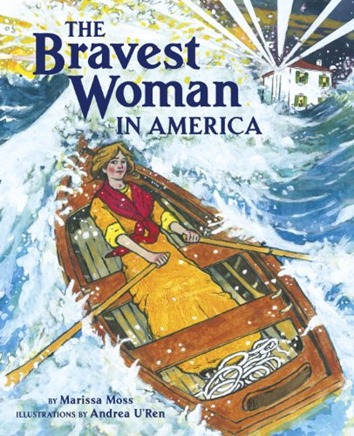
Book Review: The Bravest Woman in America by Marissa Moss

bravest woman in america

The Bravest Woman in America by Marissa Moss, illustrated by Andrea U’Ren

Ida Lewis loved the sea, from the crash of the waves to the bite of the ocean air.  When her father got a job as a lighthouse keeper, she was thrilled.  He had to cross back and forth twice a day to check the light, and he took Ida with him, teaching her how to row.  He also taught her to care for the lamp and how to rescue people without capsizing herself.  When Ida turned 15, her family moved out to live next to the lighthouse.  Ida dreamed of becoming the keeper herself one day.  That day came early when her father got ill and could no longer care for the lighthouse.  So Ida helped more and more.  Though she had never rescued anyone, she rowed out to save some boys in a sailboat that capsized.  It took all of her determination and strength to save them, but she did.

This book works on so many levels.  It is a true story about a real hero who defied what society expected of her and became what she dreamed of.  Additionally, it is the story of a girl who was strong, brave and amazing.  A girl who relied on her own strength and wits to save others rather than to be rescued herself.  Beautiful. 

Moss writes the story with drama and action, yet is never heavy handed.  She builds up to the accident nicely, showing it happen and then building to the climax of the rescue.  This is an rescue story that will have readers cheering.

U’Ren’s art is done in watercolor, ink and acrylic.  The colors are deep and lovely, from the changing colors of the sky to the blues and greens of the water that change with the storm.  Ida Lewis is always shown as a young lady, never masculinized at all.  It adds to the charm and drama of the story.

Highly recommended, this is a great book choice for women’s history units or for any child to learn that girls are heroes too.  Appropriate for ages 5-8.

Reviewed from copy received from Tricycle Press.