Review: E-mergency! by Tom Lichtenheld

e-mergency

E-mergency! by Tom Lichtenheld

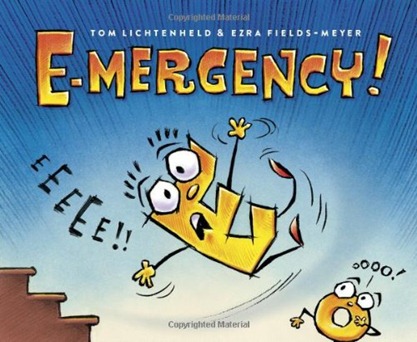
The entire alphabet lived together in one house.  Every morning they all ran down the stairs to breakfast, but one morning there was an accident.  E was running down the stairs too fast and took a tumble.  The ambulance arrived and took E off to the ER.  With E gone, A took charge and assigned E’s duties to O.  In order for E to heal, no one could use that letter.  The letters took to the airwaves to ask people not to use the letter E until E recovered.  They even went to DC to tell the government.  With O filling in for E, things got vory confusing.  But E wasn’t gotting any bottor.  Who could bo causing tho problom?

This book had me laughing aloud.  First was the puns with the different letters, the jokes told in the asides.  They are the real treasure of this book and will get young readers laughing too.  Then readers have to watch the letter characters too.  They tend to spell out appropriate words as the action in the book changes, adding another layer of humor to the book.  Add into that the humor of trying to read a book without the letter E, and you have this zany, silly wonderful book.

Lichtenheld’s illustrations are filled with humor and motion as well.  They are bright, busy and great fun to look closely at.  My favorite spread is the double-page illustration of a busy city street where E is not being used.  It results in lots of humor. 

This book reads aloud well, but I would not recommend it without reading it first, especially the many pages with O filling in for E.  It makes for a tongue-twister, but also one that young listeners will love to see you attempt. 

Hilarity, alphabet, and word play, what more could one ask for?  Appropriate for ages 4-7.

Reviewed from copy received from Chronicle Books.
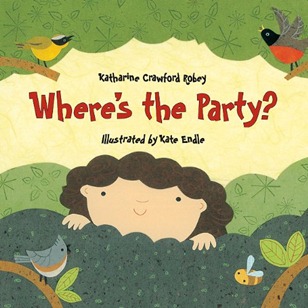
Review: Where’s the Party? by Katharine Crawford Robey

wheres the party

Where’s the Party? by Katharine Crawford Robey, illustrated by Kate Endle

When Kate wakes up, a robin is sitting on her windowsill and sings about “news!”  Then a cardinal whistles about a party.  Kate definitely wants to go!  So she heads outside and follows one bird to the next as they lead her along a path, to the wild strawberries, along the brook, and to the duck’s nest.  Finally, she arrives at the party, and it’s a very special one!  The birds in the story include a titmouse, meadowlark, yellowthroat, oriole, bluebird, heron, ducks, and killdeer.  

Robey’s text is just enough to keep the story moving.  The calls of the birds are translated into words that help Kate find the party.  Nicely, the birds are not humanized except for their calls being heard as words.  They are described with their markings and some of their habits.  The end pages include some more details on the species in the book.

Endle’s illustrations are done in collage and are filled with texture, pattern, and color.  The cut paper gives clean lines that work well with the natural setting and birds.  There is a simplicity thanks to the medium used that keeps this book very friendly to the youngest readers.

A great pick for young birdwatchers or for units about birds.  The illustrations are clear and crisp and will work well with a group, so this will also make a good choice for summer story times.  Appropriate for ages 3-5.

Reviewed from copy received from Charlesbridge.

Review: Saint Louis Armstrong Beach by Brenda Woods

saint-louis-armstrong-beach

Saint Louis Armstrong Beach by Brenda Woods

Saint loves playing the clarinet.  He plays it for tourists in New Orleans to earn money for a new clarinet and for his future at Julliard.  Life isn’t all easy though, he has taken to a stray dog that his father will not allow him to adopt and his best friend has outgrown him, now spending her time partying with the cooler, older kids.  As Hurricane Katrina approaches, Saint and his family are not that concerned since it is expected to miss New Orleans, as the days progress, the tension builds and the warnings increase.  Though Saint’s family tries to send him to safety, things don’t go as planned and Saint is trapped by the weather and the flood waters.

Woods has written a book that captures the power of music in a young man’s life nicely, bridging the days before the storm, the time during the storm, and the time afterwards together with song.  The bulk of this book is the period before the storm hits, showing the loving family that Saint comes from, his close-knit neighborhood, friends, crushes, and his love of a dog.  While I know that this had a large part in establishing reader relationships with Saint, it is lengthy and could have been made more focused.  In particular, his friendship with Money is talked about at length, but the book never returns to her after the storm. 

The period during the storm is dramatic, with Woods leaving the drama of the storm to stand on its own.  More time could have been spent here with the reader, truly exploring the emotions and complexity of survival.  The same is true of the time after the storm, where only a few chapters are left for the aftermath.  My hope is that there is a sequel that will let us better understand the effect of the storm on Saint and his family, neighbors and friends.

There were also portions of the book that were too neat and tidy.  One such instance was when Shadow, the dog, brings Saint’s parents to him after the storm.  It was just too convenient and should have been foreshadowed more clearly to work better.

In the end, I have mixed feelings about this book.  A sequel may very well fix a lot of the dangling story lines, which would go a long way.  Saint is a strong male character and this is a book that children will find shows a close-up perspective on the storm.  Appropriate for ages 9-12.

Reviewed from ARC received from Penguin.

Arctic Board Books

ArcticLand ArcticSea ArcticSky

Arctic Land

Arctic Sea

Arctic Sky

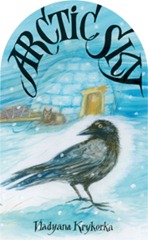
Author Vladyana Krykorka has created three board books that each look at a different aspect of wildlife in the Arctic.  The books are done in accordion style, so they spread out across laps or tables, creating even more of a vista of the Arctic landscape.  Arctic Land features caribou, wolves, musk ox, Arctic hare and polar bears.  Arctic Sea has whales, seals, narwhal, and walrus.  Arctic sky is filled with swan, crane, raven, ptarmigan, loons, and owls. 

There is a short verse that ties the animals together, but the real beauty here are the illustrations.  Done in watercolor, they have a movement that is captivating.  The long line of animals when the book is fully open is beautiful, filled with color and creatures.

While this book’s format may not survive long in public libraries, it will make a charming and education gift for a tiny naturalist.  Appropriate for ages 1-3.

Reviewed from copies received from Annick Press.

Review: A Ball for Daisy by Chris Raschka

ball for daisy

A Ball for Daisy by Chris Raschka

Daisy, the dog, adores her red ball.  She plays with it and even sleeps next to it on the couch.  When her owner takes her for a walk, Daisy brings along her ball.  At the park, she plays and chases after it.  When it gets stuck behind a fence, Daisy frets until it has been retrieved by her owner.  But when another dog tries to play with Daisy’s ball… it pops!  Daisy is broken-hearted, carrying the tattered remains of her ball.  And there is nothing that will make her feel any better.  Or is there?

This wordless book works because of the gorgeous illustrations.  Daisy is a black-and-white dog and her world is colorful and bright.  From the bright red of her ball to the striped couch in green, the book embraces color.  Raschka also uses color to convey emotion, which is particularly effective when the air itself is colored with purples and blues after Daisy’s ball is popped.  Before that, the background was done in pale blues and yellows, light and airy, even playful. 

The storyline is clear with the illustrations filling double page spreads or broken into panels.  Children will immediately relate to Daisy’s loss of a favorite toy and to her emotions throughout.  It is a book that naturally leads to discussion of when the child lost something, or something was broken, and the way that they felt about it.

A winning wordless read, this book is a joy to share with children or perhaps with your favorite furry friend.  Appropriate for ages 2-4.

Reviewed from library copy.

Also reviewed by:

The Artist Who Painted a Blue Horse Charity Auction


Inspired by Eric Carle’s The Artist Who Painted a Blue Horse, artists and celebrities across the country are creating and auctioning off art.  The paintings are from luminaries of the children’s book world and celebrities.  The NEA Foundation will receive all proceeds from the auctions and will use the funds to support arts education in schools. 

This is a worthy cause that could get you an original Ed Young, Tomie DePaola, David Ezra Stein, or Emily Arnold McCully for your home or office.  You know you want one!

Guardian–What Makes a Classic?

In the Guardian today, Lucy Mangan takes a look at what makes some children’s books classics. 

Ultimately, the books have to be read, and re-read, by children. Blyton, most of us discover, is a phase. A warm, joyful and, in its own way, valuable phase, but a phase nevertheless. But what unites both old, modern and future classics is their ability to deal with larger themes, involving eternal truths rather than just taking Timmy the dog out for a run.

Hurrah!

And don’t miss her list of her favorite children’s books, which include many of my own personal favorites.  What about yours?

Review: The Unforgotten Coat by Frank Cottrell Boyce

unforgotten coat

The Unforgotten Coat by Frank Cottrell Boyce

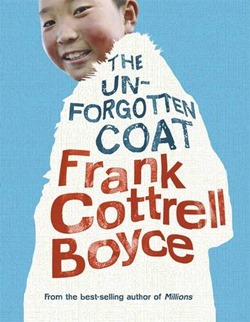
Frank Cottrell Boyce has done it again, creating a book that surprises, amazes, and twists.  This is the story of what happens when two Mongolian boys join a class in England.  They appear out of nowhere, suddenly there in school.  The two brothers refuse to be separated, so the younger boy, Nergui, stays in his older brother’s class.  The two wear large coats and fur hats.  They immediately capture the imagination of Julie, one of their classmates, who is thrilled to be selected as their “Good Guide.”  She wonders where they live, trying for days to follow them home, but they elude her.  Chingis, the older boy, has photographs of Mongolia that he shares with everyone.  The entire class learns more about Mongolia than they had ever known.  But everything is not as it seems, and Julie discovers the truth too late to be of any help in the end.

The book is short, under 100 pages, with most of it being told in a flashback by an adult Julie.  The design of the book adds much to the story, with lined pages that resemble a notebook and Polaroid photographs that capture Mongolia and England, perhaps a mix of both.  The photographs in particular are cleverly done, hiding the truth and then revealing with equal success.

This is a powerful story that seems easy.  It reads as a simple story about two unusual children joining a classroom, and then twists and turns.  It speaks to community and acceptance throughout, showing a class that is eager and willing to embrace the new children, much to my delight.  Then the story takes on a more serious subject, about immigration, fear and deportation.  There is no didactic message here that is too heavy handed, instead it is kept serious but not message driven. 

The book also dances along an edge of imagination and reality where children who pay close attention will realize that even in the end there are questions about what has happened and what truly was.  This dance strengthens the novel even more, making it a powerful choice for discussion.

Highly recommended, this book may just be his best, and that is definitely saying something.  The short length, powerful subject and complex storyline all combine to make a package that is approachable for young readers, discussable by classes, and pure delight to experience.  Appropriate for ages 9-12.

Reviewed from library copy.

Also reviewed by:

Review: One Little Chicken by Elka Weber

one little chicken

One Little Chicken by Elka Weber, illustrated by Elisa Kleven

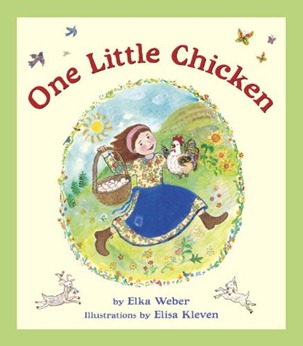
When Leora finds a chicken has wandered into their house, her mother reminds her that finders aren’t keepers.  When her father returns from work, he agrees.  But it is their duty to take care of the chicken until its rightful owners claim it.  So, they build a chicken coop.  When the hen lays eggs, they do not eat them but the eggs hatch into chicks.  Soon there are chicks everywhere.  So they take them to market and sell them for coins that they use to purchase a little goat.  They milk the goat, turn the milk into cheese, but again do not eat it, because it is not their cheese.  They sell the cheese for coins and buy another goat.  Soon they have a family of goats who are often causing mischief, creating odors, and wreaking havoc.  Finally, Leora’s mother has had enough and runs off down the road with the goats chasing after her.  And who do you think she meets on the road?

This is the retelling of a story from the Talmud and retains the feel of a classic story.  The story is not only about “finders aren’t keepers” but also speaks to the responsibility of community to care for one another.  Weber’s writing incorporates small details that add to the depth of the story.  For example, when Leora and her father are building the chicken coop: “Sawdust flew, wood shavings scattered, nails bent.”  It reads aloud with a lovely rhythm and ease.

Kleven’s illustrations are done in mixed-media collage using watercolors, ink, pastels and colored pencils.  They have a detail that is very engaging.  Some of the panels are framed in flowing flowers, others have interesting textures, and all have a warmth that is welcoming.

A great addition to units on cooperation or community, this book will also be a good pick for chicken story times.  Appropriate for ages 4-6.

Reviewed from copy received from Tricycle Press.

Also reviewed by Journey of a Bookseller.