Review: Looking at Lincoln by Maira Kalman

looking at lincoln

Looking at Lincoln by Maira Kalman

Take a fresh and radiant look at our 16th president, Abraham Lincoln in this new picture book.  A young girl is motivated to find out more about President Lincoln after spotting someone in the park who reminded her of him.  She discovers many interesting facts, some of them well known like him being born in a small log cabin and other more obscure like his love of vanilla cake.  This is a personal look at a president, allowing us to see what his road to greatness was and how it ended in tragedy. 

Kalman takes a very modern look at history here.  A large part of its modern feel is the art in the book which is bright and blazing.  She uses color with abandon, with pinks, yellows, reds and greens adding color to simple illustrations.  Her paintings range from individual objects of importance to entire scenes from history.  The diversity of the images also adds a sense of playfulness to the work that is welcome.

Her writing carries through that same light touch, making the facts all the more interesting.  As she tells the story of Lincoln’s life, she is also telling the sad story of slavery and Civil War.  Somehow her illustrations and the tone she employs here keeps the book moving and never lets it bog down into too many words. 

A colorful, fascinating look at the life of our 16th President.  This book is appropriate for ages 7-9.

Reviewed from copy received from Nancy Paulsen Books.

Review: Chitty Chitty Bang Bang Flies Again by Frank Cottrell Boyce

chitty chitty bang bang flies again

Chitty Chitty Bang Bang Flies Again by Frank Cottrell Boyce, illustrated by Joe Berger

Take a lively ride in the first follow-up to the original Chitty Chitty Bang Bang book by Ian Fleming.  The Tooting family have hit hard times, Mr. Tooting has lost his job.  But they don’t stay down hearted for long, deciding that they should take a trip around the world.  Mrs. Tooting brings home a very old and worn camping van that Mr. Tooting and Jem slowly rebuild together after taking it entirely apart.  When they go looking for parts at a local junkyard, they discover an amazing racing engine and mount it on the camping van.  The engine, of course, belonged to the original Chitty Chitty Bang Bang and now Chitty wants to get the rest of herself back together.  So the family and Chitty are off on an adventure around the world to find all of her parts.  This adventure will take them to the top of the Eiffel Tower and the depths of the ocean.

Boyce has moved the story into the modern age with cell phones and a contemporary family.  The story pay homage to the original in many ways, foremost being the search for the parts of the original Chitty.  Also, the story arc is very similar with wonderful villains who pop into the story with menacing jelly baby phones and the moment when the children are separated from their parents and have to fend for themselves.  The book also has a real spirit of the first, incorporating humor throughout.

Berger’s illustrations enliven the book, showing a multi-ethnic family and making the book more approachable for young readers.   They have a wonderful humor about them too, carrying the jolliness of the story into images.

The old-fashioned yet modern mix of this book is extremely appealing.  The book reads quickly and is completely entertaining.  Ideal for fans of the first book and sure to win new fans as well.  Appropriate for ages 8-11.

Reviewed from library copy.

Review: How Many Jelly Beans? by Andrea Menotti

how many jelly beans

How Many Jelly Beans? by Andrea Menotti, illustrated by Yancey Labat

Released in April 2012.

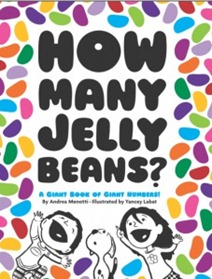
I cannot count how many dismal number and math books I have read over the years.  I’m lucky enough to have a mathematical kid, but finding books that he would enjoy was painful.  Many math books are a lot more about concept than about being fun to read.  Well, not this one!  This one winningly mixes math with candy, so that even non-mathematical kids will give it a try.  Aiden and Emma are just like most siblings, they are trying to get more than each other.  So when Emma asks for 10 jelly beans, Aiden asks for 20!  And the number just keep climbing from there.  Soon, they are up to 500 jelly beans, which may be way too many to eat.  But how about 1000 or 5000 or 10,000 in a year?  The jelly beans get smaller and smaller until the final number of 1 million is reached only be an enormous fold-out page. 

This visual sweet treat will get children able to truly visualize what the difference between thousands, tens of thousands, hundreds of thousands and a million are.  The art by Labat done in black and white with only the jelly beans for tantalizing color really works.  The focus is on the candy and the number.  Menotti nicely inserts division into the conversation too, when the children debate how many jelly beans they could eat in a year. 

I can see this over-sized book inspiring lots of counting, adding, dividing and multiplying in families, or it is also a very sweet book to share with your number-loving kid.  Appropriate for ages 5-7. 

An aside just for librarians, please don’t put this in the remoteness of the nonfiction section with your math books.  Let it enjoy being taken home as a yummy picture book with a jelly bean and math center.

Reviewed from copy received from Chronicle Books.

Review: North: The Amazing Story of Arctic Migration by Nick Dowson

north

North: The Amazing Story of Arctic Migration by Nick Dowson, illustrated by Patrick Benson

This poetic look at the amazing Arctic starts with the deep winter and the few animals who survive there year round.  Then spring comes to the Arctic and the sun comes back along with some warmth.  Plants start to appear from under the snow.  Soon more animals will arrive.  The first to head out on their journey are the gray whales, that swim from Mexico to the Arctic Circle.  Birds head north too in flocks.  Herds of pregnant caribou journey north, followed closely by the gray wolves looking for weakness.  Walrus, narwhal, schools of fish, all of this life crowds the Arctic summer until the weather turns cold and brutal again, and once more they head back around the world.

Dowson’s words are poetry in this book.  Not only written in verse form, they also speak to the soul of the Arctic, the beauty of the place and the glory of the creatures who live there.  At the same time, the words are scientific and filled with information about the place and the animals.  It is an elegant combination of poem and fact.

Benson’s art is striking.  He created paintings that are both natural and accurate but also have a sense of artistry.  Much of the art is about the landscape, the place itself and the grand amount of space there.  The illustrations of bitter winter are cold and bleak with dim, gray light.  Then the reader turns the page and it is spring with its lemony light and sprigs of green.  The change is striking to the reader and beautifully captured.  There are moments like this throughout the book.

A striking mix of poetry, art and science, this book will speak to a range of different children looking to understand their world a little better.  Appropriate for ages 5-7.

Reviewed from library copy.

Thomas Locker Dies


Thomas Locker, an author and children’s book illustrator, died on March 9th at the age of 74.  He began his career as a landscape painter in the 60s.  He didn’t start working on children’s books until the early 80s. 

Those familiar with his work will see the continued influence of his landscape painting in his books.

This Week’s Tweets and Pins

Here are the links I shared on my Twitter and Pinterest accounts that you might find interesting:

Bookshelf – Poetry – NYT – some great new poetry books for children – http://nyti.ms/Ap7C4k

Cassandra Clare To Write ‘The Dark Artifices,’ A Fantasy Series Set In Los Angeles http://huff.to/w02Wk8 #yalit

It’s all kidlit now, and that’s just fine – The Globe and Mail http://bit.ly/wwfYp5

My Hunger Name is Blight Nibbleton. I was killed in the 34th Hunger Games by crippling ennui:

hunger game names

‘Hunger Games’ Producer Nina Jacobson on the Journey from Page to Screen http://bit.ly/xvTy6v

Lauren Oliver on Romance, Blogging, “Delirium” & “Pandemonium” : The Childrens Book Review http://bit.ly/yynohn #yalit

Modern children’s books help families explore diversity http://bit.ly/xHcJdr

Parents too busy to read bedtime stories to their kids: Study – Lifestyle – DNA http://bit.ly/ykAksQ

Retweet of My love for Sophie Blackall’s work overfloweth after watching this video: http://vimeo.com/36116772

Pottermore finally vanquishes technical obstacles to open access | http://guardian.co.uk http://bit.ly/zGQ650

Remembering ‘A Wrinkle in Time’ 50 years after it won the Newbery Medal – The Washington Post http://wapo.st/x5Dgq8

Rightsholders Group to Charge Libraries for Reading Books to Kids http://tnw.co/ymhOVO

To Ensure a Bright Future, Your Teen Needs to be Reading – Scoop San Diego: Home & Family http://bit.ly/z1kJt0

Westerfeld’s Uglies continues in manga form: Shay’s Story – Boing Boing http://bit.ly/AkW2LR

What came before "The Hunger Games" – The Hunger Games – http://Salon.com http://bit.ly/wy4kSY

Review: Outside Your Window by Nicola Davies

outside your window

Outside Your Window: A First Book of Nature by Nicola Davies, illustrated by Mark Hearld (InfoSoup link)

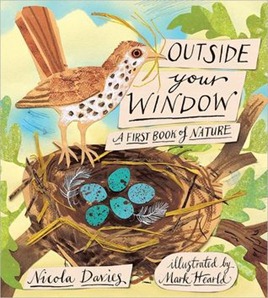
Explore nature through the seasons in this lush book of poetry that starts with the first moments of spring with melting icicles and the green shoots of bulbs.  Summer is filled with butterflies, chickens, baby birds and bees.  Autumn comes with leaves, wind, geese and acorns.  And winter ends the year filled with snow, deer and ducks.  The poems range from merry verse with lighter tones to atmospheric pieces that make you stop and think.  It is this range of moods and depth that makes the book so very readable and enjoyable. 

Davies’ poems are all very child friendly, offering new perspectives on familiar things.  Her poem, “Night”, is one of my favorites of the book, though there are many to choose from that are incredible reads.  It capture the movement of the night, the feel of the quiet, and the sense of the world turning beneath you.  It’s quiet, beautiful, and captivating.

Add to these dynamic poems the art of Hearld and you have a real jewel of a book.  Illustrated with collage that combines paper cutout work, layers of texture, and realistic depiction of nature.  This realism emphasizes the beauty of nature, its diversity, and our own place in the world.  These are images that make you dream but also put your feet squarely on the earth and your connection to it.

Gorgeous illustrations combine with vibrant poems, creating a book to treasure.  Appropriate for ages 7-10.

Reviewed from library copy.

Review: Z Is for Moose by Kelly Bingham

z is for moose

Z Is for Moose by Kelly Bingham, illustrated by Paul O. Zelinsky

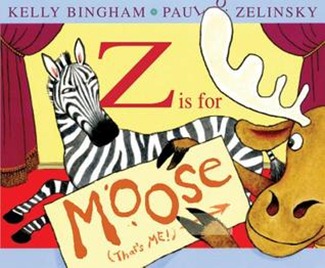
If you are looking for an alphabet book with more than a bit of nonsense, this is the one for you!  I happen to be a huge fan of alphabet books that play around, add humor and have plenty of twists.  If you are looking for a straight-forward ABC book, the title alone should be enough to have you looking elsewhere.  For those of you as silly as I am, continue on!  Zebra is in charge of the ABCs happening in the right order on stage.  Unfortunately, Moose doesn’t want to wait his turn.  He enters on D, knocking Duck away, messes up Elephant’s entrance too, gets his head in the way for Hat, pops out of the pocket for Kangaroo, and continues to be silly for Lollipop too.  But the insult truly comes when they decide to go with M is for… Mouse.  Now Moose is upset and rampages through P and Q, drawing scribbles on R and S.  Zebra tries to stop him, but ends up messing things up himself until the happy ending at Z. 

Bingham’s writing is filled with asides from the different animals.  The book is extremely funny, the pacing is brilliant, and the twists are unexpected.  There is a great tension built up as the letter M approaches, and then with the twist, it is pure genius. 

Zelinsky’s illustrations add to the mad gaiety of the book.  Moose is obnoxious but also charming, his emotions clear on his face.  The reaction of Moose as M passes him by is delightful, the rampage of destruction is great fun, and his scribbling is clever. 

It is clear that this is a book that was pure fun to create, since that is apparent on every page.  Impossible to read without laughing and grinning, this is an alphabet book that is sure to delight.  Appropriate for ages 4-6.

Reviewed from library copy.

Review: Moonlight by Helen V. Griffith

moonlight

Moonlight by Helen V. Griffith, illustrated by Laura Dronzek

Rabbit waits for the moon to appear out of the cloudy skies, but leaves a bit too soon to see the moon emerge.  The moon shines its buttery light into space and onto the earth.  It covers the mountains, the trees, enters the water, and even enters Rabbit’s burrow, making his dreams fill with the light.  He wakes up, leaves his burrow and dances in the field with the butter of the moon on his head.  

This picture book is a poetic look at moonlight as butter, continuing the metaphor throughout the book.  While some may quibble about moonlight being as yellow and thick as butter, there are nights where the light is so yellow that it almost has a weight.  Those full moon nights are buttery and rich, filled with that light that is so very different than sunlight.  Griffith embraces the metaphor entirely, enriching moonlight with her buttery idea. 

Dronzek’s illustrations really make the metaphor work in the book.  Readers can see the butter of the light as it coats the entire forest.  They can see it coat Rabbit and his dreams, along with the flowers, grass and the entire world.  She has chosen her yellow with care, selecting a color that skims between butter and moonlight. 

A bedtime book that embraces butter, this book could be used to teach about metaphor or could be used with even very small children as a solid bedtime read.  Expect hunger for buttery pancakes in the morning!  Appropriate for ages 2-4.

Reviewed from library copy.