Review: The Boy Who Harnessed the Wind by William Kamkwamba

boy who harnessed the wind

The Boy Who Harnessed the Wind by William Kamkwamba and Bryan Mealer, illustrated by Elizabeth Zunon

This picture book version of the nonfiction book manages to translate the story of William Kamkwamba with clarity and inspiration.  When a drought hit his village in Malawi in 2001 and 2002, 14-year-old William and his family were in real danger of starving.  William had always through about machines and even after he was forced to leave school due to the drought, he kept reading books about them.  He thought about what could be done with a windmill in his village, bringing light and water.  So he hunted through the junk yard and found pieces to use.  Built entirely out of scraps, his first windmill and its electric wind brought electricity to the valley.   The afterword gives more details about William’s story and how it took him longer years to bring his dream of pumping water to fruition. This inspirational story speaks to the inventor, the doer, and the dreamer in all of us.

The writing here is lovely.  The imagery is impressive, such as comparing the windmill to a “clumsy giraffe” and giving William’s sorrow at having to leave school a physical sense: “alone with the monster in his belly and the lump in his throat.”  The book carefully captures what life in Malawi was like and what little could be done to make a difference before transforming into a book where dreams create change.  

Zunon’s illustrations are exquisite.  They are a captivating mix of painting and collage.  Filled with texture, the textiles of the clothing come to life and the objects have weight and feel.  The most impressive are the faces of the people, filled with light.  The faces become the place your eyes go first, making the message of the book just that much stronger in a subtle but powerful way.

A luminous picture book version of a compelling real-life story, this book should inspire others to not only dream but to make those dreams happen.  Appropriate for ages 7-10.

Reviewed from copy received from Dial Books for Young Readers.
Gideon by Olivier Dunrea

gideon gideon and otto

Gideon by Olivier Dunrea

Gideon & Otto by Olivier Dunrea

Gideon is the newest fowl in Dunrea’s farmland.  He is a gosling who loves to play, hates to nap, and has a favorite toy, an octopus named Otto.  In the book bearing just his name, Gideon is hard at play and refusing to listen to his mother call him for his nap.  He just keeps racing on to the next thing to play with.  Readers who are paying close attention will notice that he starts slowing down towards the end of the book, just before he falls asleep all on his own.  In Gideon & Otto, Gideon is once again hard at play on land and in the water.  Otto participates happily, listening when books are read aloud, hiding in the leaves, and even bobbing in the water.  When Gideon sets Otto aside to play more, he instructs Otto to stay there.  But in the midst of playing, Otto gets knocked down and then disappears.  Gideon is about to give up when Otto appears again.  Filled with appeal, these books are jolly additions to Dunrea’s menagerie.

Toddlers and their parents will immediately recognize moments out of their own days here.  From being too busy to nap to losing a beloved toy, these moments are what create the tapestry of young lives.  Told with a wonderful humor, zinging with speed and action, these books beg to be shared.  In fact, when I was curled up to read them to myself, my 10-year-old appeared and insisted that he be read them aloud.  There is such charm to just the covers and even more inside the pages.  These are small books that are very rich.

Perfect for busy toddlers who need some time to slow down a bit.  Appropriate for ages 2-4, or for 10-year-olds who need a cuddle too.

Reviewed from library copies.

IBBY 2012 Short List

The International Board on Books for Young People has announced the short list for the 2012 Hans Christian Andersen Award.  The award is given biennially “to a living author and illustrator whose complete works have made lasting contributions to children’s literature.”  The winners will be announced on March 19th at the Bologna Children’s Book Fair.

The Author Finalists are:


Maria Teresa Andruetto (Argentina)


Paul Fleischman (US)


Bart Moeyaert (Belgium)


Jean-Claude Mourlevat (France)


Bianca Pitzorno (Italy)


The Illustrator Finalists are:


Mohammad Ali Beniasadi (Iran)


John Burningham (UK)


Roger Mello (Brazil)


Peter Sis (Czech Republic)


Javier Zabala (Spain)

Top Teachers’ Picks in the UK

A survey of teachers in the UK found their top authors and favorite children’s books:

Favorite Authors


1. Roald Dahl


2. Julia Donaldson


3. JK Rowling


4. Michael Morpurgo


5. Louis Sachar


6. CS Lewis


7. Philip Pullman


8. Enid Blyton


9. Maurice Sendak


10. David Walliams


Favorite Books


1. The Gruffalo – Julia Donaldson

2. Holes – Louis Sachar

3. Charlie And The Chocolate Factory – Roald Dahl


4. Lion, The Witch And The Wardrobe – CS Lewis

5. The Twits – Roald Dahl

6. Danny The Champion Of The World – Roald Dahl

7. The BFG – Roald Dahl


8. George’s Marvelous Medicine – Roald Dahl

9. Where The Wild Things Are – Maurice Sendak

10. Kensuke’s Kingdom – Michael Morpurgo

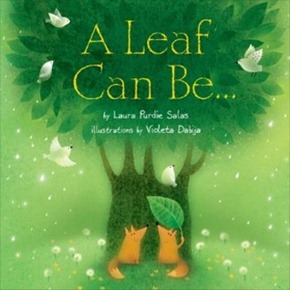
Review: A Leaf Can Be… by Laura Purdie Salas

11505

A Leaf Can Be… by Laura Purdie Salas, illustrated by Violeta Dabija

Explore leaves throughout the seasons in this work of poetry.  The book focuses less on the science of leaves and much more on their impact, their dance on the wind, the shade they spill, and the color they give.  Told in verse that will work very well with young children, this book captures the wonder of nature.  

This is a dance of a book with rhymes and rhythms that really sparkle.  Much of the book is done in two-word lines that encapsulate one aspect of leaves, “sun taker” and “food maker,” and then in the autumn, “pile grower” and “hill glow-er.” 

Dabija’s art is jewel-toned and dynamic.  Her work is infused with merriment and joy.  She uses layers and transparency to great effect, capturing the beauty of nature.  One particularly striking page is her “frost catcher” where the layers of her work shine and the details are luminous. 

A great book to use in a unit about trees, this is also a book that invites exploring a poem.  Exquisite writing is well matched with rich art in this book.  Appropriate for ages 3-6.

Reviewed from library copy.

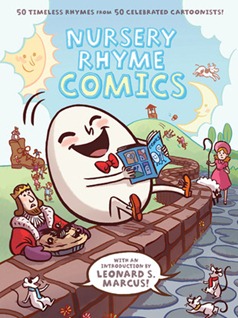
Review: Nursery Rhyme Comics

nursery rhyme comics

Nursery Rhyme Comics

Take 50 classic nursery rhymes and put them in the hands of 50 of the top cartoonists of the day, and you get a nursery rhyme book that will delight all ages!  As you turn the pages, the styles change too.   While the text stays true to the nursery rhyme, comic asides and comments merrily twist the meaning at times.  There are also plenty of modern twists on the old tales, like There Was an Old Woman Who Lived in a Shoe is a the owner of a daycare who also happens have a rock and roll band.  This is a book that embraces the humor, quirkiness and outright strangeness of nursery rhymes and takes them to another level.

When I first opened the book, I thought I might list my favorite rhymes and illustrations, but then I realized turning the pages that the real impact of this book is because there are so many diverse rhymes and illustration styles.  I tip my hat to the skill of Chris Duffy in matching illustrators to the ideal nursery rhymes.  This is really what makes the book sing.  I also appreciate the creative freedom given to the artists, making the result all the more intense and beautiful.

Highly recommended, this would be a great way to get nursery rhymes in the hands of older children who may have missed out on them when they were younger.  It’s also a delight if you know the rhymes already.  Appropriate for ages 6-10.

Reviewed from library copy.

Review: Zig and Wikki in the Cow by Nadja Spiegelman

zig and wikki in the cow

Zig and Wikki in the Cow by Nadja Spiegelman and Trade Loeffler

This is the second Zig and Wikki book, featuring two little aliens who find their way to Earth.  In this book, the two friends lose their spaceship when they return Zig’s pet fly its native habitat.  On the way, the two discover that flies eat poop, that dung beetles use it as well, and that cows have multiple stomachs.  It’s all a matter of learning things up close and personal, right down to being swallowed by a cow.  This humorous mashup of scientific fact, alien appeal, and comic format makes for an engaging read for young readers.

It is really the blend that works so well here.  The writing is light and funny, combined with scientific facts that are highlighted with photographs.  Readers learn about food cycles, ecology and habitats without even realizing it.  Add in the humorous poop factor and the graphic novel format, and this is one appealing package.

A graphic novel series that is a lot of fun and also informational, this second book is a winner, winner, cow dinner.  Appropriate for ages 7-9.

Reviewed from copy received from Candlewick Press.

Review: Zoo Girl by Rebecca Elliott

zoo girl

Zoo Girl by Rebecca Elliott (Link to InfoSoup)

Told in just a few words per page, this book tells the story of a little girl who doesn’t have a family.  At the orphanage she is lonely and has no friends.  Then the children visit the zoo and suddenly the little girl feels at home.  She is left behind at the zoo and the animals discover her.  They befriend her and she lives with them for awhile until the zookeepers discover her curled up with the tigers.  The little girl does not want to go, and the book ends with a happy ending where the little girl is adopted by the zookeeper couple.  The story is a simple one, told in only a few words, but the sense of belonging and being wanted remains a powerful message.

Elliott’s story is really told in the illustrations rather than the words.  Her art is a rich mix of texture, patterns, drawing and photographs.  The rather simply drawn characters and animals live in a world made dazzling.  Even the air itself seems to have its own feeling and shape.  The elephant has wonderful wrinkles, the tiger has plush fur, and the penguin’s feathers are swirled. 

Also, in the orphanage, the mood is not grim.  It is specifically this little girl who does not have friends and feels alone.  The other children are merry and playing with one another.  That changes the message quite a bit too.

Perfect for toddlers because of its brevity, this book is a very friendly way to talk about adoption.  Appropriate for ages 2-4.

Reviewed from library copy.

This Week’s Tweets and Pins

Here are the links I shared on my Twitter and Pinterest accounts that you might find interesting:

13 Judy Blume books coming out as e-books – The Sacramento Bee http://bit.ly/zZ73eX

67 Books Every Geek Should Read to Their Kids before Age 10 | GeekDad | http://bit.ly/zibYqD http://bit.ly/zjSwQW

Children who are brought to books early get a head start – Independent.ie http://bit.ly/xlTvOu

Children’s publisher Scholastic developing app for e-reading – The Washington Post http://wapo.st/ydKJIK

Dahl named best children’s author – The Irish Times- #kidlit http://bit.ly/yvqB5Z

Five hundred new fairytales discovered in Germany | http://guardian.co.ukhttp://www.guardian.co.uk/books/2012/mar/05/five-hundred-fairytales-discovered-germany

Five questions for Erin E. Stead — The Horn Book http://bit.ly/A3US3k

Full-time School Librarians Linked to Higher Student Reading Scores http://bit.ly/wIg4nx

Spurred By Success, Publishers Look For The Next ‘Hunger Games’ : Monkey See : NPR http://n.pr/w1b7N3

Suzanne Collins Praises Movie Version of Her Novel, The Hunger Games http://bit.ly/vZgjqR

Today Is World Read Aloud Day! http://bit.ly/z1whC6

The Unlikely Best Seller – A Wrinkle in Time Turns 50 – http://n.pr/zoLOx1

Wimpy Kid author: even my son prefers Harry Potter http://tgr.ph/At1zGx