Review: More by I. C. Springman

more

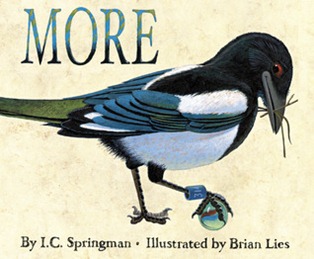
More by I. C. Springman, illustrated by Brian Lies

The book opens with a dejected magpie who has nothing at all.  Then a mouse gives him a marble that he takes to his nest.  Soon the marble is joined by a few other toys.  Then more and more, until there are so many things that the magpie has filled all sorts of nests in the tree with them.  Finally, the magpie adds one little penny to a nest and the branch cracks.  He has much too much now!  Everything tumbles to the ground, burying the poor magpie in his treasures.  The mice appear to dig him free and the pile becomes less and less as they work.  In the end, the magpie selects a few items to keep and lets the rest go, leaving with just enough.

This book is written in very spare language with only a few words per page.  They are all concept words, moving from nothing to everything to enough.  In between, there are terms like more, much, and less.  The dynamic illustrations really carry the story.  The magpie’s facial expressions range from greed to shock to satisfaction, all playing out nicely just in the shine of an eye and the curve of a bill.  Space is also played with in the images, speaking to the freedom of having just enough and the clutter of having too much.

This picture book deals directly with the idea of downsizing or having just enough toys and not too many, something that many children struggle with.  It is also a creative concept book that will work to teach those concepts through humor.  Appropriate for ages 2-4.

Reviewed from library copy.

Review: That’s Not a Daffodil by Elizabeth Honey

thats not a daffodil

That’s Not a Daffodil by Elizabeth Honey

When Tom’s neighbor gave him something that looked like an onion and said it was a daffodil, Tom was very skeptical.  Mr. Yilmaz told him to plant it to find out.  So they planted it in a large pot and Tom waited, and waited, and waited with nothing happening at all.  When Mr. Yilmaz asked how the daffodil was doing, Tom answered that it was not a daffodil, it was a desert.  So the two watered the pot.  Later, Mr. Yilmaz asked again and Tom said that the small green point sticking out of the dirt was a green beak, not a daffodil.  The beak slowly began to open.  Soon the daffodil looked more like a hand, hair, and even a rocket!  It even survived being toppled over by a dog.  Until finally, Tom gets to show Mr. Yilmaz exactly what that onion turned into.

Not only does this book perfectly capture the wonder of gardening with children with the impossibly long wait for results, but it also offers a beautiful zip of creativity along with it.  As Tom learns about patience with his daffodil, he also incorporates it into his playing.  The writing is simple and straight forward, yet has a sense of playfulness too.

Honey’s illustrations appear to be a mix of watercolor and pastels that have a homey warmth.  They also have a great texture that works well for the rough ground, dirt in the pot, and sweater knit.  At the same time, the watercolor smoothness plays against that. 

A sweet book about patience, gardening and creativity, this book would make a great addition to springtime story times.  Appropriate for ages 3-5.

Reviewed from library copy.

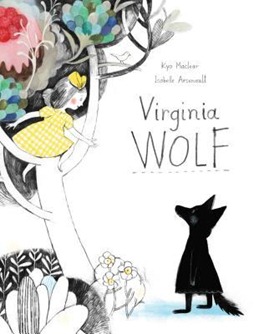
Review: Virginia Wolf by Kyo Maclear

virginia wolf

Virginia Wolf by Kyo Maclear, illustrated by Isabelle Arsenault

This picture book is loosely based on the life of Virginia Wolf and her sister.  Adults will enjoy the tie-ins, but they are not necessary for children to understand in order to enjoy the book.  It is a story told from Vanessa’s point of view.  Virginia was having a “wolfish” sort of day where nothing pleased her and any sort of noise bothered her.  Vanessa tried to talk with her and discovered that Virginia was dreaming of a far-away perfect place to be.  So Vanessa snuck away and found art supplies and paper to create that world for her sister.  Soon her walls were covered in birds, butterflies, flowers and color.  There was even room for a wolf to wander.  Virginia’s mood lifted and she was ready to play once again. 

This book takes a direct look at depression but can also be used for more transient moods of children.  The author’s writing is rich and beautiful.  When Virginia first gets depressed, she explains it this way: “The whole house sank.  Up became down.  Bright became dim.  Glad became gloom.”  When Vanessa paints the garden it is described this way: “I painted leaves that said hush in the wind and fruit that squeaked and slowly I created a place called Bloomsberry.  I made it look just the way it sounded.”  This is a book that not only has art as a solution and an escape, but also has art in the writing itself.

Arsenault’s illustrations have a wonder to them that is astonishing.  Done in mixed media of ink, pencil, watercolor and gouache, the images play with darkness and light with a fearlessness.  Color is used sparingly at first, then when the art appears it is lush and vibrant.  One completely understands the way that art can lift a person.  Perhaps my favorite small detail is that the art at first when seen through Vanessa’s eyes is adult, lush and fine lined.  Later when glimpsed in retrospect, it has a childlike quality to it instead. 

This picture book is a small work of art that speaks to the power of creativity and art to lift moods.  Appropriate for ages 5-7.

Reviewed from copy received from Kids Can Press.

Review: Animal Masquerade by Marianne Dubuc

animal masquerade

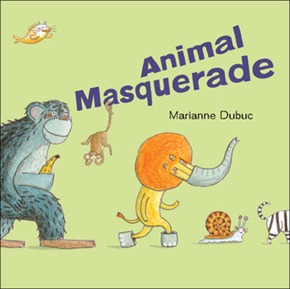
Animal Masquerade by Marianne Dubuc

This picture book takes one long-running gag and turns it into a very funny picture book.  As the animals get ready for the masquerade, they have to dress up in costumes.  Each animal dresses up as another animal and then that animal chooses yet another animal to dress up as.  It forms a neat chain.  Much of the humor is in the depictions of the costumes themselves and also in the occasional asides that break the rhythm of the book for even more of a punch-line effect.  Fonts are also played with as the hummingbird disguised as an ostrich has its fonts hidden half underground just like its head.  In another spot, the butterfly disguised as a bat has its font upside-down.  All of the small touches add to the giggles in this picture book.

Dubuc’s art here is wonderfully whimsical and playful.  The different animals in disguise are often absurd and completely strange.  Just wait until you get to the animals that dress up like a three-headed monster, Red Riding Hood dressed as a chocolate cake, and the hen that is too dim to understand what is happening and doesn’t dress up as anything at all.   The book is longer than most picture books in terms of number of pages, but that adds to the running gag theme here. 

This picture book will do well read aloud very straight and seriously until the first big joke hits.  Then make sure to leave plenty of time for the giggles to pass before moving on.  It will work well for Halloween too, without anything scary about it.  Appropriate for ages 4-6. 

Reviewed from library copy.

Review: Boy & Bot by Ame Dyckman

boy bot

Boy & Bot by Ame Dyckman, illustrated by Dan Yaccarino

One day when out collecting pinecones in the forest, a boy meets a robot.  The two of them play together and have a lot of fun.  But then when rolling down a hill, the robot’s power button gets pressed and he turns off.  The boy thinks the robot must be sick, so he takes the robot home and feeds him, reads him a book and puts him to bed.  When the boy’s parents look in at him before going to bed, they press the switch on the robot.  Now the robot notices the sleeping boy and thinks that he has malfunctioned.  Bot takes the boy to his home, gives him oil, reads him an instruction manual and is just about to replace his battery, when the Inventor arrives.  Soon all is straightened out and the two continue their grand friendship.

Dyckman’s story has a wonderful symmetry that works well.  With the two friends and their misunderstandings of one another, the story mirrors itself in a delightful way.  Both instances have their humor, as does the rest of the book.  It is this wry sense of humor that carries the story forward and makes it a pleasure to read.  The book is written in a straight-forward way, making it a great read aloud.

Yaccarino’s illustrations are very successful.  They have a wonderful sort of fifties vibe to them, while at the same time being modern.  The large robot is never frightening, thanks to his permanent smile and his care for the boy.  Yaccarino plays with bright colors throughout the book, keeping his art simple and dynamic.

Robot fans will rejoice at this fresh new take on friendship and embracing differences.  Appropriate for ages 4-6.

Reviewed from copy received from Alfred A. Knopf Books for Young Readers.

Review: Summer of the Gypsy Moths by Sara Pennypacker

summer of the gypsy moths

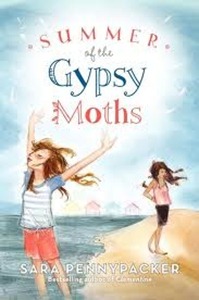
Summer of the Gypsy Moths by Sara Pennypacker

Stella lives with her great-aunt Louise on Cape Cod, where the house is always tidy, and even though Louise is not very demonstrative, Stella feels right at home.  Angel, a foster child, lives with them too, but Stella and Angel don’t get along at all.  Then one day, the girls return home to find Louise dead in her chair.  The two girls know that if anyone finds out, they will be put back into the child welfare system.  So they work together to create a plan that will let them stay in the tidy little house near the sea.  It would take a lot of work, because they would have to cover for Louise at her job of caring for four cottages on the property, and they would have to take care of the dead body too!  It’s a challenge for two girls who never got along in the first place and are headed in different directions when the summer is done.  This hope-filled book starts with a death and strangers and ends with hope and family. 

Pennypacker writes the sort of book that Stella would like to read.  It’s filled with all of the between-times, the moments of cleaning up afterwards, the small details, the real parts of life.  And it is through those moments that we get to know both girls, and Louise too.  The two girls are very different, and yet not so different after all, as readers get to know them.  They are both suffering from disappointments and loss, from being left behind, from not having families.  Stella holds onto her Hints from Heloise, determined to have a life of order and neatness that makes sense.  Angel listens to the music her mother played, hiding behind her earbuds and blocking everything out. 

One might think this would be a macabre book, and it does have those moments.  But it is much more a book about people and life, not death.  It is a book that celebrates summer, the days that stretch and lengthen, days shortened by working hard at times.  It is a story about secrets, opening up and revealing things.  It is a story about truth and lies, enemies and friendship.  Throughout the entire book, the story works naturally.  Things happen in their own good time, friendships blossom in a believable way.

This book does have a very neat ending with all of the storylines nicely fitting together.  I can only believe that Stella would approve of that being the way her story ended.  Appropriate for ages 9-12.

Reviewed from library copy.

This Week’s Tweets and Pins

Here are the links I shared on my Twitter and Pinterest accounts that you might find interesting:

You can also see my tweets and pins about libraries, ebooks and censorship on my Sites & Soundbytes blog.

Children’s Galleys to Grab: BEA 2012 http://j.mp/K7yskq #kidlit

Cybils: Two Cybils judges get a promotion to the Newbery and Caldecott committees!http://j.mp/KPg1jO #kidlit #blogging

EL James has written a ya paranormal romance http://bit.ly/JhTnjA

Giving the Gift of Reading, Children’s Librarians Feed Young Imaginations – Vineyard Gazette Online http://j.mp/K7wRuF #libraries

How Picture Books Play a Role in a Child’s Development : The Childrens Book Review http://j.mp/KKYWVv #kidlit #reading

Maurice Sendak, Children’s Author, Dies at 83 – the loss of a legend http://j.mp/IVCUPu #kidlit

The Return of ‘Rocket’ http://prsm.tc/nH61CR#kidlit

Sendak’s Legacy: Helping Kids ‘Survive Childhood’ : NPR – a lovely tribute http://j.mp/KKPhOW

Spring YA fantasy covers take wing! An utterly gorgeous display of what’s new and upcoming. Which cover is your fav? http://bit.ly/LvDwBg

Stacked: So You Want to Read YA?: Guest Post from Lee Wind http://j.mp/KKZxqd #yalit

Studies show 91% of kids are more likely to finish a book they choose themselves. We’ve got a FAB selection for summer@ http://bit.ly/2012SSC

Tara Brings Fresh International Perspectives to Picture Books http://prsm.tc/kffkt9 #kidlit

Walter Dean Myers’ lesson to children: Read –http://j.mp/K7wQqQ #kidlit #reading

Yer A Kindle, Harry! Amazon/Pottermore Offer All Seven HP Books In Kindle Lending Library http://prsm.tc/BbNPO9 #kidlit

Children’s Choice Book Award Winners

The winners of the Children’s Choice Book Awards were announced on May 7th.  Here are the winners in each category:


K-2 Book of the Year – Three Hens and a Peacock by Lester L. Laminack

3-4 Book of the Year – Bad Kitty Meets the Baby by Nick Bruel

5-6 Book of the Year – Okay for Now by Gary D. Schmidt


Teen Book of the Year – Clockwork Prince by Cassandra Clare

Author of the Year – Jeff Kinney for Diary of a Wimpy Kid: Cabin Fever

Illustrator of the Year – Brian Selznick for Wonderstruck

Happy Children’s Book Week!

Happy Children’s Book Week!  I adore this poster by David Wiesner that features many beloved characters from children’s books.  Lovely!