Review: Electrical Wizard by Elizabeth Rusch

electrical wizard

Electrical Wizard: How Nikola Tesla Lit Up the World by Elizabeth Rusch, illustrated by Oliver Dominguez

Nikola Tesla was born in Serbia during a lightning storm, something that would portend his future interest in electricity.  At a young age, Tesla became fascinated by the invisible energy everywhere around him, in the water, the wind and the insect that flew.  In college Tesla grew interested in alternating current though his professor thought it was impossible.  Tesla studied and invented and eventually figured out how to make alternating current work, but he needed help.  He headed to America to meet with Thomas Edison, someone he knew would be interested.  But Edison was not, insisting that direct current was the only electricity he would work with.  Soon Tesla and Edison were rivals in the “war of the currents.”  This first picture book biography will introduce young readers to one of the great scientific inventors of all time and his greatest rival too.

Rusch tells the compelling story of Tesla and his inventions.  She shows Tesla as a complicated person, eager to pursue his own ideas and willing to stand up for them in the face of great opposition.  She also tells the story of the rivalry of the two men in a very engaging way and Tesla’s ultimate victory and how he reached it.  Her writing is engaging, detailed and impressive.

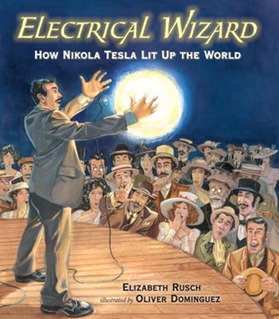
Dominguez’s illustrations are filled with period details that help ground this picture book directly in the time in which it is set.  Scientific instruments are often in the forefront of the images, showing their structures in detail.  This is a true celebration of the science of invention.

An electric read, this book shines light on a great man.  Appropriate for ages 7-9.

Reviewed from copy received from Candlewick Press.

Most-Challenged Books of 2012

banned

It’s Banned Books Week and the Office of Intellectual Freedom of the American Library Association has announced the most-challenged books of 2012.  The Office documented 464 challenges in 2012.  The list below reflects the ten most-challenged titles and also has the reasons for the challenge.

  1. Captain Underpants (series), by Dav Pilkey.
    Reasons: Offensive language, unsuited for age group
  2. The Absolutely True Diary of a Part-Time Indian, by Sherman Alexie.
    Reasons: Offensive language, racism, sexually explicit, unsuited for age group
  3. Thirteen Reasons Why, by Jay Asher.
    Reasons: Drugs/alcohol/smoking, sexually explicit, suicide, unsuited for age group
  4. Fifty Shades of Grey, by E. L. James.
    Reasons: Offensive language, sexually explicit
  5. And Tango Makes Three, by Peter Parnell and Justin Richardson.
    Reasons: Homosexuality, unsuited for age group
  6. The Kite Runner, by Khaled Hosseini.
    Reasons: Homosexuality, offensive language, religious viewpoint, sexually explicit
  7. Looking for Alaska, by John Green.
    Reasons: Offensive language, sexually explicit, unsuited for age group
  8. Scary Stories (series), by Alvin Schwartz
    Reasons: Unsuited for age group, violence
  9. The Glass Castle, by Jeanette Walls
    Reasons: Offensive language, sexually explicit
  10. Beloved, by Toni Morrison
    Reasons: Sexually explicit, religious viewpoint, violence

Review: Xander’s Panda Party by Linda Sue Park

xanders panda party

Xander’s Panda Party by Linda Sue Park, illustrated by Matt Phelan

Xander is planning a party just for pandas, but soon realizes that he is the only panda at the zoo.  So he changes the invitation to include all sorts of the bears at the zoo.  Then Koala is left out because she’s a marsupial, not a bear.  Xander chewed some bamboo and thought a bit, then changed the party to be for all mammals at the zoo.  After going through several more versions, Xander’s party changed to invite all of the animals at the zoo.  It was almost time for the party to start, when a truck and a crate arrived at the zoo.  It was a new creature for the zoo!  But would it ruin Xander’s updated party plans?

Clever, clever, clever.  This book carefully offers information on animal taxonomy to readers who will not even realize they are learning it thanks to the party-theme of the book.  Park’s writing is so impressive.  When I opened the book to see it rhyme, I must admit that I sighed.  But Park managed to created a rhyming book that is not written in stanzas.  She instead builds whole paragraphs that read like rhyming poems and make the rhymes work throughout the sentences.  It is a smart way to approach a book that harnesses the rhyme rather than galloping away with it.

Phelan’s art is entirely brilliant.  His lines have a looseness that really works, creating whole settings in just a few lines.  All of the animals have their own unique personalities.  I particularly enjoyed the rhino glaring from behind his wall and the montage of the different types of bears.  There are small touches throughout that add humor and coziness to the story.

A book that has science mixed with a message of inclusiveness, this is one has mass appeal.  Appropriate for ages 3-5.

Reviewed from library copy.

Review: The Real Boy by Anne Ursu

real boy

The Real Boy by Anne Ursu

The author of Breadcrumbs has returned with another beautiful fairy tale.  Oscar was taken in by the last known magician, Master Caleb, and in return works for him as his hand.  That means that Oscar manages the harvesting and preparation of the many herbs and plants Master Caleb uses in his magic.  Oscar is very happy with his life below the shop, accompanied only by the cats that live there too.  The only problem is Wolf, Master Caleb’s apprentice, who brutally teases Oscar any chance he gets.  But the world around Oscar is quickly changing.  The Barrow, the forest of ancient wizard wood trees that encircles the city, has also begun to be affected.  It may be that the very magic itself is changing too. 

Ursu weaves such beauty into her books.  She lingers over small things, taking the time to build a world in which her characters live.  One examples of this is her description of the Barrow early in the book:

The trees had magic in their leaves, their berries, and their bark.  Plants and shrubs and flowers grew everywhere; purplish-greenish moss crawled on the rocks; improbable mushrooms sprang from the soil in tiny little groves of their own.

The entire book is infused with a sense of rich detail and layering.  Oscar’s own small world below stairs is just as lovingly described and detailed until one longs to be the hand of a magician too and have cats for friends.

Oscar himself is an amazing character.  Because the book is told from his point of view, readers will understand him easily, but Oscar struggles with human beings, emotions and understanding what is meant.  When he is forced out from his snug workspace, the world becomes confusing.  He holds himself stiffly, hates looking people in the eye, and struggles to be social.  Clearly on the autism spectrum, Oscar has unique abilities too, allowing him to see what others do not by paying close attention. 

This amazing fantasy novel is one of the best reads for middle graders this year.  Get your hands on this one!  Appropriate for ages 11-13.

Reviewed from digital galley received from Edelweiss and Walden Pond Press.

Review: Count the Monkeys by Mac Barnett

count the monkeys

Count the Monkeys by Mac Barnett, illustrated by Kevin Cornell

It is clear from the title that this book is about counting monkeys, and the title page explains that all one has to do is turn the page to do just that.  So here we go!  Wait.  1 King Cobra has scared off all of the monkeys.  Turn the page and 2 mongooses (or mongeese maybe?) have scared off the cobra but still no monkeys.  Keep turning pages and there are more animals that scare off the ones from the page before, but no monkeys at all.  The pattern is set until the 8 lumberjacks stick around for multiple pages.  And it will take something unusual to scare them off.  But even then, where are the monkeys?

Barnett has created another surprising picture book that turns a normal counting book merrily on its head.  He speaks directly to the reader, instructing them along the way on how to move the creatures off of the page, how to best turn the page, and explaining what just went wrong.  His silly approach to a counting book will find universal approval.

Cornell’s illustrations have a wonderful humor about them as well.  He takes Barnett’s vision and makes it colorful and bright.  All of the creatures have personality, from the crocodiles in vests and top hats to the self-satisfied wolves who clear out the grandmothers.  Each page has a twinkle to it that makes it fun to take a closer look at the pages.

Pure hilarity, this counting book is made to share out loud with a giggling group of preschoolers.  Appropriate for ages 3-5.

Reviewed from library copy.

Review: Siege and Storm by Leigh Bardugo

siege and storm

Siege and Storm by Leigh Bardugo

After surviving annihilation in the Fold, Alina and Mal have fled their native country to disappear from the attention of the Darkling.  But their respite is short-lived when the Darkling discovers them and reveals the extent of his new powers.  He can now create entities from the darkness, creatures whose bites never heal and who kill quickly and mercilessly.  Alina still bears the neckpiece that the Darkling had forged and bound to her, but now the power is hers to wield.  Then she learns of two more objects of power, led to one by Mal’s tracking and the Darkling’s own desire to own both Alina and her Sun Summoner abilities.  Helped by an unlikely ally, Mal and Alina may have survived their first encounter with the Darkling, but soon hidden identities are revealed, one of them is welcomed as a saint, and Alina must come to terms with her own responsibility to save her country.

Bardugo’s second book in The Grisha series is just as riveting as the first.  She puts both Alina and Mal in trying circumstances, continually playing hope against fear and destiny against what can actually be accomplished.  These tensions in the book as well as Bardugo’s smooth but detailed writing style make for a book that cannot be put down. 

Bardugo continues to build upon the stunningly inventive world she has created.  New touches emerge, different parts of the world are revealed, and familiar characters are transformed.  My only complaint with the book is that it does have pacing issues in the middle.  While the moments of indecision by Alina are well drawn, they last too long and dull the brilliant pace of the rest of the book.

A strong addition and great second book in the series, this is a must-read for fans of the first book.  Appropriate for ages 14-17.

Reviewed from library copy.

This Week’s Tweets and Pins

Here are the links I shared on my Twitter and Pinterest accounts this week that you might find interesting:

Librocubicularist

CHILDREN’S BOOKS

Indigenous children’s books aim to preserve traditional language | Donnybrook-Bridgetown Mail http://buff.ly/19bFa3w #australia #kidlit

Thoughts on Newbery: The Age Problem | educating alice http://buff.ly/14brtBZ #kidlit

Top 10 Children’s Picture Books to Celebrate Hispanic Heritage Month http://buff.ly/1dpV90U #kidlit

The UK needs truly authentic children’s books – now | The Jewish Chronicle http://buff.ly/1dpVel9 #kidlit #Jewish

What Are Children’s Books For? | The Nation http://buff.ly/1dpV50W #kidlit

EBOOKS

A Reading App Raises a Question: What Does It Mean to Own a Book? : The New Yorker http://buff.ly/16E06Bt #ebooks

Jose Vasconcelos Library in Mexico City

LIBRARIES

20 Most Magnificent Places To Read Books http://buff.ly/1gEeATc

Libraries as Publishers | American Libraries Magazine http://buff.ly/1eVT6pB #libraries

Strombo | Why Go To The Library? Here Are Some Great Reasons, In The Style Of Vintage Book Covers http://buff.ly/18iIVlg #libraries

When the Library Is Bigger Than the School | School Library Journal http://buff.ly/19O7fyE #libraries

national-library-card-new-worlds.jpg

TEEN READS

Censoring Books in School Doesn’t Keep Teens From Learning About Rape | The Stir http://buff.ly/1emJgvA #yalit

The sequel to ‘The 5th Wave’ gets a title | Shelf Life http://buff.ly/1aOLbF8 #yalit

Talking With Rainbow Rowell About Censorship http://buff.ly/1882S2i #yalit

Review: Lifetime by Lola M. Schaefer

lifetime

Lifetime: The Amazing Numbers in Animal Lives by Lola M. Schaefer

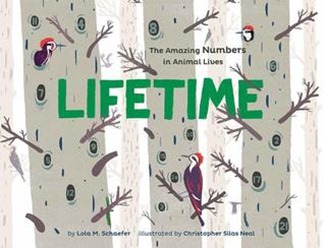
Take a unique look at what animals will do in a single lifetime in this book that combines counting, math and fascinating scientific facts.  The book focuses on how many times a single animal will do a behavior during their life.  The facts are based on estimations and opens with a description of how the numbers were figured out and explaining that each individual animal will be different than the estimate.  The book opens with one spider’s egg sac, the sole one she will create in a lifetime.  It then goes to the ten antlers that a caribou will grow and shed and moves on by tens.  The book ends with one thousand tiny baby seahorses, the number a single male seahorse will carry and birth. 

This is a spectacular way to introduce averages to children and estimation.  It is a celebration of the information that mathematics can provide to us about nature.  Schaefer has selected a wide variety of animals and intriguing facts about each of them.  Readers can find more in-depth information on the animals at the back of the book.  They will also find more information on averages and math there. 

Schaefer’s art adds to the appeal of this book.  Her illustrations have a boldness to them, a graphic quality that really works.  They are flat and vibrant, clearly laying items on the page for counting.  The book is a joy to page through since each page offers a new animal, a new habitat to see.

One of the most visually stimulating and smart concepts for a nonfiction picture book, this one is sure to beat the averages and be read more than once.  Appropriate for ages 4-6.

Reviewed from copy received from Chronicle Books.

Review: How To by Julie Morstad

how to

How To by Julie Morstad

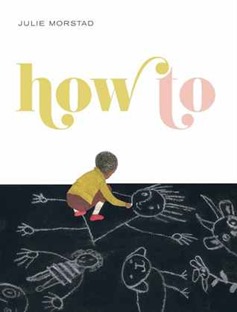
This “how to” book does not describe mechanical endeavors, instead it is a luminous look at an eclectic collection of activities.  They include how to look like a mermaid, how to see the wind, and how to go slow.  Others are straight-forward ideas but the image shows a more inventive solution.  How to wash your socks has children dancing in a puddle wearing socks.  How to make friends is the cover image of a child drawing people with chalk.  The result is a book that is an elegant and lovely exploration of the creative.

Morstad creates beautiful books and this is no exception.  Here again she mixes a quiet sense of wonder into the book and combines it with gorgeous illustrations.  She uses fine lines, particularly when drawing the children on the pages.  Their hair and faces shine with the attention she has given them.  The ideas in the book are all creative and inviting.  This is a book that will entrance some children while others will be looking for more action.

Ideal for creative children who look at the world from a more whimsical point of view.  They will make friends in these pages.  Appropriate for ages 3-5, perfect for adults too.

Reviewed from library copy.