Review: Two White Rabbits by Jairo Buitrago

Two White Rabbits by Jairo Buitrago

Two White Rabbits by Jairo Buitrago, illustrated by Rafael Yockteng, translated by Elisa Amado (InfoSoup)

A little girl and her father travel together. As they go, the little girl counts different things like chickens and the people who live by the train tracks. They are accompanied by a coyote, shown as an animal here but clearly meant to represent the person they pay to get them to safety eventually. The two board a train, riding on the roof where the little girl counts clouds and falls asleep when it gets dark. They and their coyote avoid soldiers, wait on the side of a highway, and even make new friends along the way. Her new friend gives her two white rabbits to take with them, rabbits that they eventually release into the wild near a border wall.

Filled with a powerful blend of the naive understanding of the young child and the harshness of trying to escape to a new country with a coyote, this picture book captures the risk and harrowing nature of that journey. The book ends with a statement by the President of IBBY Foundation about the millions of people who make journeys like this every year, including the hundreds of thousands of children from Central America traveling north. The author uses symbolism in a powerful way, showing the coyote as an animal and also the two white rabbits who are clearly both a present and the father and daughter themselves. The ending is ambiguous and will invite discussion about what happens to the rabbits and to the people.

The art by Yockteng is filled with delicate lines. He takes what could have been thoroughly grim moments and enlivens them with the eyes of the child. So the crossing of a muddy river becomes an adventure, the ride aboard the train is time to spend close together, and the wait by a highway is a chance to bond with another child. At the same time, readers will also see the truth, the danger and the exhaustion of the journey. It is a delicate balance that is beautifully achieved.

A book to inspire discussion, this picture book speaks the truth about desperate families looking for a better life and the risks they will take to reach it. Appropriate for ages 7-9.

Reviewed from library copy.

Review: The Sleeper and the Spindle by Neil Gaiman

The Sleeper and the Spindle by Neil Gaiman

The Sleeper and the Spindle by Neil Gaiman, illustrated by Chris Riddell (InfoSoup)

When a group of dwarfs travels through their tunnels in the mountain to another land, they discover that a sleeping curse is spreading across the world and will soon threaten the kingdom they live in. It all originated with one castle, an angry fairy and a young princess. The dwarfs return through the mountain and let their queen know of the danger. Though it is about to be her wedding day, she goes with them. They discover a land falling fast asleep and that the sleepers will follow them slowly. The castle has a hedge of thorns around it that seems impenetrable. Inside the castle is an old woman who is the only one left awake. She knows that no one can pass the thorns and considers killing the beautiful girl asleep on the bed to lift the curse, but she doesn’t. It is the queen alone who can figure out how to pass the thorns and who will recognize the evil for what it actually is.

Gaiman takes the Grimm story of Sleeping Beauty and makes it lush and incredibly beautiful. His prose is gorgeous, lingering on small things and building a world that is filled with a deadly magic. The queen herself is a great character, much more interested in being a heroine than a queen and having adventures rather than a gorgeous wedding dress. Gaiman does not cringe away from a woman saving another woman, and then he does an amazing twist to the story. One that readers will be shocked by and one that allows it all to click into place, hauntingly.

Riddell’s illustrations are done in pen and ink, made shimmering by touches of gold throughout. Yet it is truly his art which shines here, the details of people asleep as spider’s weave webs across their faces, the dark beauty of the queen and the blonde beauty of the sleeping girl. There is also a beauty to the old woman that is unique and special and to the dwarfs too with their roughened features. The setting too is brought clearly to life as they traverse it.

A glorious new feminist version of Sleeping Beauty that twists and turns before a very satisfying ending. Appropriate for ages 8-11.

Reviewed from library copy.

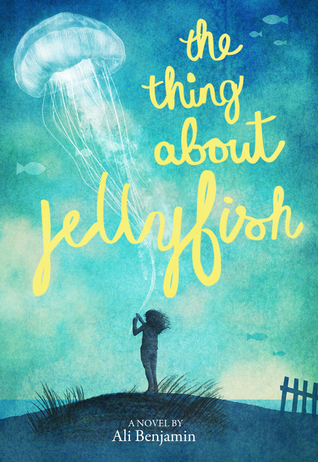
Review: The Thing about Jellyfish by Ali Benjamin

The Thing about Jellyfish by Ali Benjamin

The Thing about Jellyfish by Ali Benjamin (InfoSoup)

Suzy knows that things happen for a reason. She loves nature and all of the facts about it and the way that science makes sense. But when her best friend drowns, Suzy just can’t make sense of it. They had fought before Franny left on vacation and now there is no way for Suzy to fix that. Suzy retreats into silence, refusing to speak to her parents or to anyone at school. As Suzy searches for a reason, she discovers that Franny might have been stung by a jellyfish. It is up to Suzy to prove that that is what happened and to let everyone see that there was a cause for Franny’s death. Filled with natural wonder and tangible grief, this book is an elegant and powerful look at how one child copes with loss.

Benjamin writes about nature with such awe, sharing facts about animals as if they were precious jewels. The facts about jellyfish alone are profound and concerning, allowing readers to understand Suzy’s fascination with them. Yet though these facts are in the book, it is Suzy’s inability to cope with reality that shines. Her unwillingness to accept that death can be an accident without any reason at all will speak to all readers.

Suzy is a great character. Filled with a powerful and all-encompassing grief, she becomes silent and yet somehow does not withdraw from life. Instead her silence allows her time to be more creative, more thoughtful about the loss she has experienced even while she is in denial about what has happened. Benjamin also beautifully tackles the grieving process, mingling it with the difficulties of middle school. Filled with flashbacks about the changing friendship of Franny and Suzy, this book addresses the way that even best friends grow apart.

Beautiful and luminous, this book is a powerful look at grief, loss and the way that we process our lives. Appropriate for ages 9-12.

Reviewed from library copy.
2015 Irish Book Award Shortlists

BGE IBA brand mark CMYK blue

The shortlisted titles for the 2015 Irish Book Awards have been announced. Here are the titles in the youth categories:

Specsavers Children’s Book of the Year – Junior

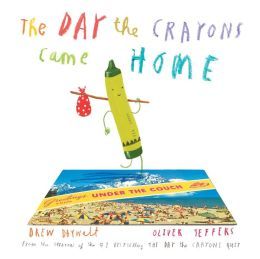
The Boy Who Fell Off the Mayflower, or John Howland's Good Fortune The Day the Crayons Came Home

The Boy Who Fell Off the Mayflower, or John Howland’s Good Fortune by P. J. Lynch

The Day The Crayons Came Home by Drew Daywalt and Oliver Jeffers

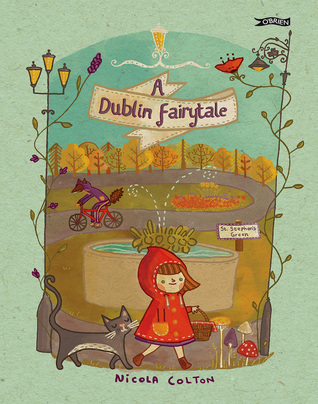
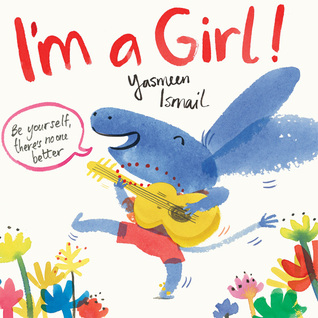
 A Dublin Fairytale I'm a Girl!

A Dublin Fairytale by Nicola Colton

I’m a Girl! by Yasmeen Ismail

Imaginary Fred The Snow Beast

Imaginary Fred by Eoin Colfer & Oliver Jeffers

The Snow Beast by Chris Judge


Specsavers Children’s Book of the Year – Senior

Asking For It Worlds Explode (Darkmouth, Book 2)

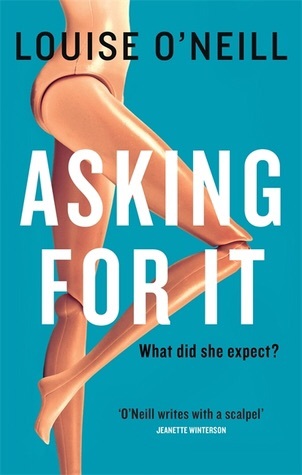
Asking For It by Louise O’Neill

Darkmouth: Worlds Explode by Shane Hegarty

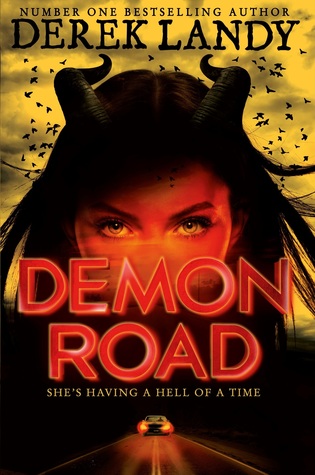
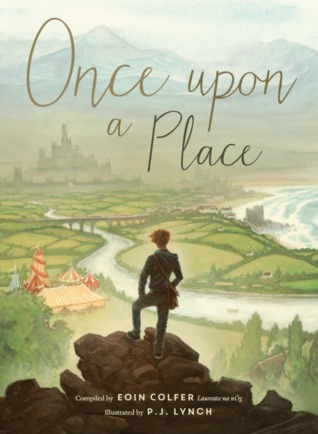
Demon Road (Demon Road, #1) Once upon a Place

Demon Road by Derek Landy

Once upon a Place by Eoin Colfer

One

One by Sarah Crossan

This Week’s Tweets, Pins and Tumbls

Here are the links I shared on my Twitter, Pinterest, and Tumblr accounts this week that I think are cool:

reading:

CHILDREN’S BOOKS

Can We Talk of Solutions? Regarding Diversifying Children’s Literature http://buff.ly/1MfJoxp #diversity #kidlit

‘Castle Hangnail’: Disney, Ellen DeGeneres Team Up to Adapt Kids Fantasy Book (Exclusive) http://buff.ly/1l7RUnU #kidlit

Editorial: We’re Not Rainbow Sprinkles – The Horn Book http://buff.ly/1MfIzoe #diversity #lgbt #kidlit

Emily Jenkins Apologizes for “A Fine Dessert” http://buff.ly/1Neheix #kidlit

Eoin Colfer: ‘It’s time I moved on from Artemis Fowl’ http://buff.ly/1P9Td24 #kidlit

J.K. Rowling Is Writing Her First Children’s Book Since ‘Harry Potter’ http://buff.ly/1P9MMfx #kidlit

The Kid’s Book ‘A Fine Dessert’ Has Award Buzz — And Charges of Whitewashing Slavery http://buff.ly/1PUNwoZ #kidlit

The Quiet Noisy Book: A Little-Known Vintage Gem by Margaret Wise Brown http://buff.ly/1RvMc9w #kidlit

Reading While White: On Letting Go http://buff.ly/1iDe4wi #kidlit

Top 10 haunted houses in fiction http://buff.ly/1Wo4bA7 #kidlit

‘Wayside School’ author Louis Sachar talks new books and old http://buff.ly/1GPpBnS #kidlit

EBOOKS

Amazon Is About to Start Paying Some Authors Every Time Someone Turns a Page http://buff.ly/1LMvqS8 #ebooks

Libraries: We're Netflix for books!:

LIBRARIES

Amazon’s New Seattle Bookstore Feels Surprisingly Familiar http://buff.ly/1RvxRKm #libraries

How a Landmark Library Is Reinventing Itself—Without Losing Its Purpose http://buff.ly/1iqwTTs #libraries

Saskatoon Public Library waives nearly $1 million in overdue fees http://buff.ly/1H8m8kv #libraries

Some public libraries home to rare and valuable treasures – The Boston Globe http://buff.ly/1GPp9WL #libraries

READING

Best Books 2015 — Goodreads Choice Awards http://buff.ly/1LOPTps

Problems Only Book Lovers Understand http://buff.ly/20s2V3N #reading

Photo:

TEEN READS

Darren Shan: the joy of a great cliffhanger http://buff.ly/1RDCH88 #yalit

Rainbow Rowell is the best thing to happen to young adult literature in ages http://buff.ly/1GZk9Pd #yalit

A Refreshing Romp of a YA Graphic Novel: Nimona http://buff.ly/1RpPco5 #yalit

Teens spend 9 hours a day using media, report says http://buff.ly/1OoORnC

Review: Job Wanted by Teresa Bateman

Job Wanted by Teresa Bateman

Job Wanted by Teresa Bateman, illustrated by Chris Sheban

When an old farm dog walks up to a farm looking for work, the farmer refuses. He sees dogs as a waste of food since they don’t give anything back like chickens or cows do. The dog then offers to be a cow instead of a dog. He gets all of the cows into the barn and lined up ready for milking before the farmer gets there, but the farmer isn’t interested in this dog-cow. The next thing the dog tries is to be a horse. He couldn’t fit in the harness for the plow, but he could run ahead of the horse with treats to get the horse to plow faster. Still, the farmer was not interested in hiring the dog. The dog next tries to be a chicken and tidies up the chicken coop before settling down in a nest of hay himself. It’s there that he finally proves the value of a dog on a farm to the reluctant farmer.

Bateman nicely incorporates a rhythm and repetition into her story. The pattern of the conversation between the dog and the farmer carries through the entire book, creating a framework that functions very nicely. On each job, the dog manages to be useful in his own way, something that is a nice surprise in the book rather than him trying to give milk or eggs himself. One immediately roots for the success of this hard-working dog.

Sheban’s illustrations are done in watercolor, graphite, and colored pencil. The result is a picture book that glows with sunlight. There is a wonderful softness to the illustrations, gauzy light that plays across the farm and the characters.

A shining picture book about resilience and being yourself. Appropriate for ages 3-5.

Reviewed from copy received from Holiday House.

Review: Beep! Beep! Go to Sleep! by Todd Tarpley

Beep Beep Go to Sleep by Todd Tarpley

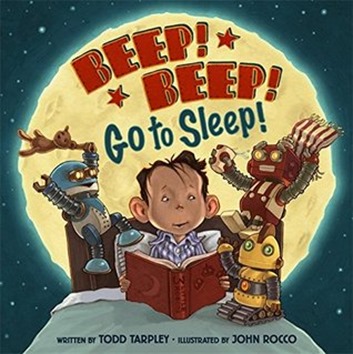
Beep! Beep! Go to Sleep! by Todd Tarpley, illustrated by John Rocco (InfoSoup)

A little boy helps his robots get ready for bed. First, they are herded into the bathroom where they brush their rotors and clean their shields. One robot even tries out the toilet. Then down the hall and into the bedroom they go, each one on a shelf with a blanket. It is quiet until Beep! Beep! The robots all want things like drinks. Then back to their beds and quiet again. It goes on and on, quiet and then beeping until finally the boy loses his temper. In the end though, one bedtime book is all it takes to get the boy off to sleep.

Tarpley has created a modern twist on the normal bedtime ritual. Here a boy takes the place of the parent, keeping his robots in line and moving towards bed. The complaints of the robots are lovely, each a riff on a classic bedtime request for more water, more light, and finally a story. The book is told in rhyme, one that is quiet at times and then other times filled with zing and snap. The most snap comes when the boy loses his temper.

Rocco’s illustrations are gorgeous. The three robots, each a primary color, all have distinct personalities and the ability to show some emotions on their metal faces. The boy is a throwback to an earlier age in his classic striped pajamas, evoking the fifties along with the classic robots. The entire house too has a vintage feeling to it, providing a clever backdrop to the very modern robot theme.

A perfect bedtime tale for robot fans, this picture book is sure to have even the sleepiest robot or child giggling. Appropriate for ages 3-5.

Reviewed from library copy.
Review: Where Do I End and You Begin? by Shulamith Oppenheim

Where Do I End and You Begin by Shulamith Oppenheim

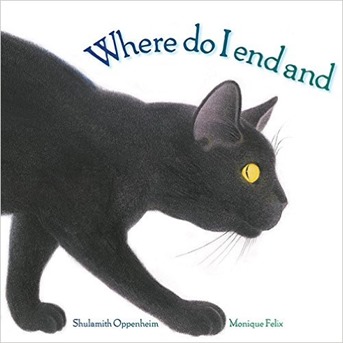
Where Do I End and You Begin? by Shulamith Oppenheim, illustrated by Monique Felix (InfoSoup)

This poetic book asks deep questions about the interconnectedness of life and nature. It begins with a cat asking where it ends and its tail begins. How about a shell and a snail? Or a branch and a tree? Perhaps the sky and the sea? Each pairing gets readers thinking about whether they can tell where one stops and the other begins. Some of them are arguably doable, like the sky and sea where a boundary is evident, others though are real questions whether emotional like a hug or physical like the snail and its shell. This is a book filled with unanswerable questions that will get readers thinking about the importance of all types of connections in our lives.

The poem at the heart of this picture book is particularly beautifully written. It uses items that are familiar to children and then guides them to think about them in a new and surprising way, examining the connections. While the poem could be read very literally at times, other pairings in the book make sure that the questions are larger than the objects themselves, lifting it up to include the interconnectedness of all of us on the planet. This grand book is sure to start interesting discussions in classrooms and families.

The illustrations by Felix are delicate and luminous. They shine on the white background, interconnect with one another and play together too. The cat is found on the next page, walking the stair within the snail’s shell. A boy and girl are present on many of the pages too, exploring the way that humans fit into the world as well.

A superb picture book that asks profound questions and then celebrates the world and our connections with it. Appropriate for ages 4-6.

Reviewed from library copy.

Review: The Girl Who Could Not Dream by Sarah Beth Durst

Girl Who Could Not Dream by Sarah Beth Durst

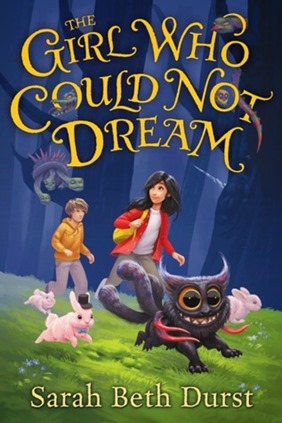
The Girl Who Could Not Dream by Sarah Beth Durst

Sophie lives above her parents’ bookstore that is actually much more than a place to sell books. Downstairs below the store is another shop, the dream shop, where her parents deal in dreams harvested from dreamcatchers and then bottled. Sophie never has dreams of her own and she has been forbidden from ever drinking a dream. One day though she tries one and discovers that she has the ability to bring things back from her dreams into real life. That’s how she gets her best friend, Monster, a creature from a nightmare. Dealing in dreams can be dangerous business since it is done on the black market. When the dream shop is robbed and Sophie’s parents are taken, Sophie has to figure out who is responsible and the find a way to free her family that will mean trusting outsiders and breaking family rules.

Durst is a master storyteller. Her flights of fancy here are intoxicatingly original and yet also pay homage to traditions too. Monster is one of my favorite characters, a wise-cracking, fuzzy and loveable creature who is ferociously loyal, brave and hungry. Then there is a snooty pegasus who has his own attitude and speaks harsh truths, not to mention the multicolored ninja bunnies. Durst builds a story that has room for all of them and remains wonderfully clear and focused on the real story going on.

Sophie is a character who is known by classmates as being prickly. It’s difficult to create a character who is embraced by the reader as a hero but faces real issues at school with making friends. Durst does it with real skill, giving Sophie a personality that is by necessity very private but also making her warm and loving to those in her inner circle. The use of that privacy is also used to isolate Sophie, making the adventure all the more harrowing and forcing her to open up to those she would not otherwise trust.

A strong fantasy for elementary readers, this book is filled with smart humor and great characters. Appropriate for ages 8-11.

Reviewed from digital galley received from NetGalley and Clarion Books.