The Night Gardener by The Fan Brothers

The Night Gardener by The Fan Brothers

The Night Gardener by The Fan Brothers (InfoSoup)

William wakes up one morning to discover that the tree outside his window has been changed into an owl topiary. Day by day, more topiary appear along Grimloch Lane. There is a cat, a rabbit, a parakeet, and an elephant. Then one day, there is a dragon, that inspires the community to hang lanterns in its branches and along the road. It is that night that William notices a stranger with a ladder walking along. He follows the man to the local park where the man turns and invites William to help him. It is the night gardener and William helps him until he falls asleep. The next morning William awakens to see the park transformed by his work. As seasons change, the topiary disappear but the community spirit doesn’t.

This is one beautiful book. The text is simple, allowing the detailed illustrations to shine. Still, the text has gorgeous moments such as William watching the first topiary until it was too dark to see it anymore. This book is slow and steady, magical but also homely. It is filled with community spirit that readers can watch build steadily as the night gardener gives his gifts.

The community spirit is shown as homes with boarded-up windows turn into a dynamic community right before their eyes. The illustrations are beautiful, filled with touches that show the where the gardener gets his inspiration. The illustrations tell much of the story, showing that William lives in an orphanage and vividly demonstrating the inspiration a community can get from art.

A gorgeous and vibrant read, this book can be paired nicely with Lane Smith’s Grandpa Green for a topiary triumph. Appropriate for ages 4-6.

Reviewed from copy received from Simon & Schuster.

The Family Fletcher Takes Rock Island by Dana Alison Levy

The Family Fletcher Takes Rock Island by Dana Alison Levy

The Family Fletcher Takes Rock Island by Dana Alison Levy

This is the second book in the Family Fletcher series and once again it is a treat to spend time with this dynamic family. This time they head to Rock Island, a place where Papa has been coming since he was a child. Rock Island is a small place where things are always the same. There is the same lighthouse, the same flavors of ice cream, and the same tiny house where all of the boys share a loft filled with beds. This year though, some things have changed. There is a fence around the lighthouse, so no one can visit it. A new family has moved in next door too, though they seem to be very annoying. The brothers themselves are also changing and heading in different directions for the first time on the island. Though one thing unites them all, the question of what is really happening to their beloved lighthouse.

Levy has once again written such a readable book. The Fletcher family is made up of gay parents and four adopted siblings of different races. Yet this series is not about growing up in a diverse and gay family, rather it is about a merry and very human family that is a joy to spend time with. The brothers all treat one another like siblings, meaning they fight, they apologize, they inadvertently hurt one another’s feelings. This series is about a real family, one that comes to life on the page.

Levy does deal very sensitively about race in this book. The scene is handled beautifully where at first readers will not realize what is going on, so their own understanding progresses at the same rate as the young characters who soon realize they are dealing with a bigoted bully. The issue is not minimized, but the family comes together to support their brother as he discovers the harshness of direct racism for the first time.

Smart and very funny, this novel for young people adds a winning second book to a series I hope continues for some time. Appropriate for ages 8-11.

Reviewed from digital galley received from Delacorte and Edelweiss.


Miss Mary Reporting by Sue Macy

Miss Mary Reporting by Sue Macy

Miss Mary Reporting: The True Story of Sportswriter Mary Garber by Sue Macy, illustrated by C. F. Payne (InfoSoup)

Mary Garber was one of the first female sports journalists in the United States. At a time when women were not newspaper reporters, Mary was a sports reporter. Her big break came during World War II when the men were sent to war. After the war, Mary was moved to a news desk but then a year later permanent came back to sports. She was there to witness Jackie Robinson join the Brooklyn Dodgers. Mary herself was barred from the press box and forced to sit with the coaches’ wives rather than the other reporters until her editor complained. Locker rooms were also a challenge. Mary continued writing about sports for more than 50 years, retiring in 2002. Along the way she garnered awards and honors and a reputation for being fair and unbiased.

Macy captures the story of this groundbreaking woman beautifully. The tone is playful and humble with Garber’s quotes often given credit and thanks to others rather than taking praise for herself. At the same time, one understands the courage it took for Mary to continue doing this job in such a male-dominated field. This story is inspirational in the best possible way.

Payne’s illustrations add to the playful feel of the title and the humor. Mary is shown as very petite, dwarfed by those around her. Yet she is clearly the center of attention on the page, her face lit from within by her big eyes and large glasses. Her short hair and can-do attitude mark her uniquely on the page as well.

A great picture book biography to share with children who enjoy sports or writing. Appropriate for ages 7-9.

Reviewed from copy received from Simon & Schuster.


There Is a Tribe of Kids by Lane Smith

There Is a Tribe of Kids by Lane Smith

There Is a Tribe of Kids by Lane Smith (InfoSoup)

A boy sets off on a journey alone and encounters all kinds of creatures along the way. There is a tribe of young goats (kids). There is a colony of penguins, a pod of whales, a flight of butterflies, and much more. He also sees different groups of objects like a formation of rocks, a family of stars, and a growth of plants. Finally his journey ends as he meets up with a tribe of children (kids) who wear outfits of leaves just like he does. He is clearly home again.

This book is filled with collective nouns. There is one after another that manage not only to show children the beauty of the language of collective nouns but also move the story ahead. They form into a cohesive journey for our young hero to embark upon. It is a book that only works this well due to the skill of the author.

Smith is of course also a great illustrator and here his illustrations shine. They show a playful magic that is impressive. They are filled with textures that were created by oils being sprayed with acrylic varnish. The result looks like sponge painting and fills the book with space and light.

A masterful look at collective nouns that is also a great read aloud. Appropriate for ages 4-6.

Reviewed from library copy.

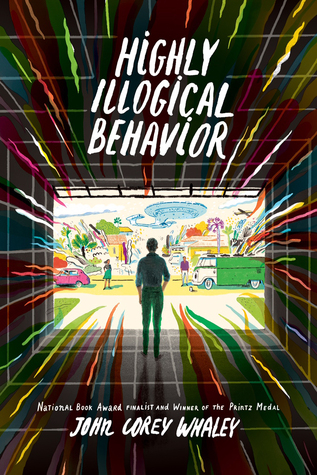
Highly Illogical Behavior by John Corey Whaley

Highly Illogical Behavior by John Corey Whaley

Highly Illogical Behavior by John Corey Whaley

Solomon hasn’t left the house in three years. Not since he had a panic attack at school and ended up in his boxers in the school fountain. Now at age 16, Solomon has decided that he really doesn’t need the outside world at all, not missing his old friends and doing his school work online. Lisa is ambitious, knowing that she wants to leave her home town far behind. Her dream is to become a psychiatrist and Solomon is her key to the essay that will earn her a full-ride scholarship to the second-best school in the country. Lisa steadily befriends Solomon, not sharing with him that she is using him as a test subject. As true friendship starts to grow with not just Lisa but also her boyfriend Clark, Solomon starts to improve. But can a friendship built on one lie survive the truth?

Pritz-Award winner Whaley has once again created characters that are beautifully crafted and intensely human. While it is easy to sympathize with Solomon, Lisa is one of the more conflicted and complex characters I’ve read in a long time. She is exceedingly easy to dislike, since readers understand her selfish motivations very clearly. Yet as the novel progresses, readers will slowly realize that they understand Lisa and may even like her. Her character brings up difficult questions about motivations and what it means to help someone else.

Solomon too is an impressive character. Whaley allows us to see Solomon beyond his agoraphobia and to see into the world of a boy who has chosen to shut everyone out. At the same time without doing information dumps, Whaley gives readers insights into this mental illness and the devastation of panic and anxiety. He gives readers the experience of wondering at times if Solomon is actually just fine and then sending Solomon into darkness once again. It is a powerful and truthful look at battling a mental illness.

This teen novel is complicated and incredibly vibrant. It looks at so much of what it takes to be a teenager in the modern world and asks whether it is the place for any teen to live. Appropriate for ages 14-18.

Reviewed from ARC received from Dial Books.

Excellent Ed by Stacy McAnulty

Excellent Ed by Stacy McAnulty

Excellent Ed by Stacy McAnulty, illustrated by Julia Sarcone-Roach (InfoSoup)

Everyone in Ed’s family is excellent except for Ed. He doesn’t understand why he isn’t allowed to eat at the table, ride in the van, sit on the couch or use the inside bathroom like the rest of the family. So he decides that he’s just not good enough and sets out to find something that he is the best in. But each time he finds something, one of the others in the family shows how much better they are than he is at exactly that thing. Finally, Ed shows why he is the perfect pet in a perfect family, though he still wonders about the inside bathroom.

This book uses humor and a dog’s perspective to take a look at being the underachiever in a family. The family is oblivious to Ed’s self-esteem crisis, continuing to excel and to applaud one another along the way. The book is cleverly crafted with Ed figuring out what he is good at and then another family member putting a twist on it and showing a new interpretation of the skill. Additionally, the list of things that Ed isn’t allowed to do serves as the basis for what he is actually very good at. It’s a lovely concept that brings the entire book full circle.

The illustrations are jaunty and delightful. In a book about a dog and not about race at all, it is great to see a family of color as the central figures. There is a lot of energy throughout the book and it is made all the more energetic by the illustrations which pack plenty of action on each page, moving the book along at a lively pace.

Dynamic, funny and very satisfying, this picture book is dog-gone good. Appropriate for ages 4-6.

Reviewed from digital galley received from Penguin Random House and Edelweiss.

Hammer and Nails by Josh Bledsoe

Hammer and Nails by Josh Bledsoe

Hammer and Nails by Josh Bledsoe, illustrated by Jessica Warrick (InfoSoup)

Darcy’s day is ruined when her best friend gets sick and has to cancel their playdate. Her father suggests that they do a Darcy-Daddy Day instead, where they pick alternating things from their to-do lists until both lists are done. They start with coffee time, or chocolate milk time for Darcy. Then comes dress up where Daddy gets super fancy in a tutu and flannel shirt. Next the lawn gets mowed in a glamorous way. Hair Salon comes next until both Darcy and Daddy are fabulous. Laundry is a sock battle and then a quest to match each sock. The day ends with repairing the fence, something new for Darcy to try, and a manicure for the both.

An ideal father and daughter book that shows how open minds and playfulness can save a day from disaster. Parents will recognize their chores as the day goes on and then their aches and pains after playing too hard. Children will love seeing a dad get into imaginative play, wearing both a tutu and a headband with no care at all. There is a real sweetness to this book that captures the adoration between a father and daughter and one special day they shared together.

Warrick nicely captures the play as the two of them have their day together. Princess dresses and tutus get grass stained and hammers nicely fit into red purses too. The lawnmower takes on royal status with its umbrella and garlands too. Each little flourish is used to great effect and the interplay between the two characters is radiant.

A testament to the power of positive parenting, this picture book will be loved by fathers and daughters alike. Appropriate for ages 3-5.

Reviewed from library copy.


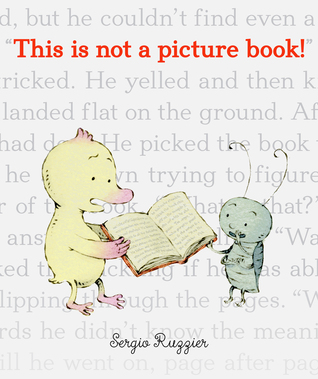
This Is Not a Picture Book by Sergio Ruzzier

This Is Not a Picture Book by Sergio Ruzzier

This Is Not a Picture Book by Sergio Ruzzier (InfoSoup)

Duck discovers a book that doesn’t have any pictures in it. He takes a look at it but kicks it away. When his friend Bug asks if he can read it, Ducks starts to try. But words can be difficult to read. He does see some words that he knows and keeps on trying. Soon Duck is finding that words can take him special places, on wild adventures or into quiet calmness. Words can be funny or sad. And words return you home again in the end, where they stay with you. Even in a book with no pictures!

Ruzzier has created a picture book that proudly sends children on their way to harder reads where they won’t have pictures to ease the way. The way that Duck deals with it, first to be frustrated and then to work hard at it speaks volumes about the way that children work to learn to read better and better. There is also a strong and soaring message about the power of words themselves and how they can convey emotions and meaning.

The book design here is wonderful. The end pages are filled with words that are just jumbled enough to be confusing, but if readers work like Duck did, they can puzzle their way into making sense of them. Ruzzier’s illustrations are always a bit wacky with strange landscapes and bright colors. The settings match what Duck is reading, showing through pictures what the words are conveying.

An inspirational book that will encourage reading, this book certainly IS a picture book that belongs in all libraries. Appropriate for ages 4-6.

Reviewed from copy received from Chronicle Books.


The Passion of Dolssa by Julie Berry

The Passion of Dolssa by Julie Berry

The Passion of Dolssa by Julie Berry (InfoSoup)

The author of All the Truth That’s in Me returns with another historical novel that once again speaks to the role of women in history. Here we follow the story of two very different young women in medieval France. There is Dolssa, born to wealth who speaks directly with Jesus and who gains the attention of the Church who brands her as a heretic and sentences her to death. There is Botille, who is a matchmaker and who owns a tavern along with her two sisters in a small seaside town. When their two stories collide, Botille discovers a person who both brings miracles and doom along with her.

Berry has created a novel that shows how power worked in the Middle Ages with two young women who are both products of their society and also find themselves outside of it some of the time. The two young women are as different as can be, both in their backgrounds and in their beliefs, but still between them there is a sisterhood that cannot be denied and a love that is transcendent.

Each of the women is fully formed on the page, shown in all of their questioning, their doubts and their beliefs. While Dolssa is certainly a different creature than Botille, it is the two of them together that is so brilliant it can be painful to read, particularly because there is no doubt that they are risking everything to support one another. Berry makes sure that readers understand the way that the Crusades and then the Inquisition worked, the holy people left to starve due to their heresy and the flames and torture that accompanied their work in France. It is a world of cruelty, particularly for two young women who have the audacity to think for themselves.

Brilliantly crafted, well researched and filled with the darkness of impending doom yet lit brightly with faith and miracles, this is a wrenching historical read. Appropriate for ages 14-18.

Reviewed from ARC received from Viking.